
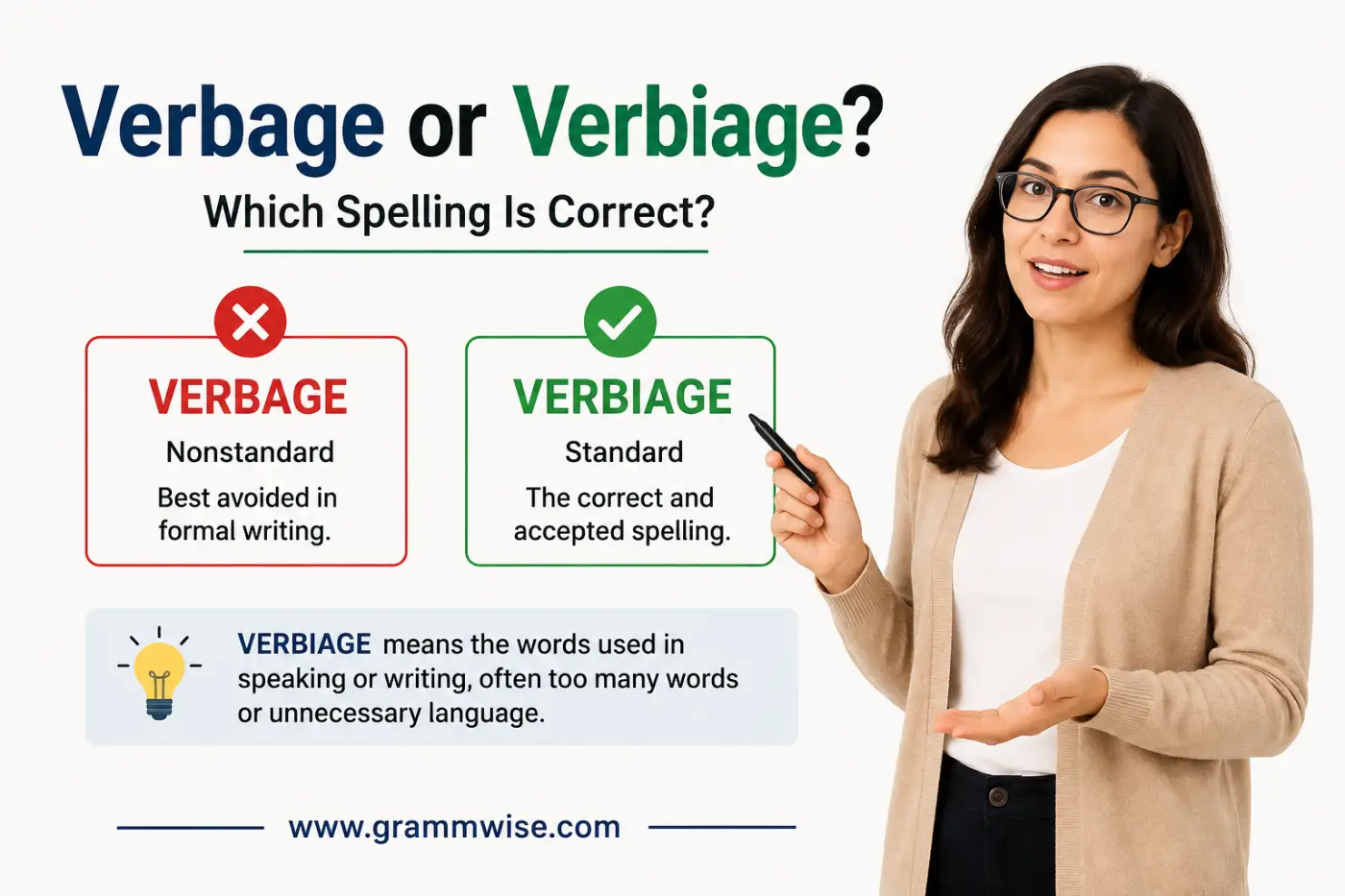
If you are confused about verbage or verbiage, the simple answer is this: verbiage is the standard word in English. Verbage is sometimes used, but it is generally considered nonstandard and should be avoided in formal writing.
The two words look and sound very similar. That is why many people mix them up. This guide will explain the difference in simple words, show you how verbiage is used, and help you remember the correct spelling.
Similar spelling mistakes happen in words with silent letters, like in our calfs or calves article.
Quick Answer: Verbage or Verbiage?
| Word | Is It Standard English? | Meaning |
|---|---|---|
| Verbiage | Yes | The words used in speaking or writing, often too many words |
| Verbage | Usually no | A nonstandard form sometimes used instead of verbiage |
Correct: The report contains too much verbiage.
Best to avoid: The report contains too much verbage.
So, when choosing between verbage or verbiage, use verbiage, especially in school, work, professional writing, and formal communication.

What Does Verbiage Mean?
Verbiage means the words or language used to express something. It often has a negative meaning when someone uses too many unnecessary words.
In simple terms, verbiage can mean:
- Too many words
- Unnecessary wording
- Wordy language
- The way something is expressed in words
Simple Examples
- The lawyer used a lot of verbiage in the document.
- Please remove the extra verbiage from this email.
- The instructions contain unnecessary verbiage.
- Her speech was clear and had very little extra verbiage.
In many cases, verbiage suggests that the language could be shorter, clearer, or simpler.
For example:
Wordy: Due to the fact that the weather conditions were unfavorable, the event was canceled.
Clear: Because of bad weather, the event was canceled.
The first sentence has more verbiage than necessary.
Is Verbiage Always Negative?
Not always. However, verbiage often carries the idea of excessive or unnecessary wording.
Look at these examples:
- The contract’s verbiage was difficult to understand.
- We need to review the verbiage of the agreement.
- The article contains too much unnecessary verbiage.
In the first two examples, verbiage simply means the wording or language used. In the third example, it clearly means too many unnecessary words.
Because of this, the meaning often depends on the sentence.
What Is Verbage?
Verbage is a word that some people use when they mean verbiage. However, it is not generally accepted as the standard choice in formal English.
You may see verbage online, in informal writing, or in everyday communication. Still, if you want your writing to look correct and professional, choose verbiage.
For example:
Less standard: Please check the verbage in this document.
Standard: Please check the verbiage in this document.
The spelling verbiage is the safer and more widely accepted choice.
Why Do People Write Verbage Instead of Verbiage?
The mistake is easy to understand. Verbiage comes from the word verbal, which relates to words or language. Because of this, some people naturally create the spelling verbage.
It may seem logical:
verb + age = verbage
But English does not always follow simple spelling patterns. The established word is verbiage, with an i before age.
This is similar to other English words where the spelling may not be exactly what you expect. The best way to avoid the mistake is to remember the full spelling:
V-E-R-B-I-A-G-E
The small i makes a big difference.
Verbage or Verbiage: What Is the Difference?
The main difference is not really about meaning. It is about standard usage.
People who use verbage usually mean the same thing as verbiage. However, verbiage is the standard form that is appropriate for careful writing.
| Feature | Verbage | Verbiage |
|---|---|---|
| Standard spelling | No, generally nonstandard | Yes |
| Used in formal writing | Best avoided | Yes |
| Meaning | Usually intended to mean wording | Wording or excessive use of words |
| Safe for school or work | No | Yes |
The easiest rule is:
Use verbiage. Avoid verbage in formal and standard English.
How Do You Use Verbiage in a Sentence?
Here are some easy examples of verbiage in daily English.
At Work
- The manager asked us to simplify the verbiage in the report.
- This email has too much verbiage. Please make it shorter.
- The legal verbiage was hard for the new employee to understand.
At School
- Your essay has good ideas, but some verbiage can be removed.
- The teacher explained the difficult verbiage in the textbook.
- Try to use clear language instead of unnecessary verbiage.
In Daily Life
- I do not understand the verbiage on this form.
- The instructions use confusing verbiage.
- He added a lot of verbiage without adding any useful information.
These examples show that verbiage is often connected with writing, documents, speeches, instructions, and communication.
Does Verbiage Mean “Too Many Words”?
Often, yes. But the exact meaning can change slightly depending on the context.
When someone says:
“This article has too much verbiage.”
They usually mean:
“This article uses too many unnecessary words.”
But when someone says:
“We need to change the verbiage in the contract.”
They may simply mean:
“We need to change the wording in the contract.”
So, verbiage can mean either wording or an excessive amount of wording. The surrounding sentence usually makes the meaning clear.
Verbiage vs. Wording
Verbiage and wording are related, but they are not always exactly the same.
Wording
Wording simply means the particular words used to say or write something.
- I like the wording of your message.
- We need to change the wording of this question.
Verbiage
Verbiage can mean wording, but it may also suggest that there are too many words or that the language is overly complicated.
- The contract contains confusing verbiage.
- Please reduce the unnecessary verbiage.
Because wording is more neutral, it is often a better choice when you simply mean “the words used.”
Verbiage vs. Verbosity
Another related word is verbosity.
Verbosity means the quality of using too many words.
For example:
- The writer’s verbosity made the article difficult to read.
- Try to reduce verbosity in your presentation.
The difference is simple:
- Verbiage = the words or wording used
- Verbosity = the habit or quality of using too many words
Here is an easy example:
The verbiage in his speech showed his verbosity.
The first word refers to the language itself. The second refers to the tendency to use too many words.

Common Situations Where Verbiage Is Used
You will often see verbiage in these situations:
Legal Documents
Legal papers often contain formal and complex language.
- The lawyer explained the difficult verbiage in the contract.
Business Communication
People may use the word when editing emails, reports, or presentations.
- Please reduce the verbiage and make the report easier to read.
Marketing
Companies carefully choose the language used in advertisements and product descriptions.
- The team changed the verbiage on the website.
School and Academic Writing
Teachers may ask students to remove unnecessary words.
- Your main idea is good, but there is too much verbiage in this paragraph.
A Simple Memory Trick for Verbiage
Here is an easy way to remember the correct spelling:
VERB + I + AGE = VERBIAGE
Remember that verbiage has an “I” after “verb.”
Think:
Words need an “I” in verbiage.
You do not need to remember the full history of the word. Just remember:
Verb + I + age → Verbiage
This small memory trick can help you avoid writing verbage.
Which Word Should You Use in Professional Writing?
Use verbiage.
If you are writing:
- An essay
- A job application
- An email
- A report
- A business document
- A website article
- A legal document
Verbiage is the standard and professional choice.
Even if you have seen verbage used by other people, it is safer not to copy that spelling.
For example:
Correct professional sentence:
Please review the verbiage before sending the document.
Another correct sentence:
We changed the verbiage to make the instructions clearer.
Can You Replace Verbiage With a Simpler Word?
Yes. Sometimes verbiage may sound more formal than necessary. Depending on what you mean, you can use simpler words.
| If you mean… | You can say… |
|---|---|
| The words used | Wording |
| Too many words | Wordiness |
| Difficult language | Language |
| Exact words in a document | Text or wording |
| Unnecessary words | Extra words |
For example:
Instead of:
Please review the verbiage in the message.
You could say:
Please review the wording in the message.
Both can work, but wording sounds more natural when you are simply talking about the words that were chosen.
The Main Rule to Remember
When you are unsure whether to write verbage or verbiage, choose verbiage.
It is the standard spelling and the safer choice for almost every type of writing.
Verbage may appear online or in informal writing, but it can look like a spelling mistake to many readers. If you want clear and professional English, use verbiage.
The easiest rule is:
Verbiage is standard. Verbage is best avoided.
How This Word Is Understood in Culture and Stories?
Words are not only used to share information. People also use words to persuade, explain, entertain, and sometimes confuse others. This is where verbiage becomes an interesting word.
In everyday culture, people often complain about someone using “too many words.” A politician may give a long answer without clearly answering a question. A company may write a simple message in a complicated way. A student may write a long paragraph when three short sentences would be enough.
In these situations, people may describe the language as too much verbiage.
For example:
- The speech had a lot of verbiage but very little useful information.
- The advertisement used fancy verbiage to make the product sound better.
- His answer was full of verbiage and did not answer the question.
The word often reminds us that more words do not always mean better communication.
A short and clear message can sometimes be stronger than a long one. That is why teachers, editors, and writers often remove unnecessary verbiage.
However, using many words is not always a bad thing. A story, poem, speech, or legal document may need detailed language. The real problem is not the number of words. The problem begins when extra words make the message harder to understand.
So, in a simple way:
Good writing uses the words it needs. Too much unnecessary language becomes verbiage.
Does Verbiage Have a Biblical or Mythological Meaning?
Verbiage does not have a special biblical or mythological meaning.
It is mainly connected with language, wording, and the use of words.
However, the general idea behind the word can connect with an old lesson found in many cultures and stories: words should have meaning and purpose.
Many religious texts, traditional stories, and famous sayings teach people to speak wisely instead of speaking without purpose. A person who talks too much may hide the real message. A person who chooses words carefully may communicate more clearly.
This does not mean that every long message is bad. A detailed explanation can be useful. The lesson is simply about choosing the right amount of language for the situation.
For example, compare these two sentences:
Long:
At this particular point in time, we are currently in the process of making preparations to begin the project.
Clear:
We are preparing to start the project.
The first sentence has more words than needed. The second sentence gives the same basic message more directly.
That is one reason the idea of unnecessary verbiage is often connected with clear communication.
Symbolism Explained in Simple Words
Although verbiage is not a symbol in the traditional sense, the idea behind it can represent different things.
Verbiage as a Symbol of Too Much Talking
Sometimes, too much language can hide a simple idea.
Imagine someone asks:
“Did you finish the work?”
Instead of saying yes or no, the person gives a five-minute explanation.
That answer may contain a lot of verbiage.
In this situation, verbiage can represent:
- Avoiding a direct answer
- Making something simple sound complicated
- Using many words without adding much meaning
Clear Language vs. Excessive Verbiage
Clear language focuses on the main idea.
Excessive verbiage adds words that may not be necessary.
Compare:
Too much verbiage:
I am writing this message for the purpose of informing you that the meeting scheduled for tomorrow will not be taking place.
Clear language:
I am writing to let you know that tomorrow’s meeting is canceled.
Both sentences communicate a similar idea. The second one is shorter and easier to understand.
This does not mean every sentence should be extremely short. Good writing needs a natural balance.
Verbiage as a Symbol of Confusion
Complicated language can sometimes make a simple message difficult to understand.
For example:
The implementation of the proposed procedural modifications will facilitate the optimization of operational efficiency.
Many readers may stop and read the sentence again.
A simpler version is:
The new changes will help us work more efficiently.
The first version uses more formal and complex language. The second version is easier for most people to understand.
This shows how unnecessary verbiage can sometimes create confusion instead of clarity.
Related Words You Should Know
Learning related words can help you understand verbiage better.
Wording
Wording means the exact words used to express something.
- The wording of the question is confusing.
- We changed the wording of the email.
Unlike verbiage, wording is usually neutral.
Wordiness
Wordiness means using more words than necessary.
- The teacher helped him reduce the wordiness of his essay.
It is very close to the negative meaning of excessive verbiage.
Verbosity
Verbosity means the habit or quality of using too many words.
- His verbosity made the presentation longer than necessary.
A person can be verbose, while a piece of writing can contain excessive verbiage.
Concise
It means short but clear.
- Her answer was concise and easy to understand.
Concise writing gives enough information without adding unnecessary words.
Conciseness
Conciseness is the quality of being clear while using only the necessary number of words.
- The editor improved the article by adding conciseness.
Verbose
Verbose describes a person or piece of writing that uses too many words.
- His explanation was too verbose.
Language
Language is a broad word that can simply mean the words or style used in speaking or writing.
- The legal language in the document was difficult to understand.
In some situations, language may sound more natural than verbiage.
Text
Text can mean written words in a document, message, website, or other piece of writing.
- Please review the text before publishing it.
This is often a simple replacement when you do not specifically mean excessive wording.

How People Actually Use Verbiage in Daily English?
You may hear verbiage in offices, schools, legal settings, marketing discussions, and editing conversations.
Here are some natural examples.
At Work
- Can you simplify the verbiage in this report?
- The manager asked us to remove unnecessary verbiage from the email.
- We need to change the verbiage before sending the proposal.
- The instructions contain too much technical verbiage.
At School
- Your essay has good ideas, but it needs less verbiage.
- The teacher explained the difficult verbiage in the passage.
- Try to remove extra verbiage and focus on your main point.
In Business
- The company changed the website verbiage to make it easier for customers to understand.
- The marketing team discussed the verbiage used in the advertisement.
- The contract contains formal legal verbiage.
In Daily Conversation
- I do not understand the verbiage on this form.
- The article has too much verbiage for such a simple topic.
- Can you explain the verbiage in simpler words?
These examples show that verbiage can refer to the wording itself or to language that feels unnecessary, complicated, or excessive.
When Is “Wording” Better Than “Verbiage”?
This is a useful question because wording is often the simpler and more natural choice.
Use wording when you are simply talking about the words someone chose.
For example:
- I like the wording of this message.
- The wording of the question needs to change.
- Please check the wording before you publish the article.
Use verbiage when you are discussing language in a more formal way or when you want to point out that there may be too much unnecessary wording.
For example:
- The document contains unnecessary verbiage.
- Please reduce the legal verbiage.
- The speech was full of complicated verbiage.
A simple rule is:
Wording is usually neutral. Verbiage can suggest excessive or complicated language.
Common Mistakes People Make
Mistake 1: Writing “Verbage”
This is the biggest mistake connected with verbage or verbiage.
Best avoided: verbage
Standard spelling: verbiage
The correct standard word contains an i:
V-E-R-B-I-A-G-E
If you are writing an essay, article, email, report, or professional document, choose verbiage.
Mistake 2: Thinking Verbiage Always Means “Wording”
Sometimes it does refer generally to wording. However, verbiage can also suggest too many unnecessary words.
For example:
This article contains too much verbiage.
Here, verbiage clearly means excessive wording.
Because of this meaning, wording is often better when you simply mean “the words used.”
Mistake 3: Using Verbiage Just to Sound More Formal
Some writers use verbiage when a simpler word would work better.
For example:
More formal:
Please review the verbiage.
Simple:
Please review the wording.
Neither sentence is necessarily wrong, but the second sentence is clearer and more natural in many situations.
Good writing does not need complicated words when simple words do the job.
Mistake 4: Thinking Longer Writing Is Always Better
Many students and writers believe that longer sentences sound smarter.
That is not always true.
Compare:
Long:
Due to the fact that there was an unexpected occurrence of heavy rainfall, the outdoor event was unfortunately unable to continue as originally planned.
Clear:
The outdoor event was canceled because of heavy rain.
The shorter sentence is easier to read and gives the main idea quickly.
The goal is not to remove every detail. The goal is to remove words that do not help the reader.
Mistake 5: Using Verbiage and Verbosity as the Same Word
The words are related, but they are not exactly the same.
- Verbiage = words or wording, often excessive
- Verbosity = the quality or habit of using too many words
For example:
His verbosity added unnecessary verbiage to the presentation.
This sentence shows the difference clearly.
Quick Practice Test
Choose the correct word: verbage or verbiage.
- The lawyer explained the difficult ______ in the agreement.
- Please remove unnecessary ______ from the article.
- We changed the ______ of the website message.
- The report contains too much unnecessary ______.
- Check the ______ before sending the final document.
- The teacher asked the student to simplify the ______.
Answers
- Verbiage
- Verbiage
- Verbiage
- Verbiage
- Verbiage
- Verbiage
A Simple Editing Trick to Reduce Unnecessary Verbiage
Here is a useful method for students and writers.
After writing a sentence, ask:
- Does every word add useful meaning?
- Can I say the same thing with fewer words?
- Is there a simpler word I can use?
- Will the reader understand my main point quickly?
For example:
Original:
She made the decision to leave the meeting early.
Simpler:
She decided to leave the meeting early.
Another example:
Original:
He gave an explanation of the problem.
Simpler:
He explained the problem.
These small changes can make writing clearer and more natural.
How to Remember: Verbage or Verbiage?
Use this simple memory trick:
Verbiage has an “I.”
Think of the spelling as:
VERB + I + AGE = VERBIAGE
When you write the word, pause and remember the small i before age.
You can also remember this sentence:
Good writing needs clarity, and “I” is in verbiage.
The memory trick does not need to explain the history of the word. It simply helps you remember the correct spelling.
Final Teacher Explanation
Here is the main lesson I would give my students.
When you see verbage or verbiage, choose verbiage for standard English. It is the accepted spelling and the safer choice for school, work, articles, emails, and other formal writing.
Verbiage can mean the wording used in a piece of writing or speech. Very often, it also suggests that there are too many unnecessary words.
If you simply mean “the exact words used,” wording may be a better and more natural choice.
So remember:
- Verbiage = standard spelling
- Verbage = generally nonstandard and best avoided
- Wording = a simple, neutral alternative
- Wordiness = too many unnecessary words
- Verbosity = the habit of using too many words
Good communication is not about using the biggest words or the longest sentences. It is about helping the reader understand your message.
Quick Recap Verbage or Verbiage
When choosing between verbage or verbiage, use verbiage. It is the standard spelling in English.
Verbiage means wording or language and can often suggest excessive or unnecessary words. Verbage is generally considered nonstandard, so it is best avoided in formal writing.

Conclusion
When choosing between verbage or verbiage, the standard and correct choice is verbiage. It refers to the words or wording used in speech or writing and can also suggest too many unnecessary words.
Remember that verbage is generally considered nonstandard, so it is best avoided in formal writing. If you simply mean the words used in a sentence or document, wording can often be a clearer and more natural choice.
Frequently Asked Questions (FAQs)
Is “verbage” a real word?
Verbage is sometimes found in informal writing, but it is generally treated as a nonstandard form of verbiage. For standard and professional English, use verbiage.
Which is correct: verbage or verbiage?
Verbiage is the correct and standard spelling. Verbage is best avoided in formal writing.
What does verbiage mean?
Verbiage means the words or language used to express something. It can also mean an excessive amount of unnecessary wording.
Why do people spell verbiage as verbage?
Many people assume the word comes directly from verb and spell it as verbage. However, the established spelling is verbiage, with an i.
Does verbiage always mean too many words?
No. In some situations, verbiage simply means wording or language. However, it often has a negative meaning when it refers to unnecessary or excessive words.
What is a simpler word for verbiage?
Depending on the sentence, you can use wording, language, text, or words.
Is verbiage appropriate in professional writing?
Yes. Verbiage is a standard word and can be used in professional writing. However, wording may sound simpler and more natural in some situations.
How do you remember the spelling of verbiage?
Remember:
VERB + I + AGE = VERBIAGE
The correct spelling includes the letter i before age.