
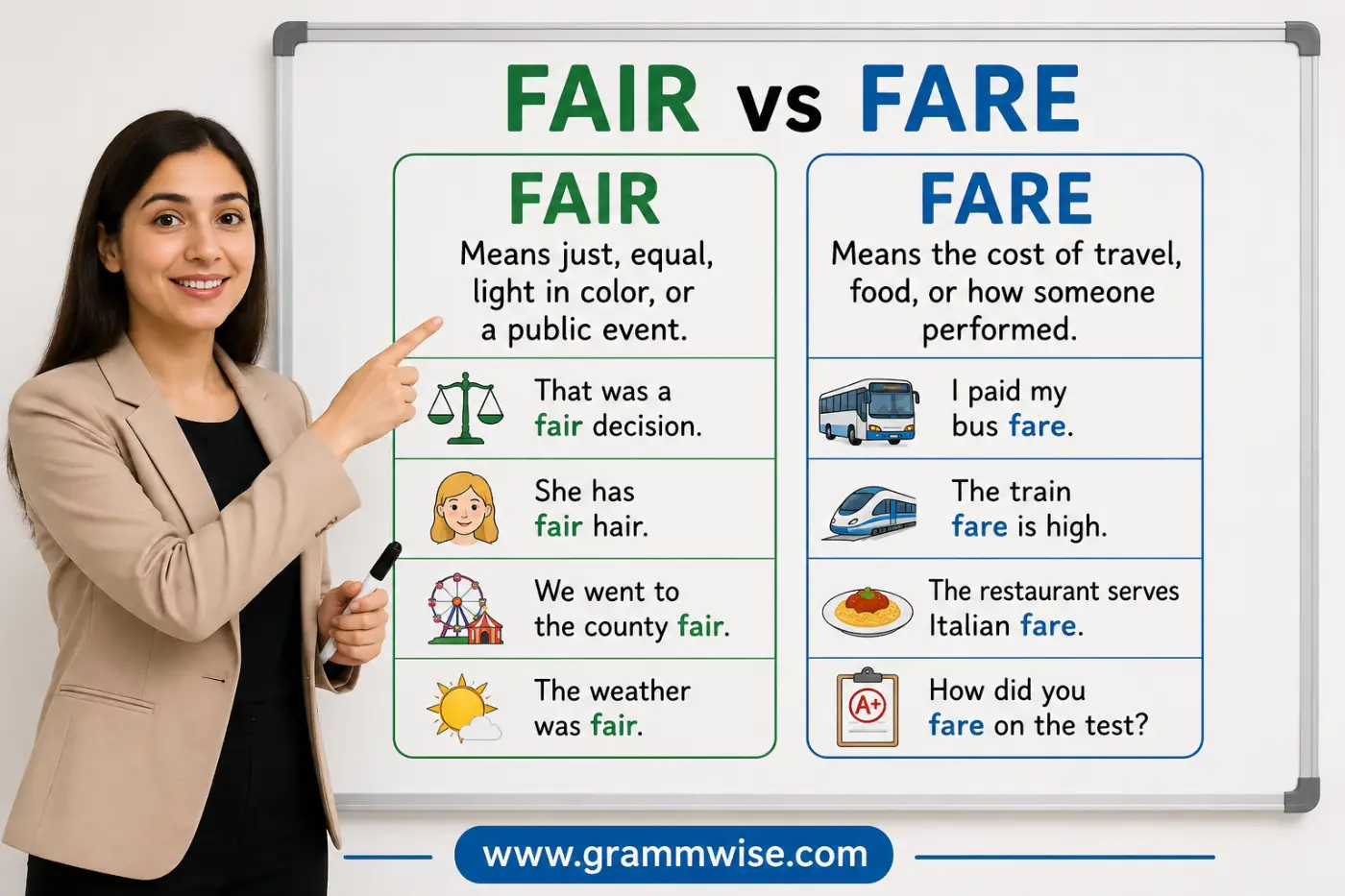
Many English learners get confused about fair vs fare because the two words sound exactly the same. They are homophones, which means they have the same pronunciation but different meanings and spellings. If you have ever stopped while writing and wondered which one is correct, you are not alone.
The good news is that the difference between fair vs fare is very easy to understand. Once you learn what each word means and see a few real-life examples, you will remember them without much effort.
This guide explains fair vs fare in simple US English. You will learn the meaning of each word, the difference between them, when to use each one, and easy tricks to remember them. By the end, you will feel confident using both words correctly in everyday writing and speaking.
Some words may seem interchangeable but carry different shades of meaning such as Although vs Despite.
Simple Answer in One Look
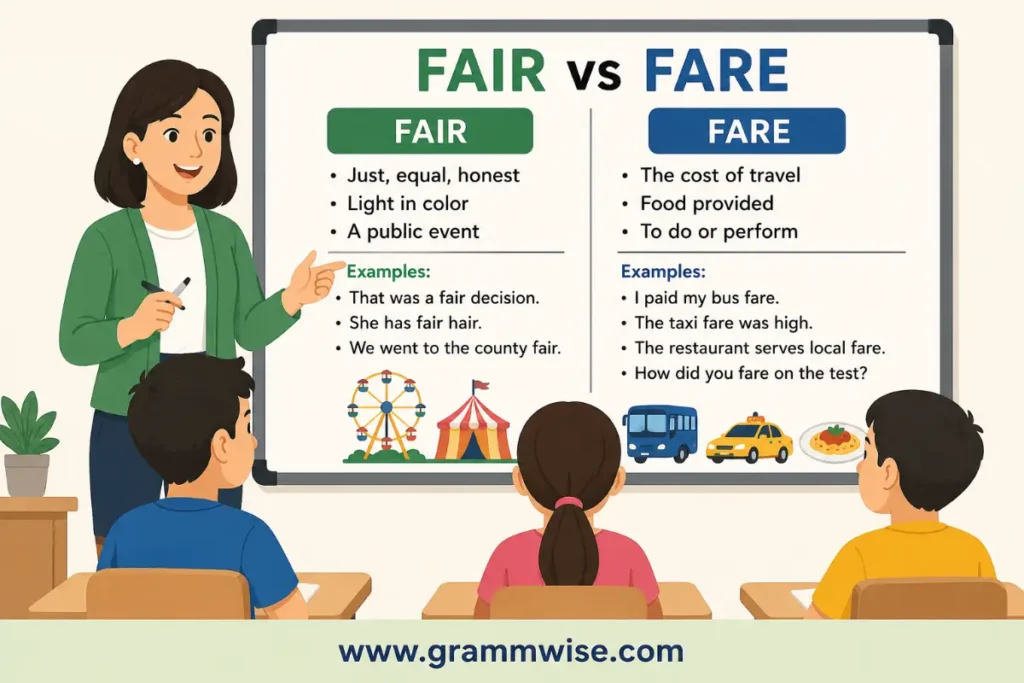
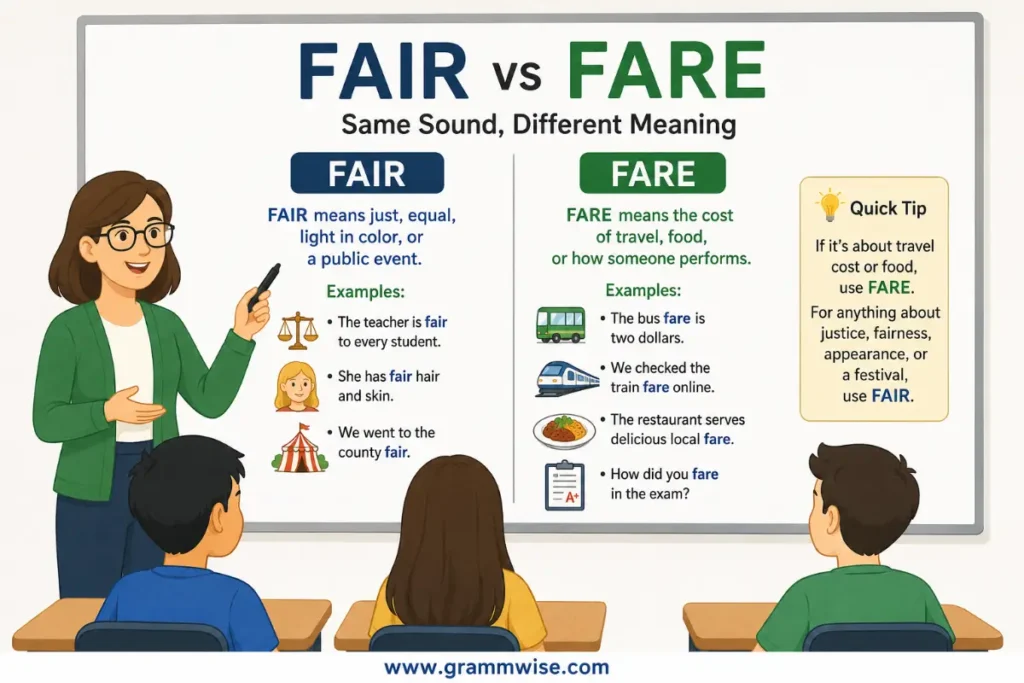
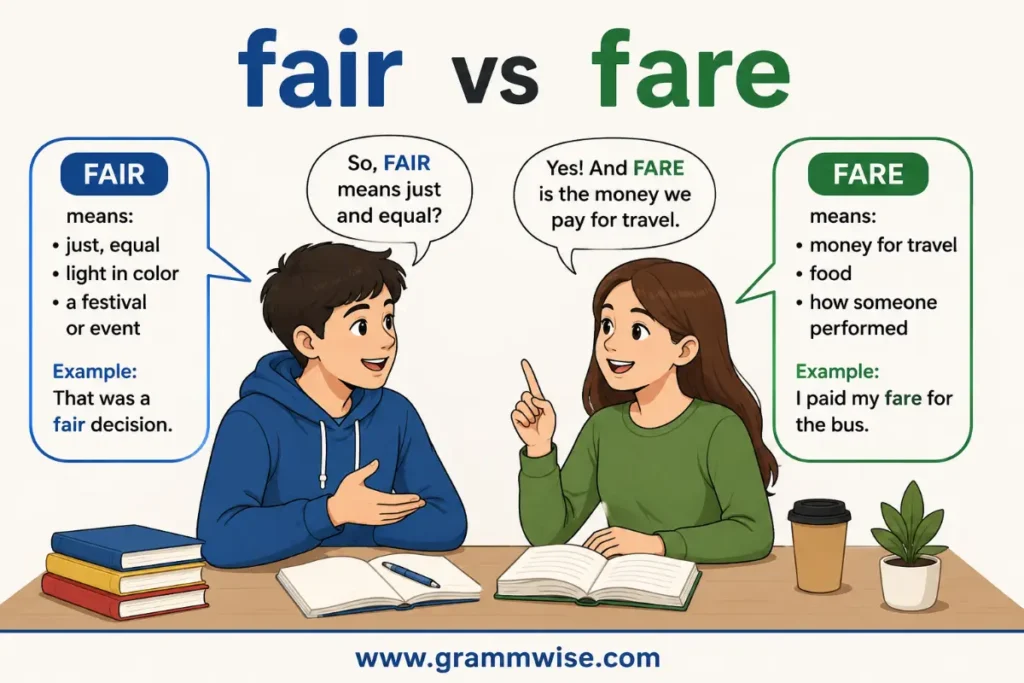
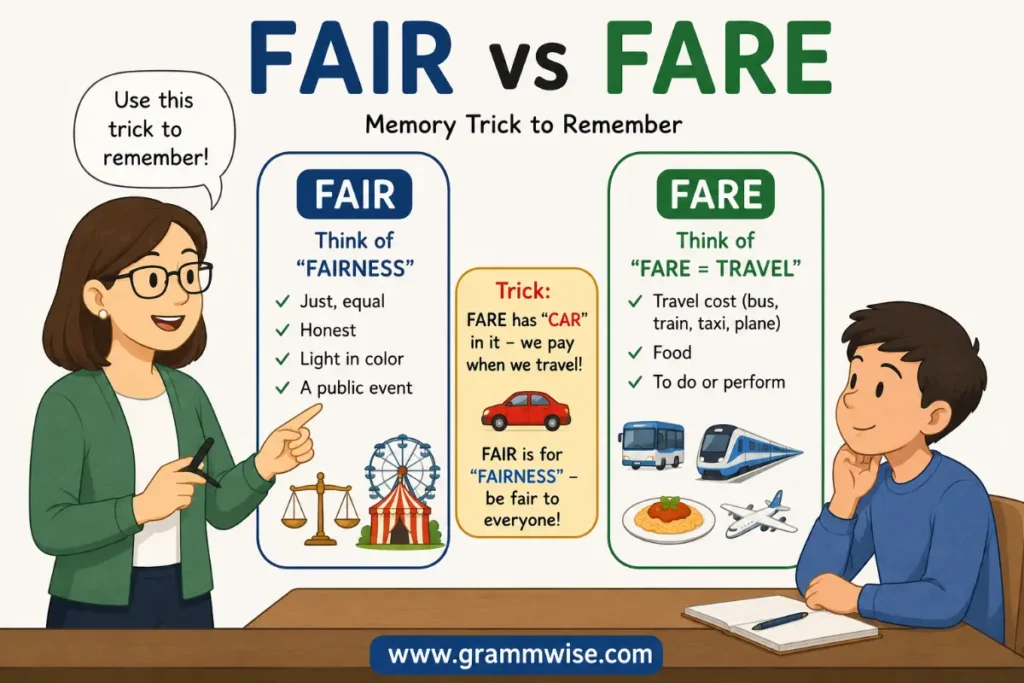
Fair usually means just, equal, light in color, or an event with games and rides.
Fare usually means the money you pay for a trip or food provided to people.
Quick tip: If you are talking about a bus, taxi, train, or airplane ticket price, use fare. For almost everything else, use fair.
What Does Fair vs Fare Means in Simple English
The easiest way to remember fair vs fare is to learn one word at a time.
What Does “Fair” Mean?
The word fair has several common meanings.
It can mean something is just or equal.
Examples:
- The teacher made a fair decision.
- Everyone should get a fair chance.
- That game was fair for both teams.
It can also describe light-colored hair or skin.
Examples:
- She has fair hair.
- The baby has fair skin.
Another meaning of fair is good enough or average.
Examples:
- The weather was fair.
- His work was fair but could be better.
Finally, fair can also mean a public event with games, rides, food, and shows.
Examples:
- We went to the county fair.
- The children loved the fair.
As you can see, fair has many meanings. The meaning depends on the sentence.
What Does “Fare” Mean?
The word fare has fewer meanings, so it is easier to remember.
Most of the time, fare means the money you pay for transportation.
Examples:
- The taxi fare was expensive.
- I paid my bus fare.
- Train fares went up this year.
Another meaning of fare is food, especially simple food served somewhere.
Examples:
- The restaurant serves traditional local fare.
- The café offers fresh vegetarian fare.
There is also the verb fare, which means to do or perform.
Examples:
- How did you fare on the test?
- She fared well in the competition.
This meaning is less common in daily conversation, but you may see it in books, news stories, and formal writing.
Why People Mix These Words “Fair vs Fare”?
Many people confuse fair vs fare because they sound exactly the same.
These words are called homophones.
When someone says the words aloud, you cannot tell which spelling they mean unless you know the context.
For example:
- The bus fare was high.
- The game was fair.
Both sentences sound almost identical when spoken.
Another reason for the confusion is that fair has many different meanings. People see it in many situations, so they sometimes choose it automatically even when fare is the correct word.
Writers also make mistakes when typing quickly.
For example:
❌ The taxi fair was twenty dollars.
✅ The taxi fare was twenty dollars.
Or:
❌ That was a fare decision.
✅ That was a fair decision.
These mistakes are very common, even among native English speakers.
Clear Difference Between Fair vs Fare Explained Simply
Here is an easy comparison of fair vs fare.
| Fair | Fare |
|---|---|
| Means just or equal | Means travel cost |
| Can describe light color | Can mean food |
| Can mean a festival or event | Can mean how someone performs |
| Used much more often | Used mainly for travel and food |
| Examples: fair game, fair teacher | Examples: bus fare, taxi fare |
Think About the Topic
If you are talking about:
- justice → fair
- equal treatment → fair
- weather → fair
- a festival → fair
- ticket price → fare
- transportation cost → fare
- restaurant food → fare
- how someone performed → fare
This simple rule works most of the time.
Which Form Should You Use Fair vs Fare?
Ask yourself one simple question.
Are you talking about money for travel?
If yes, use fare.
Examples:
- Bus fare
- Taxi fare
- Airfare
- Train fare
- Ferry fare
If not, you probably need fair.
Examples:
- Fair rules
- Fair chance
- Fair skin
- Fair weather
- Fair competition
- County fair
Easy Memory Trick
Think about the word fare.
It has the word car hidden in the middle sound.
Cars, buses, taxis, trains, and airplanes all have fares.
Now think about fair.
A fair should be fair for everyone.
This simple picture helps many students remember the difference.
Easy Real-Life Sentences on Fair vs Fare
Here are simple examples showing fair vs fare in everyday English.
Sentences with “Fair”
- The teacher was fair to every student.
- Everyone deserves a fair chance.
- We had fair weather all weekend.
- She has fair hair.
- We visited the county fair yesterday.
- The referee made a fair decision.
- It was a fair game.
- Life is not always fair.
Sentences with “Fare”
- I paid my bus fare.
- The taxi fare was too high.
- Train fares increased this year.
- The airline lowered its fares.
- The restaurant serves Italian fare.
- How did you fare on your exam?
- We checked the ferry fare online.
- The subway fare is only two dollars.
Practice reading these aloud. The sound is the same, but the meaning changes.
Fair vs Fare: Where This Word Comes From?
The words fair and fare have different histories.
The word fair comes from very old English words that meant beautiful, pleasing, or just. Over time, its meaning grew to include justice, equality, good weather, and public festivals.
The word fare comes from another old English word that meant to travel or go on a journey. Later, it became connected to the price people pay for transportation. That is why we still use words like bus fare, airfare, and train fare today.
Even though these words sound exactly alike now, they developed from different words with different meanings.
Fair vs Fare: How This Word Is Understood in Culture and Stories?
Words often carry meanings beyond the dictionary. The same is true for fair vs fare.
How People See “Fair”
The word fair is connected with honesty and kindness in many cultures. Parents teach children to be fair when they share toys. Teachers remind students to play fair during games. Judges are expected to make fair decisions.
Because of this, the word fair often gives people a feeling of trust and respect.
You will hear expressions like:
- Play fair.
- Be fair to everyone.
- Give each person a fair chance.
- That’s only fair.
These phrases remind us that everyone should be treated equally.
Another meaning of fair is a fun public event. Many towns have county fairs with games, rides, music, animals, and food. Families visit these fairs to spend time together and celebrate local traditions.
When people hear the word fair, they may think about:
- Kindness
- Equality
- Honest decisions
- Family fun
- Community celebrations
How People See “Fare”
The word fare is connected with travel and moving from one place to another.
When people plan a trip, they compare:
- Bus fares
- Train fares
- Taxi fares
- Airfares
Travel websites often advertise low fares because people always want to save money.
The second meaning of fare, which means food, is common in restaurants and travel magazines.
For example:
- Local fare
- Traditional fare
- Italian fare
- Vegetarian fare
This use sounds a little more formal, but you will still see it often.
The verb fare also appears in questions about success.
For example:
- How did you fare in the interview?
- The team fared well this season.
Although this meaning is less common in everyday speech, it still appears in newspapers and books.
Biblical and Mythological Meaning of Fair vs Fare
Neither fair nor fare has a special biblical or mythological meaning on its own.
However, the idea behind fair appears many times in religious teachings.
Many religions encourage people to:
- Treat others fairly.
- Be honest.
- Show kindness.
- Judge people without favoritism.
These ideas match the everyday meaning of fair, even though the word itself is not used as a special symbol.
The word fare does not have a special religious meaning either. It simply keeps its normal meanings of travel, food, or doing well.
So if you are reading the Bible or stories from mythology, remember that these words usually keep their normal English meanings unless the context suggests something different.
Symbolism of “Fair vs Fare” in Simple Words
Sometimes words make people think about ideas and feelings.
What “Fair” Represents?
The word fair often represents:
- Justice
- Equality
- Kindness
- Honesty
- Respect
- Balance
- Equal opportunity
If someone says,
“That was a fair decision.”
People usually feel that everyone was treated the right way.
A fair competition means nobody cheated.
A fair teacher means every student gets the same chance to succeed.
Because of these meanings, fair has a positive feeling.
What “Fare” Represents?
The word fare usually represents movement and daily life.
It reminds people of:
- Traveling
- Transportation
- Journeys
- Adventure
- Costs
- Food
- New experiences
When someone buys a train fare, they are beginning a trip.
If a restaurant serves local fare, it introduces visitors to local food.
When someone asks,
“How did you fare?”
They want to know how life is going or whether you succeeded.
Unlike fair, which often represents values, fare usually represents actions, travel, or experiences.
Related Words You Should Know
Learning related words makes fair vs fare much easier.
Fairness: Being honest and treating everyone equally.
Example: Everyone appreciated the teacher’s fairness.
Equal: The same for everyone.
Example: Each student got an equal amount of time.
Honest: Telling the truth and doing the right thing.
Example: He gave an honest answer.
Justice: Making fair decisions.
Example: The judge wanted justice for everyone.
Airfare: The cost of an airplane ticket.
Example: Airfare is cheaper during some months.
Bus Fare: The money you pay to ride a bus.
Example: I forgot my bus fare.
Train Fare: The price of traveling by train.
Example: The train fare was affordable.
Taxi Fare: The amount you pay after riding in a taxi.
Example: The taxi fare surprised us.
Local Fare: Traditional food from a place.
Example: Tourists enjoyed the local fare.
Fared: The past tense of fare, meaning how someone did.
Example: She fared better than expected.
How People Actually Use “Fair vs Fare” in Daily English
Here are natural examples that show how native speakers use fair vs fare every day.
Talking About School
“The teacher gave everyone a fair grade.”
“Our science fair starts next Friday.”
“That’s a fair rule.”
Talking About Travel
“How much is the bus fare?”
“The airline lowered its fares.”
“We checked the train fare online.”
Talking About Food
“This restaurant serves local fare.”
“The café offers healthy fare.”
Talking About Success
“How did you fare during your interview?”
“Our team fared well this season.”
Talking About Life
“Life is not always fair.”
“Give him a fair chance.”
“I think that’s a fair idea.”
“She paid the taxi fare before leaving.”
Notice how fair appears much more often in everyday conversation than fare.
Common Mistakes People Make About “Fair vs Fare”
Many learners make the same mistakes. Here are the most common ones.
Mistake 1
❌ The bus fair is expensive.
✅ The bus fare is expensive.
Remember:
Travel price = fare
Mistake 2
❌ That’s not fare.
✅ That’s not fair.
If you mean honest or equal, always choose fair.
Mistake 3
❌ The county fare opens tomorrow.
✅ The county fair opens tomorrow.
A public event with rides and games is always a fair.
Mistake 4
❌ She has fare hair.
✅ She has fair hair.
Light-colored hair uses fair.
Mistake 5
❌ The restaurant serves traditional fair.
✅ The restaurant serves traditional fare.
Food served at a restaurant is called fare.
Easy Check Before You Write
Ask yourself:
Am I talking about honesty, equality, weather, appearance, or a festival?
Use fair.
Am I talking about travel cost, food, or how someone performed?
Use fare.
This quick question helps you choose the correct word almost every time.
Final Teacher Explanation
Imagine I am standing in front of the classroom.
I would tell my students this:
Do not worry if fair vs fare seems confusing at first. Almost everyone mixes them up because they sound exactly alike. Instead of trying to memorize long grammar rules, remember the meaning.
- If your sentence is about being honest, equal, kind, light-colored, or a fun festival, choose fair.
- If your sentence is about paying for transportation, talking about food, or asking how someone did, choose fare.
Read real English books, signs, menus, and travel websites. The more examples you see, the easier these words become. Practice by making your own sentences every day.
Soon, choosing between fair and fare will feel natural.
Quick Recap “Fair vs Fare”
The difference between fair vs fare is simple. Fair means just, equal, light-colored, or a public festival. Fare means the cost of travel, food, or how someone performs. When you remember the meaning instead of only the spelling, choosing the correct word becomes easy every time.
Conclusion
Understanding fair vs fare is easier once you know what each word means. Fair is used for honesty, equality, light color, or a public festival, while fare refers to travel costs, food, or how someone performs. Remember the meaning first, and choosing the correct spelling will become natural.
With regular practice and real-life examples, you will quickly build confidence using both words correctly. Keep reading, writing, and speaking English every day, and these commonly confused words will soon become easy to remember.Fair vs Fare: Difference, Meaning, and Easy Examples
Frequently Asked Questions
What does fair mean in simple words?
Fair means honest, equal, or treating everyone the right way. It can also mean a public festival or light-colored hair or skin.
What does fare mean in simple words?
Fare usually means the money you pay for transportation. It can also mean food or how someone performed.
What is the difference between fair vs fare?
Fair is about honesty, equality, appearance, or festivals. Fare is about travel costs, food, or success in doing something.
Which is correct: bus fair or bus fare?
Bus fare is correct because it means the price you pay to ride the bus.
Is it “play fair” or “play fare”?
Play fair is correct because it means to play honestly and follow the rules.
Why do people confuse fair vs fare?
People confuse them because they are homophones. They sound the same but have different spellings and meanings.
Can fare be used as a verb?
Yes. As a verb, fare means to do or perform. For example, “She fared well in the competition.”
Can I use fair and fare in the same sentence?
Yes. For example: “The taxi fare was fair for such a long trip.” This sentence correctly uses both words with different meanings.