
Many English learners get confused about although vs despite because both are used to show contrast. They both connect two ideas that seem surprising, but they are not used in the same way. If you know one simple rule, you will stop making mistakes.
This guide will explain although vs despite in very simple English. You will learn what each word means, when to use it, and how to remember the difference. Everything is explained step by step, just like a teacher in a classroom.
By the end of this lesson, you will know the difference between although and despite, understand which is correct, and feel confident using both words in everyday English.
If you enjoy learning word differences, you may also like our guide on Farther vs Further.
Simple Answer in One Look
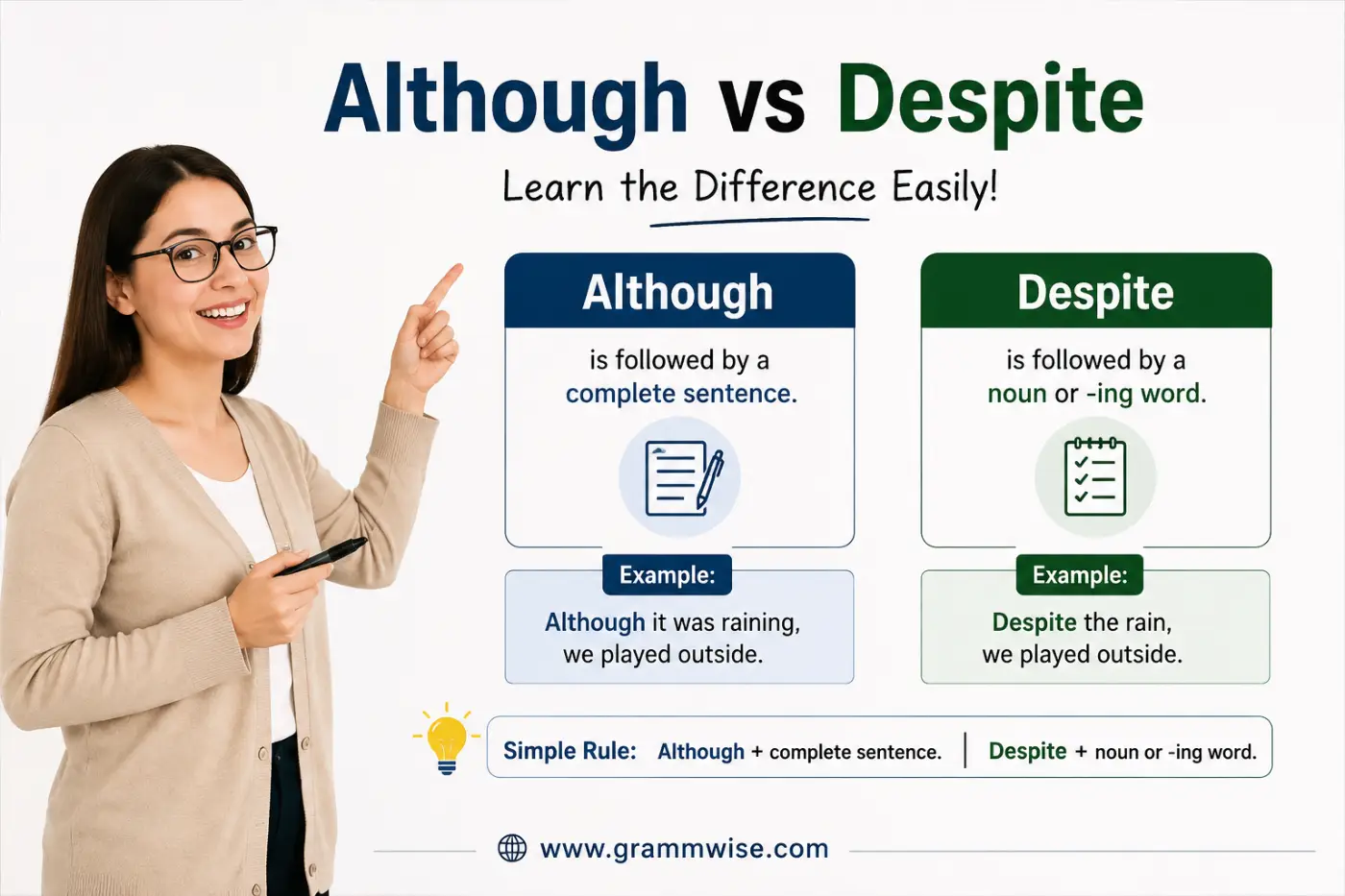
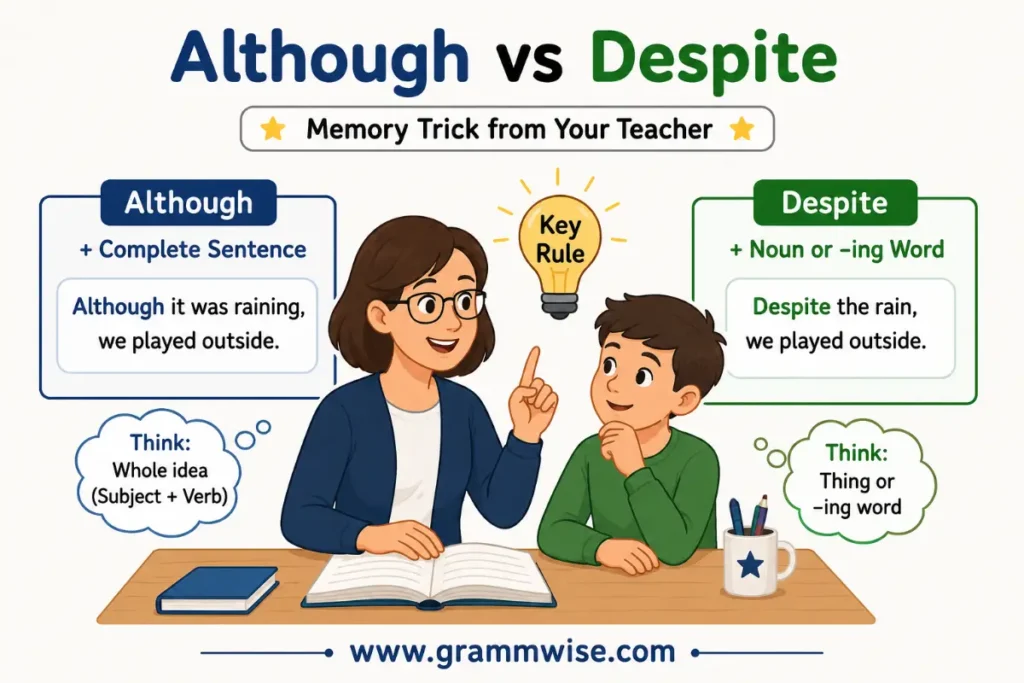
Although is followed by a complete idea (a subject and a verb).
Despite is followed by a noun, a pronoun, or an -ing word.
Quick examples:
- Although it was raining, we played outside.
- Despite the rain, we played outside.
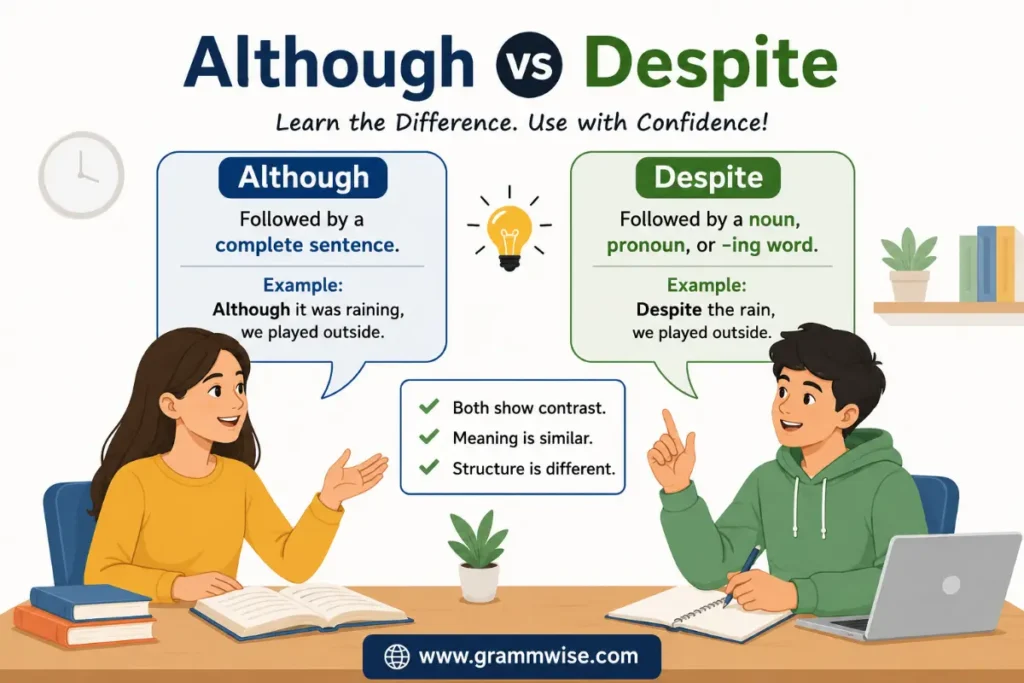
Both sentences have the same meaning, but the sentence structure is different.
What Does Although vs Despite Means in Simple English?
To understand although vs despite, think about two things that do not seem to match.
For example:
You studied very hard.
You failed the test.
Most people expect hard work to bring success. When the result is different from what we expect, we use words like although and despite.
What Does “Although” Mean?
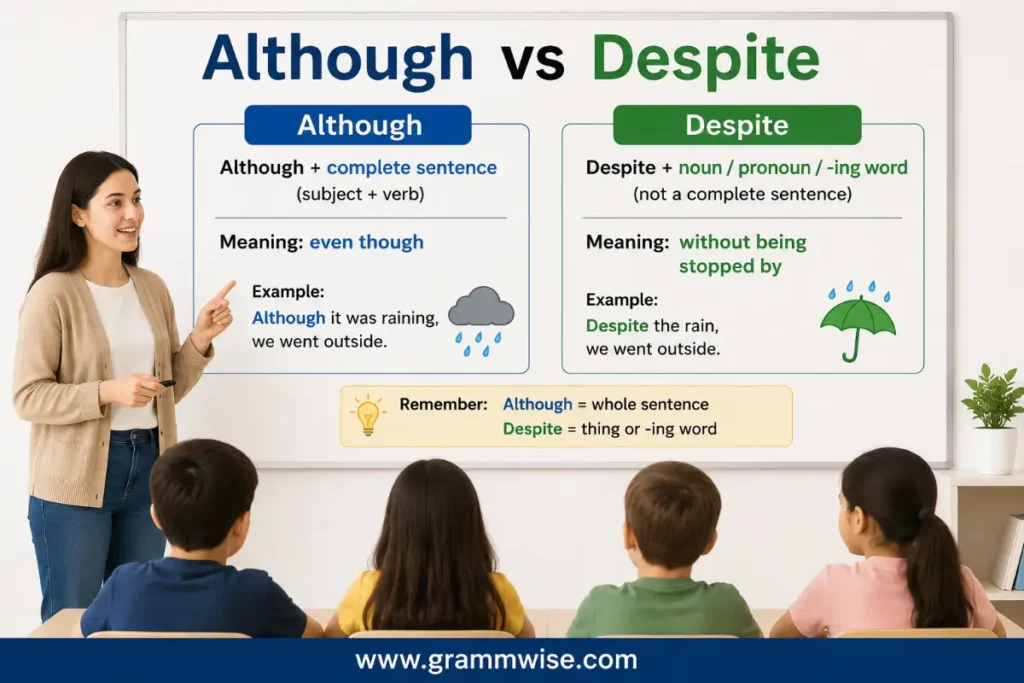
Although means even though or but.
It introduces a complete idea.
Example:
- Although she was tired, she finished her homework.
The first part tells us she was tired.
The second part tells us she still finished her homework.
Both ideas are complete.
What Does “Despite” Mean?
Despite means without being stopped by something.
It is followed by a thing, a person, or an activity.
Example:
- Despite the heavy rain, the game continued.
“The heavy rain” is not a complete sentence. It is simply a noun phrase.
Both Although vs Despite Show Contrast
Both words show that one thing happened even though another thing could have stopped it.
For example:
- Although the road was busy, we arrived on time.
- Despite the busy road, we arrived on time.
The meaning is almost the same.
The sentence pattern changes.
Think Like This
Use although when you want to tell a complete story first.
Use despite when you want to mention a thing or situation.
That simple idea will help you remember the difference.
Why People Mix These Words Although vs Despite?
Many students confuse although vs despite because both express almost the same idea.
The meaning is very close.
The grammar is different.
That is where mistakes happen.
Here are the most common reasons.
They Both Mean “Even Though”
These sentences have almost the same meaning.
- Although it was cold, we went swimming.
- Despite the cold weather, we went swimming.
Because the meaning is similar, learners often think the words can always replace each other.
They cannot.
Learners Copy the Wrong Pattern
A common mistake is this:
❌ Despite it was raining, we stayed home.
This is wrong.
Correct:
✅ Although it was raining, we stayed home.
or
✅ Despite the rain, we stayed home.
Both Although vs Despite Are Common in Daily English
You hear both words in conversations, books, movies, news stories, and school writing.
Without learning the sentence pattern, they sound almost the same.
Other Similar Words Make It Harder
English also has words like:
- though
- even though
- in spite of
- however
- but
These words all show contrast, so learners sometimes mix them together.
Direct Translation Causes Problems
Some languages use one word for every kind of contrast.
English does not.
English uses different sentence patterns depending on the word.
That is why practicing the pattern is more helpful than memorizing only the meaning.
Clear Difference Between Although vs Despite Explained Simply
Here is the easiest way to remember although vs despite.
| Although | Despite |
|---|---|
| Followed by a complete sentence | Followed by a noun or -ing word |
| Means even though | Means without being stopped by |
| Has a subject and verb after it | Does not have a complete sentence after it |
| Very common in speaking and writing | Very common in speaking and writing |
Easy Formula
Although + complete sentence
Example:
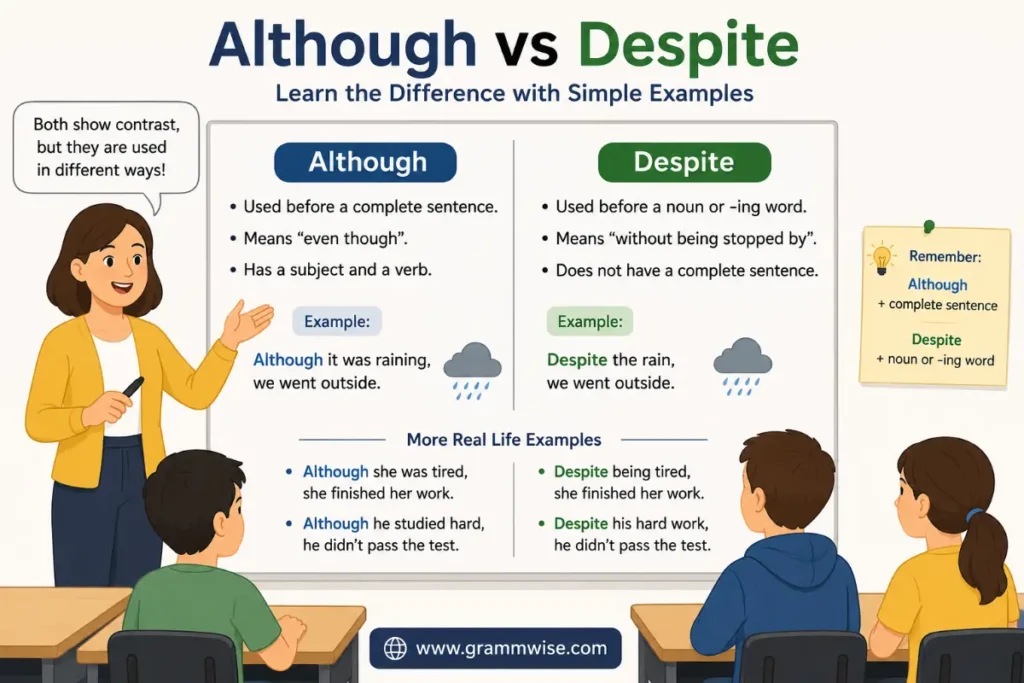
- Although she was busy, she called me.
Despite + noun
Example:
- Despite her busy schedule, she called me.
Another Formula
Despite + verb + ing
Example:
- Despite feeling sick, he went to work.
Notice that feeling sick is not a complete sentence.
Side-by-Side Examples
Although
- Although he was young, he was very smart.
- Although I was sleepy, I finished the movie.
- Although they were late, they enjoyed the show.
Despite
- Despite his young age, he was very smart.
- Despite my sleepiness, I finished the movie.
- Despite being late, they enjoyed the show.
The meaning stays almost the same.
Only the structure changes.
Memory Trick for Although vs Despite
Think of this:
Although = Whole sentence
Despite = Thing or activity
If you remember this one rule, you will avoid most mistakes.
Although vs Despite: Which Form Should You Use?
Many students ask, “Which is correct: although or despite?”
The answer depends on what comes next.
Use “Although” When You Have a Complete Idea
Example:
- Although my phone was old, it worked well.
“My phone was old” has both a subject and a verb.
So although is correct.
Use “Despite” Before a Thing
Example:
- Despite my old phone, I finished the work.
“My old phone” is only a noun phrase.
So despite is correct.
Use “Despite” Before an -ing Word
Examples:
- Despite working late, she smiled.
- Despite feeling nervous, he gave the speech.
- Despite studying hard, she failed the test.
Do Not Use “Despite” Before a Complete Sentence
Wrong:
❌ Despite she was tired, she cooked dinner.
Correct:
✅ Although she was tired, she cooked dinner.
or
✅ Despite being tired, she cooked dinner.
Use “In Spite Of” the Same Way
In spite of follows the same rule as despite.
Example:
- Despite the noise, I slept well.
- In spite of the noise, I slept well.
Both are correct.
Common Mistakes with Although vs Despite
Here are mistakes many learners make.
Mistake 1
❌ Despite I was sick, I went to school.
✅ Although I was sick, I went to school.
✅ Despite being sick, I went to school.
Mistake 2
❌ Although the rain, we played soccer.
✅ Although it rained, we played soccer.
✅ Despite the rain, we played soccer.
Mistake 3
❌ Despite he studied hard, he failed.
✅ Although he studied hard, he failed.
✅ Despite studying hard, he failed.
Mistake 4
❌ Although my headache, I finished work.
✅ Despite my headache, I finished work.
Mistake 5
❌ Despite it was expensive, I bought it.
✅ Although it was expensive, I bought it.
✅ Despite the high price, I bought it.
Learning from mistakes is one of the fastest ways to improve your English.
Easy Real-Life Sentences on Although vs Despite
These examples show how people naturally use although vs despite in daily life.
Examples with Although
- Although it was hot, we walked to the park.
- Although she was nervous, she smiled.
- Although I forgot my notes, I gave the presentation.
- Although he was busy, he helped his friend.
- Although they lost the game, they stayed positive.
- Although the food was spicy, I enjoyed it.
- Although we left early, traffic was heavy.
- Although she practiced every day, she still wanted to improve.
Examples with Despite
- Despite the heat, we walked to the park.
- Despite her nerves, she smiled.
- Despite forgetting my notes, I gave the presentation.
- Despite his busy schedule, he helped his friend.
- Despite losing the game, they stayed positive.
- Despite the spicy food, I enjoyed dinner.
- Despite the traffic, we arrived on time.
- Despite the long wait, everyone stayed calm.
Practice saying these sentences aloud.
Hearing the patterns helps you remember them.
Quick Practice
Choose the correct word.
- _____ it was snowing, the children played outside.
Answer:
Although
- _____ the snow, the children played outside.
Answer:
Despite
- _____ being tired, she finished the race.
Answer:
Despite
_____ she was tired, she finished the race.
Answer:
Although
- _____ the high price, many people bought the phone.
Answer:
Despite
- _____ the phone was expensive, many people bought it.
Answer:
Although
If you answered these correctly, you already understand the main difference.
Although vs Despite: Where This Word/Expression Comes From?
The history of although and despite is interesting but easy to understand.
Although has been used in English for hundreds of years. It came from older English words that meant even if or in spite of the fact that. Over time, it became one of the most common words for showing contrast.
Despite comes from older French and Italian words that were related to dislike or opposition. English later gave it the meaning of without being stopped by something.
Today, both words are common in books, newspapers, classrooms, conversations, and business writing.
They are simple, useful words that help people connect ideas clearly.
Quick Comparison Chart Although vs Despite
| Feature | Although | Despite |
|---|---|---|
| Meaning | Even though | Without being stopped by |
| Shows contrast | Yes | Yes |
| Followed by | Complete sentence | Noun or -ing word |
| Common in speech | Yes | Yes |
| Common in writing | Yes | Yes |
| Easy replacement | Not always | Not always |
Teacher’s Memory Trick for Although vs Despite
Imagine two doors.
The first door is called Although.
Only complete sentences can enter.
Example:
- Although she was late…
The second door is called Despite.
Only nouns or -ing words can enter.
Example:
- Despite the rain
- Despite being late
If you send the wrong kind of words through the wrong door, the sentence sounds incorrect.
This simple picture helps many students remember the rule for although vs despite.
How “Although vs Despite” Is Understood in Culture and Stories?
Language is more than grammar. It also shows how people think and tell stories. That is why understanding although vs despite can help you speak and write more naturally.
In stories, movies, and everyday conversations, people often talk about problems that did not stop someone from reaching a goal. This idea is called overcoming challenges.
Both although and despite help tell that kind of story.
For example:
- Although the road was long, they kept walking.
- Despite the long road, they kept walking.
Both sentences tell us that something difficult happened, but the people did not give up.
You will see this pattern in many books.
For example:
- Although the hero was afraid, he protected his family.
- Despite the danger, the hero protected his family.
The message is simple.
A problem existed.
The person continued anyway.
This idea appears in many cultures around the world.
Parents tell children stories about brave people.
Teachers tell stories about students who worked hard.
Athletes share stories about winning after many failures.
These stories often use words like although, despite, even though, and in spite of because they show strength and determination.
Why Writers Like These Words Although vs Despite?
Writers use contrast to make stories more interesting.
Compare these two sentences.
- She was tired. She finished the race.
- Although she was tired, she finished the race.
The second sentence sounds smoother because the relationship between the two ideas is clear.
The same happens here.
- Despite her tiredness, she finished the race.
Again, the sentence tells us that the problem did not stop her.
That is why these words are common in novels, newspapers, speeches, and everyday conversations.
A Positive Life Lesson
Many motivational quotes also use this idea.
For example:
- Although life is hard, never stop learning.
- Despite many failures, keep trying.
These sentences remind us that success often comes after difficulties.
That is why although vs despite is not only about grammar. It is also about expressing hope, courage, and persistence.
Biblical and Mythological Meaning of Although vs Despite
Neither although nor despite has a special religious meaning.
They are normal English words.
However, they often appear in English translations of the Bible because many Bible stories describe people who stayed faithful during difficult times.
For example:
- Although he faced many troubles, he trusted God.
- Despite many hardships, they continued their journey.
These words simply connect two ideas.
The religious message comes from the story itself, not from the words.
The same is true in mythology.
Many heroes face monsters, storms, or impossible tasks.
Writers may say:
- Although the hero was wounded, he continued fighting.
- Despite the danger, the hero completed the mission.
Again, the words only show contrast.
They help readers understand that the challenge did not stop the action.
So, there is no special biblical or mythological definition for although or despite. They are simply useful words that help tell powerful stories.
Symbolism of “Although vs Despite” Explained in Simple Words
What Although Represents?
The word although often represents unexpected results.
It reminds us that life does not always follow our expectations.
Examples:
- Although it rained, the picnic was fun.
- Although she was nervous, she gave a great speech.
These sentences teach us that one situation does not always decide the final outcome.
Symbolically, although represents:
- Hope
- Determination
- Positive thinking
- Looking beyond problems
- Unexpected success
It tells us that something difficult happened, but another good thing happened too.
What Despite Represents?
The word despite often represents strength against obstacles.
It focuses more on the obstacle itself.
Examples:
- Despite the rain, the picnic was fun.
- Despite her fear, she spoke confidently.
The attention goes first to the challenge.
Then we see that the challenge did not win.
Symbolically, despite represents:
- Inner strength
- Courage
- Confidence
- Persistence
- Moving forward
Simple Comparison
Think about climbing a mountain.
Although
You notice the whole situation.
- Although the mountain was steep, they reached the top.
Despite
You notice the obstacle.
- Despite the steep mountain, they reached the top.
Both celebrate success.
They simply focus on different sentence patterns.
Related Words to “Although vs Despite” You Should Know
Learning similar words makes it easier to understand although vs despite.
Though: A shorter form of although. It is very common in everyday conversation.
Example: Though I was tired, I kept working.
Even Though: A stronger version of although. It gives extra emphasis.
Example: Even though it was midnight, they continued studying.
Despite: Shows contrast before a noun or -ing word.
Example: Despite the noise, I slept well.
In Spite Of: Has almost the same meaning as despite.
Example: In spite of the traffic, we arrived early.
But: Connects two opposite ideas.
Example: I wanted to go, but I was sick.
However: Shows contrast between two separate ideas.
Example: It was raining. However, we continued walking.
Yet: Another word that shows contrast.
Example: The exam was difficult, yet she passed.
Nevertheless: Means the same as “even so.”
Example: The road was closed. Nevertheless, we found another way.
Still: Shows that something continued anyway.
Example: He was tired. Still, he finished his work.
On the Other Hand: Used when comparing two different ideas.
Example: This phone is cheap. On the other hand, it has fewer features.
Knowing these related words helps you write more naturally and gives you more ways to express contrast.
How People Actually Use “Although vs Despite” in Daily English
Native English speakers use although and despite every day.
Here are natural examples.
At School
- Although the homework was hard, I finished it.
- Despite the difficult questions, I passed the quiz.
At Work
- Although the meeting was long, we learned a lot.
- Despite the busy schedule, she completed every task.
At Home
- Although the kids were noisy, the baby slept.
- Despite the mess, the house felt comfortable.
With Friends
- Although we disagreed, we stayed friends.
- Despite our different opinions, we respected each other.
While Traveling
- Although our flight was delayed, we enjoyed the trip.
- Despite the delay, everyone stayed cheerful.
During Sports
- Although the team lost, they played well.
- Despite the injury, he finished the game.
Talking About Weather
- Although it was freezing, we went outside.
- Despite the cold weather, people were jogging.
Shopping
- Although the jacket was expensive, I bought it.
- Despite the high price, it sold quickly.
These examples show that both words are useful in almost every part of daily life.
Common Mistakes People Make About “Although vs Despite”
Even advanced learners sometimes make mistakes with although vs despite.
Here are the most common ones.
Mistake 1: Using Despite Before a Complete Sentence
❌ Despite she was late, she caught the bus.
✅ Although she was late, she caught the bus.
✅ Despite being late, she caught the bus.
Mistake 2: Using Although Before Only a Noun
❌ Although the rain, we played soccer.
✅ Despite the rain, we played soccer.
✅ Although it rained, we played soccer.stake 3: Forgetting the Verb
After although, you need a complete idea.
❌ Although my brother.
✅ Although my brother was busy, he helped me.Mistake 4: Mixing Sentence Patterns
❌ Despite he worked hard.
✅ Although he worked hard.
✅ Despite working hard.
Mistake 5: Thinking They Are Always Interchangeable
Both words express contrast.
However, you cannot simply replace one with the other without changing the sentence.
Always check what comes after the word.
If it is a complete sentence, use although.
If it is a noun or -ing word, use despite.
Teacher’s Quick Check
Ask yourself one question:
What comes next?
- A complete sentence → Although
- A noun or -ing word → Despite
This quick check prevents most mistakes.
Final Teacher Explanation
Imagine you are sitting in my English class.
I write two sentences on the board.
- Although it was raining, we played outside.
- Despite the rain, we played outside.
I ask, “Do these sentences have the same meaning?”
You answer, “Yes.”
Then I ask, “Are they built the same way?”
The answer is “No.”
That is the secret behind although vs despite.
Both words show that something surprising happened. A problem was there, but it did not stop the result. The only thing you must remember is the sentence pattern.
If you have a complete sentence with a subject and a verb, choose although.
If you have a noun, a pronoun, or an -ing word, choose despite.
Do not worry about memorizing long grammar rules. Instead, practice with real sentences every day, read books, watch English videos and listen to conversations.
Soon, choosing the correct word will feel natural.
Learning English is not about being perfect every time. It is about understanding small rules and using them again and again until they become easy.
Now you know one of the most useful contrast patterns in English.
That is a skill you will use for the rest of your life.
Quick Recap “Although vs Despite”
The difference between although vs despite is simple. Although comes before a complete sentence, while despite comes before a noun, pronoun, or -ing word.
Remember this easy rule: Although + complete sentence. Despite + noun or -ing word. If you follow this pattern, you will use both words correctly in speaking and writing.
Conclusion
Understanding although vs despite is easier when you remember one simple rule. Use although before a complete sentence and despite before a noun or an -ing word. Once you know this pattern, choosing the correct word becomes much easier.
Practice with real-life examples every day, and soon these words will feel natural in your speaking and writing. The more you read and use them, the more confident you will become in everyday English.
Frequently Asked Questions
What does although mean in simple words?
Although means even though. It shows that one thing happened even when another thing could have changed the result.
What does despite mean in simple words?
Despite means without being stopped by something. It comes before a noun or an -ing word.
What is the main difference between although and despite?
Although is followed by a complete sentence. Despite is followed by a noun, pronoun, or -ing word.
Is it correct to say “despite she was tired”?
No. Say Although she was tired or Despite being tired.
Can I replace although with despite?
Sometimes, yes. But you must also change the sentence structure so it follows the correct pattern.
Is “in spite of” the same as “despite”?
Yes. They have almost the same meaning and are used in the same way.
Which is more common in everyday English?
Both are very common. Native speakers use although and despite in conversations, books, news articles, and formal writing.
Why do people get confused between although vs despite?
They have similar meanings, so learners think they follow the same pattern. The real difference is what comes after each word. Remember: Although + complete sentence. Despite + noun or -ing word.