
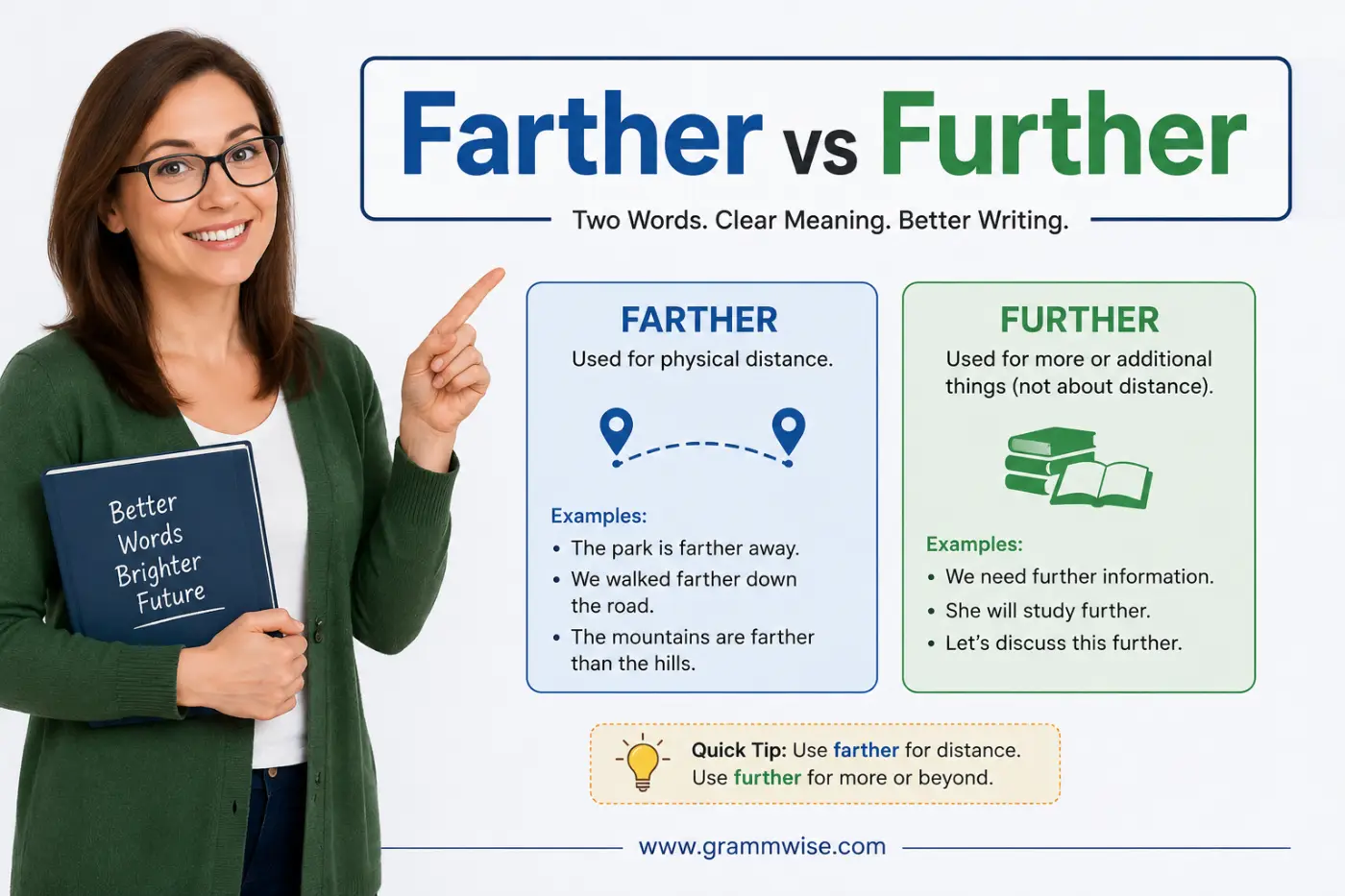
Many English learners get confused about farther vs further because both words talk about distance or progress. They often look the same, sound almost the same, and can even be used in similar ways. That is why many people ask, “What is the difference between farther vs further?” or “Which one is correct?”
The good news is that the difference is easy to understand. Once you learn one simple rule, you will know when to use each word. You do not need to memorize long grammar rules. You only need to remember what each word usually describes.
In this lesson, I will explain farther vs further in very simple English. You will see clear examples, memory tips, and everyday sentences that make these words easy to remember.
Similar confusion happens in other word pairs such as Fair vs Fare.
Simple Answer in One Look
Farther is usually used for physical distance.
Further is usually used for more, extra, or figurative distance, such as time, ideas, discussions, or progress.
Quick rule:
- Farther = physical distance
- Further = everything else
Both words are correct, but they are not always used in the same way.
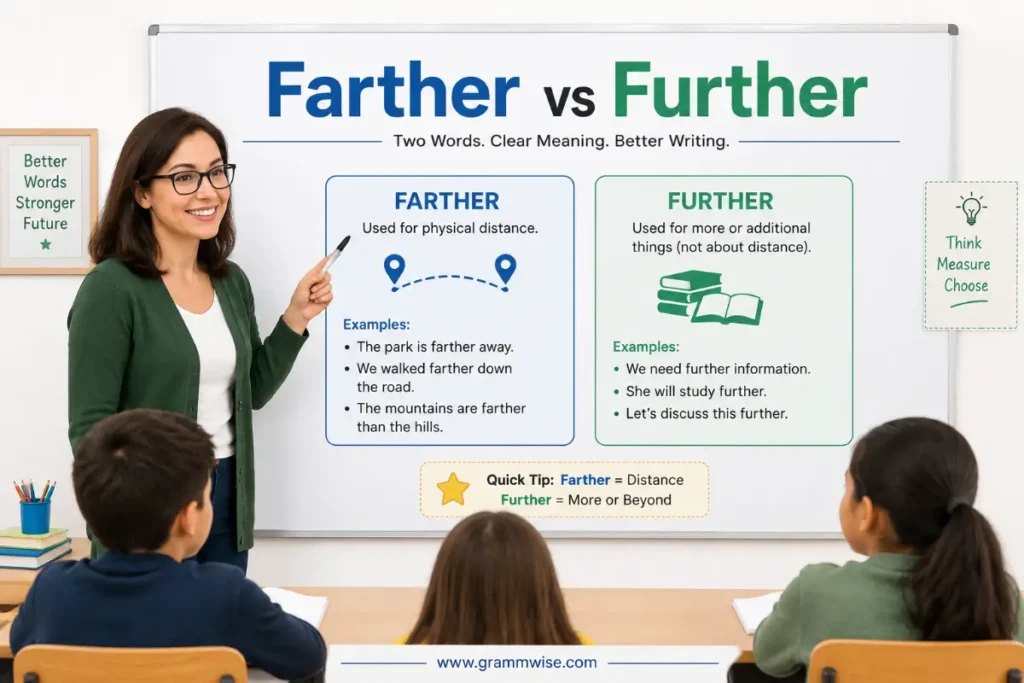
What Does Farther vs Further Mean in Simple English?
Imagine you are walking to a park.
If your friend says,
“The park is farther than I thought.”
They mean the park is physically farther away.
Now imagine your teacher says,
“We will discuss this further tomorrow.”
The teacher is not talking about distance. They mean the discussion will continue or go deeper.
That is the biggest difference.
Farther talks about places you can measure.
Further talks about things you cannot measure with a ruler.
Here are more examples.
Farther
- farther down the road
- farther from home
- farther across the river
- farther north
- farther away
These all describe real places.
Further
- further information
- further study
- further discussion
- further help
- further progress
These describe ideas, actions, or situations.
Why Do People Mix These Words Farther vs Further?
There are several reasons.
They sound almost the same.
Only one letter is different.
- farther
- further
When spoken quickly, many people cannot hear the difference.
Both Farther vs Further come from the same old English root.
Hundreds of years ago, the words were used more freely. Over time, people started giving each word a different job, but some overlap still remains.
Many native speakers use them interchangeably.
In casual conversation, you may hear:
- We walked further down the street.
- We walked farther down the street.
Many dictionaries accept both for physical distance, although farther is usually the better choice in formal writing.
English learners follow what they hear.
If you hear both words used for distance, it becomes difficult to know which one is preferred.
That is why understanding the simple rule helps.
Clear Difference Between Farther vs Further Explained Simply
Here is the easiest comparison.
| Farther | Further |
|---|---|
| Physical distance | Figurative distance |
| Real places | Ideas, plans, discussions |
| Miles, feet, roads | Knowledge, progress, help |
| Usually measurable | Usually not measurable |
Think of it like this.
Use farther when you can measure it.
Examples:
- farther down the road
- farther from school
- farther across the lake
- farther away from town
Use further when you cannot measure it.
Examples:
- further explanation
- further information
- further education
- further action
- further research
This simple rule works most of the time.
Farther vs Further: Which Form Should You Use?
Here is an easy guide.
Use farther for real distance.
Ask yourself:
Can I measure it?
If the answer is yes, choose farther.
Examples:
- My house is farther than yours.
- The store is farther away.
- We walked farther than yesterday.
- The mountain is farther from here.
Use further for ideas and progress.
Ask yourself:
Is this about information, time, plans, or progress?
If yes, use further.
Examples:
- We need further information.
- She continued her further studies.
- Do you have any further questions?
- We need further improvements.
Can further describe physical distance?
Yes.
Modern English often accepts further for physical distance.
For example:
- We walked further into the forest.
This sentence is correct.
However, many teachers and editors still prefer farther because it makes the meaning clearer.
If you want your writing to be simple and accurate, use this rule:
- Physical distance → farther
- Everything else → further
Easy Memory Trick to Use Farther vs Further
Here is a simple classroom trick.
Farther has the word “far.”
Think about being far away.
If something is far away from you, use farther.
Examples:
- farther down the road
- farther from school
- farther away
Now remember this.
Further has no “far” sound inside your memory trick.
Think of it as meaning:
- more
- extra
- additional
- beyond
Examples:
- further explanation
- further help
- further study
This trick helps many students remember the difference.
Easy Real-Life Sentences on Farther vs Further
Here are everyday examples.
Examples with farther
- My friend’s house is farther than mine.
- We drove farther than expected.
- The gas station is farther down the road.
- She threw the ball farther than I did.
- The beach is farther from the city.
Examples with further
- I need further information.
- Can you explain this further?
- We discussed the topic further.
- She wants to continue her further education.
- The police are doing further investigations.
- We need further support.
- Further questions are welcome.
- We made further progress this week.
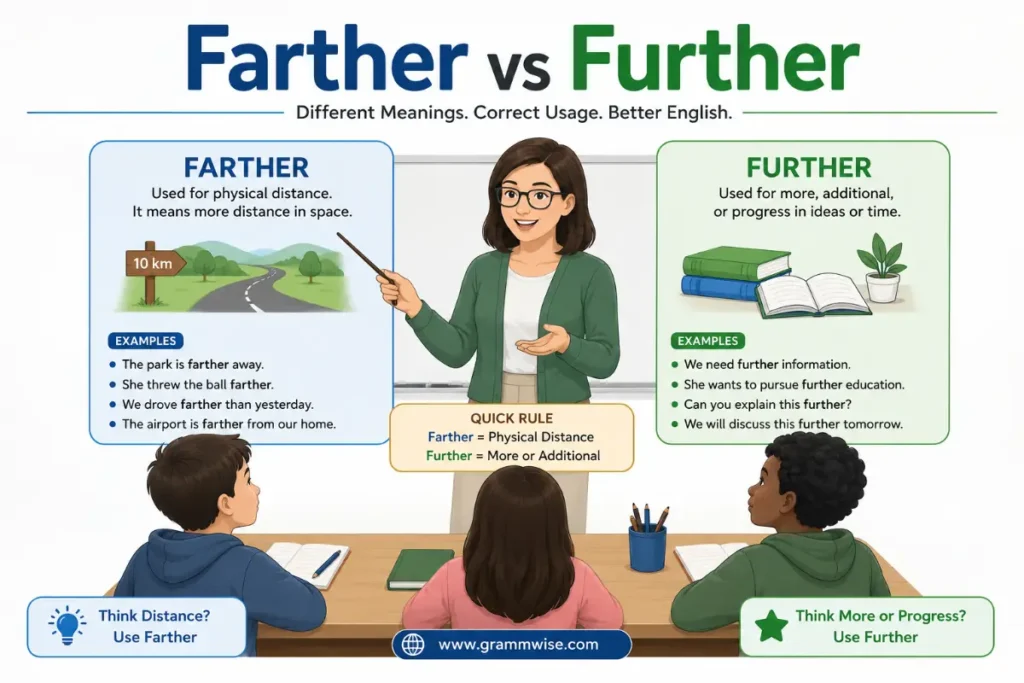
Which Is More Common “Farther vs Further“?
In modern English, further appears more often.
Why?
Because it is used in many situations besides distance.
You will often see:
- further information
- further details
- further assistance
- further education
- further notice
These expressions are very common in schools, offices, hospitals, websites, and businesses.
Farther is mostly limited to physical distance.
Farther vs Further: Where This Word Comes From?
The words farther and further have been part of English for hundreds of years.
Both come from old forms of English that meant “more distant” or “beyond.”
Long ago, people often used the two words almost the same way.
Later, teachers and writers began using a simple rule.
- Farther became the preferred word for physical distance.
- Further became the preferred word for ideas, time, progress, and additional information.
Today, this is the rule taught in many schools because it makes writing clearer.
How Is Farther vs Further Understood in Culture and Stories?
People often use distance to talk about life. That is why farther vs further is more than just a grammar lesson. These words can also show growth, change, and new experiences.
Think about a movie where a hero begins a long journey.
If someone says,
“The hero traveled farther than anyone before.”
They mean the hero went a greater physical distance.
Now imagine the ending of the same movie.
Someone says,
“The hero learned something further about courage.”
This is not about walking. It means the hero gained more understanding.
That is how these words often work in stories.
Farther usually describes where someone goes.
Further usually describes how someone grows.
You will see this idea in books, movies, speeches, and even songs.
For example:
- A traveler goes farther across the desert.
- A student studies further after high school.
- A scientist takes research further.
- A team moves further in a competition.
- Explorers travel farther into the mountains.
Notice how farther shows movement through space, while further often shows progress or improvement.
This simple idea appears in many stories because people often compare life to a journey.
Biblical and Mythological Meaning of Farther vs Further
The Bible does not teach a special grammar rule about farther vs further.
However, both ideas appear in different ways.
People in the Bible often traveled farther from one place to another. They walked through deserts, crossed rivers, and visited distant lands.
At the same time, they also grew further in wisdom, faith, and understanding.
So, while the exact word choice depends on the Bible translation, the ideas are familiar.
In mythology, many heroes travel long distances.
For example:
- They go farther into forests.
- They sail farther across the sea.
- They learn further lessons about bravery.
- They gain further knowledge before returning home.
The physical journey and the personal journey often happen together.
Symbolism of Farther vs Further Explained in Simple Words
Words can sometimes carry feelings as well as meanings.
Although farther and further are everyday words, they can also symbolize different kinds of journeys.
What Farther Represents?
Farther often represents:
- Travel
- Adventure
- Exploration
- New places
- Physical movement
- Discovery
Imagine standing at the edge of a road.
Every step you take moves you farther from where you started.
That image makes people think about travel and adventure.
Examples:
- Going farther into the forest
- Flying farther across the world
- Running farther than before
- Climbing farther up the mountain
The focus is on real movement.
What Further Represents?
Further often represents:
- Learning
- Improvement
- Progress
- Growth
- Better understanding
- New ideas
Think about learning English.
You may not move anywhere physically, but every lesson takes you further.
Examples:
- Further education
- Further research
- Further success
- Further development
- Further understanding
The focus is on moving forward in life, not moving across land.
Easy Comparison of Farther vs Further
| Farther | Further |
|---|---|
| Physical journey | Personal journey |
| Roads | Ideas |
| Miles | Knowledge |
| Travel | Growth |
| Places | Progress |
This comparison makes farther vs further much easier to remember.
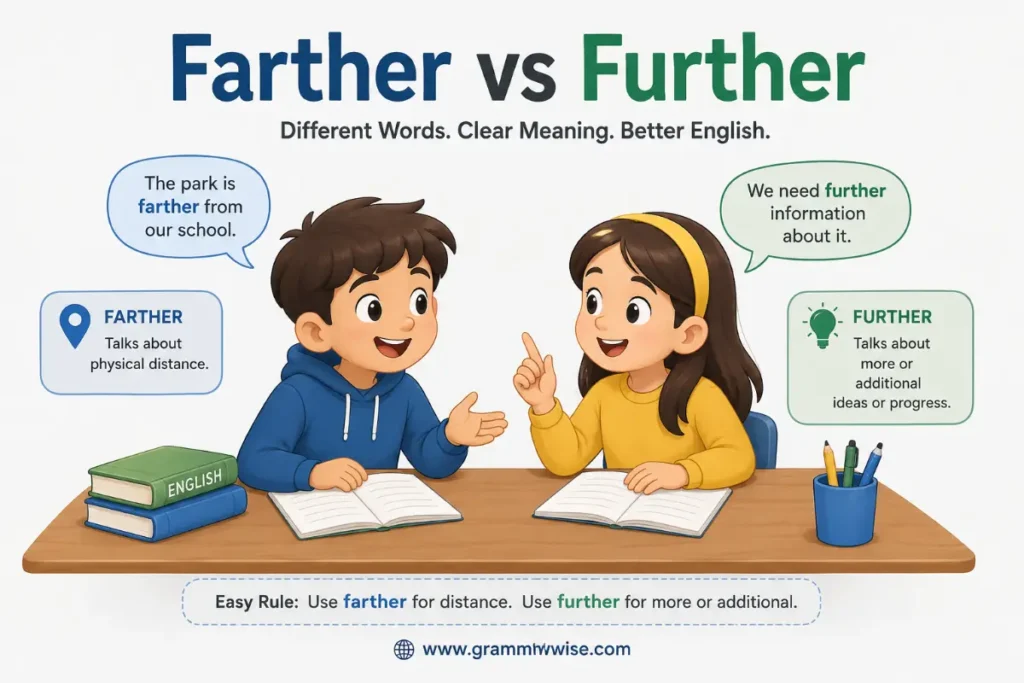
Related Words to Farther vs Further You Should Know
Learning similar words helps you understand English more naturally.
Distance: The space between two places.
Example: “The distance between our houses is five miles.”
Away: Not close.
Example: “The school is far away.”
Beyond: On the other side or more than something.
Example: “The mountains are beyond the river.”
Advance: To move forward or improve.
Example: “Our project is advancing quickly.”
Progress: Moving toward a goal.
Example: “She is making good progress.”
Continue: To keep going.
Example: “Please continue reading.”
Additional: More than what you already have.
Example: “I need additional time.”
Extra: Something added.
Example: “We brought extra water.”
Extend To make something longer.
Example: “They extended the meeting.”
Improve: To become better.
Example: “Practice helps you improve.”
These words are often used in the same kinds of situations where further appears.
How People Actually Use Farther vs Further in Daily English
Native speakers use these words every day.
Here are some natural examples.
At home
“Can you move the chair a little farther?”
At school
“Do you have any further questions?”
At work
“We need further information before we decide.”
During travel
“The hotel is farther than I expected.”
At the doctor’s office
“You need further tests.”
During a meeting
“We will discuss this further next week.”
While hiking
“We cannot walk much farther.”
Talking about college
“She wants to continue her further education.”
Watching a game
“Our team went further than last year.”
Driving
“The gas station is farther down the highway.”
These are exactly the kinds of sentences you will hear in everyday English.
Common Expressions with Farther vs Further
Some expressions almost always use further. Learn these because they are very common.
- Further Information: “Please contact us for further information.”
- Further details: “We will send further details tomorrow.”
- Further action: “No further action is needed.”
- Until further notice: “The office will stay closed until further notice.”
- Further education: “He plans to continue his further education.”
- Further research: “Scientists are doing further research.”
- Further assistance: “Call us if you need further assistance.”
These expressions sound natural because native speakers use them often.
Learn some common expressions that always use farther. These usually describe physical distance.
- farther away
- farther down the street
- farther north
- farther south
- farther east
- farther west
- farther from home
- farther into the woods
Each one describes a real place.
Common Mistakes People Make About Farther vs Further
Many learners make the same mistakes.
The good news is that they are easy to fix.
Mistake 1
❌ I need farther details.
✅ I need further details.
Details are information, not distance.
Mistake 2
❌ We discussed it farther.
✅ We discussed it further.
A discussion is not a place.
Mistake 3
❌ The restaurant is further away.
✅ The restaurant is farther away.
This is physical distance.
Mistake 4
❌ She wants farther education.
✅ She wants further education.
Education is learning, not travel.
Mistake 5
❌ We need farther help.
✅ We need further help.
Help is not measurable distance.
Mistake 6
❌ The hikers walked further than us.
✅ The hikers walked farther than us.
The sentence talks about walking distance.
Easy Self-Check
Before choosing the word, ask yourself:
Can I measure this distance?
If yes, choose farther.
If no, choose further.
This one question solves most mistakes.
Practice Test
Choose the correct word.
1. Can you give me _____ information?
A. farther
B. further
Answer: further
2. Their house is _____ from the park.
A. farther
B. further
Answer: farther
3. The company will take _____ action.
A. farther
B. further
Answer: further
4. We walked much _____ than yesterday.
A. farther
B. further
Answer: farther
5. Do you have any _____ questions?
A. farther
B. further
Answer: further
6. The airport is _____ than I remembered.
A. farther
B. further
Answer: farther
7. Scientists need _____ research.
A. farther
B. further
Answer: further
Final Teacher Explanation
Imagine you are sitting in my classroom, and you ask me one last question:
“How do I remember farther vs further?”
I would tell you not to worry about long grammar rules.
Just remember one simple idea.
If you are talking about a real place that someone can walk, drive, run, or measure, use farther.
If you are talking about ideas, learning, plans, discussions, progress, or anything that means “more” or “additional,” use further.
Yes, you may sometimes see further used for physical distance. Modern English allows this in many situations. However, using farther for physical distance makes your writing clearer and easier to understand.
A simple memory trick is:
- Farther = Far = Physical distance
- Further = Further learning, further help, further progress
Whenever you are unsure, ask yourself:
“Can I measure it?”
If the answer is yes, use farther.
If the answer is no, use further.
That single question will help you choose the correct word almost every time.
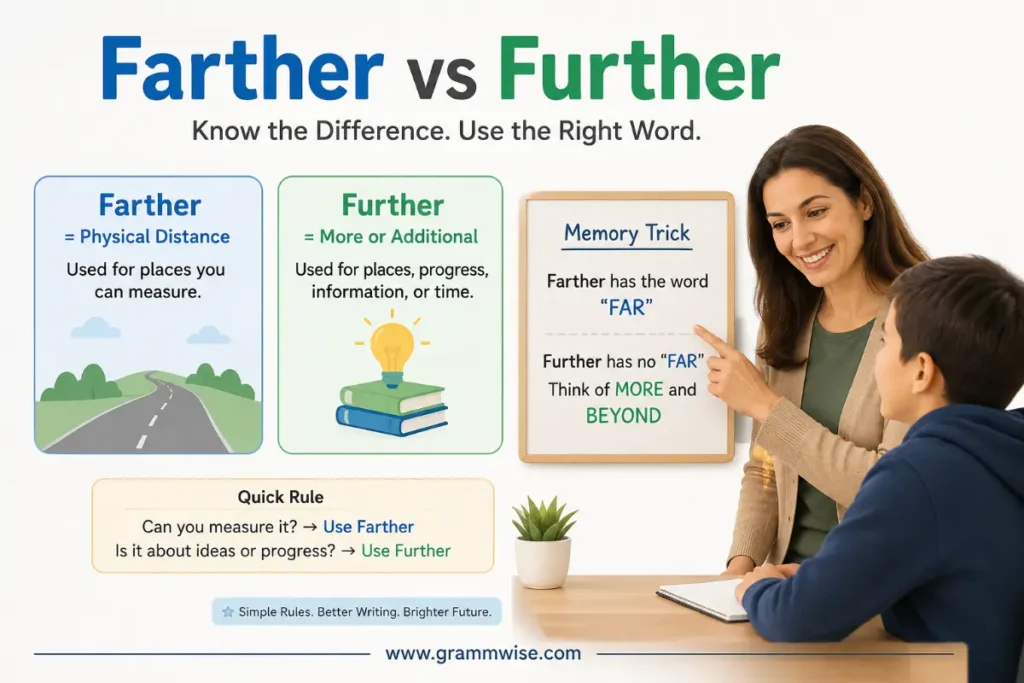
Quick Recap Farther vs Further
The difference between farther vs further is simple. Farther usually describes physical distance, while further usually means more, additional, or a greater level of progress, discussion, or understanding.
To remember the rule, think “farther = far away” and “further = more or beyond.” This easy trick will help you use both words correctly in everyday English.
Conclusion
Understanding farther vs further does not have to be difficult. Once you remember that farther is mainly for physical distance and further is mainly for ideas, progress, and extra information, choosing the right word becomes much easier.
Keep practicing with real-life examples, ask yourself if the distance can be measured, and use the simple memory trick: farther = far away, further = more or beyond. With a little practice, you will use both words naturally and confidently in both speaking and writing.
Frequently Asked Questions
What does farther mean in simple words?
Farther means a greater physical distance. It describes places that you can measure.
What does further mean in simple words?
Further means more, additional, or beyond. It often talks about ideas, progress, discussions, or information.
What is the difference between farther vs further?
Farther is mainly for physical distance. Further is mainly for ideas, progress, time, and extra information.
Which is correct: farther vs further?
Both are correct. Use farther for physical distance and further for most other situations.
Can I use further for physical distance?
Yes. Modern English often allows it. However, many teachers and editors still prefer farther because it is clearer.
Why do people get confused between farther vs further?
The words look and sound very similar. They also have a shared history, and further is sometimes used for physical distance.
Is further information correct?
Yes. Further information is the standard and natural expression in English.
How can I remember farther vs further?
Remember this simple rule: Farther = far away. Further = more or additional. If you can measure the distance, use farther. Otherwise, use further.