
Many people use envy vs jealousy as if they mean the same thing. You may hear someone say, “I’m jealous of your new phone,” or “She is jealous because her friend got a promotion.” In everyday English, people often swap these words. But they are not exactly the same.
The good news is that the difference is easy to understand. Once you learn one simple rule, you will know when to use each word with confidence. You do not need difficult grammar or fancy words.
In this lesson, I will explain envy vs jealousy in very simple English. We will look at the meaning, the differences, real-life examples, and why so many people confuse these two words.
Many English learners mix up similar-looking words such as Continual vs Continuous.
Simple Answer in One Look
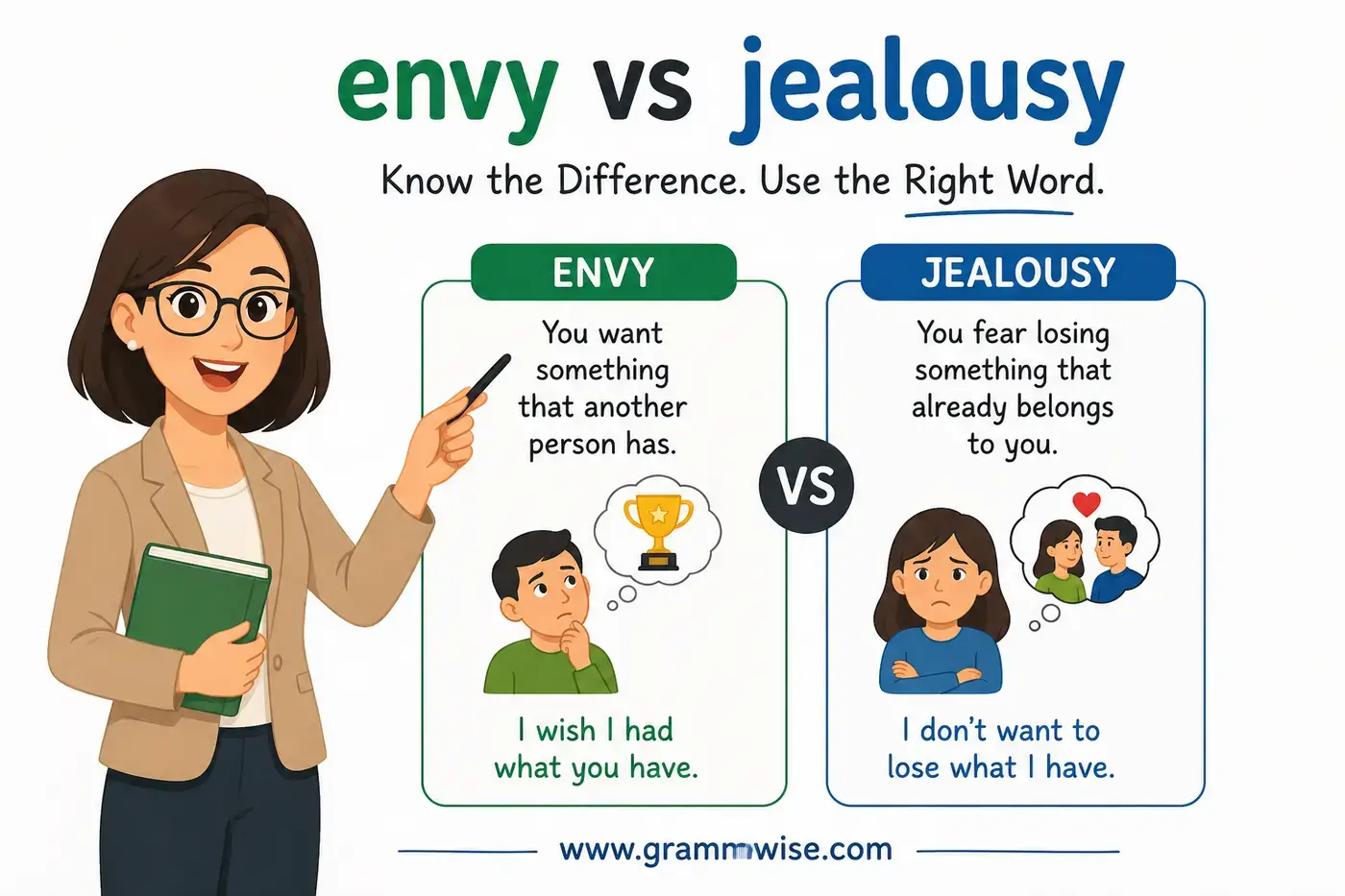
Envy means you want something that another person has.
Jealousy means you are afraid someone will take away something that already belongs to you, such as a relationship, friendship, or position.
What Does Envy vs Jealousy Mean in Simple English?
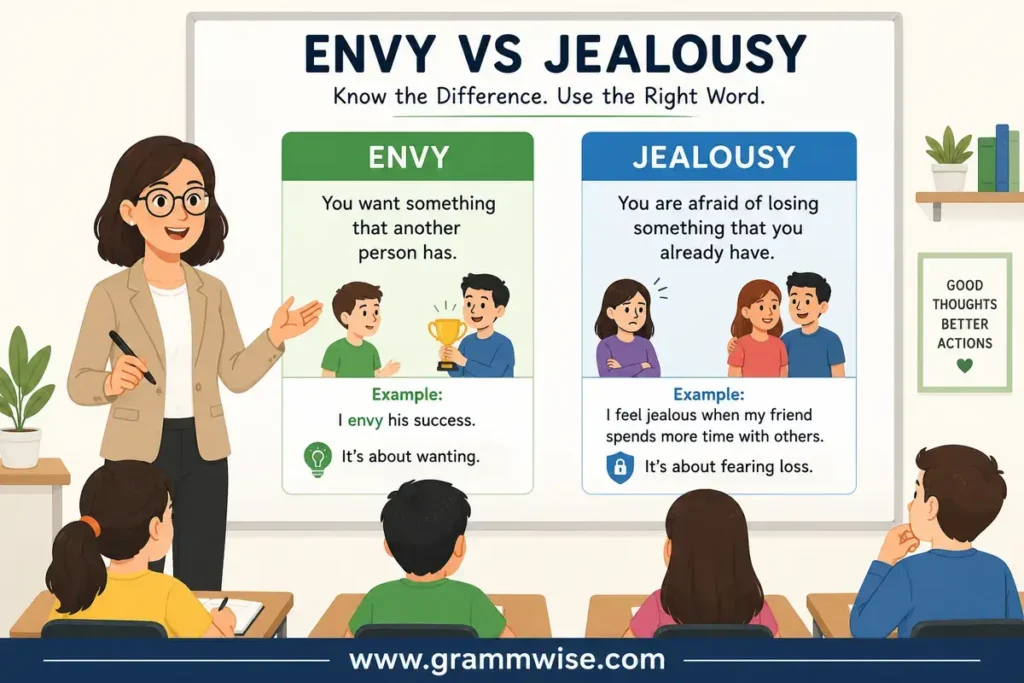
Think about two children in a classroom. One child has a brand-new bicycle. The other child says, “I wish I had that bike.”
That feeling is envy.
Now think about another child. His best friend starts spending more time with someone else. He worries that he may lose his best friend.
That feeling is jealousy.
Here is an easy way to remember it.
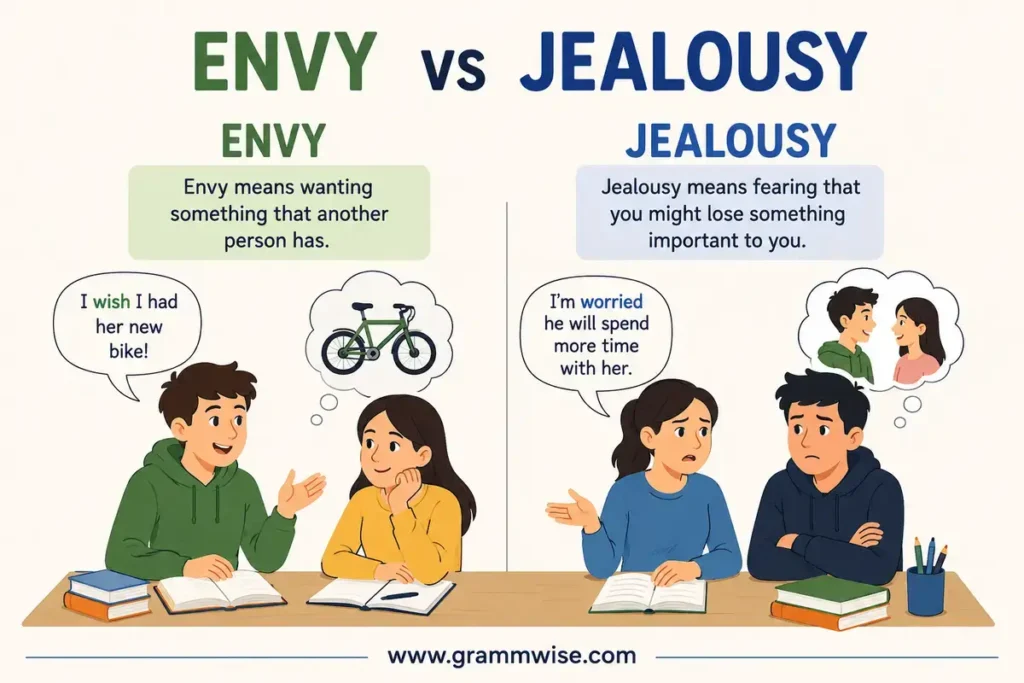
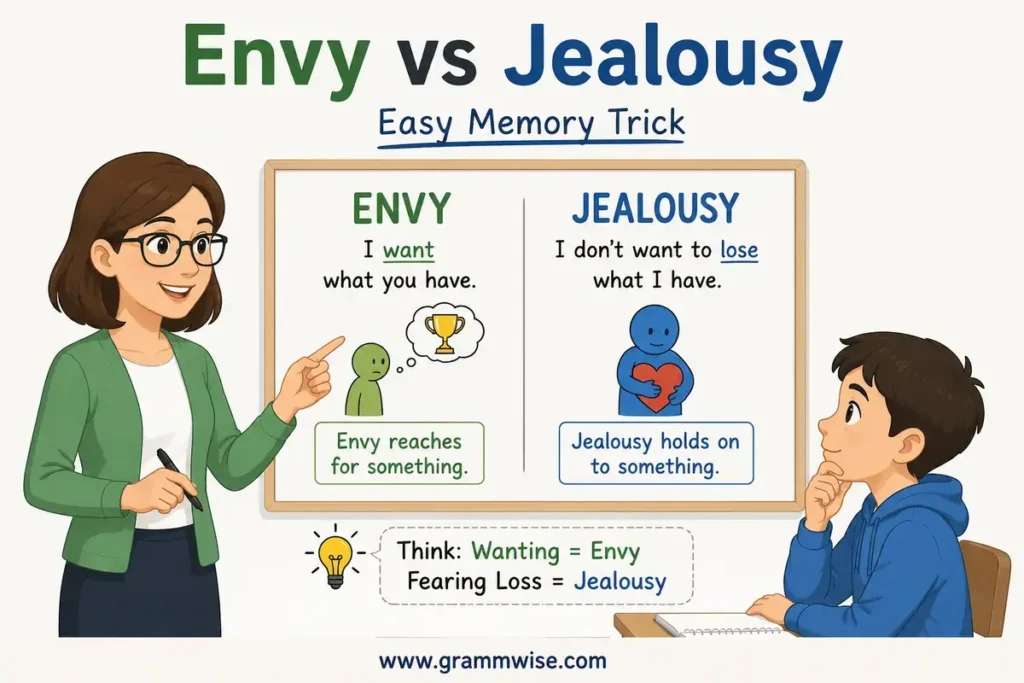
- Envy = I want what you have.
- Jealousy = I don’t want to lose what I already have.
This small difference makes the meaning much clearer.
What Is Envy?
Envy happens when another person has something you wish you had.
It could be:
- Money
- A nice house
- Good grades
- A new car
- A great job
- A beautiful voice
- More free time
You are not afraid of losing anything. You simply wish that you also had what another person enjoys.
For example:
- I envy your cooking skills.
- She envies her sister’s confidence.
- We envy people who can travel every month.
What Is Jealousy?
Jealousy is different. It usually involves three people or three things. You have something important. You worry that someone else might take it away.
This often happens in:
- Friendships
- Families
- Romantic relationships
- Workplaces
- Sports teams
Examples:
- He felt jealous when his girlfriend talked to another man.
- The little girl became jealous when her baby brother got all the attention.
- Tom was jealous because another worker received more praise from the boss.
In each example, someone fears losing attention, love, trust, or respect.
Why Do People Mix These Words Envy vs Jealousy?
Many English speakers use these words in the same way during everyday conversations. For example, someone may say: “I’m jealous of your vacation.” Strictly speaking, this feeling is envy, not jealousy.
However, native speakers often say jealous when they really mean envious. That is why learners become confused.
Movies, TV shows, songs, and social media also mix these words. Because people hear them used in similar ways, they begin thinking both words have the same meaning.
Another reason is that both feelings are about comparing ourselves with others.
Both emotions can make people feel unhappy.
Both can make someone wish life were different.
But the reason behind each feeling is different.
Clear Difference Between Envy vs Jealousy Explained Simply
Here is the easiest way to compare envy vs jealousy.
| Envy | Jealousy |
|---|---|
| You want what another person has. | You fear losing what you already have. |
| Usually involves two people. | Often involves three people. |
| Focuses on gaining something. | Focuses on protecting something. |
| Can happen with money, success, or skills. | Often happens in relationships or friendships. |
| Means wishing you had something. | Means worrying someone will take something away. |
Think about these examples.
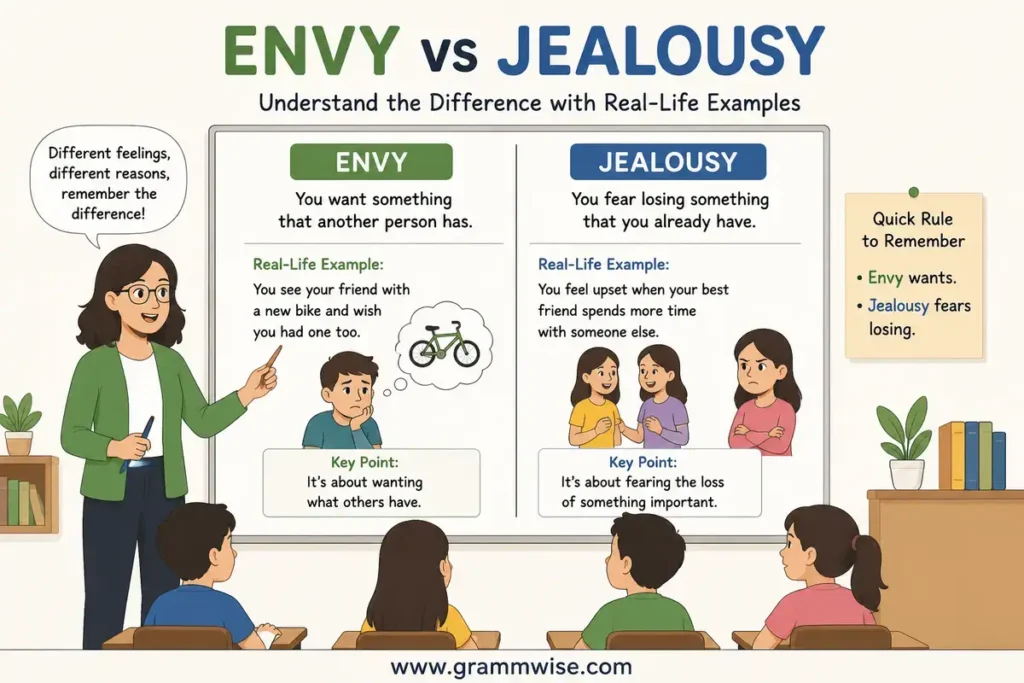
Example 1: Emma buys a new laptop. Lisa wishes she had one too. Lisa feels envy.
Example 2: Emma spends more time with another friend. Lisa worries Emma may stop being her friend. Lisa feels jealousy.
Notice how the feeling changed.
The first example is about wanting. The second example is about fearing loss.
Envy vs Jealousy: Which Form Should You Use?
A simple question can help you choose the correct word.
Ask yourself:
Do I want something another person has?
If the answer is yes, use envy.
Examples:
- I envy your patience.
- We envy their beautiful home.
- She envies your success.
Now ask:
Am I afraid of losing something important to me?
If the answer is yes, use jealousy.
Examples:
- He is jealous because someone else is getting attention.
- The dog became jealous when another pet entered the house.
- She felt jealous after seeing her friend with someone new.
This simple rule works almost every time.
Is It Wrong to Say “I’m Jealous of You”?
Not really.
Modern English often accepts this sentence.
If someone says,
“I’m jealous of your vacation,”
most native speakers understand the meaning.
They know the speaker wishes they also had a nice vacation.
So, while envious is more exact, jealous is very common in everyday speech.
This is why dictionaries often mention that both words can overlap in casual English.
Still, if you want your English to sound more accurate, remember this rule:
- Wanting what someone has = envy.
- Fearing loss = jealousy.
Easy Trick to Remember Envy vs Jealousy
Here is a memory trick many students enjoy.
Envy begins with E.
Think of:
E = Everybody else has it.
You want what somebody else has.
Now think about Jealousy.
Imagine holding something tightly because you do not want to lose it.
That is jealousy.
You are trying to keep something that already belongs to you.
Another easy trick is this:
Envy reaches out.
Jealousy holds on.
Students often remember these two short ideas for years.
Can You Feel Both Envy and Jealousy?
Yes.
Sometimes people experience both feelings together.
Imagine your friend gets promoted at work. You wish you had the promotion. That is envy.
Now imagine you worry your boss likes your friend more than you. You fear losing your good position. That is jealousy.
The same situation can create both emotions. But each feeling comes from a different reason.
Positive and Negative Envy
Not all envy is bad. Sometimes envy inspires people.
For example:
You see someone speaking English very well. Instead of becoming angry, you decide to study harder. This is often called healthy envy. It pushes you to improve yourself.
Examples:
- I envy her piano skills, so I started taking lessons.
- We envy successful people because they inspire us.
- He envied his friend’s fitness and joined a gym.
This kind of envy can become motivation.
When Jealousy Becomes a Problem
A little jealousy is normal.
People sometimes worry about losing someone they love. But too much jealousy can cause problems.
Someone may:
- Stop trusting others.
- Become angry very easily.
- Feel worried all the time.
- Try to control other people.
- Damage friendships or relationships.
Healthy relationships need trust. Without trust, jealousy can grow stronger.
Common Expressions with Envy
English has many useful expressions with envy.
Green with envy
Meaning:
Very envious.
Example:
She was green with envy after seeing her neighbor’s new house.
Envy of everyone
Meaning:
Something many people admire.
Example:
His garden is the envy of the neighborhood.
Envy someone
Meaning:
Wish you had what another person has.
Example:
I envy your confidence.
Common Expressions with Jealousy
Feel jealous
Example:
He felt jealous when his brother received more gifts.
Jealous of
Example:
She is jealous of her friend’s success.
In everyday English, this often means envy.
Jealous partner
Meaning:
Someone who worries about losing their relationship.
Example:
Nobody likes having an overly jealous partner.
Easy Real-Life Sentences on Envy vs Jealousy
Here are simple examples you can use every day.
- I envy your beautiful handwriting.
- She envies her friend’s new house.
- We envy people who can speak many languages.
- My brother envies my new bicycle.
- They envy your cooking skills.
- He became jealous when his best friend ignored him.
- Sarah felt jealous after her sister received more attention.
- The little boy became jealous of the new baby.
- Tom was jealous because his teammate won the award.
- My dog gets jealous when I pet another dog.
These examples show how the meaning changes depending on the situation.
Envy vs Jealousy: Where This Word and Expression Comes From?
The word envy comes from an old Latin word that meant “to look at someone with dislike or desire.” Over hundreds of years, English speakers began using it for the feeling of wanting something another person has.
The word jealousy has a different history. It came from old French and Latin words connected with being careful, protective, or suspicious.
At first, it mostly described people who worried about losing someone’s love.
Later, English speakers started using it more widely. That is why jealousy is still strongly connected with relationships today.
Although both words have different histories, everyday English has slowly brought them closer together.
Many native speakers now use jealous when they actually mean envious.
That is why understanding the real difference gives you stronger English than simply copying what you hear.
How These Feelings of “Envy vs Jealousy” Are Understood in Culture and Stories?
People have talked about envy vs jealousy for thousands of years. These feelings appear in stories, books, movies, songs, and even children’s tales. That is because almost everyone has felt envy or jealousy at some point.
Writers often use these emotions to show what a character is thinking. A person who feels envy may work hard to get what they want. Another person may become angry because someone else has more money, success, or attention.
Jealousy usually appears in stories about love, friendship, or family. A character may worry that another person will take away someone they care about. This fear can lead to sadness, arguments, or poor decisions.
You can also see these feelings in everyday life.
A student envies a classmate who always gets high grades.
A child becomes jealous when a new baby receives all the attention.
A worker envies a coworker who gets a promotion.
A husband feels jealous when he thinks someone else is trying to win his wife’s attention.
These examples show that envy vs jealousy is not just about words. They describe real emotions that people experience every day.
Biblical and Mythological Meaning of Envy vs Jealousy
The Bible talks about both envy and jealousy many times.
Envy is usually shown as a harmful feeling because it grows from wanting what belongs to someone else. The story of Cain and Abel is one well-known example. Cain became envious after God accepted Abel’s offering. His envy grew into anger and led to a terrible choice.
The Bible also speaks about jealousy, but its meaning is sometimes different. Man jealousy can become harmful when it grows into distrust or anger. However, some passages describe God’s jealousy as a way of showing deep love, faithfulness, and the desire for people to stay loyal. This is not the same as selfish Man jealousy.
In Greek mythology, envy was also seen as a dangerous feeling. Stories often warned that envy could destroy friendships and bring unhappiness. Characters who could not control envy usually suffered because of it.
These old stories remind us that both envy and jealousy can become problems if we allow them to control our actions.
Symbolism of Envy vs Jealousy in Simple Words
What Envy Represents?
Envy often stands for:
- Wanting more
- Comparing yourself with others
- Feeling unhappy with what you have
- Wishing your life looked like someone else’s
Sometimes envy pushes people to improve themselves.
Other times it makes people feel bitter.
Everything depends on how they respond to the feeling.
What Jealousy Represents?
Jealousy often stands for:
- Fear of losing someone
- Protecting relationships
- Wanting love and attention
- Feeling insecure
A little jealousy is natural.
Too much jealousy can damage trust and hurt relationships.
Related Words You Should Know
Learning similar words makes envy vs jealousy even easier to understand.
Envious: Feeling envy.
Example: She felt envious of her friend’s new house.
Jealous: Feeling jealousy.
Example: He became jealous when someone else talked to his girlfriend.
Admire: To respect or like something about another person.
Example: I admire your kindness.
Admiration is positive. It does not mean you want to take anything away.
Appreciate: To be thankful for something.
Example: I appreciate everything I have.
People who appreciate their own lives often feel less envy.
Resentment: A lasting feeling of anger because something seems unfair.
Example: His envy slowly turned into resentment.
Competition: Trying to do better than others. Competition is healthy when it encourages learning and hard work.
Insecurity: Not feeling confident. Insecurity often causes jealousy.
Contentment: Feeling happy with what you already have. Contentment is one of the best ways to reduce envy.
How People Actually Use Envy vs Jealousy in Daily English
Native speakers do not always follow the exact dictionary meaning.
That is why learners hear different examples.
Here are common situations.
Talking About Success
“I envy your new job.”
This is the correct use because you want something another person has.
Talking About Relationships
“He is jealous because his girlfriend spends time with someone else.”
This is true jealousy because he fears losing the relationship.
Talking About Skills
“I envy people who can play the piano.”
Again, this is envy.
Talking About Family
“My older brother became jealous when the baby arrived.”
He fears losing attention from his parents.
Talking About Friends
“I was jealous when my best friend stopped calling me.”
The feeling comes from fear of losing the friendship.
Everyday Casual English
Many people simply say,
- “I’m jealous of your vacation.”
- “I’m jealous of your new car.”
- “I’m jealous of your beautiful garden.”
These sentences are extremely common.
Although envious is more exact, native speakers usually understand the meaning without any confusion.
Common Mistakes People Make About Envy vs Jealousy
Many English learners make the same mistakes.
Here are the most common ones.
Mistake 1: Using Jealous for Everything
Incorrect idea:
Jealous always means wanting what someone else has.
Better understanding:
Jealous often means fearing that you may lose something important.
Mistake 2: Thinking the Words Are Always Different
Some learners become worried because native speakers often say “jealous” instead of “envious.”
Remember this:
Casual English allows this overlap.
Formal or careful English keeps the meanings separate.
Mistake 3: Feeling Guilty About Every Bit of Envy
Not every feeling of envy is bad.
If envy encourages you to study harder, save money, or improve your skills, it can become motivation.
Mistake 4: Ignoring the Reason Behind the Feeling
Instead of asking,
“Which word sounds better?”
Ask,
“What am I feeling?”
If you want something another person has, choose envy.
If you fear losing something you already have, choose jealousy.
Mistake 5: Forgetting the Memory Rule
Students sometimes forget the difference after a few days.
Keep this rule in mind.
Envy reaches for something.
Jealousy holds on to something.
That simple picture helps many learners remember the correct word.
Final Teacher Explanation
Imagine you are sitting in my classroom. I write two short sentences on the board.
- “I want your new bicycle.”
- “I don’t want to lose my best friend.”
The first sentence is envy. The second sentence is jealousy.
That is really all you need to remember.
Of course, English speakers do not always follow this rule perfectly. Many people say “I’m jealous of your new phone” even though they mean “I’m envious.”
Do not let this confuse you. If you understand the real meaning, your English will sound clearer and more natural.
Whenever you feel unsure, ask yourself one question.
Am I wanting something?
If yes, think of envy.
Am I afraid of losing something?
If yes, think of jealousy.
This simple habit will help you choose the correct word almost every time.
Quick Recap Envy vs Jealousy
The difference between envy vs jealousy is simple.
Envy means wanting something another person has.
Jealousy means fearing that you might lose someone or something you already have.
Even though everyday English sometimes mixes the two words, knowing the real difference will make your speaking and writing more accurate.
Conclusion
Understanding envy vs jealousy is easier than many people think. Envy is the feeling of wanting something another person has, while jealousy is the fear of losing someone or something that already belongs to you. Once you remember this simple rule, choosing the right word becomes much easier.
English speakers sometimes use these words in the same way during everyday conversations, but knowing the real difference will help you speak and write with greater confidence. Keep practicing with real-life examples, and soon the difference between envy vs jealousy will feel natural every time you use it.
Frequently Asked Questions
Is envy the same as jealousy?
No. Envy means wanting something another person has. Jealousy means fearing the loss of something you already have.
Which word is correct: envy vs jealousy?
Both words are correct. The right choice depends on the situation. Use envy when you want what someone else has. Use jealousy when you fear losing something that belongs to you.
Why do people say “I’m jealous of you”?
In casual English, many native speakers use jealous when they actually mean envious. This has become common in everyday conversation.
Can envy be a good thing?
Yes. Healthy envy can motivate you to work harder, learn new skills, and improve yourself instead of feeling angry.
Is jealousy always bad?
No. A small amount of jealousy is a normal man emotion. However, too much jealousy can damage trust and relationships.
What is the easiest way to remember envy vs jealousy?
Remember this simple rule:
Envy = I want what you have.
Jealousy = I don’t want to lose what I have.
Which word is more common in everyday English?
Both are common, but jealous is often used in casual conversation even when envious would be more accurate.
How can I stop feeling envy or jealousy?
Focus on your own goals, appreciate what you already have, celebrate other people’s success, and remember that everyone has different strengths and challenges.