
Many English learners get confused about continual vs continuous because both words talk about something that keeps happening. They also look and sound almost the same. That is why many people use them in the wrong way.
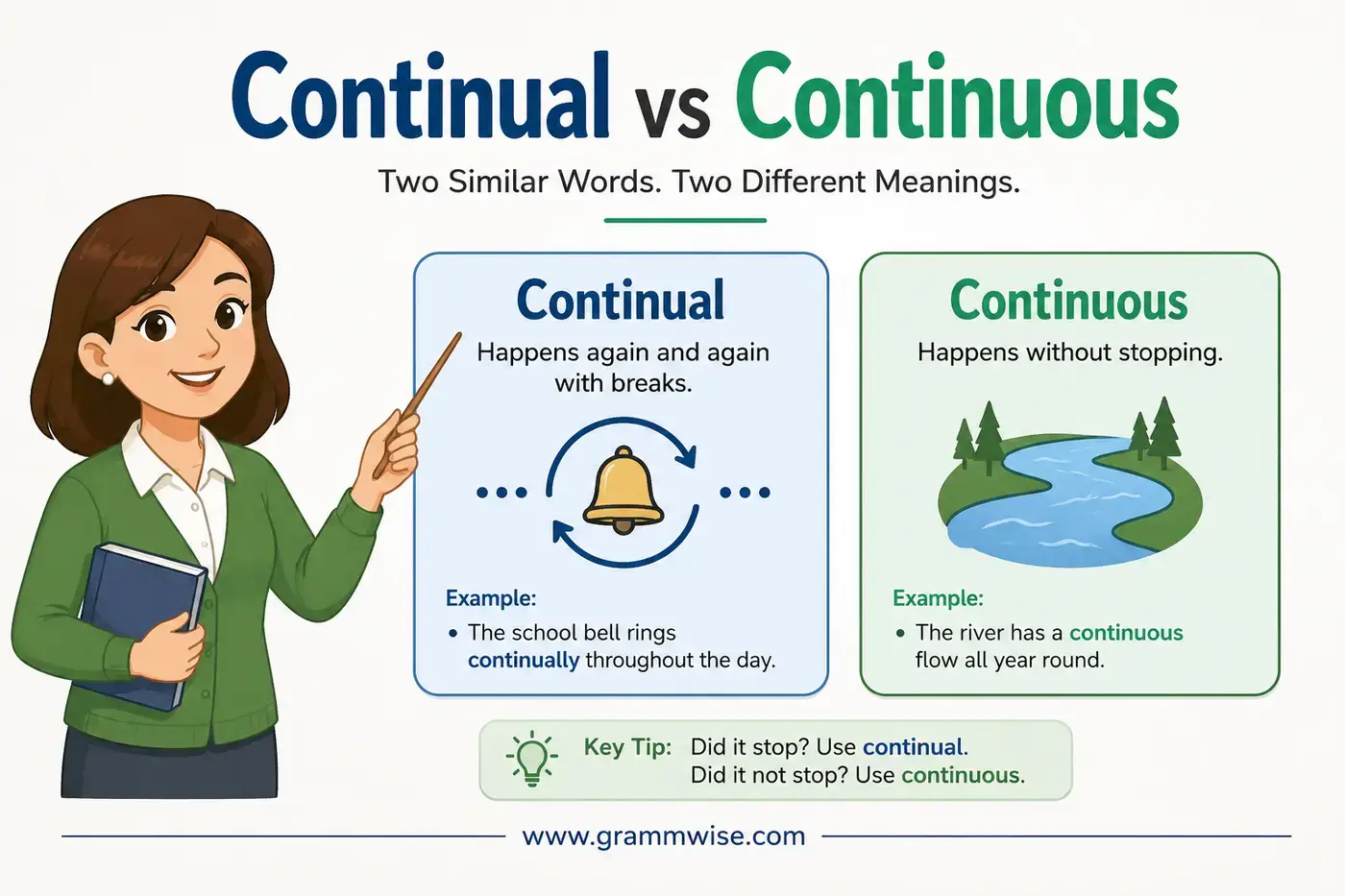
The good news is that the difference is simple. Continual means something happens again and again with small breaks. Continuous means something goes on without stopping at all.
In this lesson, I will explain continual vs continuous in very simple English. By the end, you will know which word to use, how to remember the difference, and how to avoid common mistakes.
You might also find our comparison of similar confusing word pairs useful like Historic vs Historical.
Simple Answer in One Look
Continual = happens again and again with breaks.
Continuous = happens all the time without any break.
Example:
- The baby made continual noises all night. (The noises stopped and started.)
- The river has a continuous flow. (The water never stops.)
What Does Continual vs Continuous Mean in Simple English?
Continual
Think about something that keeps coming back. It happens many times. But it stops for a short time before it starts again.
That is continual.
Imagine a child knocking on your door every few minutes.
Knock.
Stop.
Knock again.
Stop.
That is continual knocking.
The action repeats, but there are small breaks.
Easy examples
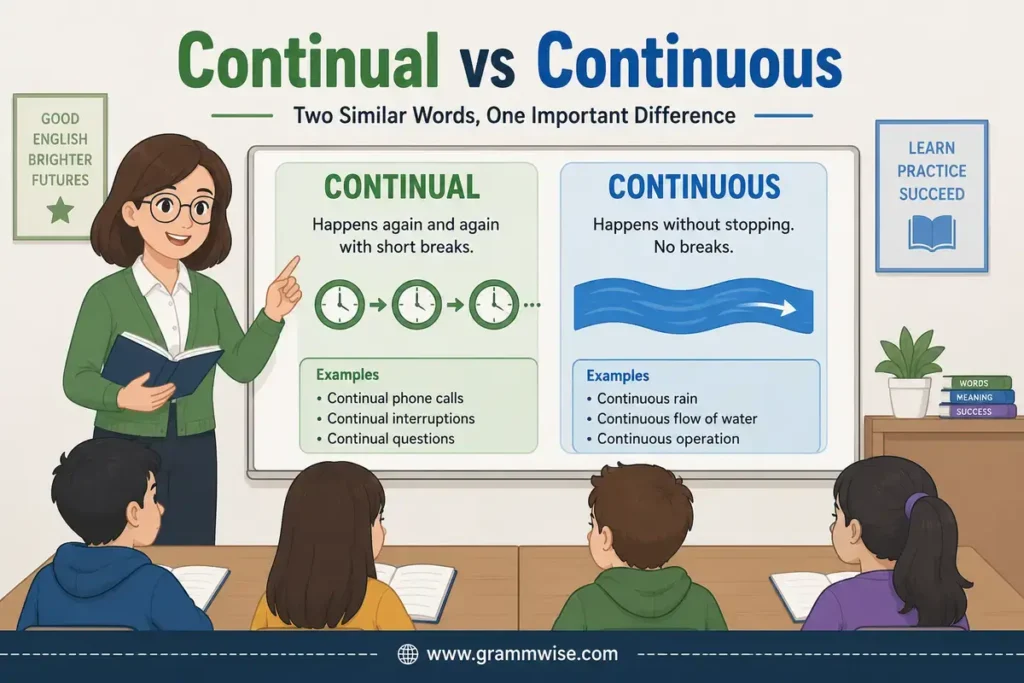
- We had continual phone calls during dinner.
- She faced continual problems at work.
- There were continual interruptions during the meeting.
- My dog made continual barking sounds.
In every example, the action happened many times, but not every single second.
Continuous
Now think about something that never stops. There are no breaks. That is continuous.
Picture a waterfall. The water keeps moving. It does not stop every few minutes. That is continuous.
Easy examples
- We had continuous rain for two days.
- The machine runs continuous operations all day.
- The fan makes a continuous humming sound.
- The road has a continuous white line.
Everything keeps going without stopping.
Why Do People Mix These Words Continual vs Continuous?
Many people confuse continual vs continuous because they are very similar.
They:
- start with the same letters
- end with similar letters
- have almost the same meaning
- both describe repeated actions
When people speak quickly, they often use one instead of the other.
Another reason is that many dictionaries explain them with words like “constant” or “repeated,” which can sound confusing.
The easiest way is to remember this:
- Continual = repeated with breaks
- Continuous = never stops
That simple rule works almost every time.
Continual vs Continuous: Clear Difference Explained Simply
Here is the easiest comparison.
| Continual | Continuous |
|---|---|
| Happens again and again | Never stops |
| Has small breaks | Has no breaks |
| Repeats often | Keeps going all the time |
| Stop → Start → Stop | One long action |
Think about these pictures in your mind.
Continual
Doorbell rings.
Stops.
Rings again.
Stops.
Rings again.
Continuous
A river keeps flowing.
No stopping.
No breaks.
Just one long flow.
That is the biggest difference.
Continual vs Continuous in Everyday Life
Imagine these situations.
Situation 1
Your little brother asks questions every few minutes. He stops. Then asks again, stops. Then asks another question.
That is continual questioning.
Situation 2
A loud alarm keeps ringing without stopping. There is no silence.
That is continuous ringing.
Situation 3
A teacher gives homework every week. There are breaks between assignments.
That is continual homework.
Situation 4
Snow falls all night without stopping.
That is continuous snowfall.
Continual vs Continuous: Which Form Should You Use?
Ask yourself one simple question.
Did the action stop?
If the answer is Yes, use continual.
If the answer is No, use continuous.
Quick guide
Use continual for:
- repeated complaints
- repeated mistakes
- repeated phone calls
- repeated interruptions
- repeated reminders
Use continuous for:
- flowing water
- nonstop music
- nonstop rain
- nonstop sound
- nonstop movement
This little question makes choosing easy.
Easy Trick to Remember Continual vs Continuous
Here is a classroom memory trick.
Continual
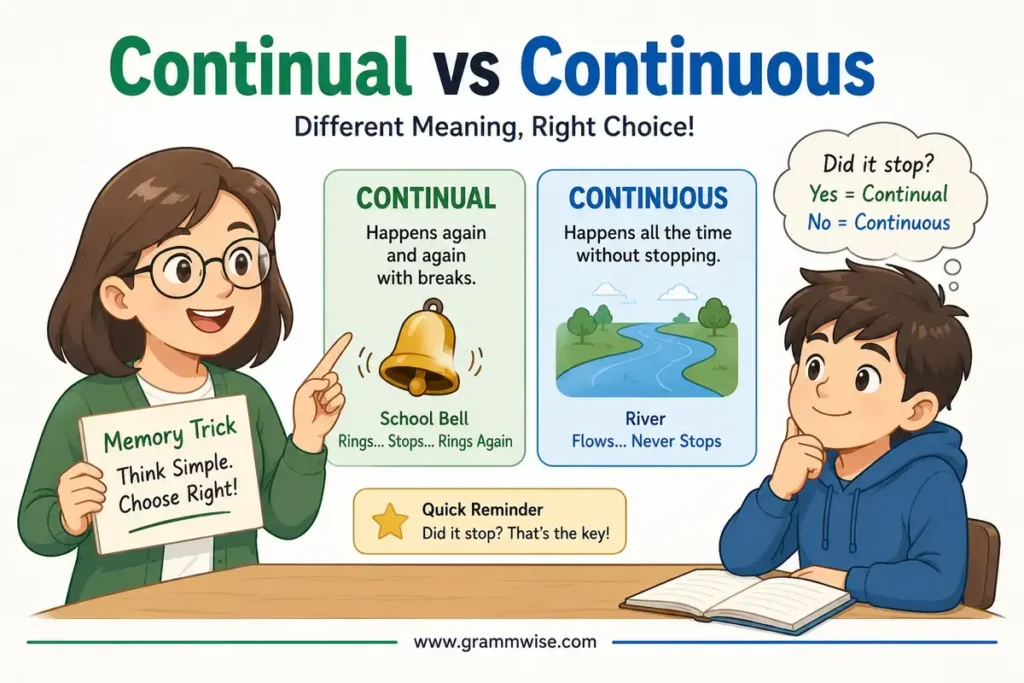
Think of a school bell.
Ring.
Stop.
Ring.
Stop.
It keeps coming back.
That is continual.
Continuous
Think of a river.
It never stops flowing.
That is continuous.
Remember this sentence.
Bell = Continual
River = Continuous
Most students remember the difference right away with this trick.
Easy Real-Life Sentences on Continual vs Continuous
Here are some simple examples.
Continual
- We had continual visitors all afternoon.
- The teacher faced continual questions.
- My phone received continual messages.
- The baby had continual coughing during the night.
- They experienced continual delays.
Continuous
- The clock made a continuous ticking sound.
- The river has a continuous flow.
- The machine worked for continuous hours.
- We heard continuous thunder.
- The lights stayed on in a continuous line.
Continual vs Continuous in School
Teachers often use these words.
Examples:
“The student made continual mistakes.”
The mistakes happened many times.
There were breaks.
“The student showed continuous improvement.”
The improvement never stopped.
It kept growing over time.
Continual vs Continuous at Work
These words also appear in offices.
Examples
We had continual meetings throughout the week.
The meetings happened again and again.
There were breaks between them.
The factory runs with continuous power.
The electricity stays on all the time.
Continual vs Continuous in Nature
Nature gives great examples.
Continual
- Continual storms during spring
- Continual bird visits
- Continual waves hitting the shore
The events repeat.
There are pauses.
Continuous
- Continuous sunshine
- Continuous river flow
- Continuous wind
These continue without stopping.
Common Words Used with Continual
You will often see:
- continual complaints
- continual interruptions
- continual questions
- continual delays
- continual problems
- continual reminders
- continual arguments
- continual changes
- continual visits
- continual requests
These actions happen repeatedly.
Common Words Used with Continuous
Common examples include:
- continuous flow
- continuous rain
- continuous noise
- continuous movement
- continuous music
- continuous operation
- continuous speech
- continuous sound
- continuous production
- continuous light
These actions do not stop.
Common Mistakes People Make About Continual vs Continuous
Many learners write:
❌ Continuous phone calls all day.
If there were breaks between the calls, this is wrong.
✅ Continual phone calls all day.
Another mistake:
❌ Continual rain for twelve hours.
If the rain never stopped, use:
✅ Continuous rain for twelve hours.
Another example.
❌ The machine gives continual power.
If the power never stops,
✅ The machine gives continuous power.
Continual vs Continuous in American English
Both words are common in American English. Writers, teachers, and newspapers use both.
People sometimes use continuous when they really mean continual, especially in everyday conversation.
In careful writing, using the correct word makes your English sound more natural.
Continual vs Continuous in British English
British English follows the same rule.
The meanings do not change.
If you write in American English or British English, remember:
- Continual has breaks.
- Continuous has no breaks.
Where Do These Words Continual vs Continuous Come From?
Both words come from the Latin word continuus, which means “joined together.” Over many years, English gave them slightly different meanings.
Continual came to describe things that happen repeatedly.
Continuous came to describe something that never stops.
Today, English speakers keep these meanings separate in careful writing.
How Are Continual vs Continuous Understood in Culture and Stories?
When people tell stories, they often choose words carefully. Using continual or continuous can change the picture in the reader’s mind.
Continual often describes events that happen again and again. These events may be annoying, exciting, or surprising. They repeat, but they do not happen every second.
For example:
- A character faces continual problems before reaching success.
- A family has continual visitors during the holidays.
- A child asks continual questions because they are curious.
These examples show repeated actions with small breaks.
Continuous, on the other hand, creates the idea of something that never stops. It often describes nature, time, movement, or strong feelings.
For example:
- A continuous river flows through the valley.
- A continuous wind blows across the desert.
- A continuous light shines from the lighthouse.
Writers use continuous to make readers imagine one long, unbroken action.
Movies also use these words in different ways. A detective may face continual challenges while solving a mystery. Each challenge comes after another.
During a storm scene, there may be continuous rain that never stops until the scene ends.
Even children’s books follow this pattern.
A rabbit may make continual trips to collect food.
A waterfall has continuous water flowing over the rocks.
Knowing this difference helps you understand stories more clearly and makes your own writing sound more natural.
Biblical and Mythological Meaning of Continual vs Continuous
The words continual and continuous are not special religious words. However, ideas like repeated actions and never-ending actions appear in many religious writings and old stories.
In the Bible, the word continual is used more often than continuous in many English translations.
For example, you may read about:
- continual prayer
- continual praise
- continual offerings
These actions happened regularly over time. They were repeated again and again, but not every second.
The word continuous is usually used in modern English to describe something that never stops.
In mythology, many stories describe continuous rivers, continuous light, or continuous fire to show power or eternity.
The important thing to remember is simple.
Continual usually describes repeated actions.
Continuous usually describes actions that never stop.
Symbolism of Continual vs Continuous in Simple Words
Words can also have symbolic meanings. They help us imagine feelings and ideas.
What Continual Represents?
Continual often represents effort.
It reminds us that success usually comes from trying again and again.
For example:
- continual learning
- continual practice
- continual kindness
- continual improvement
These things happen many times. Each small step helps us grow.
Continual also reminds us that life has breaks.
We work.
We rest.
Then we work again.
That is normal.
What Continuous Represents?
Continuous often represents strength and stability.
Think about these images:
- a river that never stops
- sunlight shining all day
- a machine working without stopping
- a heartbeat that keeps going
These examples show something steady and unbroken.
People often connect continuous with patience, endurance, and lasting power.
A simple way to remember the symbolism is this:
- Continual represents repeated effort.
- Continuous represents steady action without stopping.
Related Words You Should Know
Learning similar words makes your vocabulary stronger.
Constant: Something that stays the same or happens all the time.
Example: The room stayed at a constant temperature.
Regular: Something happens on a normal schedule.
Example: She takes regular exercise.
Frequent: Something happens many times.
Example: He makes frequent phone calls.
Repeated: Something happens again and again.
Example: The teacher gave repeated reminders.
Ongoing: Something has started and is still happening.
Example: The project is still ongoing.
Unbroken: Something has no gaps or breaks.
Example: The road has an unbroken white line.
Endless: Something seems like it will never end.
Example: The children asked endless questions.
Steady: Something stays smooth and even.
Example: The car moved at a steady speed.
Each of these words has its own meaning, but some are close to continual or continuous.
Continual vs Continuous Compared with Similar Words
Sometimes learners wonder which word is closest.
Here is a simple guide.
- Continual is close to repeated, frequent, and recurring.
- Continuous is close to nonstop, unbroken, constant, and uninterrupted.
These words are similar, but they are not always fine replacements.
Always think about one question.
Does the action stop?
If yes, choose continual.
If no, choose continuous.
How People Actually Use Continual and Continuous in Daily English
Here are real-life examples that sound natural.
- “My neighbor makes continual noise during the weekend.”
- “We had continual visitors all afternoon.”
- “My phone received continual notifications.”
- “The baby had continual coughing during the night.”
- “The teacher answered continual questions.”
- “The machine needs continuous power.”
- “The river has a continuous flow.”
- “We heard continuous music during the show.”
- “The road has a continuous white line.”
- “The factory works with continuous production.”
Notice the pattern.
The first group repeats with breaks.
The second group never stops.
Continual vs Continuous in Business English
These words often appear at work.
A manager might say: “We need continual training for our employees.” Training happens many times during the year.
A factory report may say: “The machine provides continuous operation.” The machine keeps running without stopping.
Using the correct word makes reports and emails clearer.
Continual vs Continuous in School Writing
Students often use these words in essays.
Correct examples:
“The class faced continual interruptions.”
“The science experiment needed continuous heat.”
Teachers notice these small differences.
Using the right word can improve your writing.
Common Mistakes People Make
Many English learners make the same mistakes.
Mistake 1
❌ The river has continual flow.
✅ The river has continuous flow.
A river does not stop flowing.
Mistake 2
❌ We had continuous phone calls today.
✅ We had continual phone calls today.
Each call ended before the next one started.
Mistake 3
❌ She gave continuous reminders every hour.
✅ She gave continual reminders every hour.
There were breaks between the reminders.
Mistake 4
❌ Continuous visitors came to our house.
✅ Continual visitors came to our house.
Visitors arrived one after another, not all at the same second.
Mistake 5
❌ Continual snowfall for two days without stopping.
✅ Continuous snowfall for two days without stopping.
The snowfall never stopped.
Easy Practice Quiz
Choose the correct answer.
- We heard __________ thunder all night without a break.
- Answer: continuous
- She received __________ emails during the morning.
- Answer: continual
- The machine needs __________ electricity.
- Answer: continuous
- Our meeting had __________ interruptions.
- Answer: continual
- The waterfall has a __________ flow.
- Answer: continuous
If you answered all five correctly, you understand the difference very well.
Final Teacher Explanation
Imagine I am standing in front of a classroom with two pictures.
In the first picture, a school bell rings every hour.
It rings.
It stops.
Later, it rings again.
That is continual.
In the second picture, a river flows day and night.
It never stops.
That is continuous.
You do not need to memorize long grammar rules.
Just remember one simple question.
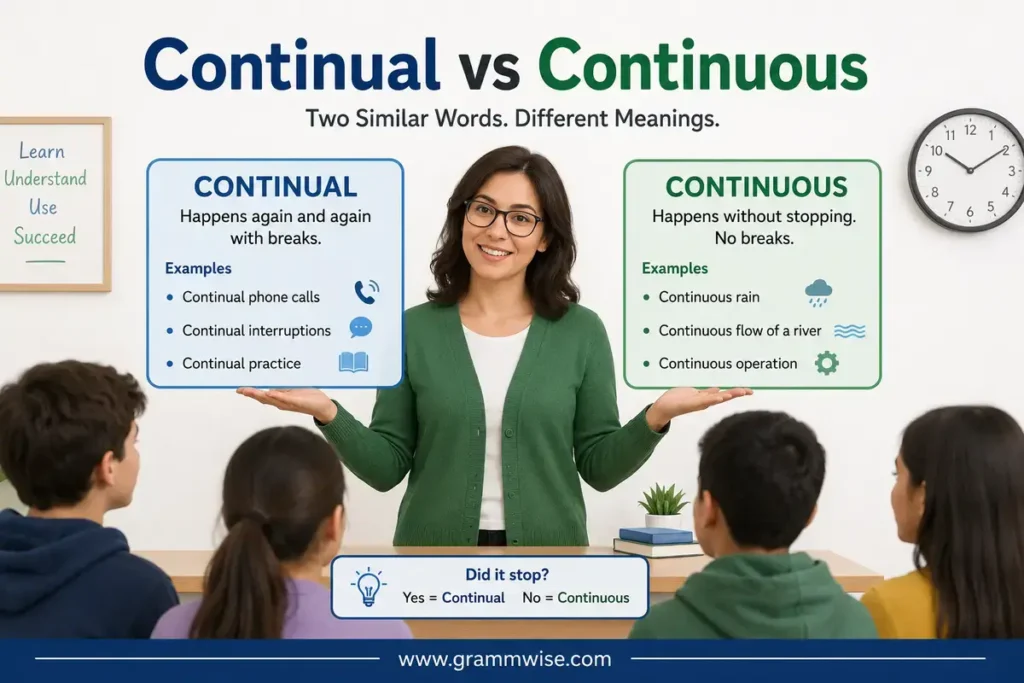
Did it stop?
If the answer is yes, use continual.
If the answer is no, use continuous.
This one question will help you choose the correct word in almost every situation.
The more you read, write, and speak English, the more natural this choice will become.
Quick Recap Continual vs Continuous
The difference between continual vs continuous is easy to remember.
Continual means something happens again and again with short breaks.
Continuous means something happens without stopping.
Think school bell = continual and river = continuous. That simple memory trick will help you use both words correctly.
Conclusion
Understanding continual vs continuous is easier when you remember one simple rule. Continual means something happens again and again with short breaks, while continuous means something happens without stopping. Once you know this difference, choosing the correct word becomes much easier in both speaking and writing.
Keep asking yourself, “Did it stop?” If the answer is yes, use continual. If the answer is no, use continuous. Practice with everyday examples, and soon these two commonly confused words will feel natural whenever you use English.
Frequently Asked Questions (FAQs)
What is the difference between continual and continuous?
Continual means repeated with breaks. Continuous means happening without any break.
Is continual the same as continuous?
No. They are similar, but continual has pauses while continuous does not.
Which is correct: continual or continuous?
Both are correct. The right choice depends on if the action has breaks.
When should I use continual?
Use continual for actions that happen again and again with short pauses, like continual phone calls or continual interruptions.
When should I use continuous?
Use continuous for actions that never stop, like continuous rain or continuous music.
Why do people confuse continual and continuous?
They look and sound almost the same, and both describe actions that keep happening.
Can I use both words in formal writing?
Yes. Both words are correct in formal and informal writing when used with the right meaning.
How can I remember the difference between continual and continuous?
Remember this simple trick: school bell = continual because it rings with breaks, and river = continuous because it never stops flowing.