
Many English learners search for in route vs en route because the two expressions look and sound similar. It is easy to think both are correct, but they are not used in the same way. If you want to write clear and correct English, you should know the difference between them.
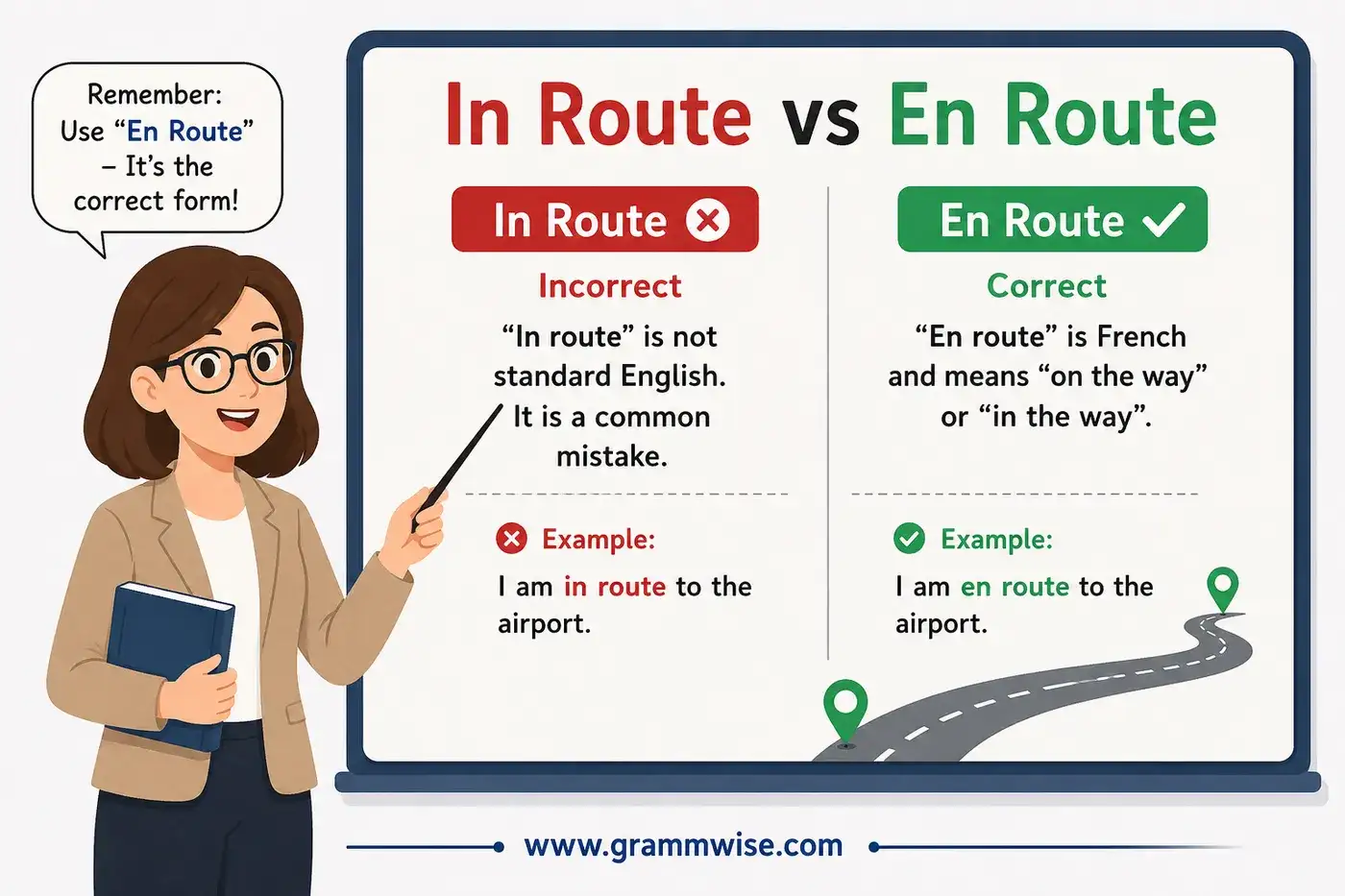
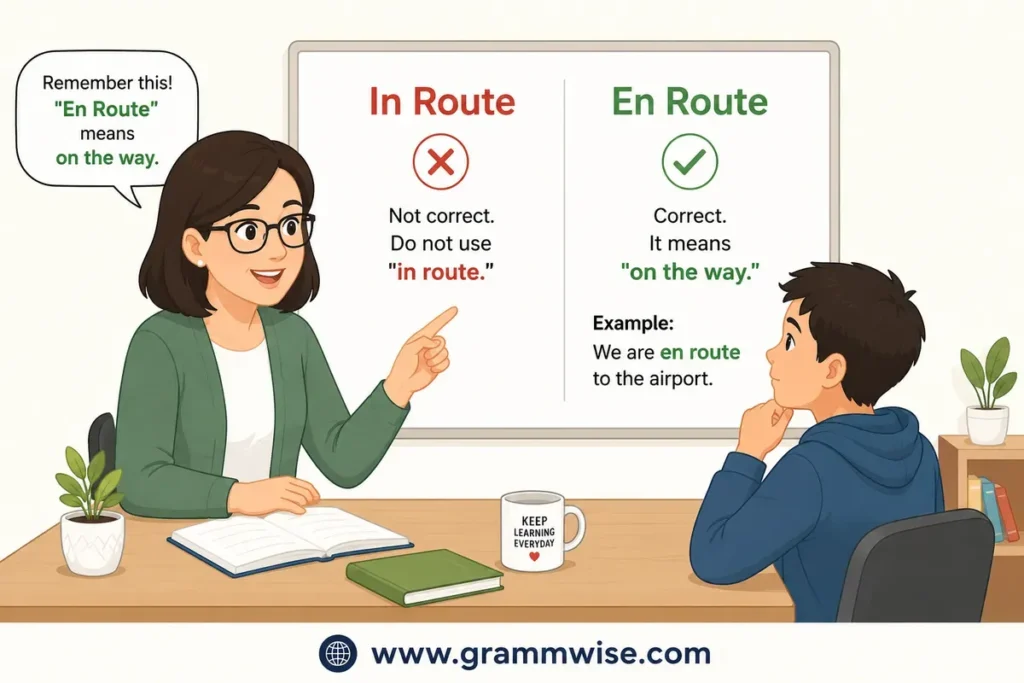
The short answer is simple. En route is the correct expression in standard English. It means on the way or while traveling to a place. In route is usually considered incorrect in everyday English, although it may appear in a few special or regional situations. In almost every case, en route is the better choice.
This guide explains the difference between in route vs en route in very simple English. You will learn the meaning, spelling, pronunciation, history, and correct usage with plenty of easy examples. By the end, you will know exactly which expression to use in conversations, emails, schoolwork, and professional writing.
Practice more commonly confused words to sharpen your writing.
Simple Answer in One Look
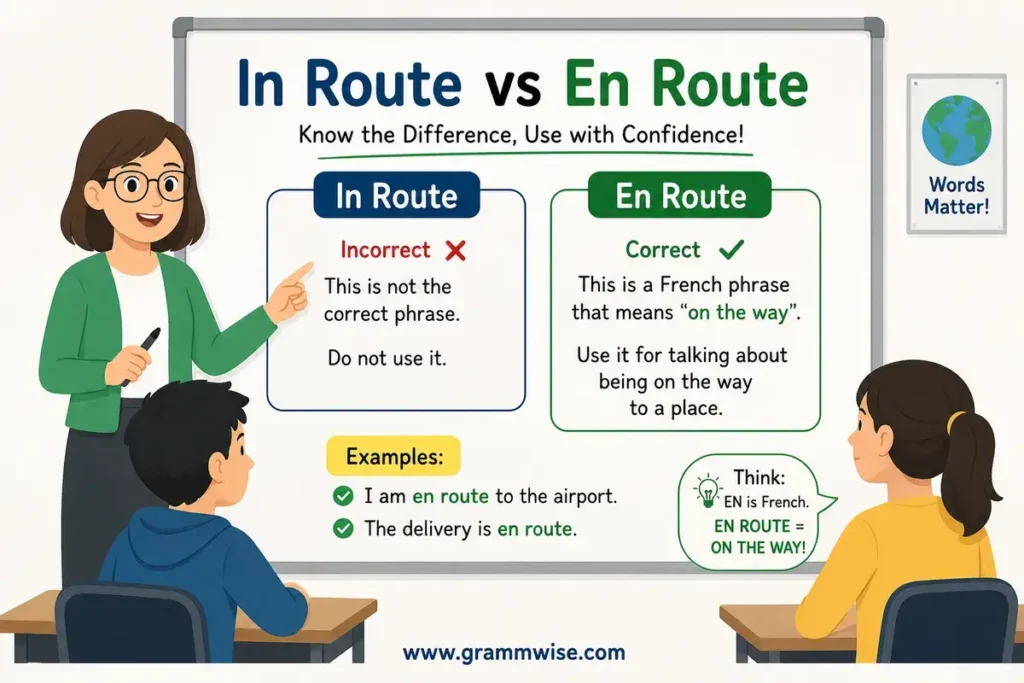
En route is the correct expression. It means on the way to a place.
In route is generally not correct in standard English and should be avoided in everyday writing and speaking.
Quick Tip:
If you can replace the phrase with on the way, use en route.
Example:
- We are en route to the airport.
- The package is en route to your house.
- The ambulance is en route to the hospital.
What Does “En Route” Mean in Simple English?
The expression en route simply means traveling toward a destination. It tells us that someone or something has already started the journey but has not arrived yet.
Think of it like this.
You leave your house at 8:00 a.m. to go to school. While you are traveling, you are en route to school. Once you arrive, you are no longer en route because your trip is finished.
People use en route every day when talking about travel, deliveries, emergency services, flights, buses, trains, and road trips.
Here are some easy examples.
- We are en route to the beach.
- Dad called while he was en route home.
- The pilot said we were en route to New York.
- Your food order is en route.
- The firefighters are en route to the accident.
- She texted me while she was en route to work.
In every example, the person or thing is moving toward a destination.
Another easy way to remember it is this:
En route = On the way
If you can say on the way, then en route is almost always correct.
Compare these sentences.
- We are on the way to the museum.
- We are en route to the museum.
Both sentences have the same meaning.
Because en route is short and professional, you will often see it in news reports, travel updates, airline announcements, delivery tracking, and business emails.
For example:
- Your package is en route.
- The train is en route to Chicago.
- Medical staff are en route to the scene.
All of these sound natural because en route is the standard English expression.
Why People Mix These Words “In Route vs En Route”
Many people become confused about in route vs en route because the two expressions sound similar when spoken quickly.
Another reason is that the word en is not common in English. Most English words do not begin with en followed by another word, so learners sometimes replace it with the more familiar word in.
Spelling checkers and autocorrect tools can also create confusion. Someone may accidentally type in route, and another person may copy it without realizing it is not the standard form.
Some people also think in route makes sense because we often say phrases like:
- in school
- in town
- in class
- in traffic
This pattern leads learners to believe in route should also be correct. However, en route is a fixed expression borrowed from French, so it does not follow normal English spelling patterns.
Another reason for confusion is pronunciation. Many native speakers pronounce en route very quickly, making it sound similar to in route. When learners hear the phrase instead of seeing it written, they may spell it the wrong way.
The good news is that the rule is very easy to remember.
Whenever you mean on the way, choose en route.
That one simple rule will help you avoid this common mistake in almost every situation.
Clear Difference Between “In Route vs En Route”
If you are still wondering about in route vs en route, this simple comparison will help.
En Route
- Correct in standard English
- Means on the way
- Used in speaking and writing
- Common in travel, shipping, business, and daily conversations
In Route
- Usually incorrect in standard English
- Rarely used in everyday communication
- May appear by mistake or in a few special technical situations
- Best avoided unless you are using a specific industry term
Here is an easy comparison.
| En Route | In Route |
|---|---|
| Correct | Usually incorrect |
| Means “on the way” | Not the standard expression |
| Common in everyday English | Rare in general English |
| Used in formal and informal writing | Better avoided |
Now compare these examples.
✔ The bus is en route to the station.
✘ The bus is in route to the station.
✔ My friend is en route to my house.
✘ My friend is in route to my house.
✔ The doctor is en route to the hospital.
✘ The doctor is in route to the hospital.
Notice how en route sounds natural and correct in every sentence.
A Simple Memory Trick
Here is an easy trick you can remember.
En route = On the way
Whenever you want to say on the way, use en route.
Ask yourself this question:
Can I replace it with “on the way”?
If the answer is yes, then en route is the correct choice.
Example:
- She is on the way to work.
- She is en route to work.
Both sentences mean exactly the same thing.
In Route vs En Route: Which Form Should You Use?
The answer is simple.
Use en route in almost every situation.
Whether you are writing an email, sending a text message, posting on social media, writing an essay, or speaking with friends, en route is the correct expression.
Here are some common situations.
When Traveling
- We are en route to the airport.
- They are en route to the hotel.
For Deliveries
- Your order is en route.
- The package is en route and should arrive tomorrow.
For Emergency Services
- Police are en route.
- An ambulance is en route to the accident.
For Business
- The shipment is en route to the warehouse.
- Our team is en route to the meeting.
For Daily Conversations
- I’m en route now.
- I’ll call you when I arrive. I’m en route.
These examples show why en route is used so often. It works in many different situations and sounds natural to native English speakers.
Is “In Route” Ever Correct?
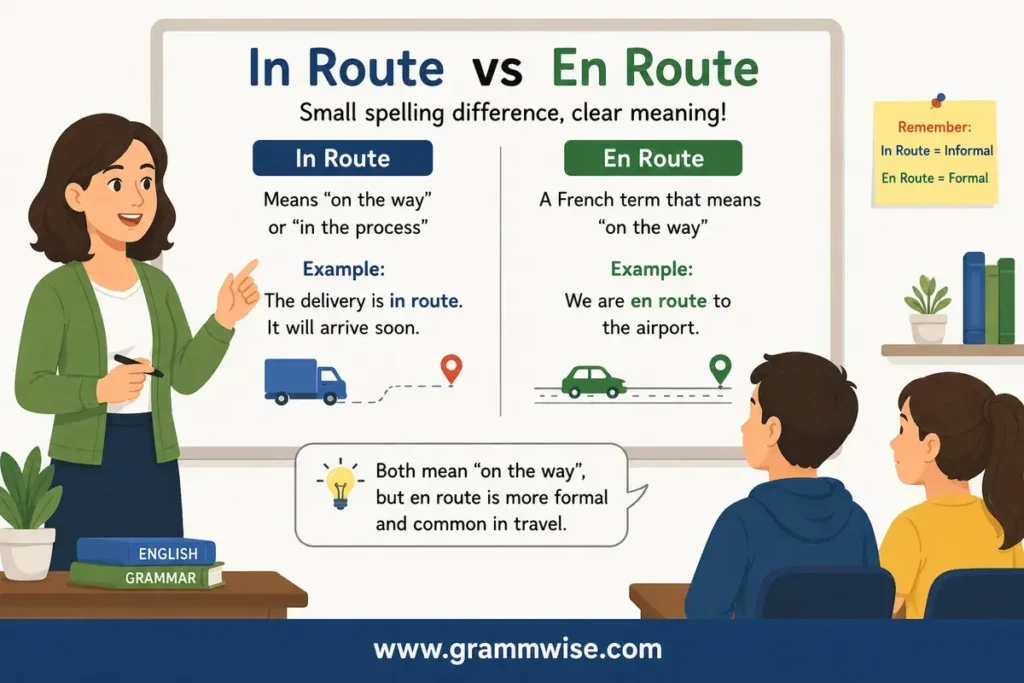
Most English teachers and style guides recommend avoiding in route because en route is the accepted expression.
However, you may occasionally see in route in transportation, navigation, or logistics. In these cases, route is often used as a noun, and in describes something happening within a route rather than on the way.
For example, a technical manual might describe in-route navigation or in-route procedures. Here, the meaning is different. It does not mean on the way. Instead, it refers to actions or systems that happen during a planned route.
For everyday English learners, you do not need to use this form.
A simple rule is:
- Use en route when you mean on the way.
- Avoid in route in normal writing and speaking.
Following this rule will help you sound more natural and avoid a very common mistake.
Easy Real-Life Sentences on “In Route vs En Route”
Reading examples is one of the best ways to remember new expressions. Here are some natural sentences using en route.
- I am en route to the office.
- We are en route to the beach.
- My parents are en route home now.
- The train is en route to Boston.
- Your pizza is en route.
- The pilot announced that we were en route to London.
- The rescue team is en route to the mountain.
- She called me while she was en route to school.
Now look at these incorrect sentences.
- ✘ I am in route to the office.
- ✘ The package is in route.
- ✘ We are in route to the airport.
Replace in route with en route, and the sentences become correct.
Practice saying these sentences aloud. Hearing the correct expression helps you remember it more easily.
In Route vs En Route: Where This Expression Comes From
The expression en route comes from the French language.
In French, en means on or in, and route means road or way. Together, en route means on the way.
English borrowed this phrase many years ago because it clearly describes someone or something traveling toward a destination.
Even though the expression comes from French, it is now a normal part of English vocabulary. You will hear it in airports, train stations, delivery updates, television news, weather reports, emergency services, and everyday conversations.
Because it is a borrowed expression, the spelling has stayed the same. That is why we write en route, not in route.
Once you remember that it is a French expression, the correct spelling becomes much easier to remember.
As you can see, the difference between in route or en route is not difficult. One expression is the accepted standard, while the other is usually a spelling mistake in everyday English. Knowing this simple rule will help you write with confidence and avoid a common error.
In Route vs En Route: How This Word Is Understood in Culture and Stories?
People often use en route to show that someone is moving toward a goal. It does not only mean traveling from one place to another. It can also describe progress in life, work, or learning. For example, someone may say, “She is en route to becoming a doctor.” This means she is still working toward that goal.
In stories, movies, and books, characters are often described as being en route before an important event happens. They may be traveling to meet someone, solve a problem, or begin a new adventure. The phrase helps readers understand that the journey has started, even if the destination has not been reached.
People also use en route in news reports. You may hear that firefighters are en route to a fire or that an ambulance is en route to help a patient. This tells everyone that help is already on the way.
Because the phrase sounds formal and clear, it is common in announcements, travel updates, emergency services, and business communication. It gives a quick and easy way to say that something or someone is already traveling.
Biblical and Mythological Meaning of “In Route vs En Route”
The exact phrase en route does not appear in the Bible because it comes from the French language. However, the idea of being on a journey appears many times throughout the Bible.
Many Bible stories are about people traveling with a purpose. Abraham traveled to a new land. Moses led the Israelites through the wilderness. The disciples traveled from town to town to share their message. Each person was on a journey that had meaning and direction.
In mythology, heroes also spend much of their time traveling. Characters such as Odysseus in Greek mythology faced many challenges while trying to reach home. These journeys teach lessons about courage, patience, wisdom, and hope.
So, while en route is not a biblical or mythological word, the idea behind it matches many famous stories about moving toward a goal or fulfilling a purpose.
Symbolism of “In Route vs En Route” Explained in Simple Words
What “In Route” Represents?
The phrase in route usually represents a spelling mistake rather than a meaningful English expression. Many people write it because they hear en route and spell it the way it sounds. Seeing in route reminds us that English contains many borrowed words whose spelling does not always match their pronunciation.
It also shows why checking spelling is important. A small letter change can make writing look less professional and may confuse readers.
What “En Route” Represents?
En route represents movement, progress, and purpose. It shows that someone has started a journey but has not yet reached the final destination.
People often use it as a symbol for personal growth. A student can be en route to graduation. A new business can be en route to success. Someone learning English can be en route to becoming a confident speaker.
The phrase reminds us that success usually happens step by step. Every journey begins with moving in the right direction.
Related Words You Should Know
Here are some related words and expressions that are often used with en route.
On the way – The most common everyday English expression for traveling to a place.
Heading to – Shows the direction someone is traveling.
Traveling – Moving from one place to another.
Journey – The act of traveling from one place to another.
Destination – The place where a journey ends.
Arrival – The moment someone reaches the destination.
Departure – The moment someone leaves a place.
Transit – Traveling through one place while going somewhere else.
Inbound – Traveling toward a place.
Outbound – Traveling away from a place.
Underway – Already started and continuing.
Knowing these related words will help you understand en route more easily and choose the best expression for different situations.
How People Actually Use “In Route vs En Route” in Daily English
You will hear en route most often in travel updates, news reports, business communication, and emergency services. In everyday conversations, many people simply say on the way because it sounds more casual. Both expressions can mean the same thing, but en route is usually more formal.
Here are some real-life examples:
- The delivery driver is en route to your house.
- The police officers are en route to the accident.
- We are en route to the airport now.
- The train is en route to Chicago.
- Our guests are en route and should arrive soon.
- The rescue team is en route to help the hikers.
- She called to say she was en route home.
- The package is en route and will arrive tomorrow.
- The doctor was en route to the hospital.
- We stopped for coffee while we were en route to the beach.
You can also use en route in a figurative way when talking about progress instead of travel.
- She is en route to becoming a great teacher.
- Our project is en route to completion.
- The company is en route to reaching its yearly goal.
- He is en route to earning his college degree.
- With practice, you are en route to speaking better English.
Common Mistakes People Make About “In Route vs En Route”
Many English learners make small mistakes with en route because the phrase comes from French. Here are the most common errors and the correct way to use it.
Mistake 1: Writing “in route”
❌ We are in route to the hotel.
✅ We are en route to the hotel.
Remember that en route is the correct spelling in standard English.
Mistake 2: Thinking “in route” is correct because it sounds similar
Many people hear en route and assume it begins with the English word in. This is a common spelling mistake. Dictionaries and style guides recognize en route as the standard form.
Mistake 3: Using “en route” when “route” is needed
❌ We chose the fastest en route to the city.
✅ We chose the fastest route to the city.
Use route when you mean a road, path, or direction. Use en route when you mean on the way.
Mistake 4: Forgetting that “en route” works as a phrase
❌ She is an en route driver.
✅ She is en route to the office.
The phrase describes someone who is traveling. It is not usually used as an adjective before a noun.
Mistake 5: Using it in very casual conversations when “on the way” sounds more natural
Although en route is correct, many native speakers simply say on the way in everyday speech.
For example:
- I’m on the way.
- I’m en route.
Both are correct, but on the way is more common in casual conversations.
Final Teacher Explanation
Think of en route as a simple way to say on the way. It tells us that someone or something is already traveling toward a destination. Even though it comes from French, it has become a normal part of English and is widely used in news reports, travel updates, business messages, and daily writing.
The biggest thing to remember is this: en route is the correct spelling, while in route is generally considered a spelling mistake. If you remember that en is part of the original French phrase, you will avoid one of the most common English writing errors. Whenever you want to describe someone who is already traveling, choose en route with confidence.
Quick Recap
If you are choosing between in route vs en route, the correct expression is en route. It means on the way or traveling toward a destination.
Remember this easy rule: Use “en route” in speaking and writing. Avoid “in route” because it is considered incorrect in standard English.
Conclusion
If you are choosing between in route vs en route, the correct expression is en route. It means on the way and is the standard spelling used in English. Knowing this simple difference will help you avoid common writing mistakes and use the phrase with confidence in both speaking and writing.
Remember this easy rule: en route is correct, while in route is generally considered incorrect in standard English. Keep practicing with real-life examples, and soon choosing the right expression will become natural.
Frequently Asked Questions (FAQs)
What does en route mean in simple words?
En route means on the way or traveling to a place.
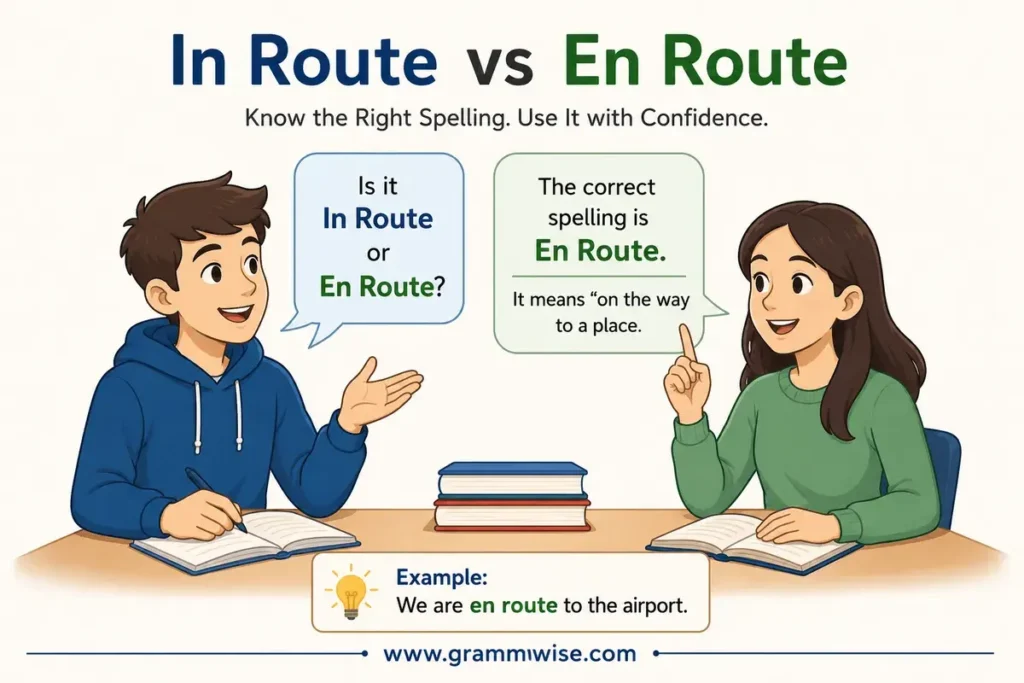
Is in route or en route correct?
En route is the correct spelling in standard English. In route is usually a spelling mistake.
Why do people write in route?
People often spell it the way they hear it. Since en sounds similar to in, the mistake is very common.
Can I use en route in formal writing?
Yes. En route is correct in both formal and informal English.
Is en route a French phrase?
Yes. It comes from French and means on the way. English has borrowed and kept the original spelling.
Can I say on the way instead of en route?
Yes. Both expressions have the same basic meaning. On the way is more common in everyday conversations.
Is en route one word or two words?
It is always written as two words: en route.
How can I remember the correct spelling?
Think of en route as the original French phrase. If you remember en, you will avoid writing in route.