
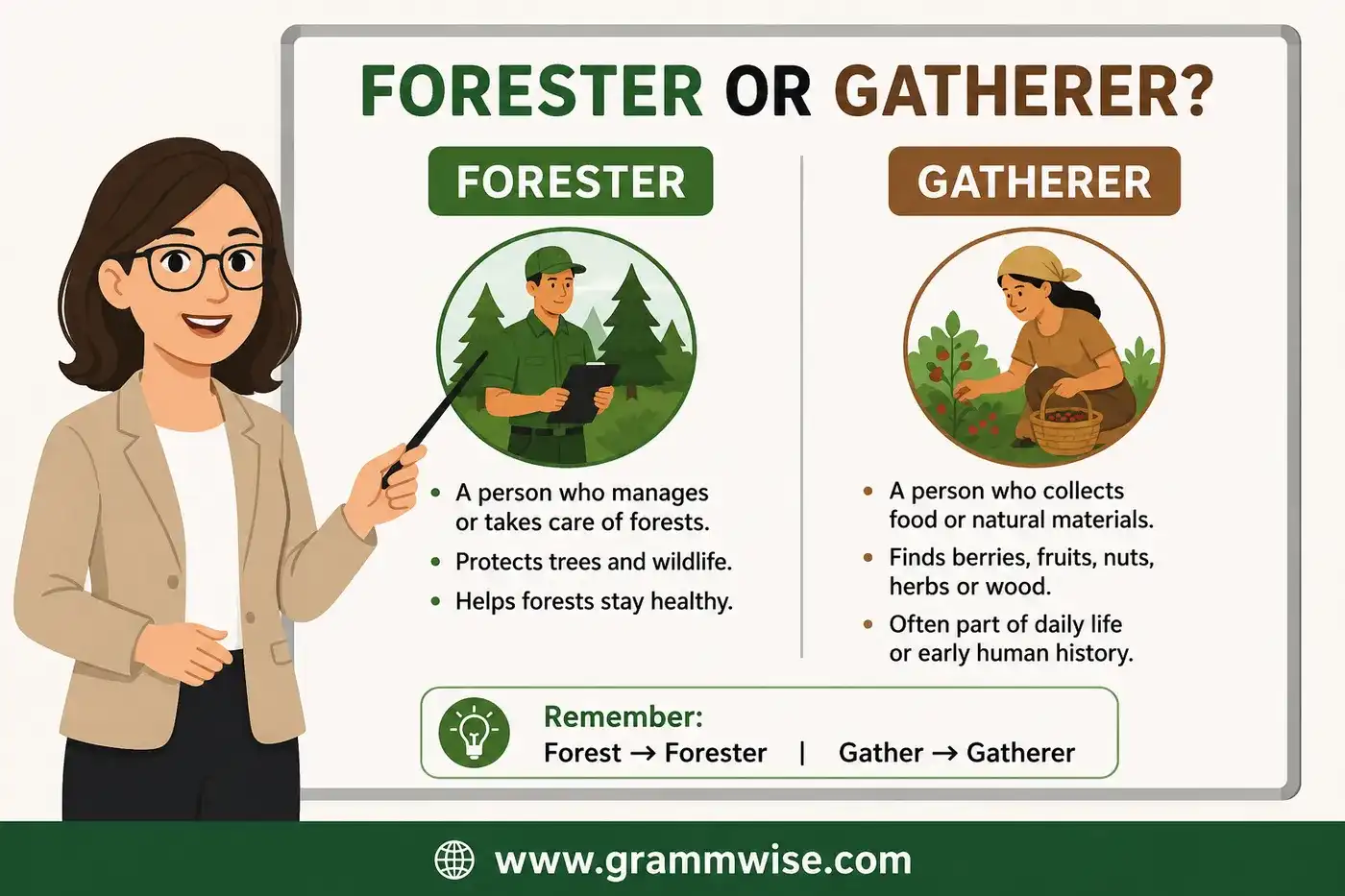
Many people search for forester or gatherer because they are unsure which word is correct. The truth is that these two words are not synonyms. They describe different kinds of people with different jobs or roles. That is why they should not be used in place of each other.
If you have seen forester or gatherer in a quiz, article, or school lesson, you may wonder which one fits your sentence. The answer depends on what you are talking about. A forester works with forests. A gatherer collects natural things like fruits, nuts, or plants. Knowing this simple difference makes choosing the right word much easier.
This guide explains the difference in very simple English. You will learn what each word means, why people confuse them, how to use them correctly, and where they came from. By the end, you will know exactly which word to choose.
Understanding word differences improves writing clarity and communication.
Simple Answer in One Look
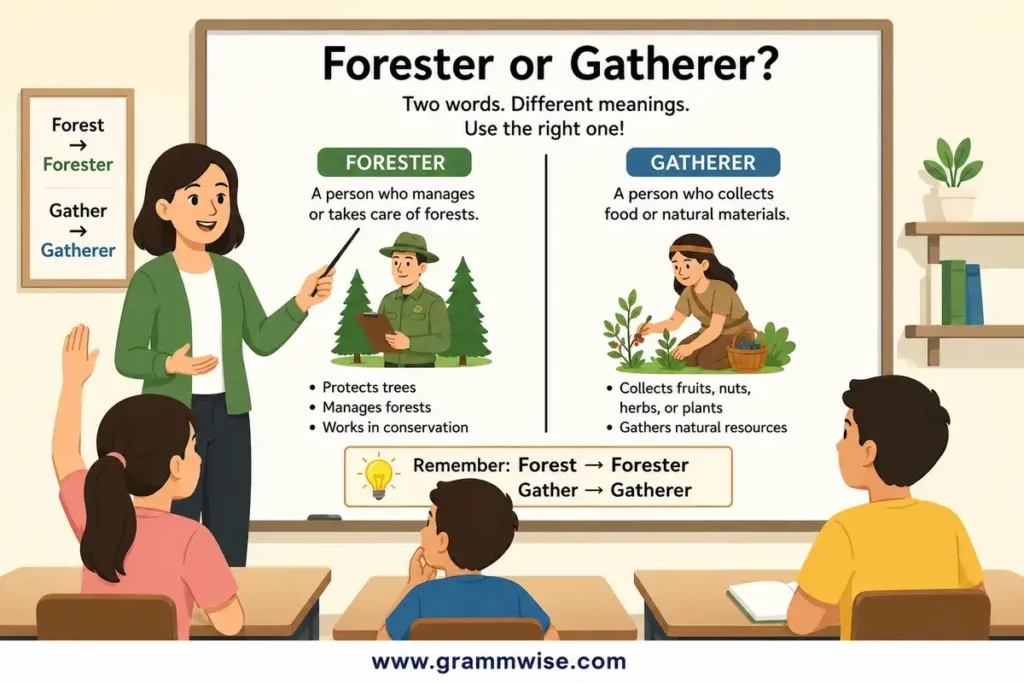
- Forester = a person who manages or takes care of forests.
- Gatherer = a person who collects food or natural materials.
They have different meanings and cannot replace each other.
Meaning of “Forester or Gatherer” in Simple English
Think about a forest.
A forester is someone whose job is to protect and manage that forest. They may plant new trees, help keep the forest healthy, watch for fires, and protect wildlife. Many foresters work for government agencies or private companies.
A gatherer is someone who collects things from nature. They may gather berries, mushrooms, nuts, herbs, or firewood. Long ago, gatherers collected food to help their families survive.
Here is a simple way to remember it.
- Forester works in the forest.
- Gatherer collects from nature.
The two words describe different activities.
Simple definitions
Forester
- Takes care of forests.
- Protects trees and wildlife.
- Helps forests stay healthy.
Gatherer
- Collects natural foods or materials.
- Finds berries, fruits, plants, or nuts.
- May gather food for daily life.
Why People Mix These Words “Forester or Gatherer”?
People usually confuse these words because both are connected to nature.
A forester often spends time in forests.
A gatherer also spends time in forests or other natural places.
Since both people may walk through woods and work outdoors, some learners think the words have the same meaning. They do not.
Another reason is that many students learn about hunter-gatherers in history. Later, they hear about foresters in science or environmental studies. Because both topics involve forests, the words can become mixed up.
Here are a few examples.
❌ The forester collected berries for dinner.
✅ The gatherer collected berries for dinner.
❌ Ancient foresters searched for wild fruits.
✅ Ancient gatherers searched for wild fruits.
❌ The gatherer managed the national forest.
✅ The forester managed the national forest.
These examples show that each word has its own purpose.
Clear Difference Between “Forester or Gatherer”
| Forester | Gatherer |
|---|---|
| Takes care of forests | Collects natural items |
| Usually a trained professional | May be anyone collecting food or materials |
| Plants and protects trees | Finds berries, herbs, fruits, nuts, or wood |
| Focuses on forest management | Focuses on collecting resources |
| Common in environmental work | Common in history and daily life |
Quick comparison
Forester
- Manages forests.
- Protects nature.
- Studies trees.
- Helps wildlife habitats.
Gatherer
- Collects food.
- Picks plants and fruits.
- Finds natural resources.
- Often mentioned with hunters.
The difference is easy to remember.
Forester protects the forest.
Gatherer collects from the forest.
Forester or Gatherer: Which Form Should You Use?
Ask yourself one simple question.
Is the person taking care of a forest?
If yes, use forester.
Example:
- The forester checked the health of the trees.
- Our school invited a forester to teach us about forests.
Now ask another question.
Is the person collecting things from nature?
If yes, use gatherer.
Example:
- The gatherer filled a basket with mushrooms.
- The children became gatherers during the nature walk.
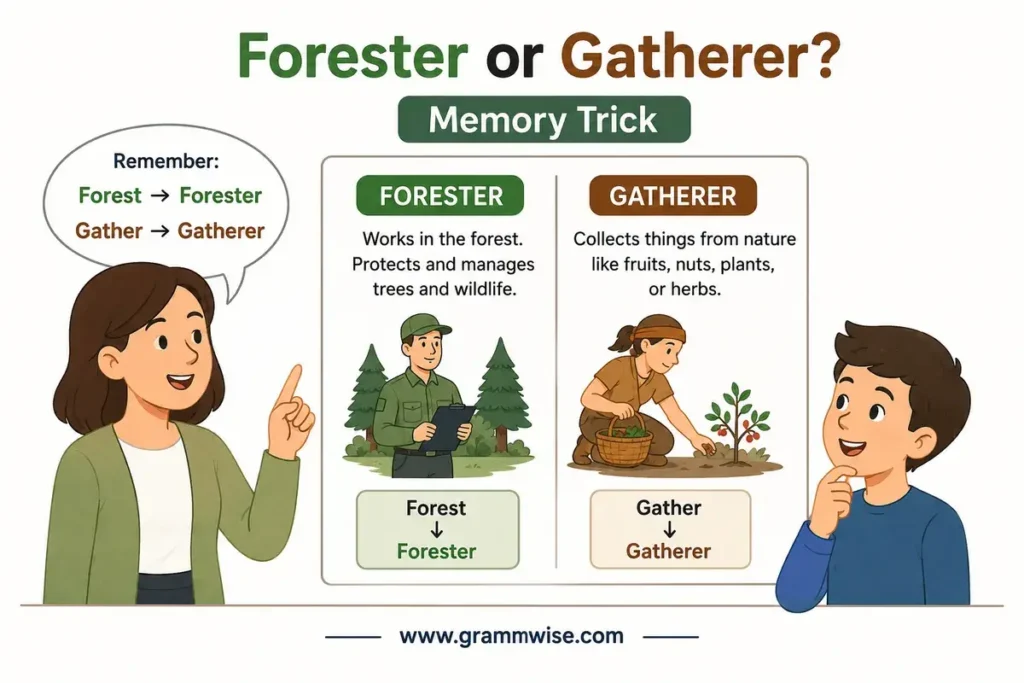
Easy memory trick
Notice the beginning of the word.
Forest → Forester
The word forest is already inside forester.
Now think about the verb gather.
Gather → Gatherer
A gatherer gathers things.
This small trick helps many students remember the difference.
Easy Real-Life Sentences on “Forester or Gatherer”
Here are some simple examples.
Sentences with forester
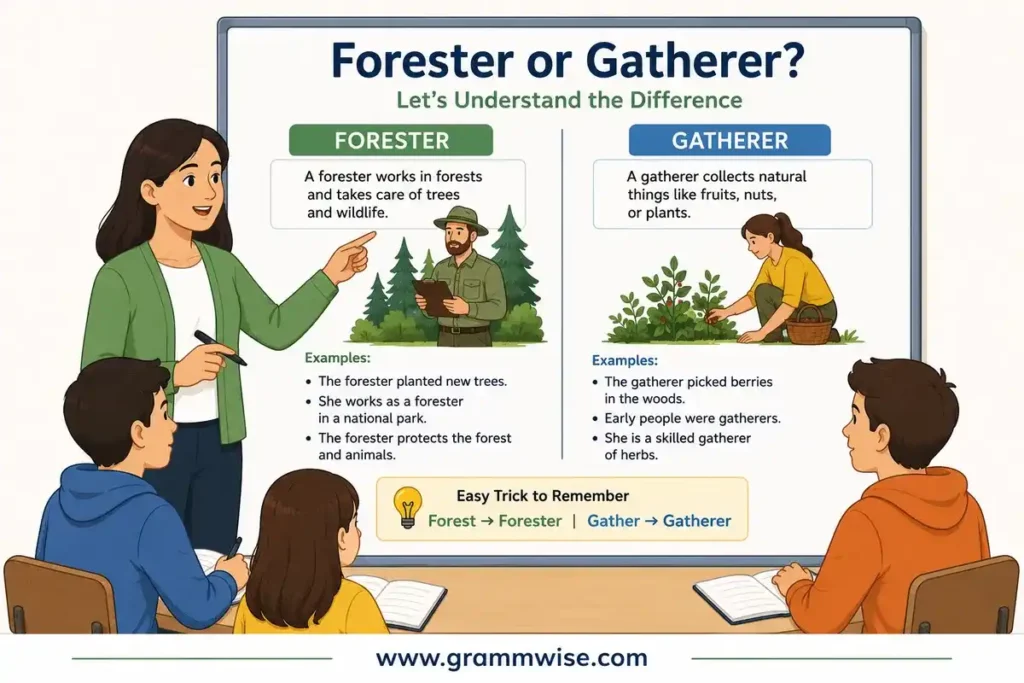
- The forester planted new trees after the fire.
- My uncle works as a forester.
- The forester checked the health of the forest.
- A forester teaches people how to protect nature.
- The forester marked old trees for study.
Sentences with gatherer
- The gatherer picked fresh berries.
- We became gatherers during our camping trip.
- Ancient gatherers searched for wild fruits.
- She is a skilled gatherer of herbs.
- The gatherer carried a basket full of mushrooms.
Forester or Gatherer: Where This Word Comes From?
The word forester has been used for hundreds of years. It comes from the word forest. Long ago, a forester looked after forests owned by kings or landowners. Their job was to protect the trees, animals, and land.
The word gatherer comes from the verb gather, which means to collect things together. People have used this word for many centuries.
History books often talk about hunter-gatherers. These were early humans who survived by hunting animals and gathering fruits, nuts, roots, and plants. They lived this way long before farming became common.
Today, the word forester is mostly used for a trained worker or forest expert.
The word gatherer is still used for anyone who collects natural materials or when talking about early human history.
How “Forester or Gatherer” Is Understood in Culture and Stories?
The words forester and gatherer are not only job titles. They also appear in stories, history, and culture. Each word brings a different picture to our minds.
When people hear forester, they often imagine someone walking through a peaceful forest, checking trees, helping wildlife, and protecting nature. In books and movies, a forester is usually shown as someone who cares for the land. They understand forests and want to keep them healthy for future generations.
A gatherer, on the other hand, reminds many people of early human life. Before people built cities or farms, they searched for food in nature. Gatherers collected berries, nuts, roots, seeds, and plants. They helped their families survive by bringing food home.
Many children’s books also show gatherers picking apples, flowers, or herbs. These stories teach that nature gives us many useful things when we care for it wisely.
You may also hear the phrase hunter-gatherer in history classes. This phrase describes people who lived before farming became common. They hunted animals and gathered plants for food.
These cultural pictures help us remember the difference.
- A forester protects nature.
- A gatherer collects from nature.
Even though both spend time outdoors, their roles are very different.
Biblical and Mythological Meaning of “Forester or Gatherer”
Neither forester nor gatherer has a special meaning in the Bible. However, the idea of gathering appears many times. People gathered crops after harvest. Families gathered food during difficult times.
The word gather is also used to describe bringing people together. For example, groups gathered to worship, celebrate, or listen to important messages.
The Bible often uses gathering as a picture of unity, care, and providing for others.
The word forester is not commonly used in biblical stories. Forests are mentioned, but the role of a modern forester did not exist in the same way it does today.
In mythology and old legends, forests are often magical places. People who protect forests are sometimes shown as wise guardians or caretakers. While these characters are not always called foresters, they have similar responsibilities.
So, if we compare the two words in stories:
- Gatherer is linked with collecting food and survival.
- Forester is linked with caring for forests and protecting nature.
Symbolism of “Forester or Gatherer”
Words often carry ideas beyond their basic meaning. These ideas are called symbols. Understanding these symbols can make the words easier to remember.
What Forester Represents?
A forester often represents:
- Protection
- Responsibility
- Care for nature
- Wisdom
- Planning for the future
A forester plants trees that may take many years to grow. This teaches patience and responsibility.
People may also see a forester as someone who keeps nature balanced.
What Gatherer Represents?
A gatherer often represents:
- Survival
- Hard work
- Preparation
- Gratitude
- Using nature wisely
A gatherer does not simply collect food. They know where to look and what is safe to take. This shows knowledge and careful thinking.
Many people also connect gatherers with teamwork because families often gathered food together.
Simple Comparison
| Forester | Gatherer |
|---|---|
| Protects nature | Collects from nature |
| Plans for the future | Meets today’s needs |
| Takes care of forests | Finds food and useful plants |
| Symbol of responsibility | Symbol of survival |
| Helps forests grow | Uses nature wisely |
Neither symbol is better than the other. They simply represent different kinds of work.
Related Words You Should Know
Learning related words helps you understand forester or gatherer even better.
Forest
A large area filled with trees and wildlife.
Example: We walked through a beautiful forest.
Forestry
The work or study of managing forests.
Example: She studies forestry at college.
Ranger
A person who protects parks or natural areas.
Example: The park ranger answered our questions.
Lumberjack
A worker who cuts down trees for wood.
Example: The lumberjack used a large saw.
Gather
To collect things together.
Example: Please gather your books before leaving.
Collection
A group of things gathered together.
Example: He has a collection of old coins.
Hunter-Gatherer
A person from early human history who hunted animals and gathered plants for food.
Example: Hunter-gatherers moved from place to place.
Harvest
The time when crops are collected.
Example: Farmers work hard during harvest.
Conservation
Protecting nature so it stays healthy.
Example: Tree planting supports conservation.
Wildlife
Animals living freely in nature.
Example: The forest is home to many kinds of wildlife.
Knowing these words makes reading books and articles much easier.
How People Actually Use “Forester or Gatherer” in Daily English
Most people do not use the words forester and gatherer every day, but they still appear in conversations, books, documentaries, schools, and news stories.
Here are some natural examples.
- My cousin works as a forester in a national park.
- The forester explained why old trees are important.
- Ancient gatherers searched for berries and roots.
- We became gatherers during our camping trip.
- The teacher talked about hunter-gatherers in history class.
- A forester helped protect the forest after the wildfire.
- The children gathered flowers, but they were not real gatherers.
- She enjoys gathering mushrooms like early gatherers did.
- The forester taught us how young trees grow.
- Our guide said the first people here were hunter-gatherers.
Notice that forester usually appears in discussions about forests, wildlife, or environmental work.
Gatherer appears more often in history, nature, camping, or survival topics.
Common Mistakes People Make About “Forester or Gatherer”
Many English learners make the same mistakes when choosing between forester or gatherer.
Mistake 1: Using them as synonyms
❌ He is a gatherer who manages the forest.
✅ He is a forester who manages the forest.
A gatherer collects things.
A forester manages forests.
Mistake 2: Thinking every person in a forest is a forester
Someone walking in the woods is not automatically a forester.
A forester has the job of caring for forests.
Mistake 3: Calling ancient people foresters
❌ Early foresters collected berries.
✅ Early gatherers collected berries.
History usually describes these people as gatherers or hunter-gatherers.
Mistake 4: Forgetting the simple word clue
Remember this easy trick.
Forest → Forester
Gather → Gatherer
The beginning of each word tells you its meaning.
Mistake 5: Mixing modern jobs with historical roles
A forester is usually a modern profession.
A gatherer often describes early humans or someone collecting natural items.
Keeping this difference in mind prevents many mistakes.
Final Teacher Explanation
Imagine we are sitting together in a classroom. I write two words on the board.
Forester
Gatherer
Now I ask one question.
Does this person protect forests or collect things?
If the answer is protect forests, choose forester.
If the answer is collect things from nature, choose gatherer.
That is really all you need to remember.
Many students worry because both words relate to nature. But once you focus on the person’s job or action, the answer becomes easy.
A forester looks after forests. A gatherer gathers food or natural materials.
Neither word is more correct than the other. They simply describe different people doing different things.
Whenever you are unsure, use this memory trick.
- Forest → Forester
- Gather → Gatherer
This simple rule will help you choose the correct word every time.
Quick Recap
When choosing between forester or gatherer, think about the person’s role. A forester manages and protects forests, while a gatherer collects food or natural materials from nature. They are different words with different meanings, so they cannot replace each other.
Conclusion
Understanding forester or gatherer is simple once you know what each word means. A forester manages and protects forests, while a gatherer collects food or natural materials from nature. They are both correct words, but they are used in different situations.
The easiest way to remember the difference is this: Forest → Forester and Gather → Gatherer. Keep this simple rule in mind, and you will confidently choose the right word in speaking, writing, schoolwork, and everyday English.
Frequently Asked Questions (FAQs)
What does forester mean in simple words?
A forester is a person who takes care of forests, trees, and wildlife.
What does gatherer mean in simple words?
A gatherer is someone who collects food, plants, or other natural materials.
Which is correct, forester or gatherer?
Both are correct words. The right choice depends on the meaning of your sentence.
Why do people confuse forester or gatherer?
People confuse them because both words are connected to nature and forests, but they describe different roles.
Can I use forester instead of gatherer?
No. A forester manages forests, while a gatherer collects natural resources.
What is a hunter-gatherer?
A hunter-gatherer is an early human who survived by hunting animals and gathering plants for food.
Is forester a real job today?
Yes. Many foresters work for governments, parks, and private organizations to protect and manage forests.
How can I remember the difference between forester or gatherer?
Use this simple trick: Forest → Forester and Gather → Gatherer. If someone protects forests, they are a forester. If someone collects from nature, they are a gatherer.