
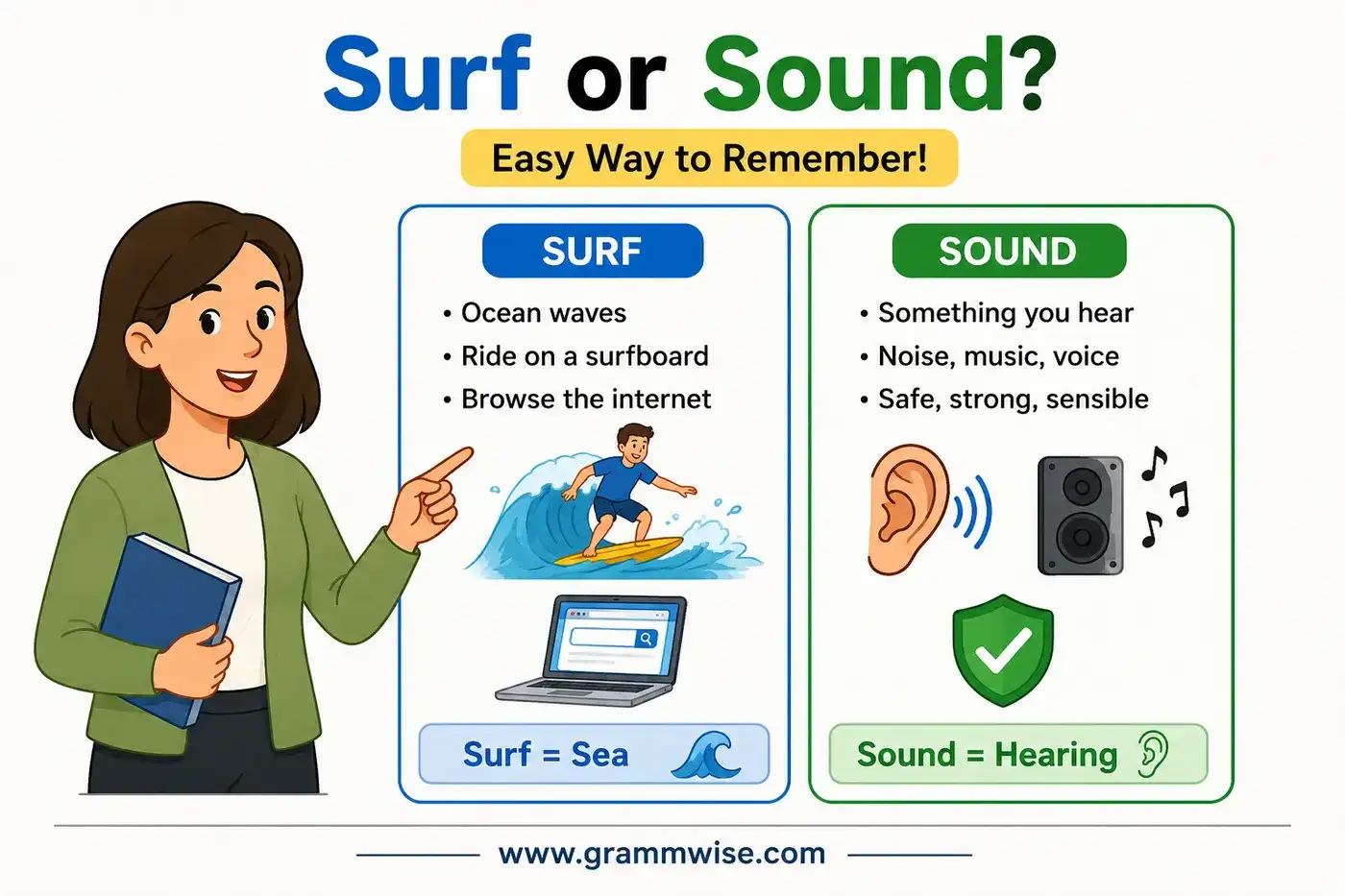
Many English learners search for surf or sound because the two words may look similar at first, but they have completely different meanings. If you are wondering which word is correct, the answer depends on what you want to say. Surf is related to waves, the internet, or riding on water. Sound is related to what you hear or can also mean something that is safe or correct.
Understanding surf or sound is easy once you learn what each word means. They are not synonyms, and they cannot replace each other. This guide will explain the difference in very simple English with clear examples and easy memory tricks.
By the end of this lesson, you will know exactly when to use surf and when to use sound in everyday English.
Understanding word differences improves writing clarity and communication.
Simple Answer in One Look
- Surf = waves, surfing, or browsing the internet.
- Sound = something you hear, or something that is safe, healthy, or sensible.
They have different meanings and are never interchangeable.
Meaning of “Surf or Sound” in Simple English
The word surf has more than one meaning.
It can mean the waves near the beach.
It can also mean riding those waves on a surfboard.
Today, many people also use surf to mean looking around on the internet.
Examples:
- We watched the surf at the beach.
- She loves to surf every summer.
- I surf the internet every evening.
The word sound also has more than one meaning.
Most often, it means something you hear.
Examples:
- I heard a strange sound.
- That sound came from outside.
It can also describe something that is safe, strong, or based on good judgment.
Examples:
- The bridge is sound.
- That sounds like a sound decision.
Although both words have several meanings, they are used in completely different situations.
Why People Mix These Words “Surf or Sound”?
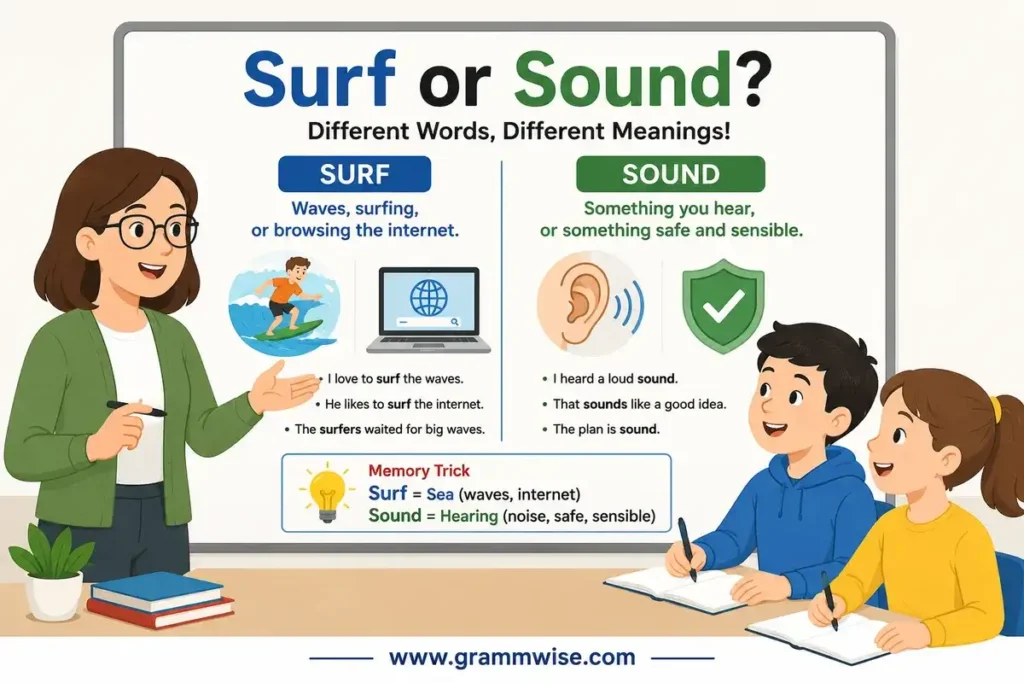
Most people do not confuse surf and sound because of their meanings. Instead, they may confuse them because both words appear in different expressions, and new English learners sometimes remember only part of the sentence.
For example:
- Surf the internet
- Sound advice
- Sound asleep
- Surf the waves
Since both words are common, learners sometimes choose the wrong one when writing quickly.
Here are some examples.
❌ I like to sound the internet.
✅ I like to surf the internet.
❌ We heard a loud surf.
✅ We heard a loud sound.
❌ The building has a surf structure.
✅ The building has a sound structure.
Looking at the whole sentence usually makes the correct choice easy.
Clear Difference Between “Surf or Sound” Explained Simply
| Surf | Sound |
|---|---|
| Waves near a beach | Something you hear |
| Ride ocean waves | Safe or strong |
| Browse the internet | Good judgment or sensible |
| Related to water | Related to hearing or quality |
Quick comparison
Surf
- Ocean waves
- Surfboard
- Beach activity
- Browse the web
Sound
- Noise
- Voice
- Music
- Safe
- Strong
- Sensible
The easiest way to tell them apart is to think about the topic.
If the sentence is about water or the internet, use surf.
If it is about hearing or safety, use sound.
Surf or Sound: Which Form Should You Use?
Ask yourself one question.
Am I talking about waves or browsing online?
If yes, use surf.
Examples:
- They surf every weekend.
- I surf the web after school.
Now ask another question.
Am I talking about hearing something or describing something as safe or sensible?
If yes, use sound.
Examples:
- I heard a loud sound.
- The roof is still sound.
- Your plan sounds good.
Easy Memory Trick
Remember this simple clue.
Surf → Sea
Both words start with S.
Think of the ocean.
Now think about Sound.
You hear sound with your ears.
Another easy trick:
- Surf = Sea
- Sound = Speaker
This makes the meanings easy to remember.
Easy Real-Life Sentences on “Surf or Sound”
Sentences with surf
- My brother loves to surf.
- The surf was rough today.
- We surfed the internet together.
- They learned to surf during vacation.
- The surfers waited for bigger waves.
- I surf the web to find recipes.
Sentences with sound
- I heard a funny sound.
- The baby woke up because of the loud sound.
- Your idea sounds great.
- The old bridge is still sound.
- She gave me sound advice.
- We listened to the sound of birds.
Surf or Sound: Where This Word Comes From?
The word surf comes from old words that described the waves breaking along the shore. Over time, it also became the name of the sport of riding those waves. Later, when people started using the internet, the phrase surf the internet became popular because moving from one website to another felt like riding waves.
The word sound comes from very old English. It first referred to something people could hear. Later, it also came to describe something that was healthy, solid, or dependable. That is why we say sound advice, sound sleep, or a sound building.
How “Surf or Sound” Is Understood in Culture and Stories
The words surf and sound appear in many parts of everyday culture. Movies, books, songs, and conversations often use them.
When people hear surf, they usually think about beaches, sunshine, waves, and adventure. Surfing is popular in places near the ocean, and many movies show surfers enjoying the sea. Because of this, the word often brings feelings of freedom, fun, and excitement.
The word sound appears in almost every part of life. Music, voices, animals, nature, and machines all create sounds. Stories often use sound to help readers imagine what is happening.
For example:
- The sound of thunder can make a scene feel scary.
- The sound of birds can make a scene feel peaceful.
- The sound of laughter can make a scene feel happy.
Both words are common, but they create very different pictures in our minds.
- Surf makes us think of water and movement.
- Sound makes us think of hearing and communication.
That is why understanding the difference between surf or sound is usually easy once you connect each word to its main idea.
Biblical and Mythological Meaning of “Surf or Sound”
The word surf does not have a special biblical meaning. However, water and seas appear many times in the Bible. Large waves often represent challenges, power, or nature’s strength.
Because surf is connected to ocean waves, some people may think of the sea when they hear the word.
The word sound appears more often in religious writings.
People hear sounds from trumpets, singing, prayers, celebrations, and important events.
In many stories, sound is used to send messages or gather people together.
In mythology, sounds are often connected to magical instruments, warnings, or communication between people and gods.
Neither surf nor sound has a special religious definition by itself, but both connect to ideas found in many stories.
Symbolism of “Surf or Sound” Explained in Simple Words
Words often represent bigger ideas than their basic meanings.
What Surf Represents?
The word surf often represents:
- Adventure
- Freedom
- Movement
- Exploration
- Fun
People who surf ride changing waves. Because of this, surf can symbolize learning to handle challenges and enjoying life’s journey.
Many people connect surf with travel, outdoor activities, and an active lifestyle.
What Sound Represents?
The word sound often represents:
- Communication
- Understanding
- Awareness
- Knowledge
- Connection
Sound helps people share ideas and feelings. Without sound, conversations would be much harder.
When sound means “safe” or “strong,” it can also represent:
- Stability
- Trust
- Good judgment
Simple Comparison “Surf or Sound”
| Surf | Sound |
|---|---|
| Adventure | Communication |
| Ocean life | Hearing |
| Movement | Understanding |
| Exploration | Knowledge |
| Excitement | Stability |
This comparison helps explain why the words feel very different even though they are both common English words.
Related Words You Should Know
Learning related words can make surf or sound even easier to understand.
Wave: Water moving across the ocean.
Example: The wave was very large.
Surfer: A person who rides waves.
Example: The surfer waited for the perfect wave.
Surfboard: A board used for surfing.
Example: She carried her surfboard to the beach.
Internet: A worldwide network of websites.
Example: We use the internet every day.
Noise: A sound, often loud or unwanted.
Example: The noise woke me up.
Voice: The sound made when a person speaks.
Example: I recognized her voice immediately.
Music: Organized sounds that people enjoy listening to.
Example: The music sounded beautiful.
Audio: Recorded sound.
Example: The audio was very clear.
Echo: A sound that repeats after bouncing back.
Example: We heard an echo in the cave.
Silence: The absence of sound.
Example: The room was completely silent.
These related words help build a stronger understanding of both terms.
How People Actually Use “Surf or Sound” in Daily English
Many people use surf and sound every day.
Here are some natural examples.
Examples with Surf
- I like to surf the internet after dinner.
- The surf was rough this morning.
- My cousin learned to surf last summer.
- We watched the surfers from the beach.
- The surf became stronger during the storm.
Examples with Sound
- I heard a strange sound outside.
- That sounds like a great idea.
- The speaker made a loud sound.
- She gave me sound advice.
- The building is still sound after many years.
Everyday Conversations
- Person A: What do you do online?
- Person B: I usually surf the internet and read news.
- Person A: Did you hear that sound?
- Person B: Yes, it came from the kitchen.
- Person A: Do you think this is a good plan?
- Person B: It sounds like a sound decision.
These examples show how naturally both words appear in daily English.
Common Mistakes People Make About “Surf or Sound”
People sometimes make mistakes when choosing between surf or sound.
Mistake 1: Using Surf for Noise
❌ I heard a strange surf.
✅ I heard a strange sound.
Surf is not something you hear. Sound is.
Mistake 2: Using Sound for Internet Browsing
❌ I sound the internet every night.
✅ I surf the internet every night.
When talking about browsing websites, use surf.
Mistake 3: Forgetting the Different Meanings of Sound
Some learners only know one meaning of sound.
For example:
❌ Sound only means noise.
Actually, sound can also mean:
- Safe
- Strong
- Sensible
Examples:
- A sound investment.
- Sound advice.
- A sound structure.
Mistake 4: Thinking Surf Only Means a Sport
Many learners know surfing at the beach but forget another meaning.
Surf can also mean:
- Browse the internet
Example:
- I surf the web every day.
Mistake 5: Mixing the Topics
A simple rule helps.
If the sentence is about:
- Water or the internet → Surf
- Hearing or safety → Sound
This rule solves most mistakes immediately.
Final Teacher Explanation
Imagine I am writing these two words on a classroom board:
Surf
Sound
Now I ask one simple question.
Are we talking about:
- Waves?
- Surfing?
- Browsing the internet?
If yes, choose surf.
Next question:
Are we talking about:
- Hearing something?
- Music?
- Noise?
- A safe or sensible idea?
If yes, choose sound.
That is the easiest way to remember the difference.
Many students worry because both words are common English words with more than one meaning. But when you look at the topic of the sentence, the answer becomes clear.
- A sentence about the sea usually needs surf.
- A sentence about hearing usually needs sound.
- A sentence about something reliable or sensible also needs sound.
Keep those simple rules in mind, and you will rarely make a mistake.
Quick Recap
When choosing between surf or sound, remember that surf relates to ocean waves, surfing, or browsing the internet. Sound relates to hearing, noise, music, or something that is safe and sensible.
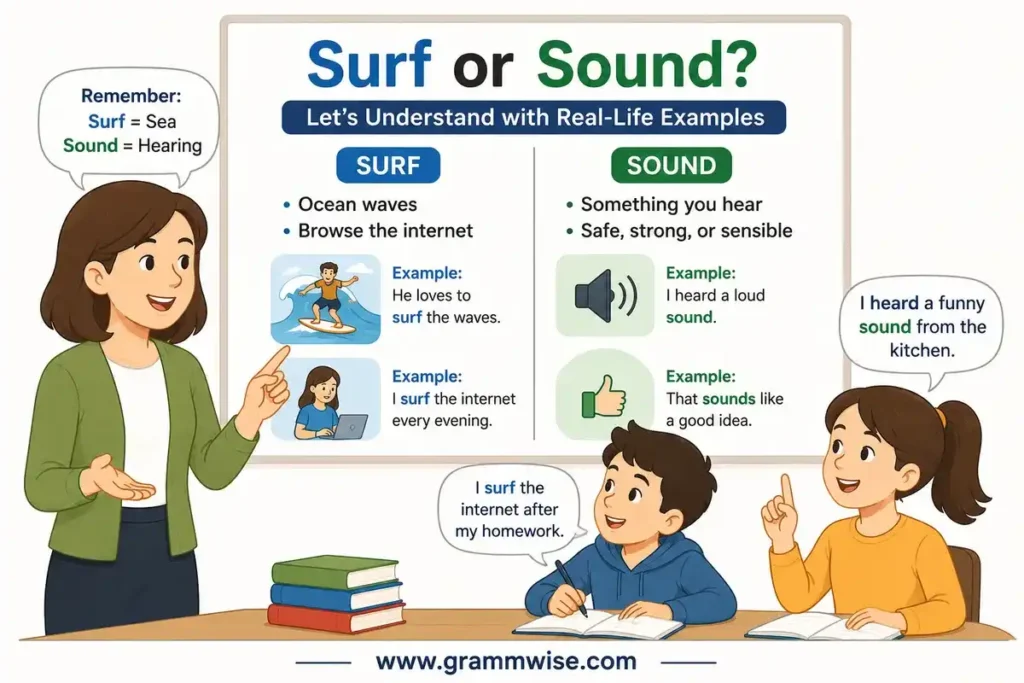
Think of it this way: Surf = Sea and Sound = Hearing. This simple memory trick makes the difference easy to remember.
Conclusion
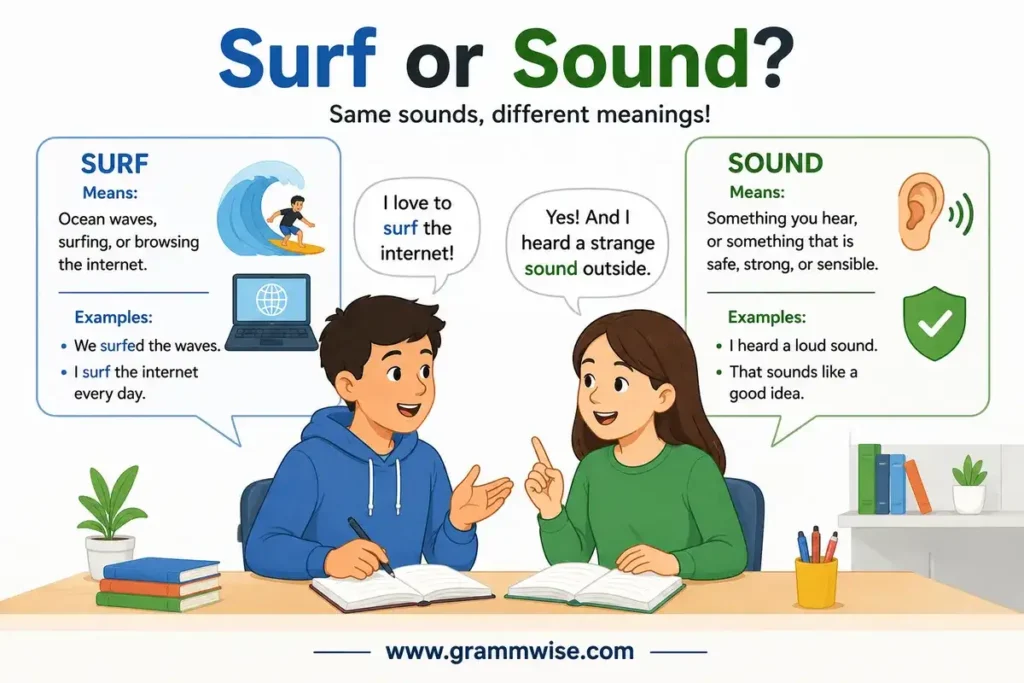
Understanding surf or sound becomes easy when you know the meaning of each word. Surf is about ocean waves, surfing, or browsing the internet, while sound refers to what you hear or something that is safe, strong, or sensible. They are both correct words but are used in completely different situations.
A simple way to remember them is Surf = Sea and Sound = Hearing. Keep this memory trick in mind, and you’ll confidently choose the right word in conversations, writing, school assignments, and everyday English.
Frequently Asked Questions (FAQs)
What does surf mean in simple words?
Surf means ocean waves, riding those waves, or browsing the internet.
What does sound mean in simple words?
Sound is something you hear. It can also mean safe, strong, or sensible.
Which is correct, surf or sound?
Both words are correct. The right choice depends on your sentence and meaning.
Why do people confuse surf or sound?
Most learners confuse them when they focus on the word instead of the topic of the sentence.
Can I use surf instead of sound?
No. Surf and sound have different meanings and cannot replace each other.
Does surf mean using the internet?
Yes. “Surf the internet” means browsing websites online.
Can sound mean something other than noise?
Yes. Sound can also mean safe, reliable, or based on good judgment.
How can I remember the difference between surf or sound?
Use this simple trick: Surf = Sea and Sound = Hearing. This helps you choose the correct word quickly.