
Many English learners get confused about plain or plane because the two words sound exactly the same. They are easy to mix up in writing, but they have very different meanings. Once you understand plain or plane, you will know which word to use in everyday English without feeling confused.
The word plain can describe something simple, clear, or flat. The word plane usually means an aircraft or a flat surface. Since both words sound alike, many people choose the wrong spelling by mistake.
In this guide, you will learn the difference between plain or plane in very simple English. You will also see easy examples, common mistakes, and simple memory tips that you can use every day.
If homophones confuse you, explore more words like Principal vs principle.
Plain or Plane: Simple Answer in One Look
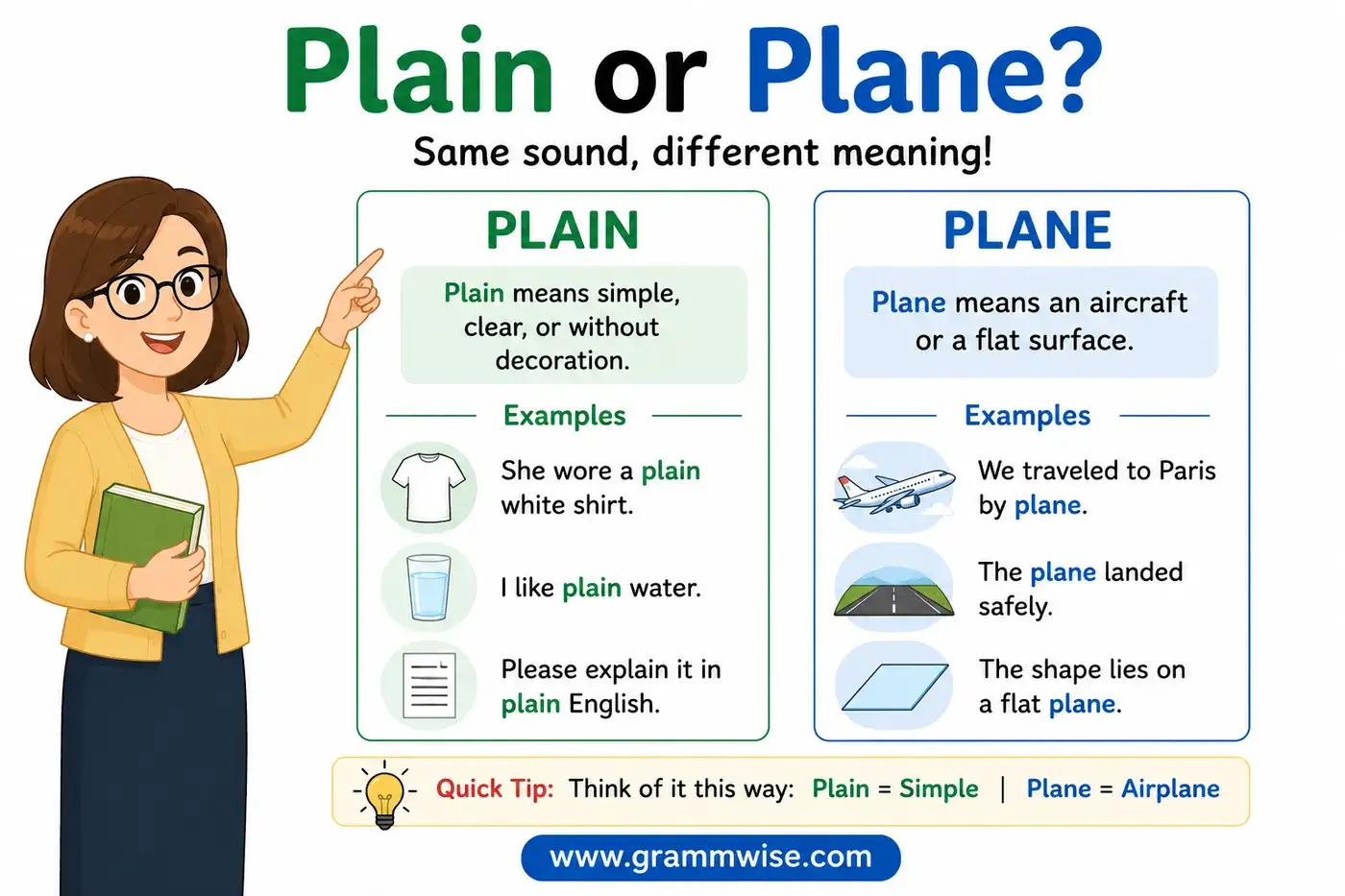
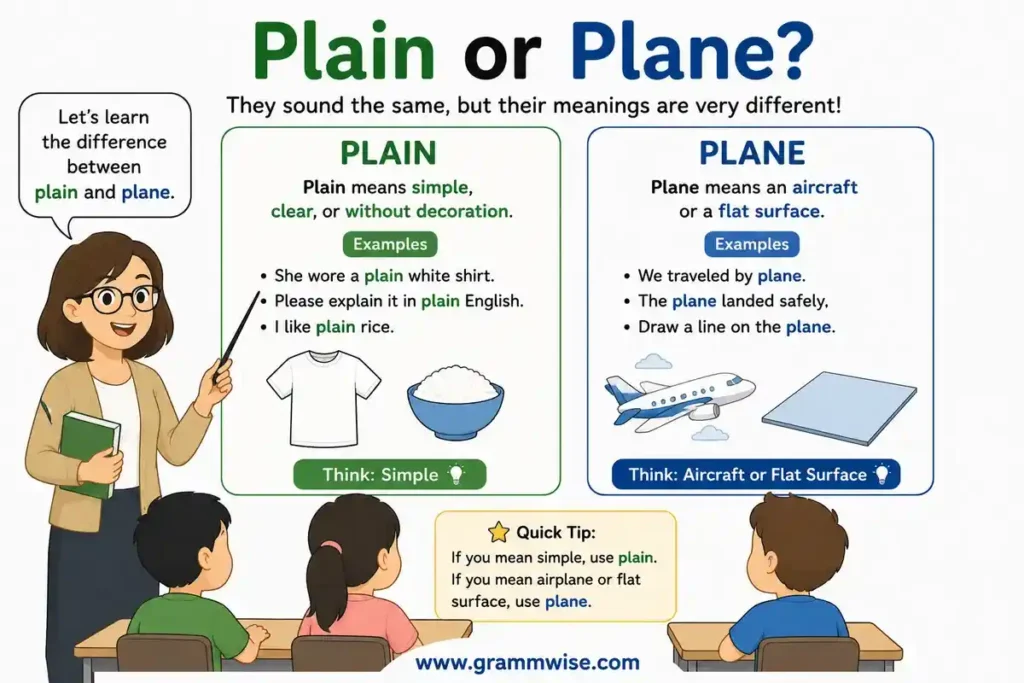
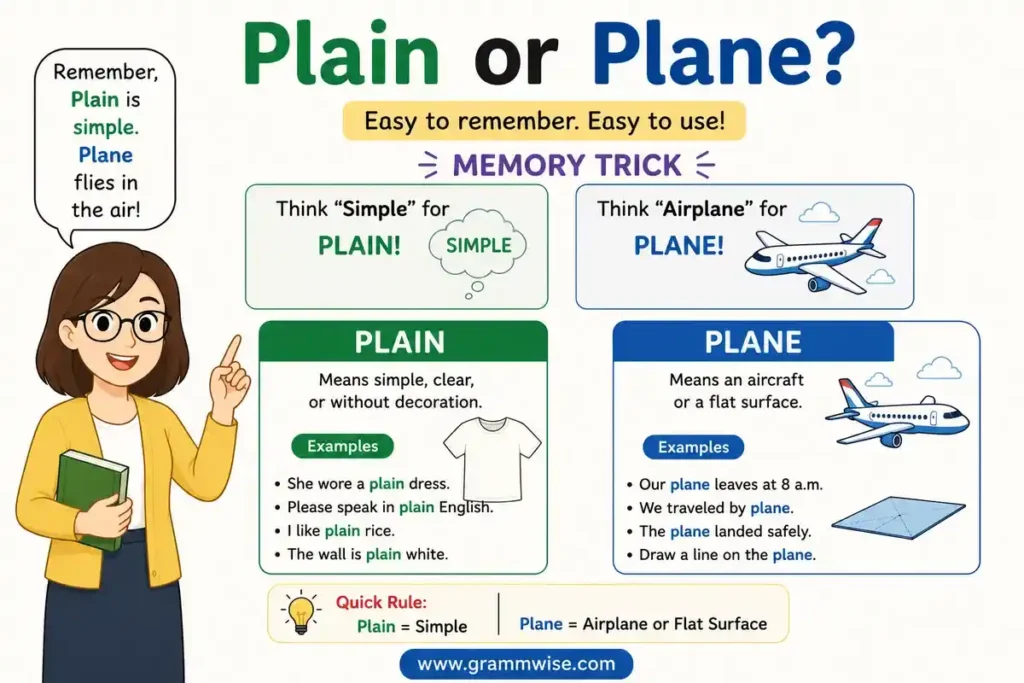
Plain means simple, clear, or without decoration.
Plane means an aircraft or a flat surface.
Remember this easy rule:
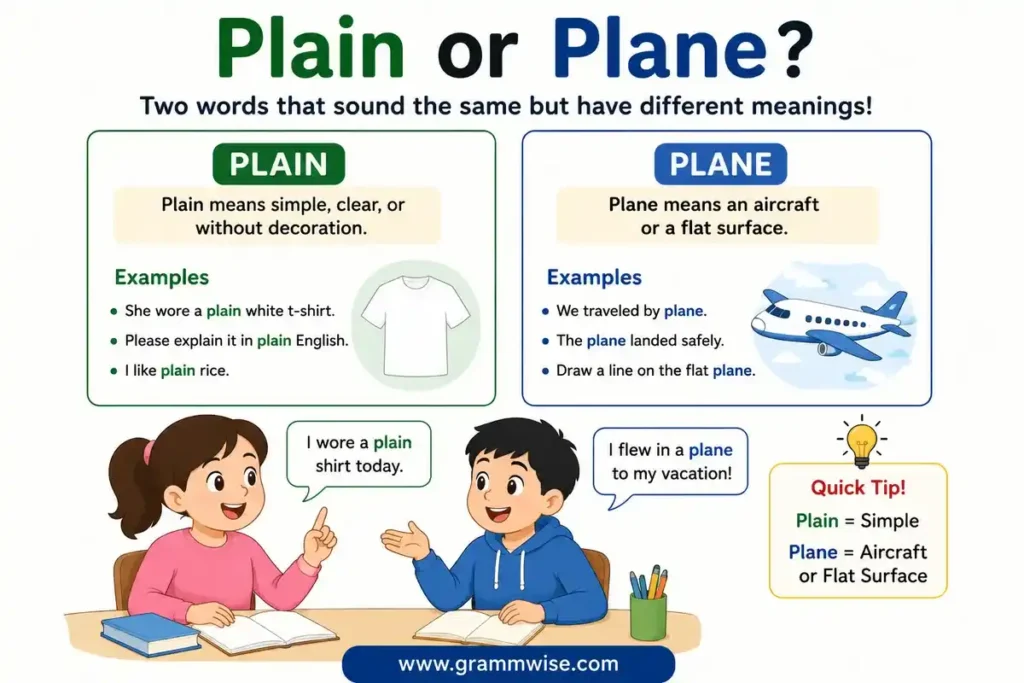
- Plain = Simple.
- Plane = Aircraft or flat surface.
Meaning of Plain or Plane in Simple English
Imagine you are wearing a white T-shirt with no pictures or designs. That is a plain T-shirt. It is simple. The word plane can also describe a flat surface. For example, the top of a table is a flat plane.
Now imagine you are traveling from one country to another. You fly in a plane. That is an aircraft.
So the meanings are very different.
One word talks about something simple or clear.
The other talks about flying or flat surfaces.
Plain or Plane: Why People Mix These Words?
Many people confuse plain or plane because they sound exactly the same. These words are called homophones.
Homophones are words that sound alike but have different meanings and spellings.
For example, someone may hear this sentence:
“The plane is ready.”
When writing, they might accidentally spell it as plain.
The opposite mistake also happens.
Someone may write,
“I like plain food.”
but spell it as plane.
The pronunciation is the same.
Only the meaning tells you which spelling is correct. That is why understanding the meaning is more helpful than trying to remember the spelling alone.
Clear Difference of Plain or Plane Explained Simply
Here is the easiest way to understand plain or plane.
Plain
Use plain when something is:
- Simple
- Easy to understand
- Without decoration
- Ordinary
Examples:
- She wore a plain dress.
- Please use plain English.
- The wall is plain white.
- I like plain rice.
Think about something simple.
That is plain.
Plane
Use plane when talking about:
- An aircraft
- A flat surface
- A level in math or science
Examples:
- The plane landed safely.
- We traveled by plane.
- The bird flew above the plane.
- The drawing is on a flat plane.
In everyday English, plane usually means an airplane.
Easy Comparison on Plain or Plane
Plain
- Simple
- Clear
- Ordinary
- Not decorated
Plane
- Aircraft
- Airplane
- Flat surface
- Level area
One word describes something simple.
The other describes something that flies or is flat.
Plain or Plane: Which Form Should You Use?
Ask yourself one question.
Are you talking about something simple, clear, or ordinary?
If yes, use plain.
Examples:
- The shirt is plain.
- Please explain it in plain English.
- She likes plain coffee.
Now ask another question.
Are you talking about an airplane or a flat surface?
If yes, use plane.
Examples:
- Our plane leaves at noon.
- The plane landed safely.
- Draw a line across the plane.
This simple question will help you choose the correct word almost every time.
Easy Memory Trick for Plain or Plane
Here is an easy trick.
Plain has the word “ain.”
Think about something plain and simple.
Nothing extra.
Nothing fancy.
That is plain.
Plane has the word “air.”
Even though the spelling is different, think of plane as reminding you of air.
Planes fly in the air.
Whenever you think about flying, remember plane.
This simple picture helps many students remember the difference.
Easy Real-Life Sentences on Plain or Plane
Here are some everyday examples.
- I like plain yogurt.
- She wore a plain black dress.
- Please use plain language.
- The room has plain white walls.
- Our plane is ready to leave.
- We traveled by plane last summer.
- The plane arrived on time.
- The pilot flew the plane safely.
Read each sentence slowly.
Notice how the meaning changes with each word.
Plain or Plane in Terms of Grammar
Plain as an Adjective
Most of the time, plain is an adjective.
It describes a noun.
Examples:
- A plain shirt
- Plain water
- Plain food
- Plain paper
- Plain language
In every example, the word means simple or not decorated.
Plain as a Noun
Sometimes plain is a noun.
It can mean a large area of flat land with very few trees.
Examples:
- The horses ran across the plain.
- We saw a wide plain during our trip.
- Farmers worked on the open plain.
This meaning is common in geography and nature.
Plane as a Noun
The most common meaning of plane is an airplane.
Examples:
- The plane took off early.
- Our plane arrived late.
- I have never flown on a plane.
People use this meaning every day.
Plane as a Flat Surface
Sometimes plane means a flat surface.
This meaning is common in math, science, and engineering.
Examples:
- Draw the shape on a flat plane.
- The two lines meet on the same plane.
Most beginners will hear this meaning less often than the airplane meaning.
Common Phrases with Plain or Plane
These expressions are very common.
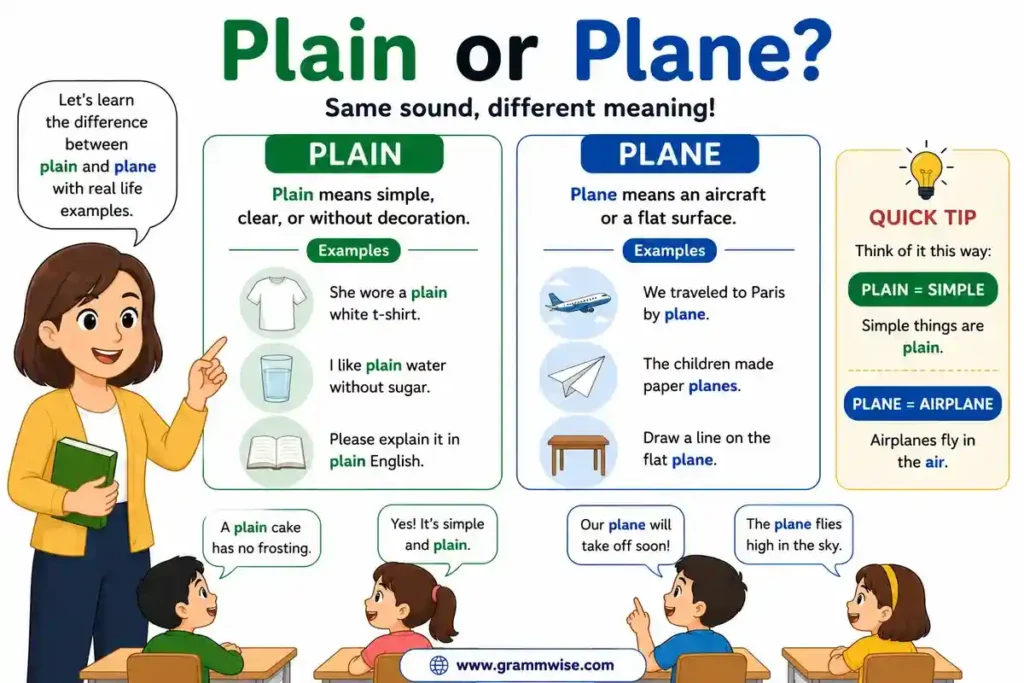
Plain English
Simple English that is easy to understand.
Example:
Please explain it in plain English.
Plain Clothes
Regular clothes instead of a uniform.
Example:
The police officer was wearing plain clothes.
Plain Truth
The simple and honest truth.
Example:
The plain truth is that we were late.
Plain White
Something with no extra colors or designs.
Example:
She bought a plain white notebook.
By Plane
Traveling in an airplane.
Example:
We went to Canada by plane.
Paper Plane
A toy made from folded paper.
Example:
The children made paper planes.
Plane Ticket
A ticket for air travel.
Example:
I booked my plane ticket online.
Catch a Plane
To get on an airplane before it leaves.
Example:
We must leave now to catch our plane.
Plain or Plane in Everyday Situations
Imagine these simple situations.
At the Airport
You check your luggage.
Then you get on a plane.
At the Clothing Store
You buy a simple blue shirt.
It has no pictures.
It is a plain shirt.
At School
Your teacher says,
“Use plain English.”
She wants you to write clearly and simply.
During Breakfast
You choose plain toast instead of toast with butter and jam.
It is simple.
Plain or Plane: Where This Word Comes From?
The word plain comes from an old Latin word that meant “clear” or “simple.” Over time, English kept the same idea. Today, plain still means simple, easy to understand, or not decorated.
The word plane also comes from Latin. It first described a flat surface. Many years later, people began using plane to describe airplanes because they were flying machines with flat wings. Today, the most common meaning of plane is an aircraft.
How Plain or Plane Is Understood in Culture and Stories?
Words often carry ideas that people understand right away. The words plain and plane appear in books, movies, songs, and daily conversations because they describe things people see and experience often.
The word plain is usually connected with simplicity. When people hear the word, they often think about something that is simple, honest, and easy to understand.
For example:
- A person may wear plain clothes.
- A writer may use plain language.
- A room may have plain walls.
In many stories, a plain character is not flashy or fancy. Instead, that person is often honest, kind, and realistic. The word plane often brings thoughts of travel and adventure. When people hear the word plane, they usually think about:
- Flying
- Vacations
- New places
- Long journeys
In stories and movies, planes often help characters begin exciting adventures. A plane trip may take someone to a new city, a new country, or a life-changing experience.
Because of this, plain and plane create very different pictures in people’s minds.
One suggests simplicity. The other suggests travel and movement.
Biblical and Mythological Meaning of Plain or Plane
The word plain appears in some Bible translations when talking about open areas of land. For example, people traveled across plains, lived on plains, or fought battles on plains. The meaning is usually simple and direct. It describes flat land. The word plain can also connect with honesty and simplicity. Many people value plain speech because it is clear and truthful.
The word plane does not have a special biblical meaning because airplanes did not exist in biblical times.
In mythology, neither word has a major symbolic role on its own. However, the ideas behind them can still appear in stories.
A plain may represent openness and simplicity.
A plane may represent a journey, discovery, or a new beginning.
Symbolism of Plain or Plane Explained in Simple Words
What Plain Represents?
The word plain often represents:
- Simplicity
- Honesty
- Clarity
- Humility
- Everyday life
- Truth
When someone uses plain language, they want everyone to understand. When someone wears plain clothing, they may care more about comfort than appearance.
Because of this, plain often has a positive meaning.
It shows that something does not need extra decoration to be valuable.
What Plane Represents?
The word plane often represents:
- Travel
- Freedom
- Adventure
- Progress
- Discovery
- New opportunities
A plane can take people far from home. It can connect different countries and cultures. Because of this, planes often symbolize movement and new experiences.
Many people see a plane as a sign of exciting possibilities.
Related Words You Should Know
Learning related words can make English easier.
Simple
Something easy to understand.
Example:
The directions were simple.
Basic
Something without extra features.
Example:
I bought a basic notebook.
Clear
Easy to understand.
Example:
Her explanation was clear.
Ordinary
Not special or unusual.
Example:
It was an ordinary day.
Aircraft
A machine that flies.
Example:
The aircraft landed safely.
Airplane
Another word for plane.
Example:
The airplane arrived on time.
Flight
A trip through the air.
Example:
Our flight leaves tonight.
Journey
Travel from one place to another.
Example:
The journey took three hours.
Travel
Going from one place to another.
Example:
Many people travel by plane.
Open Land
A large flat area.
Example:
The animals crossed the open land.
How People Actually Use Plain or Plane in Daily English?
Here are examples you may hear in everyday conversations.
- “I like plain coffee without sugar.”
- “Please explain it in plain English.”
- “She wore a plain white shirt.”
- “The room looks plain but clean.”
- “Our plane leaves at eight o’clock.”
- “The plane landed safely.”
- “We traveled by plane last summer.”
- “I need to book a plane ticket.”
- “The pilot flew the plane through the storm.”
- “The children made paper planes.”
These examples show how common both words are in daily life.
Common Mistakes People Make About Plain or Plane
Many learners make the same mistakes when using plain or plane.
Mistake 1
❌ We traveled by plain.
✅ We traveled by plane.
Remember:
Airplanes fly.
Use plane.
Mistake 2
❌ I like plane rice.
✅ I like plain rice.
The rice is simple.
Use plain.
Mistake 3
❌ The plain landed safely.
✅ The plane landed safely.
An airplane lands.
Use plane.
Mistake 4
❌ Please write in plane English.
✅ Please write in plain English.
Simple English is called plain English.
Mistake 5
Thinking both words mean the same thing.
They do not.
One means simple.
The other means an aircraft or a flat surface.
Always think about the meaning before choosing the spelling.
Final Teacher Explanation on Plain or Plane
Imagine we are finishing today’s lesson.
I write two words on the board.
Plain
Plane
Then I ask a simple question.
“Are you talking about something simple, clear, or ordinary?”
If the answer is yes, choose plain.
Then I ask another question.
“Are you talking about an airplane or a flat surface?”
If the answer is yes, choose plane.
That is the easiest way to remember the difference. You do not need difficult rules. You only need to remember two simple ideas.
Plain means simple.
Plane means aircraft or flat surface.
Keep practicing with short sentences. The more you read and write these words, the easier they become. Soon, you will know the correct spelling without stopping to think.
Final Thought on Plain or Plane
Plain means simple, clear, ordinary, or not decorated.
Plane means an airplane or a flat surface.
If you remember plain = simple and plane = airplane, you will choose the correct word almost every time.
Conclusion
Understanding plain or plane becomes simple when you focus on the meaning of each word. Use plain when something is simple, clear, ordinary, or without decoration. Use plane when talking about an airplane or a flat surface. This easy rule can help you avoid common mistakes in speaking and writing.
Keep practicing these words in everyday situations. The more examples you read and use, the more natural they will feel. With regular practice, choosing the correct word will become quick and easy.
Frequently Asked Questions (FAQs)
What does plain mean in simple words?
Plain means simple, clear, ordinary, or without decoration.
What does plane mean in simple words?
Plane usually means an airplane. It can also mean a flat surface.
Which is correct: plain or plane?
Both words are correct. The right choice depends on the meaning you want to express.
Why do people confuse plain or plane?
They sound exactly the same, but they have different spellings and meanings.
Can I use plain and plane in the same sentence?
Yes.
Example: “I wore a plain shirt while traveling on a plane.”
What is plain English?
Plain English means simple and easy-to-understand language.
Is plane another word for airplane?
Yes. In everyday English, plane is a shorter word for airplane.
How can I remember the difference between plain or plane?
Think of plain as simple and plane as something that flies in the air.