
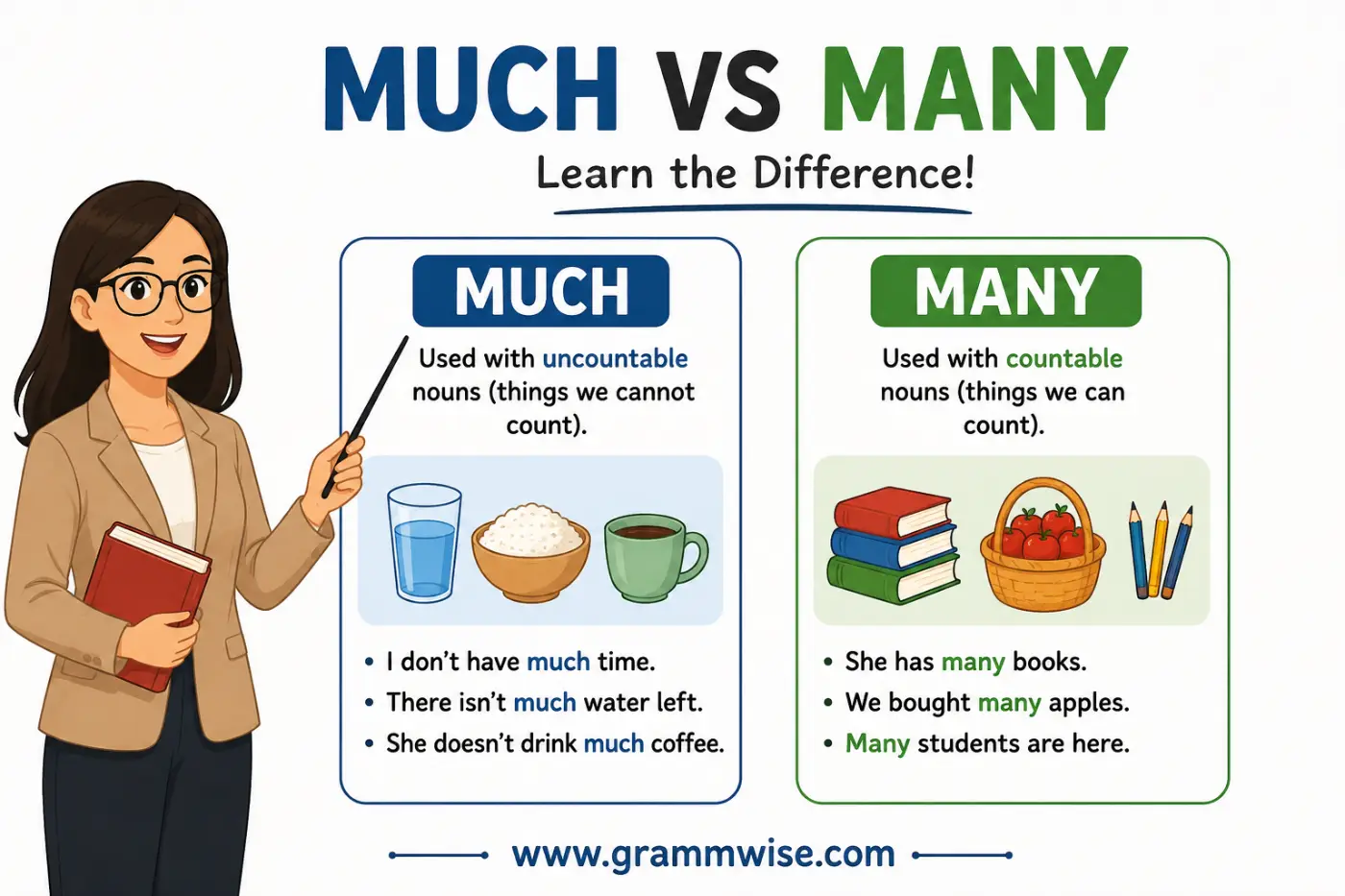
Many English learners get confused about much vs many because both words talk about quantity. They both mean “a large amount” or “a large number,” but they are not used in the same way. Choosing the wrong one can make your sentence sound unnatural, even if people still understand you.
The good news is that much vs many is one of the easiest grammar topics to learn. Once you know one simple rule, you can use both words correctly in speaking and writing. You do not need to memorize long grammar rules.
In this guide, you will learn the meaning of much and many, understand the difference between them, see real-life examples, and discover simple memory tricks that will help you remember which one to use every time.
Some words may seem interchangeable but carry different shades of meaning such as near vs nearby.
Simple Answer in One Look
Here is the quick answer.
- Much is used with things you cannot count.
- Many is used with things you can count.
Examples
- I don’t have much water.
- She has many books.
Think of it this way:
- If you can count it one by one, use many.
- If you cannot count it one by one, use much.
That is the easiest way to remember the difference.
What Much vs Many Mean in Simple English?
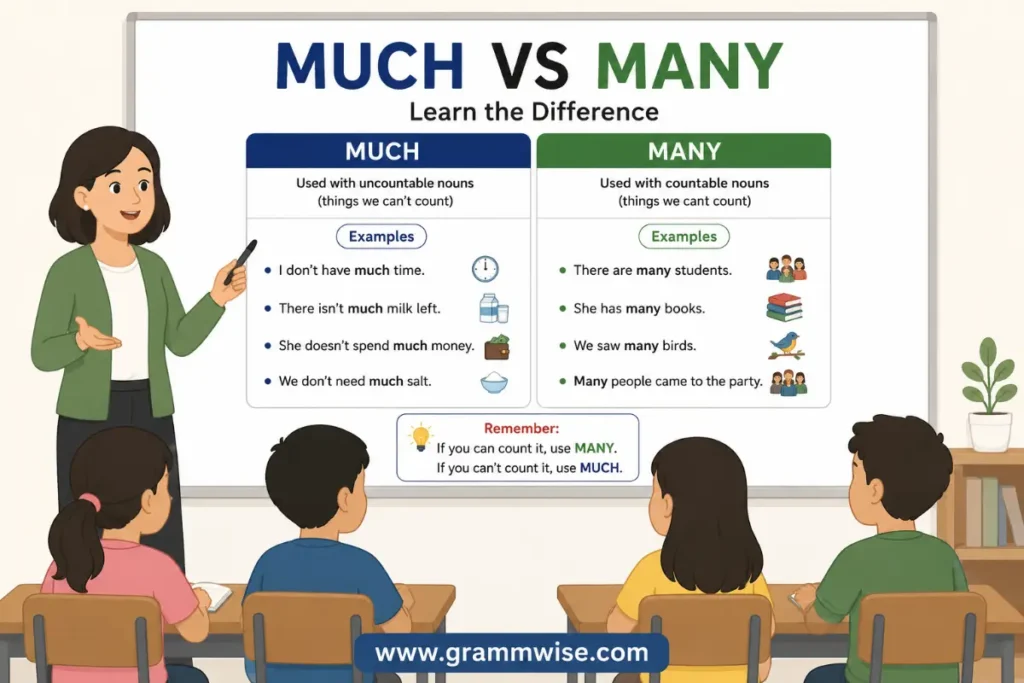
Both much and many tell us about quantity.
They answer questions like:
- How much?
- How many?
Even though they have similar meanings, they are used with different kinds of nouns.
What Does “Much” Mean?
Much means a large amount of something that cannot be counted one by one.
These things are often measured instead of counted.
Examples include:
- Water
- Milk
- Sugar
- Rice
- Money
- Time
- Air
- Coffee
Examples:
- We don’t have much milk.
- She spent too much money.
- There isn’t much time left.
- I didn’t drink much water today.
You cannot normally count these items one by one.
Instead, you measure them.
For example:
- Two litres of water
- Five kilos of rice
- Three cups of coffee
That is why much is the correct choice.
What Does “Many” Mean?
Many means a large number of things that you can count.
Examples include:
- Books
- Apples
- Cars
- Students
- Chairs
- Pens
- Dogs
- Friends
Examples:
- She has many books.
- We saw many birds.
- Many people came to the party.
- There are many trees in the park.
These are all things you can count individually.
One book.
Two books.
Three books.
That is why many is correct.
Why People Mix These Words Much vs Many?
Many learners struggle with much vs many because both words describe quantity.
Here are the most common reasons.
They Have Similar Meanings
Both words tell us that there is a large quantity.
Compare these sentences.
- There isn’t much water.
- There aren’t many bottles.
Both talk about quantity.
The difference is what comes after the word.
Some Languages Use Only One Word
In many languages, one word is used for both countable and uncountable nouns.
English separates them into two different words.
This can confuse learners.
Countable and Uncountable Nouns Can Be Tricky
Sometimes it is easy.
Books can be counted.
Water cannot.
But some words are harder.
For example:
- Advice
- Information
- Furniture
- Luggage
- News
These look like things you could count, but in English they are treated as uncountable.
So we say:
- Much information
- Much advice
- Much furniture
Not:
❌ Many information
❌ Many advice
Daily Speech Is Sometimes Different
In casual conversation, native speakers often use words like:
- A lot of
- Lots of
- Plenty of
Instead of:
- Much
- Many
For example:
Instead of saying:
- I don’t have much money.
People may say:
- I don’t have a lot of money.
Both are correct.
This makes the topic seem more confusing than it really is.
Clear Difference Between Much vs Many Explained Simply
The easiest way to understand much vs many is to ask yourself one question.
Can I count it?
If the answer is yes, use many.
If the answer is no, use much.
Use Many for Countable Things
Examples:
- Many students
- Many cookies
- Many pencils
- Many houses
- Many flowers
- Many phones
You can count every one of these.
Use Much for Uncountable Things
Examples:
- Much water
- Much coffee
- Much love
- Much happiness
- Much information
- Much traffic
These are not usually counted one by one.
Quick Comparison Table Much vs Many
| Much | Many |
|---|---|
| Used with uncountable nouns | Used with countable nouns |
| Talks about amounts | Talks about numbers |
| Much water | Many bottles |
| Much time | Many hours |
| Much money | Many coins |
Remember:
Much = amount
Many = number
Much vs Many: Which Form Should You Use?
The correct word depends on the noun that follows it.
Use Much When You Cannot Count Something
Examples:
- I don’t have much patience.
- There wasn’t much rain.
- She doesn’t drink much coffee.
- We don’t have much space.
- Is there much traffic today?
These things are measured, not counted.
Use Many When You Can Count Something
Examples:
- I don’t have many friends here.
- There are many cars on the road.
- We visited many museums.
- She owns many dresses.
- How many pencils do you have?
Every item can be counted.
Memory Trick for Much vs Many That Really Works
Ask yourself:
Can I say:
One…
Two…
Three…
If yes, use many.
If not, use much.
That simple question solves most mistakes.
Common Expressions with Much
These expressions are very common.
- Too much
- So much
- How much
- Much better
- Much easier
- Very much
- As much as
- Not much
Examples:
- Thank you very much.
- That costs too much.
- How much sugar do you need?
- I miss you very much.
- It is much easier now.
Notice that some of these expressions do not describe nouns directly.
For example:
- Thank you very much.
Here, much strengthens the phrase.
Common Expressions with Many
These expressions are also very common.
- Too many
- So many
- How many
- Many people
- Many years
- Many times
- Many different
- As many as
Examples:
- Too many people arrived early.
- How many students are absent?
- She has many hobbies.
- I’ve visited London many times.
These phrases appear in everyday English.
Easy Real-Life Sentences on Much vs Many
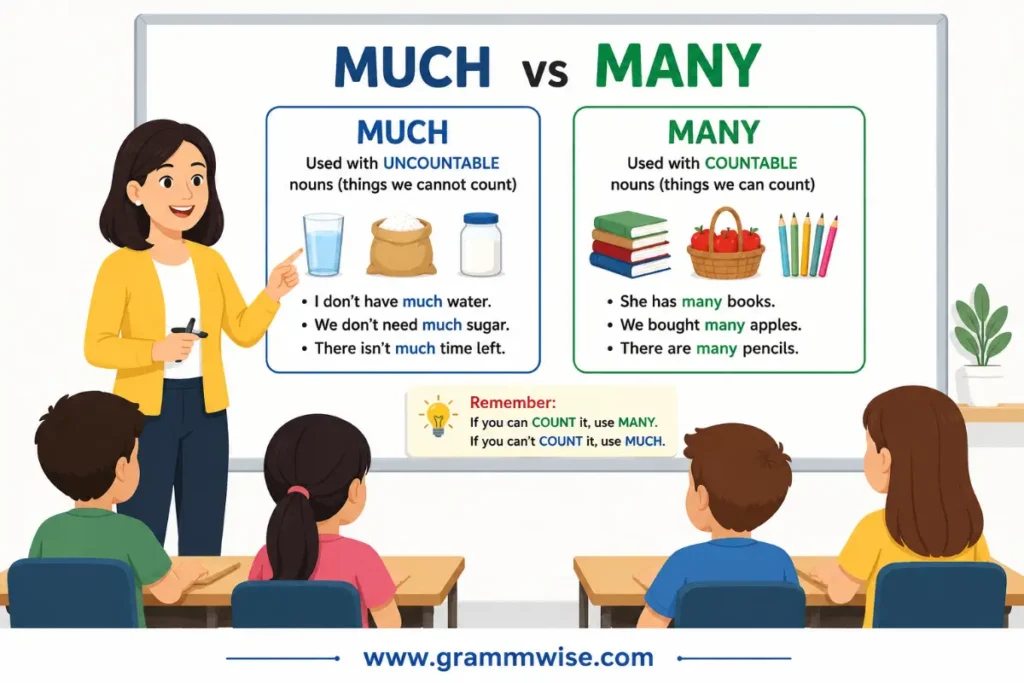
Examples with Much
- I don’t have much money today.
- There isn’t much snow this winter.
- She doesn’t eat much sugar.
- We don’t have much time.
- Is there much traffic?
- I didn’t get much sleep.
- They don’t need much help.
- There wasn’t much noise outside.
Examples with Many
- Many children like cartoons.
- We planted many trees.
- She has many cousins.
- Many people enjoy swimming.
- I don’t own many shoes.
- We invited many guests.
- There were many questions.
- He has read many books.
Reading these sentences helps you hear the natural pattern.
Much vs Many: Where These Words Come From?
The words much and many have been part of English for hundreds of years.
They come from Old English, where different words were already used to describe amounts and numbers.
Over time, English kept this simple system.
Much became the word for things that are measured.
Many became the word for things that are counted.
Even today, this rule remains almost exactly the same.
That is one reason these words are so important in English.
Quick Comparison Chart
| Feature | Much | Many |
|---|---|---|
| Meaning | Large amount | Large number |
| Used with | Uncountable nouns | Countable nouns |
| Examples | Water, time, money | Books, cars, people |
| Question | How much? | How many? |
| Easy memory | Measure it | Count it |
Much vs Many: How These Words Are Understood in Culture and Everyday Life
Language reflects the way people think and communicate. The words much and many may seem small, but native English speakers use them every day.
You will hear them at school, at work, while shopping, and even while watching TV.
Although they are grammar words, they help people ask questions, describe quantities, and explain everyday situations.
For example, parents may ask:
- How much milk is left?
- How many apples do we need?
Teachers may ask:
- How much time do we have?
- How many students finished the homework?
These questions are part of daily life.
Much in Everyday Life
People use much when talking about things that cannot usually be counted one by one.
For example:
- There isn’t much traffic today.
- I don’t have much energy.
- We don’t need much salt.
- She spent too much money.
These sentences sound natural because the nouns are measured instead of counted.
Many in Everyday Life
People use many for things that can be counted.
For example:
- Many families visited the park.
- We have many chairs.
- There were many questions.
- She owns many books.
Whenever people talk about numbers of objects or people, many is usually the correct choice.
Biblical and Mythological Meaning of Much vs Many
The words much and many do not have special biblical or mythological meanings.
They are everyday English words used to describe quantity.
However, English translations of the Bible often use them because many stories talk about large numbers of people or large amounts of something.
For example:
- Many people followed the teacher.
- Much wisdom comes from experience.
These words simply describe quantity.
The message comes from the story itself, not from the words.
The same is true in mythology.
Stories about kings, heroes, and gods often mention:
- Many warriors
- Many kingdoms
- Much courage
- Much power
Again, many describes things that can be counted, while much describes things that cannot.
Symbolism Explained in Simple Words
What Much Represents?
The word much often represents things that cannot be easily counted.
These are usually ideas, feelings, or substances.
For example:
- Much love
- Much happiness
- Much patience
- Much hope
These things do not come as separate pieces.
Symbolically, much represents:
- Abundance
- Kindness
- Love
- Time
- Energy
- Knowledge
People often use much when talking about emotions or experiences.
What Many Represents?
The word many represents things that can be counted.
Examples include:
- Many friends
- Many dreams
- Many opportunities
- Many choices
Symbolically, many represents:
- Growth
- Community
- Variety
- Opportunity
- Numbers
- Possibilities
It reminds us that life often gives us many chances to learn and improve.
Simple Comparison
Imagine a classroom.
There are many students.
You can count every student.
Inside the classroom there is also much learning.
You cannot count learning one by one.
This picture makes the difference easy to remember.
Related Words You Should Know
Learning related words will help you understand much vs many even better.
A Lot Of
Used with both countable and uncountable nouns.
Example:
- We have a lot of homework.
- She owns a lot of books.
Lots Of
A more casual way to say a lot of.
Example:
- There are lots of flowers outside.
Plenty Of
Means more than enough.
Example:
- We have plenty of food.
Several
Means more than two but not many.
Example:
- I have several questions.
Few
Means a small number of countable things.
Example:
- Few people knew the answer.
A Few
Means some countable things.
Example:
- I bought a few apples.
Little
Means a small amount of something uncountable.
Example:
- We have little time.
A Little
Means some amount, but not much.
Example:
- Add a little sugar.
Number
Used with countable nouns.
Example:
- A large number of students attended.
Amount
Used with uncountable nouns.
Example:
- A small amount of water spilled.
Knowing these words will improve your vocabulary and help you talk about quantity more naturally.
How People Actually Use Much and Many in Daily English
Here are examples you might hear every day.
At School
- How many students are in your class?
- We don’t have much homework today.
- Many children enjoy reading.
- I don’t have much time before class.
At Home
- There isn’t much bread left.
- We invited many relatives.
- Do we have much milk?
- Many dishes need washing.
While Shopping
- How much does this shirt cost?
- How many bananas do we need?
- There isn’t much juice left.
- Many customers came today.
At Work
- We don’t have much free time.
- Many people attended the meeting.
- She completed many projects.
- There wasn’t much stress today.
Talking About Food
- Don’t add too much salt.
- We bought many oranges.
- I didn’t drink much water.
- Many restaurants were open.
Talking About Travel
- We visited many cities.
- There wasn’t much traffic.
- Many tourists came this summer.
- We didn’t spend much money.
These are natural sentences that native English speakers use every day.
Common Mistakes People Make About Much vs Many
Many English learners make the same mistakes when using much vs many.
Here are the most common ones.
Mistake 1: Using Many with Uncountable Nouns
❌ Many water
✅ Much water
Water cannot be counted one by one.
Mistake 2: Using Much with Countable Nouns
❌ Much books
✅ Many books
Books are countable.
Mistake 3: Saying “Many Money”
❌ Many money
✅ Much money
Money is treated as an uncountable noun when talking about an amount.
Mistake 4: Confusing Information
❌ Many information
✅ Much information
Information is uncountable in English.
Mistake 5: Confusing Advice
❌ Many advice
✅ Much advice
Advice is also uncountable.
Mistake 6: Forgetting the Simple Rule
Before choosing much or many, ask yourself:
Can I count it?
If yes, use many.
If no, use much.
This question helps you avoid almost every mistake.
Practice Time
Choose the correct word.
- I don’t have __ time.
- How __ books do you own?
- There isn’t __ milk left.
- We invited __ friends.
- She doesn’t have __ patience.
- There are __ birds in the garden.
✅ Answers:
- much
- many
- much
- many
- much
- many
If you answered these correctly, you already understand the basic rule.
Final Teacher Explanation
Imagine we are finishing today’s English lesson.
I place two boxes on the table.
The first box contains apples.
You can count them.
One apple.
Two apples.
Three apples.
This box belongs to many.
The second box contains water.
Can you count the water one by one?
No.
You measure it instead.
This box belongs to much.
That is the whole lesson.
You do not need difficult grammar rules.
Just remember one simple idea.
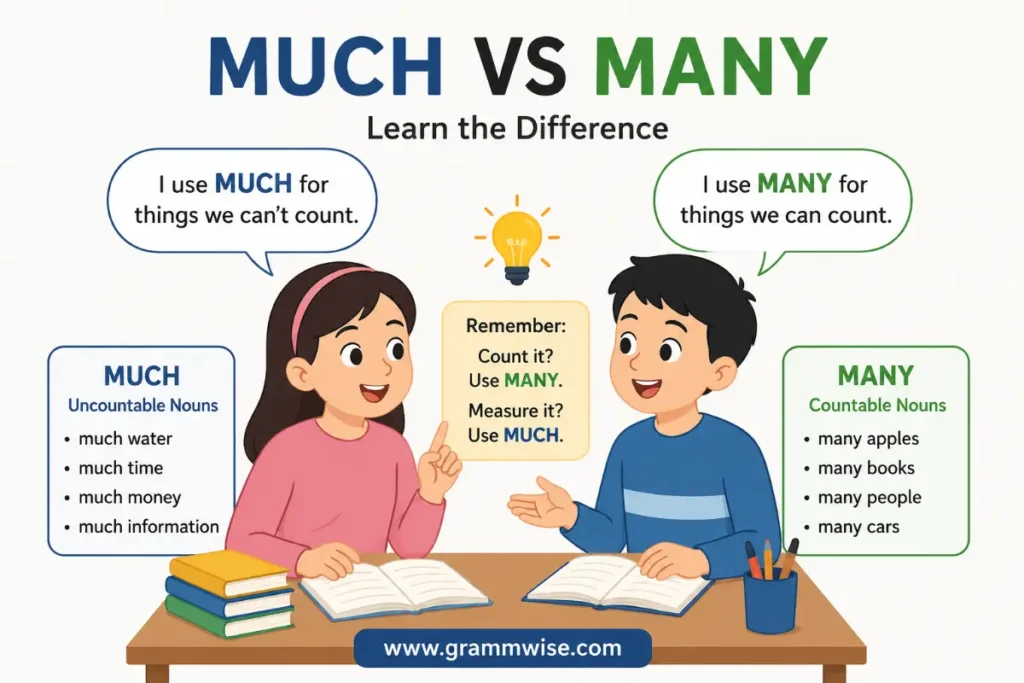
Count it? Use many.
Measure it? Use much.
Whenever you speak or write English, stop for one second and ask yourself that question.
Soon, choosing between much and many will become automatic.
The more you practice with everyday sentences, the easier it becomes.
Quick Recap Much vs Many
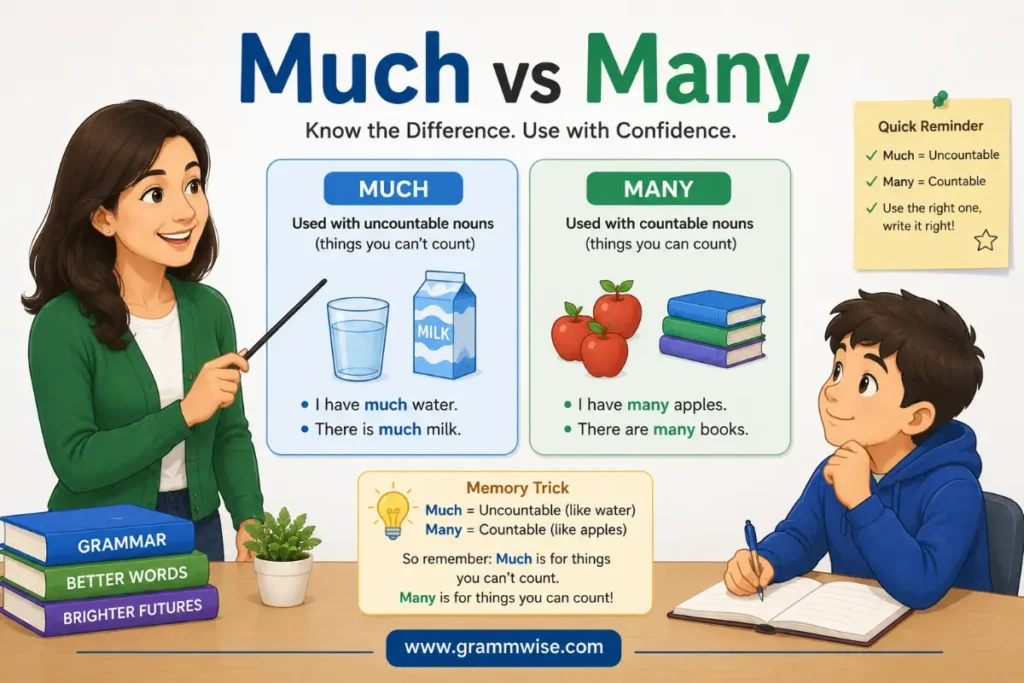
The difference between much vs many is simple. Much is used with uncountable nouns, while many is used with countable nouns.
Remember this easy rule: If you can count it, use many. If you measure it, use much. This simple trick will help you use both words correctly in everyday English.
Conclusion
Understanding much vs many is simple when you remember one easy rule. Use much with uncountable nouns like water, time, and money, and use many with countable nouns like books, people, and apples. This small rule will help you avoid common grammar mistakes.
Keep practicing with everyday conversations and real-life examples to build your confidence. The more you read and use these words, the more natural they will become, helping you speak and write English more accurately.
Frequently Asked Questions (FAQs)
What is the difference between much vs many?
Much is used with uncountable nouns, while many is used with countable nouns.
When should I use much?
Use much when talking about things you cannot count individually, such as water, time, money, or sugar.
When should I use many?
Use many when talking about things you can count, such as books, people, chairs, or apples.
Is it “much people” or “many people”?
The correct phrase is many people because people can be counted.
Is it “many money” or “much money”?
The correct phrase is much money because money is treated as an uncountable noun when talking about an amount.
Can I use “a lot of” instead of much or many?
Yes. A lot of works with both countable and uncountable nouns and is very common in everyday English.
Why do people confuse much vs many?
Both words describe quantity, but they follow different kinds of nouns. Remembering if the noun is countable or uncountable makes choosing the correct word much easier.
What is the easiest way to remember much vs many?
Use this simple rule: Count it? Use many. Measure it? Use much. This memory trick works in most everyday situations.