
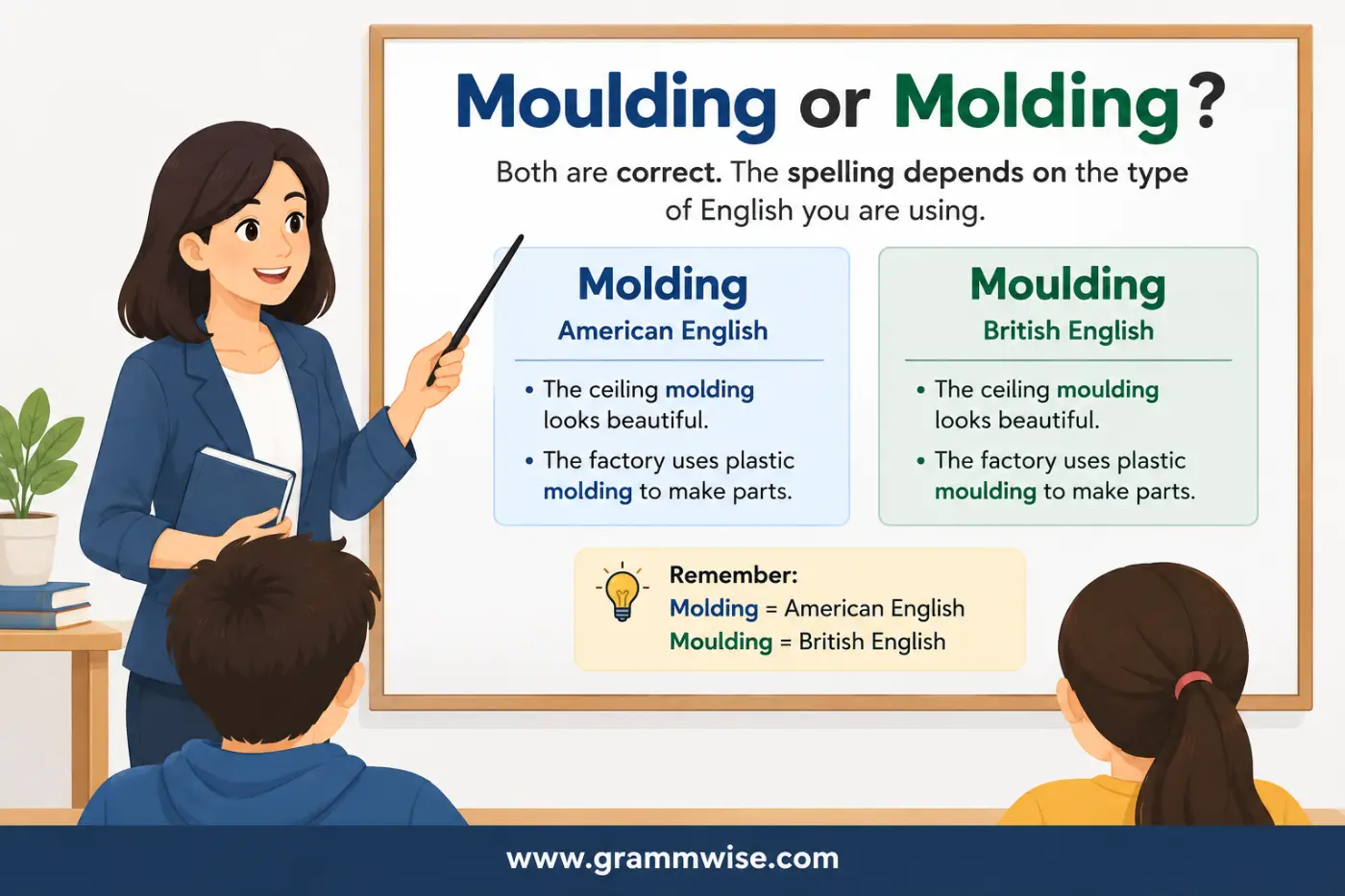
Have you ever seen the words moulding and molding and wondered which one is correct? You are not alone. Both spellings are correct, but they are mainly used in different types of English.
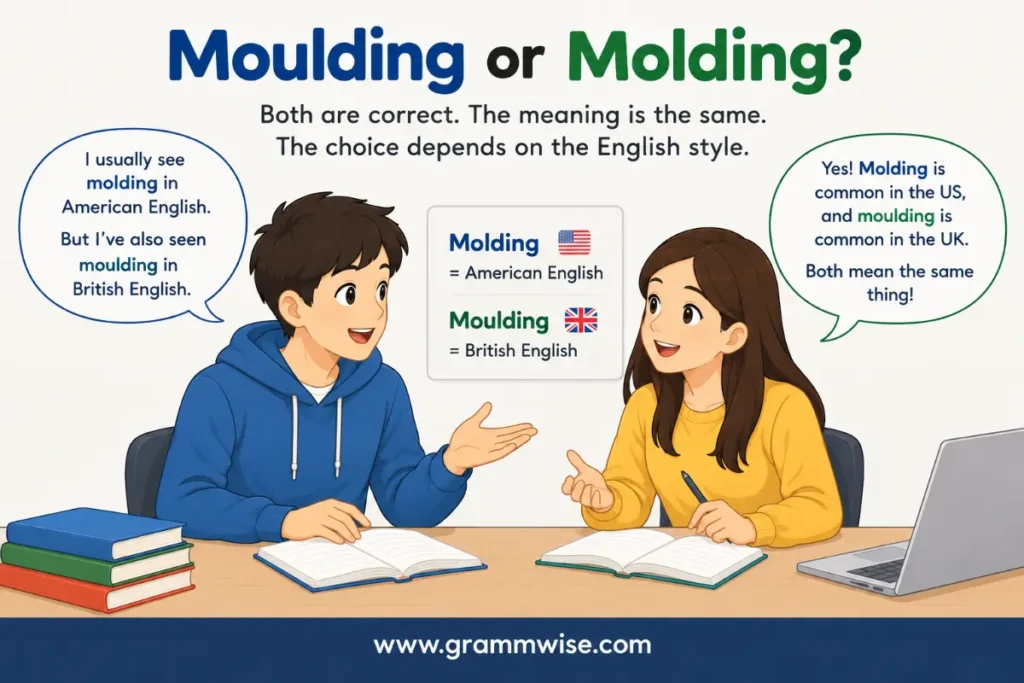
Molding is the standard spelling in American English, while moulding is the standard spelling in British English. Both words usually have the same meaning. The main difference is the spelling style used in different countries.
For example, an American writer would usually write, “The wooden molding looks beautiful.” A British writer would usually write, “The wooden moulding looks beautiful.” The meaning does not change.
In this guide, we will explain the difference between moulding or molding, when to use each spelling, why people spell the word differently, and how you can remember the correct form easily.
Confused about the correct structure? Learn how to use neither…nor correctly.
Simple Answer in One Look
The easiest answer is this:
Molding is the American English spelling.
Moulding is the British English spelling.
Both words can describe a decorative strip or feature used on walls, ceilings, doors, or furniture. They can also describe the process of shaping a material into a particular form.
Here is a quick comparison:
| Word | Main English Style | Example |
|---|---|---|
| Molding | American English | The ceiling molding looks elegant. |
| Moulding | British English | The ceiling moulding looks elegant. |
So, if you are writing for an American audience, use molding.
If you are writing for a British audience, use moulding.
The same spelling difference appears in other words, such as mold/mould, molded/moulded, and molder/moulder.
Is “moulding” wrong?
No. Moulding is not wrong. It is the standard British English spelling.
Is “molding” wrong?
No. Molding is not wrong either. It is the standard American English spelling.
The important thing is to choose the spelling that matches your audience and stay consistent.
What Moulding or Molding Means in Simple English?
To understand moulding or molding, it helps to understand the word mold or mould first.
A mold or mould can be a shape or container used to give something a particular form. For example, a factory may pour plastic into a mold to create a product. The word can also refer to a decorative feature in a building.
For example:
The house has beautiful molding around the windows.
Here, “molding” means a decorative strip or raised design around the windows.
In British English, the same sentence would normally be written:
The house has beautiful moulding around the windows.
There is no difference in meaning.
The spelling changes because American and British English often use slightly different spelling patterns.
This is similar to other common differences:
color → American English
colour → British English
favorite → American English
favourite → British English
neighbor → American English
neighbour → British English
molding → American English
moulding → British English
This makes the difference easy to understand. You are not choosing between two different things. You are choosing between two spelling systems.
Moulding or Molding: Why People Mix These Words?
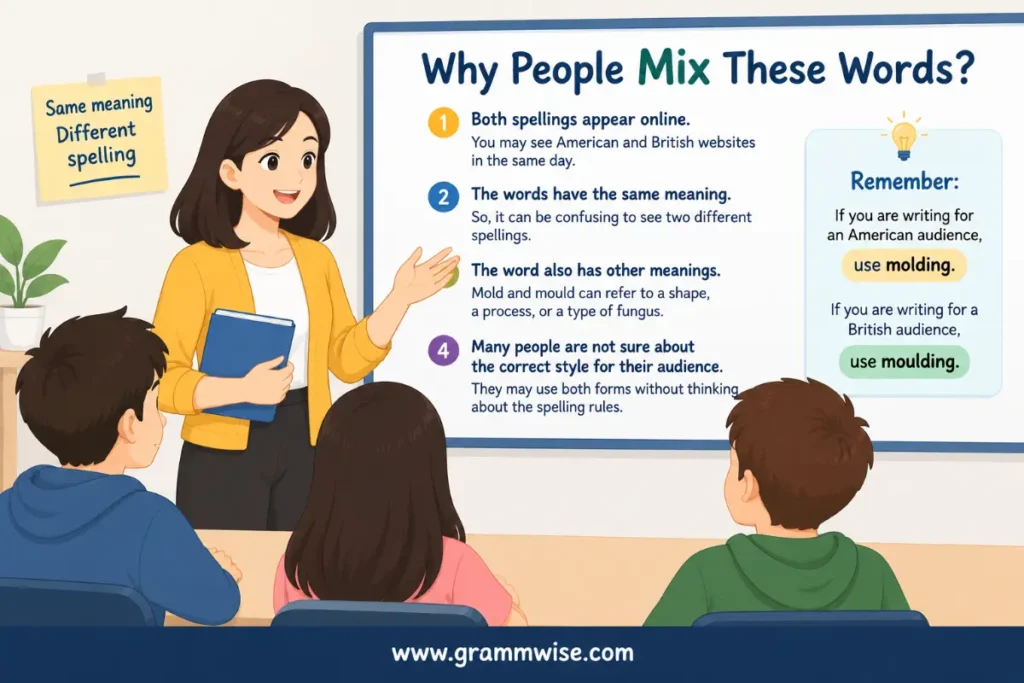
People often mix up moulding and molding because both forms appear online.
The internet has made English more international than ever. You may read an American website in the morning and a British website in the afternoon. You may also see product descriptions from companies based in different countries.
For example, an American home improvement website may say:
“Choose decorative molding for your living room.”
A British website may say:
“Choose decorative moulding for your living room.”
If you see both forms, it can make you wonder if they have different meanings. They usually do not. The difference is mainly regional spelling.
Another reason for confusion is that mold and mould have several meanings. The word can refer to a shape, a process of shaping something, or a type of fungus.
For example:
The artist used a mold to create the statue.
The artist used a mould to create the statue.
Again, the spelling depends on the English variety.
The same pattern continues when the word becomes molding or moulding.
Clear Difference Explained Simply
The difference between moulding or molding is mainly about American and British spelling.
Molding
Molding is the preferred American English spelling.
It is commonly used in the United States in areas such as:
- home design
- construction
- woodworking
- manufacturing
- architecture
- interior design
For example:
- The contractor installed new molding around the doors.
- The plastic molding process is used to make many products.
- The wall molding gives the room a classic look.
If your website, school, company, or publication follows American English, molding is usually the form you should choose.
Moulding
Moulding is the preferred British English spelling. It is commonly seen in the United Kingdom and other places where British spelling is used.
For example:
- The contractor installed new moulding around the doors.
- The plastic moulding process is used to make many products.
- The wall moulding gives the room a classic look.
The meaning remains the same.
The extra u is the main spelling difference.
A Simple Memory Trick
Here is an easy way to remember it:
Molding = American English
Moulding = British English
Think about the pair:
mold → molding
mould → moulding
The American form drops the u, while the British form keeps it.
You can also remember the connection with:
color → colour
favorite → favourite
neighbor → neighbour
American English often removes the u in these words, while British English keeps it.
Which Form Should You Use?
The answer depends on your audience.
- If you are writing for readers in the United States, use molding.
- If you are writing for readers in the United Kingdom, use moulding.
- If you are writing for an international audience, either spelling can be understood.
However, consistency is important. For example, if your article uses American English throughout, it is better to write:
The molding around the windows gives the room a clean look.
Do not switch to:
The moulding around the windows gives the room a clean look.
unless you have a specific reason to use British English.
The same rule applies to your other spelling choices.
If you choose American English, you might write:
color, favorite, neighbor, molding
If you choose British English, you might write:
colour, favourite, neighbour, moulding
There is no need to worry that one version is automatically more correct. The key is to use the form that matches your chosen style.
What Should American Writers Use?
American writers should normally use molding.
Example:
The molding around the fireplace needs to be painted.
What Should British Writers Use?
British writers should normally use moulding.
Example:
The moulding around the fireplace needs to be painted.
What About Online Writing?
For online writing, choose the spelling that fits your target readers. If your content is aimed mainly at American readers, use molding. If your content is aimed mainly at British readers, use moulding.
Search engines can understand both spellings, but using the spelling that your readers expect can make your content more natural.
Easy Real-Life Sentences You Can Use
Seeing examples is one of the easiest ways to understand moulding or molding.
Here are some simple examples.
Examples with Molding
1. The carpenter installed new molding around the door.
Here, “molding” means a decorative strip around the door.
2. The white molding looks beautiful against the blue wall.
The word refers to a decorative part of the room.
3. We replaced the old molding in the living room.
The speaker is talking about decorative building material.
4. The house has simple molding around every window.
The molding is used as a decorative feature.
5. The factory uses plastic molding to make small parts.
Here, “molding” refers to the process of shaping plastic.
6. The ceiling molding gives the room a traditional look.
The word describes decoration near the ceiling.
7. The carpenter measured the molding before cutting it.
The molding is a physical piece of material.
Examples with Moulding
The same sentences can be written in British English by changing molding to moulding.
1. The carpenter installed new moulding around the door.
2. The white moulding looks beautiful against the blue wall.
3. We replaced the old moulding in the living room.
4. The house has simple moulding around every window.
5. The factory uses plastic moulding to make small parts.
6. The ceiling moulding gives the room a traditional look.
7. The carpenter measured the moulding before cutting it.
Notice that the meaning has not changed. Only the spelling has changed.
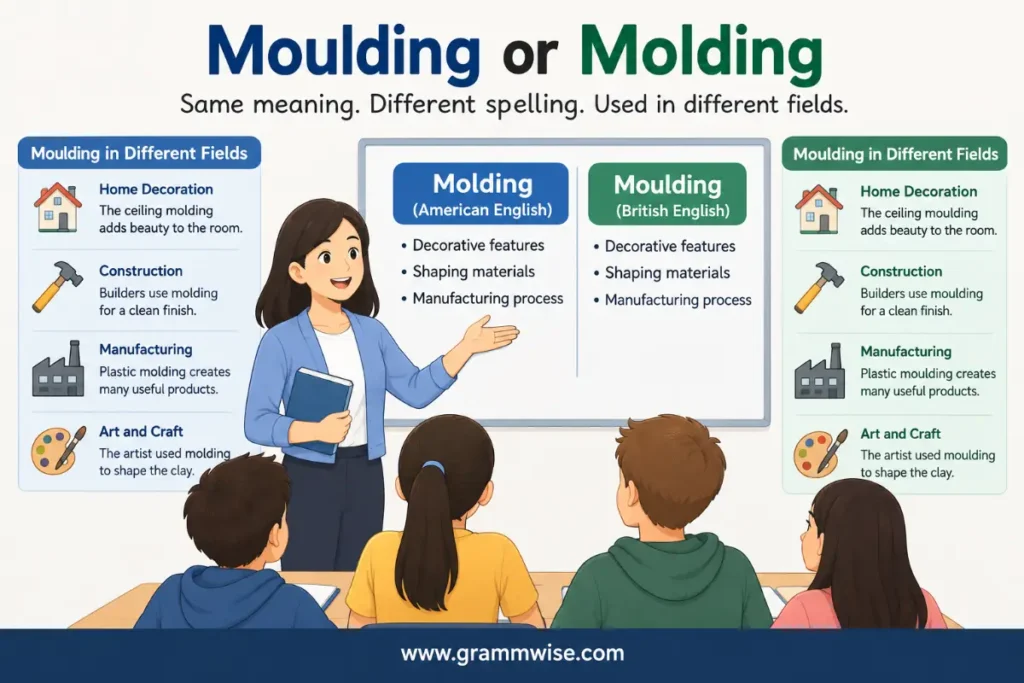
Molding and Moulding in Different Fields
The word appears in many areas of everyday life.
Home Decoration
In interior design, molding or moulding can mean a decorative strip added to walls, ceilings, doors, windows, or furniture.
For example:
The new molding makes the room look more elegant.
British English:
The new moulding makes the room look more elegant.
Construction
Builders and carpenters often use molding or moulding as part of a building’s design.
It can cover edges, create decorative patterns, or give walls and ceilings a finished appearance.
Manufacturing
In manufacturing, molding or moulding can describe the process of shaping a material.
Plastic, rubber, metal, and other materials may be shaped into useful products.
For example:
The company uses injection molding to produce plastic parts.
In British English, this is normally written:
The company uses injection moulding to produce plastic parts.
Art and Craft
Artists and craftspeople may also use molds or moulds to create repeated shapes.
For example:
The artist used a mold to make several identical pieces.
British English:
The artist used a mould to make several identical pieces.
Again, the spelling changes, but the basic idea stays the same.
Where This Word Comes From?
The words mold and mould have a long history in English.
The spelling mould has been used in English for many centuries. The form is connected to older words referring to a shape, form, or model used to give something a particular shape.
Over time, English developed different spelling traditions in different regions.
British English generally kept the u in words such as mould, while American English often simplified these spellings to mold.
The American spelling became common as American English developed its own spelling conventions. Many American spellings became shorter or more simplified.
This is why we now commonly see:
mould → British English
mold → American English
And:
moulding → British English
molding → American English
The change does not mean that the words developed completely different meanings. It is mainly a difference in spelling tradition.
One Important Point to Remember
When you see moulding or molding, do not think that you are looking at two completely different words.
They are usually the same word written in two different English varieties.
Molding is American English.
Moulding is British English.
Both can refer to decorative building features or the process of shaping material.
So, if you write for an American audience, choose molding. If you write for a British audience, choose moulding.
The most important rule is simple: choose one spelling style and use it consistently.
How This Word Is Understood in Culture and Stories?
The word moulding or molding is not usually a word that carries a special cultural meaning by itself. Most of the time, people use it in practical situations related to buildings, design, manufacturing, art, and crafts.
However, the basic idea behind the word can be connected to a common idea in stories and everyday language: shaping something into a particular form.
For example, when someone says that a teacher, parent, or experience “molded” a person, the word is being used in a figurative way.
Consider this sentence:
Her teacher molded her into a confident speaker.
The teacher did not physically shape the student. Instead, the teacher helped develop her skills and confidence.
In British English, the same sentence would normally be:
Her teacher moulded her into a confident speaker.
The meaning is the same.
This figurative use is common because a mold is used to give something a shape. When we say that an experience “molded” someone, we mean that the experience helped shape that person’s character, habits, skills, or way of thinking.
You may also hear expressions such as:
His childhood experiences molded his personality.
Good teachers can mold young minds.
The experience molded her future career.
In British English, these would use moulded instead of molded.
So, the word can have both a physical and a figurative use. The physical meaning is about shaping material. The figurative meaning is about shaping a person, idea, habit, or future.
Biblical and Mythological Meaning
There is no special biblical or mythological meaning attached specifically to the spelling difference between moulding and molding.
However, the general idea of molding or moulding can be connected with the idea of creating or shaping something.
In religious writing, the idea of shaping or forming can sometimes be used as a metaphor for creation, character, or spiritual development. But this does not make molding or moulding a special religious word.
For example, someone may use the idea of being “molded” by life as a metaphor for personal growth.
The important point is that the spelling difference remains the same:
molding = American English
moulding = British English
The spelling does not change because of religion, mythology, or symbolism.
Symbolism Explained in Simple Words
Because moulding or molding is mainly a spelling variation, the two forms do not represent two different ideas. Both versions can represent the same basic concept:
giving something a shape or form.
This can be a physical shape or a figurative shape.
What Molding Represents
In American English, molding can represent the idea of shaping.
For example:
The artist is molding the clay into a bowl.
Here, the artist is physically giving the clay a new shape.
It can also be used figuratively:
Her experiences molded her into a strong leader.
Here, experiences helped shape her character.
The word can also represent beauty and design when it refers to decorative molding in a building.
For example:
The decorative molding around the ceiling adds character to the room.
So, depending on the sentence, molding can be connected with:
- shape
- design
- creation
- development
- change
- personal growth
What Moulding Represents
Moulding represents the same ideas in British English.
For example:
The artist is moulding the clay into a bowl.
Or:
Her experiences moulded her into a strong leader.
The spelling is different, but the meaning is the same.
When moulding refers to decoration, it can also suggest style and craftsmanship.
For example:
The detailed moulding around the fireplace gives the room a classic appearance.
Again, the difference is not meaning. It is regional spelling.
Related Words You Should Know
Learning related words can make moulding or molding much easier to remember.
Mold and Mould
Mold is the American English spelling.
Mould is the British English spelling.
A mold or mould can be a container or shape used to form something.
Example:
The chocolate was poured into a mold.
British English:
The chocolate was poured into a mould.
The word can also mean fungus.
For example:
There is mold on the old bread.
British English:
There is mould on the old bread.
So, always look at the context.
Molded and Moulded
Molded is the American English spelling.
Moulded is the British English spelling.
Example:
The plastic was molded into a small toy.
British English:
The plastic was moulded into a small toy.
The same difference appears when the word is used figuratively:
His experiences molded his character.
British English:
His experiences moulded his character.
Molder and Moulder
Molder is the American spelling.
Moulder is the British spelling.
This word can describe something slowly breaking down or decaying.
For example:
The old wooden box began to molder.
In British English:
The old wooden box began to moulder.
These related forms follow the same spelling pattern.
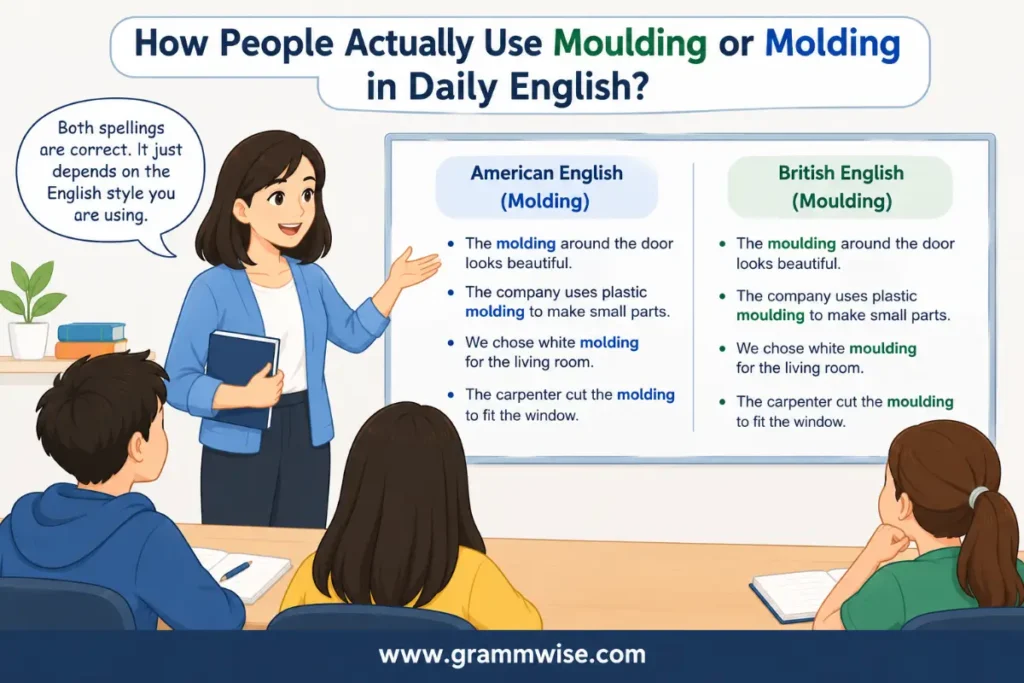
How People Actually Use Moulding or Molding in Daily English?
You will see molding or moulding in many real-life situations.
Here are some examples that make the difference easier to understand.
1. Home Decoration
The new molding around the windows looks great.
This is American English.
British English:
The new moulding around the windows looks great.
Here, the word refers to a decorative feature.
2. Interior Design
We chose white molding for the living room.
British English:
We chose white moulding for the living room.
The word describes decorative material used inside the room.
3. Carpentry
The carpenter cut the molding to fit the door.
British English:
The carpenter cut the moulding to fit the door.
Here, molding or moulding is a physical piece of material.
4. Manufacturing
The factory uses plastic molding to make small parts.
British English:
The factory uses plastic moulding to make small parts.
Here, the word refers to a manufacturing process.
5. Art
The artist is molding the clay with her hands.
British English:
The artist is moulding the clay with her hands.
The artist is shaping the clay.
6. Personal Development
Her experiences molded her into a responsible person.
British English:
Her experiences moulded her into a responsible person.
This is a figurative use. Experiences helped shape her character.
7. Education
Good teachers can mold a student’s habits.
British English:
Good teachers can mould a student’s habits.
The teacher is not physically shaping the student. The meaning is that the teacher can influence the student’s development.
8. Design
The decorative molding gave the room a traditional look.
British English:
The decorative moulding gave the room a traditional look.
The word describes a design feature.
9. Product Making
The company specializes in plastic molding.
British English:
The company specializes in plastic moulding.
The word describes a production method.
10. Building Restoration
The old molding was carefully repaired.
British English:
The old moulding was carefully repaired.
Here, the word refers to decorative architectural material.
Common Mistakes People Make
Even though the difference is simple, people make several common mistakes with moulding or molding.
Mistake 1: Thinking One Spelling Is Incorrect
Some people believe that moulding is a spelling mistake because they are used to seeing molding.
Others may think molding is incorrect because they learned British English.
Both assumptions are wrong.
Molding is correct in American English.
Moulding is correct in British English.
Mistake 2: Mixing American and British Spelling
A writer may use molding in one paragraph and moulding in another.
For example:
The molding around the door looks beautiful. The old moulding near the window was also repaired.
The reader can understand the sentence, but the spelling style is inconsistent.
If you are using American English, stay with molding.
If you are using British English, stay with moulding.
Mistake 3: Thinking They Have Different Meanings
Some learners believe that molding means one type of material while moulding means another.
That is usually not the case.
The spelling does not normally tell you what type of material is being used.
The difference is mainly regional.
Mistake 4: Forgetting the Connection With Mold and Mould
It can be easier to remember the spelling if you connect the words.
American English:
mold → molding
British English:
mould → moulding
If you remember this pattern, you are less likely to mix them up.
Mistake 5: Using the Wrong Style for Your Audience
Imagine that you are writing a guide for an American home improvement company but use British spellings throughout the article.
The information may still be correct, but the spelling may not match the company’s preferred English style.
Always think about your readers.
Mistake 6: Assuming the Word Only Refers to Decoration
Molding or moulding can have more than one use.
It can refer to:
- decorative building material
- shaping material
- a manufacturing process
- the act of shaping something
- figurative personal development
Understanding the context helps you understand the exact meaning.
Final Teacher Explanation
If I were explaining moulding or molding to a student in class, I would keep it very simple.
I would say:
“Both spellings are correct. The difference is where the English is used.”
Then I would write this on the board:
American English → molding
British English → moulding
I would then give the student this example:
The molding around the door is beautiful.
American English.
Then:
The moulding around the door is beautiful.
British English.
I would explain that both sentences describe the same thing. The biggest mistake is thinking that one word is right and the other is wrong. That is not how this spelling difference works.
The best choice depends on your audience. If you are writing American English, use molding. If you are writing British English, use moulding.
And once you choose one style, try to keep the same style throughout your writing.
Here is another useful memory trick:
American = no U
British = keep the U
So:
mold → molding
mould → moulding
This simple pattern can help you remember the correct spelling.
Quick Recap Moulding or Molding
The difference between moulding or molding is mainly a difference between British and American English.
Molding is the standard American English spelling.
Moulding is the standard British English spelling.
Both words can refer to decorative features in buildings, the process of shaping materials, or the act of shaping something.
For example:
American English: The molding around the door looks beautiful.
British English: The moulding around the door looks beautiful.
Both sentences have the same meaning.
So remember:
Molding = American English
Moulding = British English
Neither spelling is automatically wrong. Choose the version that matches the English style you are using, and keep your spelling consistent.
Conclusion
When choosing between moulding or molding, remember that both spellings are correct. Molding is the standard American English spelling, while moulding is the standard British English spelling. Both can describe decorative features, shaping materials, or the process of giving something a particular form.
The easiest way to remember the difference is to connect the words with mold and mould. American English usually drops the “u,” while British English keeps it. Choose the spelling that matches your audience and use it consistently throughout your writing.
Frequently Asked Questions
Is molding or moulding correct?
Both are correct. Molding is the standard American English spelling, while moulding is the standard British English spelling.
Is moulding British or American?
Moulding is the British English spelling. American English normally uses molding.
Is molding American English?
Yes. Molding is the standard American English spelling.
What is the difference between molding and moulding?
The main difference is spelling style. Molding is used in American English, while moulding is used in British English. Their meanings are generally the same.
Should I use molding or moulding in the US?
If you are writing for readers in the United States, use molding.
Should I use moulding in the UK?
Yes. Moulding is the standard British English spelling.
Is molding used only for decoration?
No. Molding can refer to decorative building features, the process of shaping materials, or figuratively shaping someone’s character or development.
How can I remember molding vs moulding?
Use this simple trick: American English drops the U: mold → molding. British English keeps it: mould → moulding.