
Many people wonder about Jam vs Jelly because both are sweet fruit spreads that look very similar. You may see them on toast, sandwiches, or breakfast tables, but they are not exactly the same. Learning Jam vs Jelly is easy once you know how each one is made and when people use them.
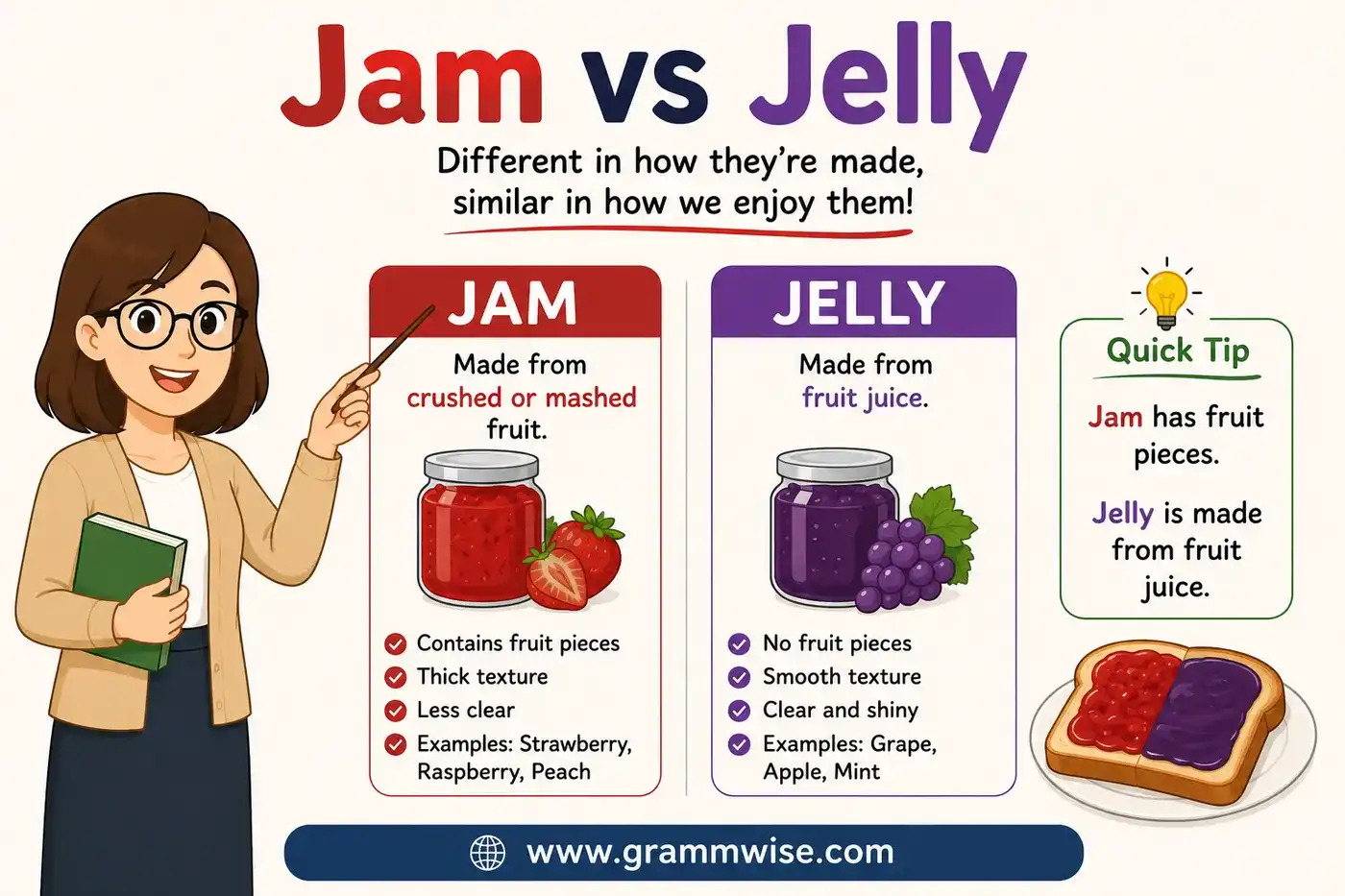
Jam and jelly both come from fruit. However, jam is made with crushed or mashed fruit, while jelly is made from fruit juice. This small difference changes the texture, look, and even the way people enjoy them.
In this guide, you will learn the difference between Jam vs Jelly in very simple English. You will also see easy examples, common mistakes, and simple tips to help you remember which one is which.
Understanding word differences improves writing clarity and communication.
Simple Answer in One Look
Jam is made with crushed fruit.
Jelly is made with fruit juice.
Jam has small pieces of fruit, while jelly is smooth and clear.
Meaning of “Jam vs Jelly” in Simple English
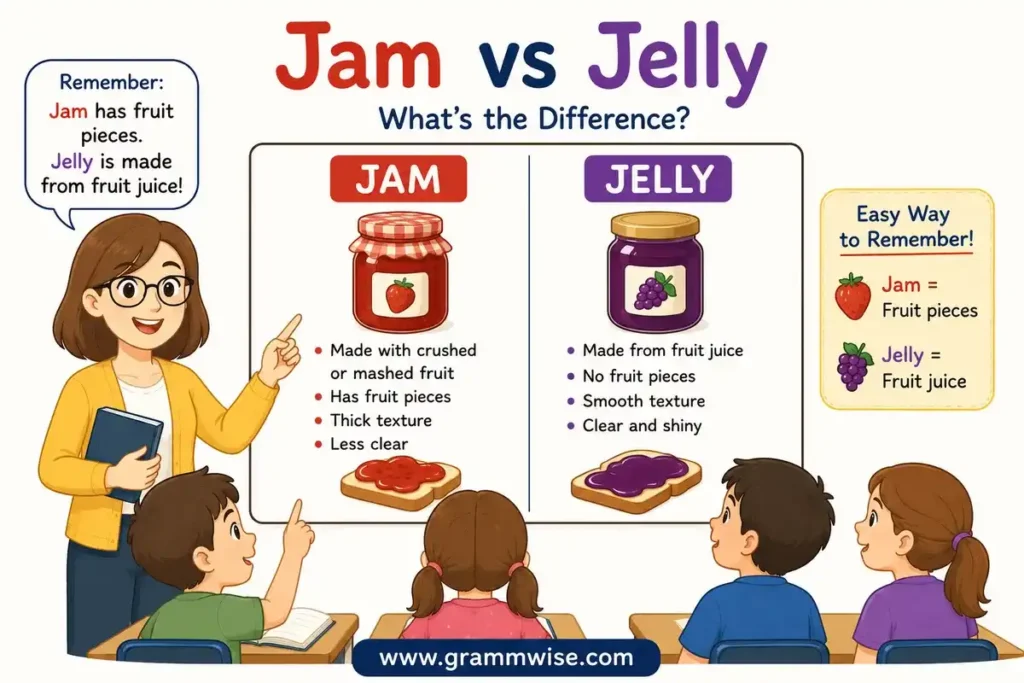
Think about eating fresh strawberries. If someone crushes the strawberries, cooks them with sugar, and makes a spread, you get jam.
Now imagine someone squeezes the strawberries and keeps only the juice. The juice is cooked with sugar until it becomes smooth. That makes jelly.
- Both taste sweet.
- Both are spread on bread.
- But one has fruit pieces, and the other is smooth.
That is the easiest way to understand Jam vs Jelly.
Jam vs Jelly: Why People Mix These Words
Many people confuse Jam vs Jelly because both are made from fruit.
They are also used in the same way.
You can spread both on:
- Toast
- Bread
- Biscuits
- Pancakes
- Peanut butter sandwiches
Since they look similar in a jar, many people think they are the same.
In some countries, people even use one word for both products.
Another reason is that grocery stores often place jam and jelly on the same shelf.
If you do not know how they are made, it is easy to think there is no difference.
The good news is that one simple rule makes everything clear.
- Jam has fruit pieces.
- Jelly is made from fruit juice.
Clear Difference of “Jam vs Jelly” Explained Simply
Here is the easiest way to understand Jam vs Jelly.
Jam
Made from:
- Crushed fruit
- Mashed fruit
- Sugar
- Sometimes pectin
Usually has:
- Small fruit pieces
- A thick texture
- A rich fruit taste
Examples:
- Strawberry jam
- Raspberry jam
- Peach jam
- Blueberry jam
Jelly
Made from:
- Fruit juice
- Sugar
- Pectin
Usually has:
- No fruit pieces
- A smooth texture
- A clear look
Examples:
- Grape jelly
- Apple jelly
- Mint jelly
Easy Comparison
Jam
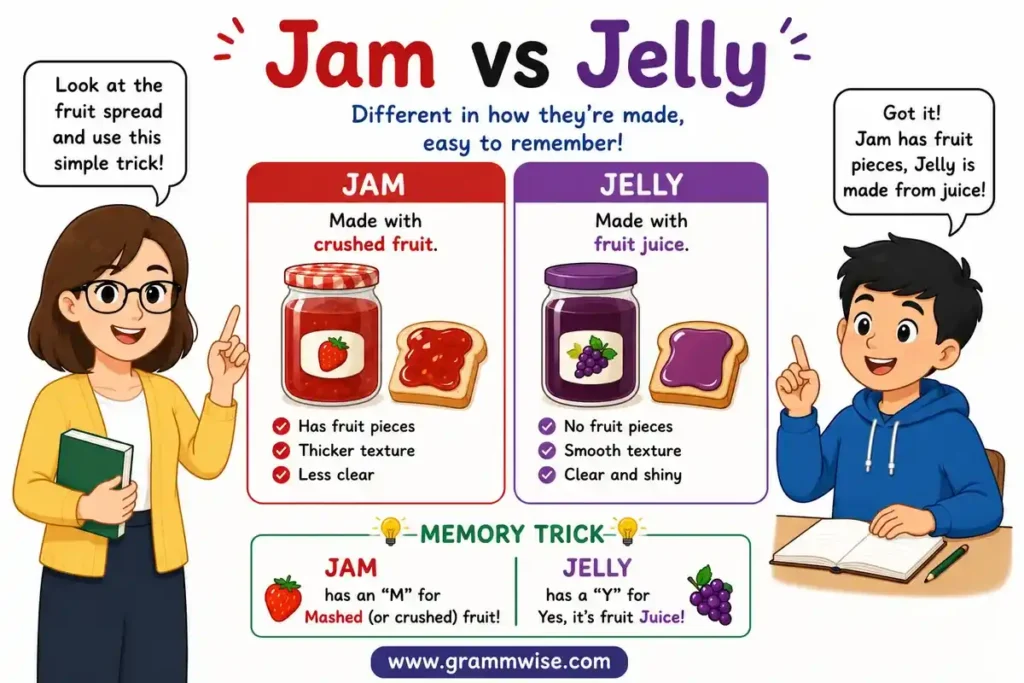
- Made from crushed fruit
- Contains fruit pieces
- Thick texture
- Less clear
Jelly
- Made from fruit juice
- No fruit pieces
- Smooth texture
- Clear appearance
Remember this simple idea.
If you can see fruit pieces, it is probably jam.
If it is smooth and clear, it is probably jelly.
Jam vs Jelly Comparison Table
| Feature | Jam | Jelly |
|---|---|---|
| Main Ingredient | Crushed or mashed fruit | Fruit juice |
| Fruit Pieces | Yes | No |
| Texture | Thick and chunky | Smooth |
| Appearance | Less clear | Clear |
| Taste | Rich fruit flavor | Smooth fruit flavor |
| Common Uses | Toast, bread, desserts | Toast, sandwiches, biscuits |
| Easy Way to Remember | Fruit pieces | Fruit juice |
Quick Tip
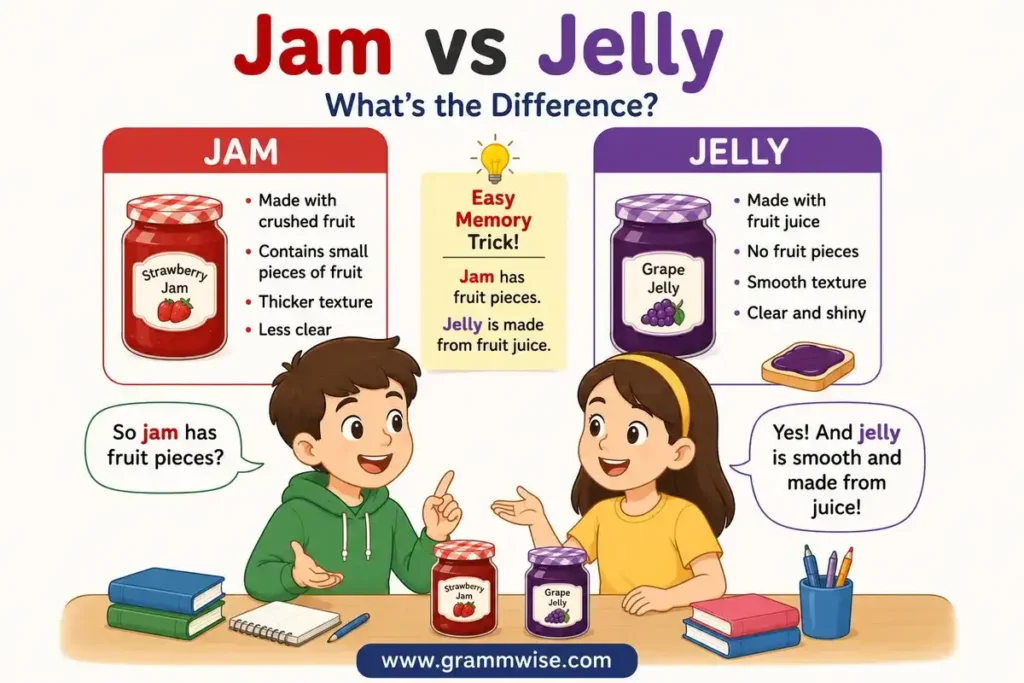
The easiest way to remember Jam vs Jelly is this:
Jam = Fruit pieces.
Jelly = Fruit juice.
Jam vs Jelly: Which Form Should You Use?
Ask yourself one simple question.
Does the spread have pieces of fruit?
If yes, it is jam.
Examples:
- Strawberry jam
- Apricot jam
- Blackberry jam
Now ask another question.
Is the spread smooth with no fruit pieces?
If yes, it is jelly.
Examples:
- Grape jelly
- Apple jelly
- Mint jelly
This simple question helps you choose the correct word every time.
Easy Memory Trick to Remember “Jam vs Jelly”
Here is an easy trick.
Jam
Think about the letter M in Jam.
M can remind you of Mashed fruit.
Jam is made from mashed or crushed fruit.
Jelly
Think about the letter J in Juice.
Jelly is made from fruit juice.
This easy trick helps many students remember the difference.
Easy Real-Life Sentences on “Jam vs Jelly”
Here are some everyday examples.
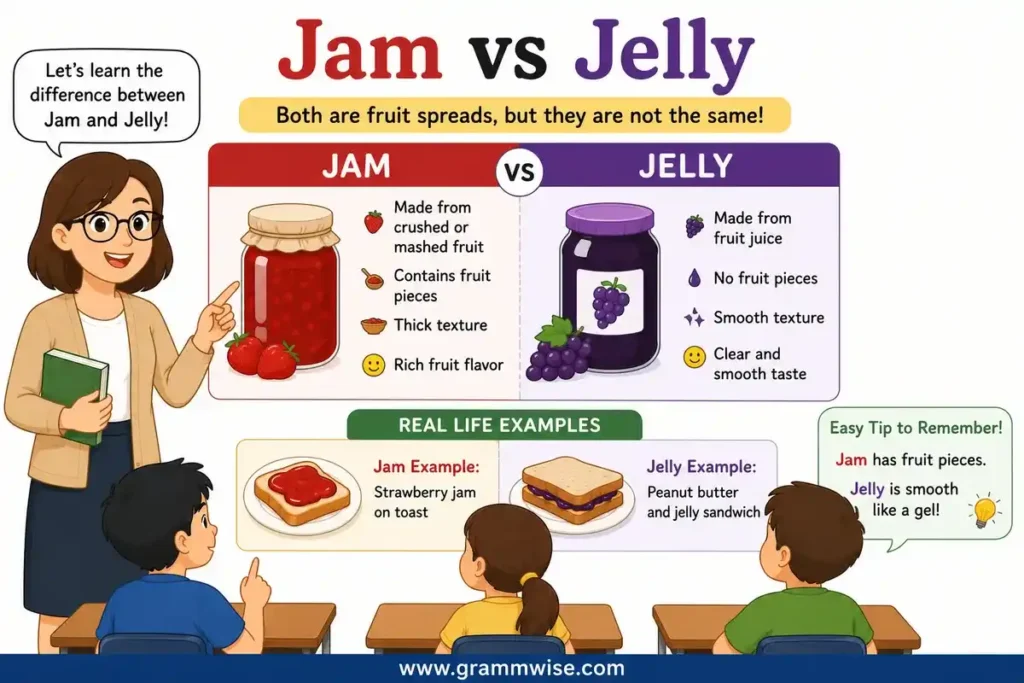
- I spread strawberry jam on my toast.
- She likes grape jelly with peanut butter.
- My grandmother makes homemade jam.
- We bought apple jelly at the market.
- This jam has real fruit pieces.
- The jelly is smooth and sweet.
- I enjoy raspberry jam for breakfast.
- He made a peanut butter and jelly sandwich.
These examples show how both words are used naturally.
Jam as a Food
Jam is a sweet fruit spread.
People often enjoy it with:
- Toast
- Bread
- Muffins
- Pancakes
- Yogurt
Many families also use jam in cakes and cookies.
Homemade jam is popular because it contains real fruit pieces.
Jelly as a Food
Jelly is also a sweet fruit spread.
People often use it for:
- Peanut butter and jelly sandwiches
- Toast
- Biscuits
- Crackers
- Glazes for meat
Because jelly is smooth, some people prefer it over jam.
Common Phrases with “Jam vs Jelly”
Here are common expressions.
Jam on Toast
Example:
I had jam on toast for breakfast.
Homemade Jam
Example:
My aunt makes homemade strawberry jam.
Fruit Jam
Example:
We bought fruit jam at the farmers market.
Jam Jar
Example:
The jam jar is almost empty.
Peanut Butter and Jelly
Example:
My favorite lunch is a peanut butter and jelly sandwich.
Grape Jelly
Example:
She likes grape jelly best.
Fruit Jelly
Example:
This fruit jelly is very smooth.
Jelly Sandwich
Example:
The children enjoyed jelly sandwiches.
“Jam vs Jelly” Used in Everyday Situations
Imagine these simple situations.
At Breakfast
You spread strawberry jam on warm toast. You can see small fruit pieces. That is jam.
At Lunch
You make a peanut butter and jelly sandwich. The jelly is smooth. There are no fruit pieces.
At the Grocery Store
You compare two jars. One contains crushed strawberries. The other contains only grape juice. The first is jam. The second is jelly.
At Home
Your grandmother cooks fresh berries with sugar. She keeps the fruit pieces. She is making jam.
Jam vs Jelly: Where This Word Comes From?
The word jam has been used in English for hundreds of years. People began making jam to keep fruit fresh for a longer time. Cooking fruit with sugar helped it last longer.
The word jelly comes from an old French word that described something soft and gel-like. As cooking changed over time, people used the word for smooth fruit spreads made from fruit juice.
Today, both foods are enjoyed around the world.
How Jam vs Jelly Are Understood in Culture and Stories
People around the world enjoy fruit spreads, but they may use different names for them. In the United States, people usually know the difference between jam and jelly. In some other countries, people may simply call both of them “jam.”
Because of this, the topic Jam vs Jelly often confuses travelers and English learners.
Jam is often connected with homemade food. Many families make jam from fresh fruit during the summer. Grandparents sometimes pass their favorite jam recipes from one generation to the next.
Jelly is often connected with quick and easy meals.
One famous example is the peanut butter and jelly sandwich. It is a popular lunch for many children in the United States.
Both foods also appear in children’s books, cartoons, and family stories.
You may hear someone say,
“Grandma makes the best strawberry jam.”
Or,
“I packed a peanut butter and jelly sandwich for school.”
These simple examples show how both words are part of everyday life.
Biblical and Mythological Meaning of “Jam vs Jelly”
The words jam and jelly do not have special meanings in the Bible. They also do not have important meanings in mythology.
However, fruit has always been a symbol of nature, health, and good harvests. Many old stories describe people collecting fresh fruit during harvest time.
Today, jam and jelly remind many people of family meals, homemade cooking, and sharing food with others.
Their meanings come more from daily life than from religion or mythology.
Symbolism of “Jam vs Jelly” Explained in Simple Words
What Jam Represents?
Jam often represents:
- Homemade food
- Family traditions
- Fresh fruit
- Comfort
- Care
- Sharing
Many people think of jam as something made with love at home. A jar of homemade jam can remind someone of childhood or family gatherings. Because jam contains real fruit pieces, people often connect it with natural cooking.
What Jelly Represents?
Jelly often represents:
- Smoothness
- Simplicity
- Convenience
- Quick meals
- Childhood lunches
Many children remember eating peanut butter and jelly sandwiches at school. Because jelly spreads easily, people often think of it as a simple and convenient food.
Although jam and jelly are different, both bring happy memories for many families.
Related Words You Should Know
Learning related food words makes English easier.
Preserve
A fruit spread made with larger pieces of fruit.
Example:
My grandmother makes peach preserves.
Marmalade
A fruit spread usually made from oranges or other citrus fruits.
Example:
I like orange marmalade on toast.
Fruit Spread
A general name for sweet spreads made from fruit.
Example:
This fruit spread has no added sugar.
Compote
Soft fruit cooked with sugar.
Example:
Apple compote tastes great with pancakes.
Syrup
A sweet liquid used on pancakes and waffles.
Example:
He poured maple syrup over his pancakes.
Pectin
A natural ingredient that helps jam and jelly become thick.
Example:
Pectin helps jelly keep its shape.
Spread
Food that can be spread on bread.
Example:
Butter is another common spread.
Homemade
Made at home instead of bought from a store.
Example:
Homemade jam tastes fresh.
Use of “Jam vs Jelly” in Daily English
Here are examples you may hear every day.
- “I like strawberry jam on my toast.”
- “My kids love peanut butter and jelly sandwiches.”
- “Can you pass me the grape jelly?”
- “This homemade jam tastes amazing.”
- “I bought raspberry jam at the farmers market.”
- “The jelly is smooth and easy to spread.”
- “My mom makes fresh blueberry jam every summer.”
- “We had toast with apple jelly for breakfast.”
- “I prefer jam because it has fruit pieces.”
- “My brother likes jelly because it is smooth.”
These examples show how naturally people use both words.
Common Mistakes People Make About “Jam vs Jelly”
Many English learners make these mistakes.
Mistake 1
Thinking jam and jelly are exactly the same.
✅ They are different.
Jam has crushed fruit.
Jelly is made from fruit juice.
Mistake 2
Calling every fruit spread jelly.
✅ Some spreads are jam.
Others are jelly, preserves, or marmalade.
Mistake 3
Thinking jelly always has fruit pieces.
✅ Jelly is smooth.
It does not contain fruit pieces.
Mistake 4
Thinking jam is always homemade.
✅ Jam can be homemade or store-bought.
Both are correct.
Mistake 5
Using the wrong word at the grocery store.
Always read the label.
The jar will tell you if it is jam or jelly.
Final Teacher Explanation
Imagine we are finishing today’s lesson.
I place two jars on the classroom table. One jar has small fruit pieces. The other jar is smooth and clear. Then I ask one simple question.
“Which jar has fruit pieces?”
The answer is jam.
Next I ask,
“Which jar is smooth and made from fruit juice?”
The answer is jelly.
That is the easiest way to remember the difference. You do not need difficult cooking lessons. You only need one simple rule.
Jam has crushed fruit.
Jelly is made from fruit juice.
Whenever you see a fruit spread, look inside the jar. If you can see fruit pieces, it is jam. If it is smooth and clear, it is jelly.
Final Answer “Jam vs Jelly”
Jam is made with crushed or mashed fruit and usually contains fruit pieces.
Jelly is made from fruit juice and has a smooth texture.
Remember this simple rule: Jam = Fruit pieces. Jelly = Fruit juice.
Conclusion
Understanding Jam vs Jelly is simple when you remember how each one is made. Jam is made with crushed or mashed fruit, while jelly is made from fruit juice. This easy rule will help you choose the correct word if you are shopping, cooking, or talking about your favorite breakfast spread.
Keep practicing with real-life examples and reading food labels whenever you can. The more you see and use these words, the easier they become. Soon, you will know the difference between jam and jelly without even thinking about it.
Frequently Asked Questions (FAQs)
What is the main difference between Jam vs Jelly?
Jam is made from crushed fruit, while jelly is made from fruit juice.
Which is smoother, jam or jelly?
Jelly is smoother because it does not contain fruit pieces.
Can I use jam and jelly in the same way?
Yes. Both can be spread on toast, bread, biscuits, and sandwiches.
Why do people confuse Jam vs Jelly?
Both are sweet fruit spreads, look similar, and are often sold together in stores.
Which is better, jam or jelly?
Neither is better. It depends on whether you like fruit pieces or a smooth spread.
Is peanut butter and jelly made with jam?
Usually, it is made with jelly, especially grape jelly, but some people use jam instead.
Are preserves the same as jam?
No. Preserves usually contain larger pieces or whole pieces of fruit.
Can homemade jam and homemade jelly taste different?
Yes. Jam often has a richer fruit texture, while jelly has a smoother taste.