
Many English learners get confused about hooves or hoofs because both forms appear in books, websites, and everyday writing. When you see two different plural forms of the same word, it is natural to wonder which one is correct.
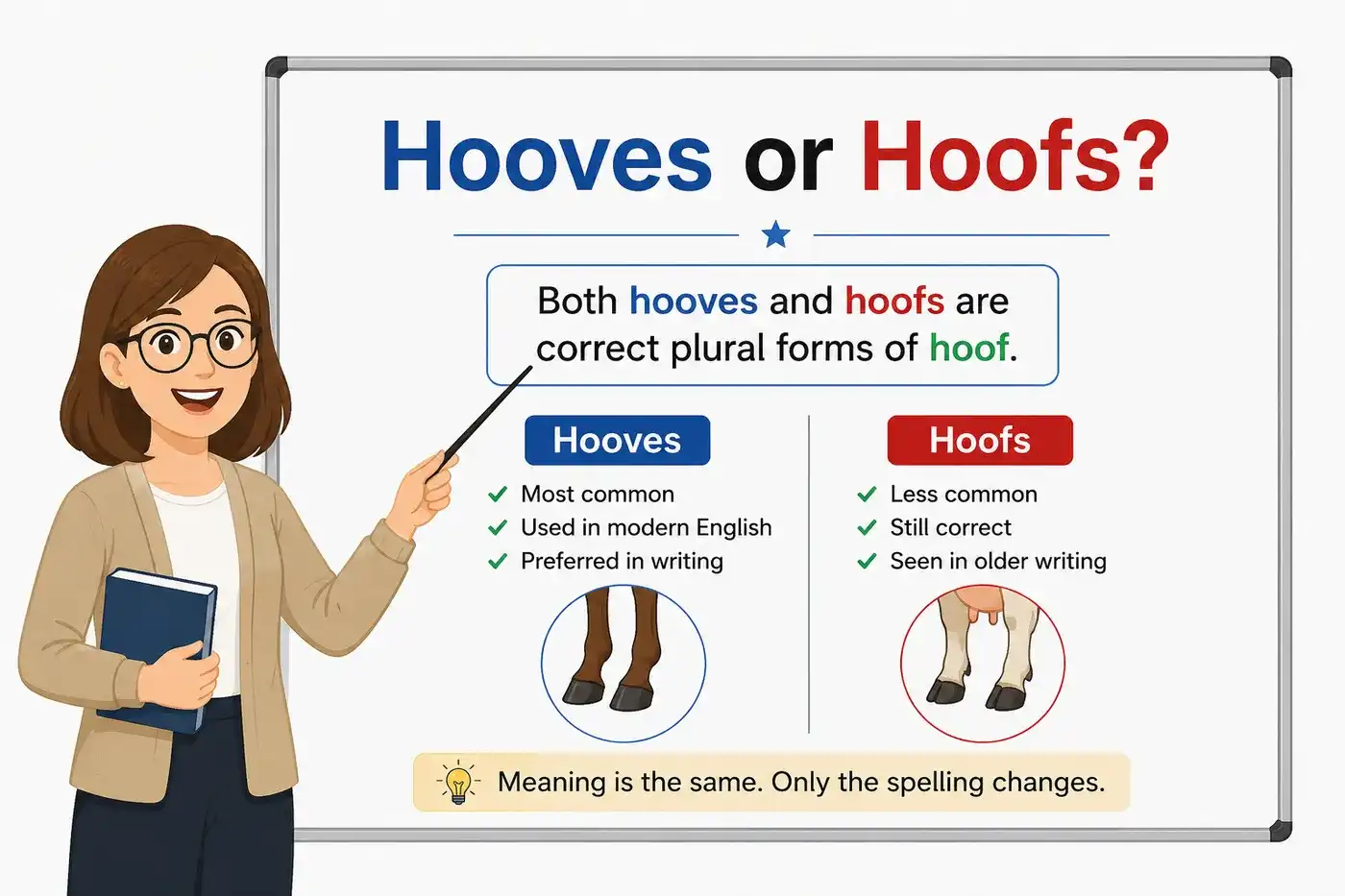
The short answer is that both hooves and hoofs are correct plural forms of hoof. A hoof is the hard foot of animals such as horses, cows, deer, goats, and sheep. While both forms are accepted, hooves is much more common in modern English.
If you have ever asked about the difference between hooves or hoofs, this guide will explain everything in very simple words. You will learn which form people use most often, why two versions exist, and how to use each one correctly in real-life sentences.
If you want to learn more confusing word pairs? Read our guide.
Simple Answer in One Look Hooves or Hoofs
Both hooves and hoofs are correct.
- Hooves is the most common plural form today.
- Hoofs is also accepted but used less often.
- In most writing, hooves is usually the better choice.
Example:
✅ The horse’s hooves made a loud sound on the road.
✅ The horse’s hoofs made a loud sound on the road.
Both are correct, but many readers expect to see hooves.

Means of Hooves or Hoofs in Simple English
Before understanding hooves or hoofs, it helps to know what a hoof is. A hoof is the hard covering on the foot of certain animals. Horses, cows, goats, sheep, deer, and many other animals have hooves. Think of a horse’s foot. The hard part that touches the ground is called a hoof.
One animal foot = hoof
More than one animal foot = hooves or hoofs
Examples:
- One horse has a hoof.
- A horse has four hooves.
- A cow has hooves.
- Deer have hooves.
The confusion starts because English allows two plural forms.
Many words simply add -s.
For example:
- Book → Books
- Car → Cars
- Dog → Dogs
But some words change slightly when they become plural.
Examples:
- Leaf → Leaves
- Wolf → Wolves
- Knife → Knives
Because of these patterns, many people naturally use hooves instead of hoofs.
Why People Mix These Words Hooves or Hoofs?
People often mix up hooves or hoofs because English does not always follow one simple rule. Many words ending in -f change to -ves in the plural.
Examples:
| Singular | Plural |
|---|---|
| Leaf | Leaves |
| Wolf | Wolves |
| Knife | Knives |
| Life | Lives |
When people see the word hoof, they expect the same pattern.
So:
- Hoof → Hooves
This feels natural to many English speakers.
However, English also has words that simply add -s.
For example:
- Roof → Roofs
- Chief → Chiefs
- Belief → Beliefs
Because of these words, some people write:
- Hoof → Hoofs
That is why both versions exist.
Another reason for confusion is reading different sources.
You may see:
- Hooves in novels
- Hoofs in older books
- Hooves in school materials
- Hoofs in some dictionaries
When learners notice both spellings, they wonder which one is right.
The truth is simple:
Both are right, but hooves is more common.
Clear Difference of Hooves or Hoofs Explained Simply
When comparing hooves or hoofs, the meaning stays exactly the same. There is no difference in meaning. The only difference is the spelling of the plural form.
Hooves
- More common today
- Preferred by many writers
- Seen often in books and articles
- Sounds more natural to many readers
Example:
The horse lifted its hooves from the muddy ground.
Hoofs
- Less common today
- Still correct
- Found in some dictionaries
- Sometimes seen in older writing
Example:
The horse cleaned its hoofs before entering the stable.
Quick Comparison Hooves or Hoofs
| Feature | Hooves | Hoofs |
|---|---|---|
| Correct? | Yes | Yes |
| Most common? | Yes | No |
| Modern usage | Very common | Less common |
| Meaning | Animal feet | Animal feet |
The important thing to remember is that readers understand both forms.
Which Form Should You Use Hooves or Hoofs?
If both forms are correct, which one should you choose?
For most situations, use hooves.
Why?
Because it is the version most people expect to see.
It appears more often in:
- School writing
- Articles
- Blogs
- Books
- News reports
Using hooves helps your writing look natural to a wider audience.
Use Hooves When:
- Writing for school
- Creating website content
- Writing articles
- Writing stories
- Writing professional documents
Examples:
- The horse’s hooves struck the ground.
- The farmer checked the cow’s hooves.
- Snow stuck to the deer’s hooves.
Use Hoofs When:
- Following a style guide that prefers it
- Quoting older material
- Matching a source that uses it
Examples:
- The rancher examined the horse’s hoofs.
- Mud covered the animals’ hoofs.
Even in these situations, many writers still choose hooves.
Teacher Tip Hooves or Hoofs
If you are unsure whether to write hooves or hoofs, choose hooves. It is the safer option because it is more common in modern English.

Is Hooves More Correct Than Hoofs?
This is a question many learners ask.
The answer is no.
Hooves is not more correct. Hoofs is not wrong. Both forms are accepted by major dictionaries and English language guides. The difference is popularity.
Think of it like two roads leading to the same place. One road is used by many more people. That road is hooves. The other road is less busy. That road is hoofs.
Both roads still arrive at the same destination.
Why Does English Allow Two Plurals?
English has changed over hundreds of years. Words often developed different spellings as the language grew. Some speakers preferred one form. Other speakers preferred another. Over time, both versions remained in use. This happens with other English words too.
Examples include:
- Dwarfs and dwarves
- Scarfs and scarves
- Wharfs and wharves
These pairs show that English sometimes accepts more than one plural spelling. The word hoof belongs to this group. That is why the debate about hooves or hoofs continues today.
Easy Real-Life Sentences of Hooves or Hoofs You Can Use
Here are simple examples showing how people use these words.
Sentences with Hooves
- The horse’s hooves made a loud sound on the road.
- The farmer checked the cow’s hooves.
- Mud stuck to the goat’s hooves.
- The deer ran quickly on its strong hooves.
- Snow covered the horse’s hooves.
- The veterinarian cleaned the animal’s hooves.
- The pony lifted its hooves carefully.
- The horse’s hooves left marks in the dirt.
Sentences with Hoofs
- The rancher washed the horse’s hoofs.
- Dirt covered the animal’s hoofs.
- The horse’s hoofs needed cleaning.
- The stable worker checked the hoofs each day.
- The animal’s hoofs were healthy.
Both sets of sentences are correct.
You can see that the meaning never changes.
Hooves or Hoofs in Everyday Conversation
In normal conversation, most people do not think about the spelling. They simply say the word. When spoken aloud, many listeners may not even notice whether a speaker prefers the spelling hooves or hoofs.
The choice matters more in writing. That is why writers, students, and content creators often ask which form they should use. For most modern writing, hooves is the form readers see most often.
Origin of The Word Hooves or Hoofs
The word hoof comes from very old forms of English used many centuries ago. Back then, spelling was not as fixed as it is today. People often wrote words in different ways. As English developed, two plural forms stayed alive:
- Hooves
- Hoofs
Over time, hooves became more popular. That popularity continues today. Still, the older form hoofs never completely disappeared. Because both forms remained in dictionaries and writing, modern English accepts both versions.
This is one reason English can seem tricky. Some words keep older forms while also allowing newer ones.
How This Word Is Understood in Culture and Stories
When people talk about animals in stories, they often mention their hooves. Horses, deer, goats, and other animals with hooves appear in books, movies, and folk tales from many cultures. In many stories, a horse’s hooves create a strong image. Readers may imagine a horse running across a field, racing through a forest, or carrying a hero on an important journey.
When writers use hooves or hoofs, they are usually describing movement, strength, speed, or life in nature. The choice between the two spellings does not change the meaning of the story.
Children’s books often use the word when describing farm animals. Adventure stories use it when horses travel long distances. Nature stories use it when describing deer, elk, or wild goats moving through mountains and forests.
Because animals with hooves have lived alongside people for thousands of years, the word appears in many cultures and traditions around the world.
A reader may not even notice whether a writer chooses hooves or hoofs. The focus is usually on the animal and the story itself.
Biblical and Mythological Meaning Hooves or Hoofs
The word hoof appears in some Bible translations when animals are described. In these passages, the focus is usually on identifying different kinds of animals. The hoof itself does not carry a special meaning. It is simply a physical feature of the animal. In mythology, animals with hooves sometimes appear as powerful or magical creatures.
Examples include:
- Horses connected with heroes.
- Deer connected with forests and nature.
- Goats connected with mountain life.
- Mythical creatures that combine human and animal features.
These stories usually focus on the animal’s strength, speed, or connection to nature rather than on the word hooves or hoofs itself. The spelling choice does not affect any biblical or mythological meaning.

Symbolism Hooves or Hoofs Explained in Simple Words
Animals with hooves often symbolize movement, freedom, endurance, and strength. Because these animals travel long distances and survive in many environments, people sometimes connect them with determination and progress.
What Hooves Represents?
Hooves is the form most people see today. Because it is common in modern books and writing, many readers see it as the standard choice.
It may feel:
- More modern
- More familiar
- More natural in everyday reading
- More expected in professional writing
The meaning stays connected to strong and active animals.
What Hoofs Represents?
Hoofs has the same meaning. However, because it appears less often, some readers may connect it with:
- Older writing
- Traditional spelling choices
- Certain style preferences
It still represents exactly the same animals and ideas.
Simple Comparison Hooves or Hoofs
| Hooves | Hoofs |
|---|---|
| More common today | Less common today |
| Seen often in modern writing | Seen less often |
| Same meaning | Same meaning |
| Refers to animal feet | Refers to animal feet |
The symbolism never changes. Only the spelling changes.
Related Words Hooves or Hoofs You Should Know
Hoof
The singular form. It means one animal foot.
Example: The horse injured a hoof.
Horse
A large animal commonly connected with hooves.
Example: The horse ran across the field.
Stable
A building where horses live.
Example: The horse returned to the stable.
Rider
A person who rides a horse.
Example: The rider guided the horse carefully.
Gallop
A fast way for a horse to run.
Example: The horse began to gallop.
Horseshoe
A metal piece attached to a horse’s hoof.
Example: The horseshoe needed replacement.
Livestock
Farm animals such as cows, sheep, and goats.
Example: The farmer checked the livestock daily.
Herd
A group of animals.
Example: A herd of deer crossed the field.
Pasture
An area where animals eat grass.
Example: The horses rested in the pasture.
Veterinary
Related to animal health.
Example: The veterinarian examined the horse’s hooves.
Use of Hooves or Hoofs in Daily English
Most people use hooves much more often than hoofs in everyday writing.
Here are some natural examples:
- The horse’s hooves were covered in mud.
- I could hear hooves coming down the road.
- The farmer checked the cow’s hooves this morning.
- The deer left hoof prints in the snow.
- Those horses have strong hooves.
- The veterinarian cleaned the horse’s hooves.
- We heard hooves outside the barn.
- The goat’s hooves helped it climb the rocky hill.
- The pony lifted its hooves carefully.
- The animal’s hooves made soft sounds on the grass.
In conversation, people usually focus on the animal rather than the spelling.
That is why many speakers never think about the difference between hooves or hoofs until they start writing.
Common Mistakes People Make About Hooves or Hoofs
Mistake 1: Thinking Only Hooves Is Correct
Many learners believe hoofs is wrong.
Correct: Both forms are accepted.
Mistake 2: Thinking They Have Different Meanings
Some people think the words describe different animal feet.
Correct: They mean exactly the same thing.
Mistake 3: Using Different Forms in the Same Article
Switching back and forth can confuse readers.
Better:
Choose one spelling and use it throughout your writing.
Mistake 4: Comparing It to Every -F Word
Not all English words follow the same plural pattern.
Examples:
- Leaf → Leaves
- Wolf → Wolves
- Roof → Roofs
- Chief → Chiefs
The word hoof is unusual because both plural forms are accepted.
Mistake 5: Using the Less Common Form Without a Reason
Hoofs is correct, but many readers expect hooves.
For modern writing, hooves is usually the easier choice.
Mistake 6: Switching Forms in One Piece of Writing
Choose one style and stay consistent.
Good example:
✅ The horse lifted its hooves. The hooves were muddy.
Less clear:
⚠️ The horse lifted its hooves. Later, the hoofs were washed.
Consistency makes writing smoother.
Final Teacher Explanation Hooves or Hoofs
Imagine you are sitting in an English class and a student asks, “Should I write hooves or hoofs?”
My answer would be simple.Both are correct. The word hoof can become either hooves or hoofs when talking about more than one animal foot. However, modern English uses hooves more often. That means readers see it more frequently in books, websites, articles, and school writing.
If you want the safest and most natural choice, use hooves. If you see hoofs, do not assume it is a mistake. It is simply a less common plural form that still exists in English.
The most important thing is consistency. Pick one form and use it throughout your writing. Once you remember that both are correct and that hooves is more common, this grammar question becomes very easy.
Quick Recap Hooves or Hoofs
When choosing between hooves or hoofs, both forms are correct plural versions of hoof. Hooves is the most common choice in modern English, while hoofs is less common but still accepted. For most writing, use hooves because readers expect it more often.

Conclusion
When deciding between hooves or hoofs, remember that both forms are correct. The difference is not meaning but usage. Hooves is the form most people use and expect to see in modern English, while hoofs appears less often.
A simple way to remember the rule is this: if you are unsure, choose hooves. It sounds natural to most readers, works well in everyday writing, and helps keep your English clear and professional.
Frequently Asked Questions (FAQs)
Is it hooves or hoofs?
Both are correct. Hooves is more common in modern English.
Which plural form is used most often?
Hooves is used more often in books, articles, and everyday writing.
Is hoofs wrong?
No. Hoofs is a correct plural form of hoof.
Why do people get confused between hooves or hoofs?
English allows two accepted plural spellings for the same word.
Should I use hooves in school writing?
Yes. Hooves is usually the preferred choice for modern writing.
Do hooves and hoofs have different meanings?
No. They mean exactly the same thing.
Can I use both forms in one article?
It is better to choose one form and stay consistent.
What is the singular form?
The singular form is hoof.