
Many people see the phrase fact or cap on social media and wonder what it means. It appears in comments, videos, text messages, and online conversations. Because these words are used together so often, many English learners want to understand the difference between them.
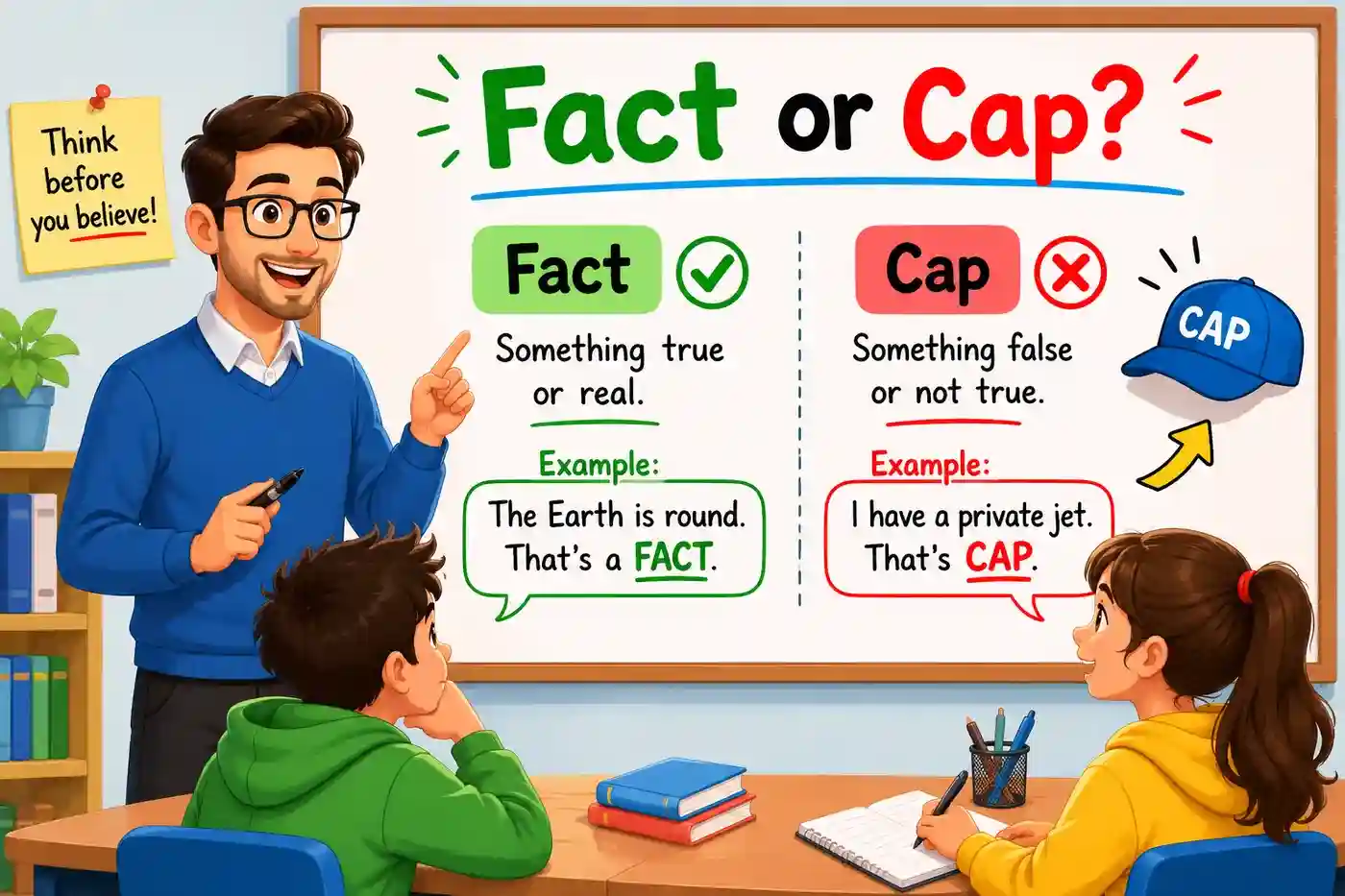
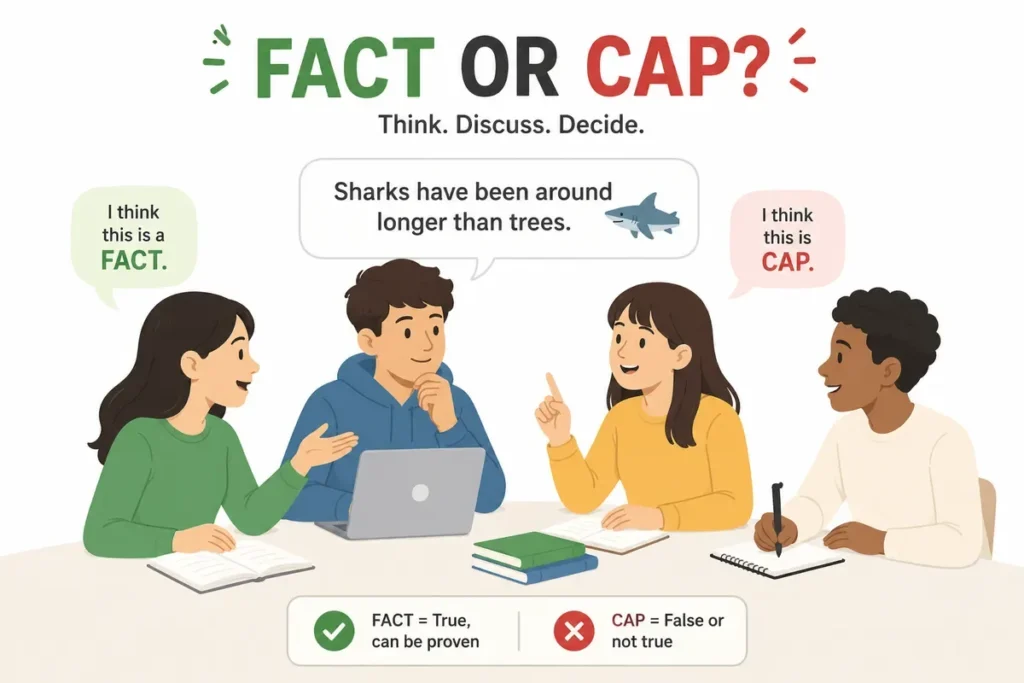
The simple answer is that fact means something true, while cap is modern slang that means a lie or something that is not true. When someone says “fact or cap,” they are asking if a statement is true or false.
If you are searching for these words, this guide will explain the meaning, usage, difference, examples, and real-life context in very simple English.
Discover the correct usage of Advise or Advice
Simple Answer in One Look Fact or Cap
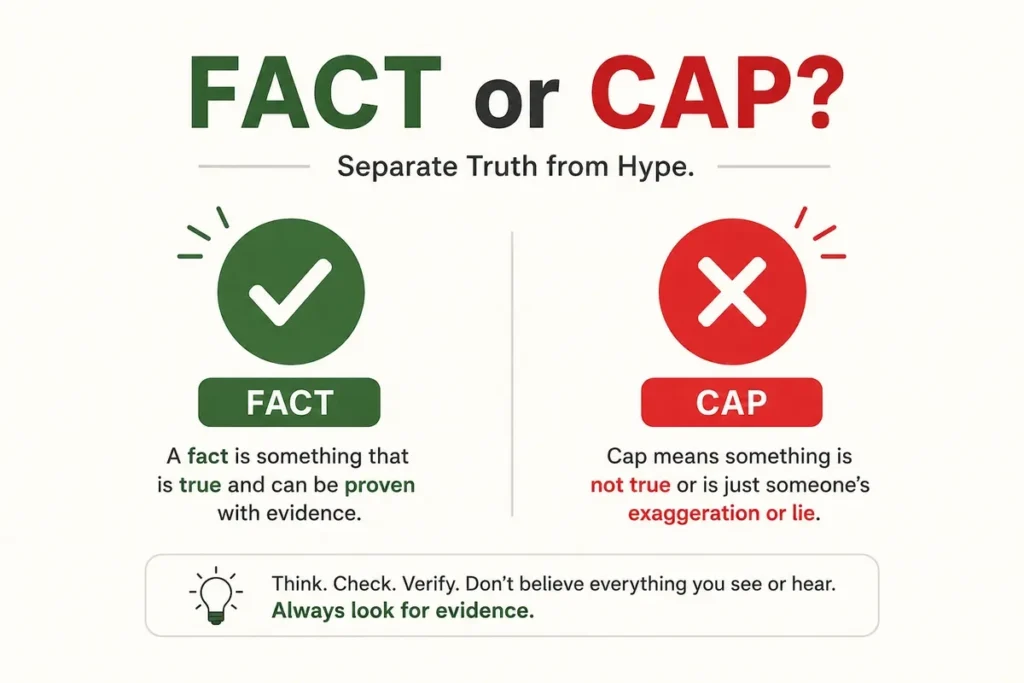
Fact = true statement
Cap = lie or false statement
Fact or cap means: “Is this true or not?”
Means of Fact or Cap in Simple English
The easiest way to understand these words is to learn each word separately.
Fact Mean
A fact is something that is true.
It can be proven with evidence.
Examples:
- Water freezes at 32°F (0°C).
- The Earth goes around the sun.
- A week has seven days.
These statements are facts because they are true.
Simple meaning:
Fact = truth.
Cap Mean
Cap is a slang word.
In modern English slang, cap means a lie or something false.
Examples:
- That’s cap.
- He is capping.
- No cap.
If someone says, “That’s cap,” they mean:
“That is not true.”
Simple meaning:
Cap = lie or false statement.
There is Also a Word “No Cap”
You may also hear:
“No cap.”
This means:
“I’m telling the truth.”
Example:
“This pizza is the best thing I’ve ever eaten, no cap.”
The speaker means they are being honest.
Reasons of People Mix These Words Fact or Cap
People usually do not confuse the meanings of fact and cap. Instead, they become confused because cap is a newer slang term.
Cap Has Another Meaning
Traditionally, a cap is something you wear on your head.
Examples:
- Baseball cap
- Winter cap
Because of this, many learners are surprised when cap means “lie.”
Social Media Popularity
The slang meaning became popular through:
- TikTok
- YouTube
- Online gaming
- Music culture
Many people learn the phrase online before understanding its meaning.
New Slang Changes Quickly
English slang changes over time. Words can develop new meanings. Cap is one example of this.
Clear Difference of Fact or Cap Explained Simply
The difference between these words is easy when you focus on truth.
Fact
Meaning:
Something true.
Examples:
- The sky is blue.
- Birds have feathers.
- Two plus two equals four.
Cap
Meaning:
Something false.
Examples:
- I own ten private jets.
- I can run faster than a race car.
- I never sleep.
These statements are probably cap.
Quick Comparison Table About Fact or Cap
| Word | Meaning | Example |
|---|---|---|
| Fact | Truth | Water freezes at 32°F |
| Cap | Lie or false statement | I own a castle |
Easy Memory Trick
Think:
Fact = factual
Both relate to truth.
Think:
Cap = fake claim
This can help you remember the slang meaning.
When should We Use Words Fact or Cap?
The answer depends on what you want to say.
Use Fact When Something Is True
Examples:
- That’s a fact.
- The report contains facts.
- She shared an interesting fact.
Use fact when talking about truth or evidence.
Use Cap When Talking About Something False
Examples:
- That’s cap.
- Stop capping.
- That story sounds like cap.
Use cap only when talking informally.
Important Note
Cap is slang. It is common in casual conversations.
It is usually not appropriate in:
- School essays
- Formal reports
- Business writing
- Academic writing
In formal situations, use words such as:
- false
- incorrect
- untrue
instead of cap.
Easy Real-Life Sentences About Fact or Cap
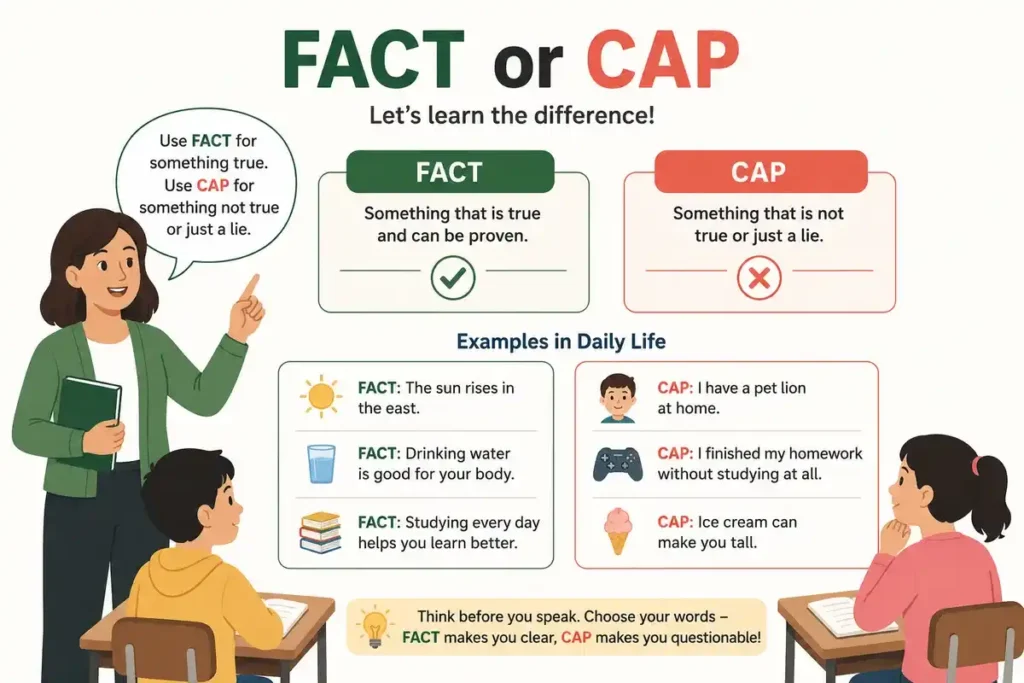
Here are simple examples using fact.
- It is a fact that water is essential for life.
- She shared a fun fact about dolphins.
- The facts support his argument.
- This statement is a fact.
- Scientists rely on facts.
- The teacher explained the facts clearly.
- We checked the facts before publishing.
- The news report included several facts.
Now look at examples using cap.
- That’s cap.
- Stop capping.
- No cap, that movie was amazing.
- His story sounds like cap.
- That’s complete cap.
- No cap, I studied all night.
- You’re capping right now.
- Everyone knew it was cap.
Origin of These Words Fact or Cap
History of Fact
The word fact has been used in English for hundreds of years. It comes from older Latin words connected to actions, events, and reality. Over time, fact became associated with something known to be true.
History of Cap
The slang meaning of cap is much newer. It became popular through African American Vernacular English (AAVE), music culture, and social media.
The phrase spread through:
- Rap music
- Online videos
- Social media posts
Today, millions of people use cap and no cap online.
Popularity of The Word
People like short and simple slang. Instead of saying:
“That is not true.”
Someone can simply say:
“That’s cap.”
This made the phrase popular among younger speakers.
Fact, Opinion, and Cap
These three ideas are useful to compare.
Fact
Can be proven true.
Example:
“The Earth has one moon.”
Opinion
A personal belief.
Example:
“Summer is the best season.”
Cap
A false claim.
Example:
“I can jump over a skyscraper.”
This comparison makes the meaning even clearer.
Deep Meaning, Culture, and Practical Use of Fact or Cap
The phrase fact or cap has become a popular part of modern culture. You can hear it in videos, music, social media posts, and everyday conversations. When people say fact or cap, they are usually asking a simple question:
“Is this true or false?”
This phrase has become popular because it is short, easy to remember, and fun to use.
Fact in Stories
Facts are important in stories because they help readers understand what is real within the story.
For example:
- A character’s age may be a fact.
- A place may be a fact.
- An event may be a fact.
Facts provide information and help build trust.
Cap in Stories
Cap often appears when a character exaggerates or tells something that is not true.
For example:
A character might say:
“I can lift a car with one hand.”
Another character may reply:
“That’s cap.”
This means they do not believe the statement.
Social Media and Modern Culture Fact or Cap
The phrase fact or cap became very popular on social media.
People use it when:
- Rating opinions
- Checking claims
- Challenging stories
- Discussing trends
Example:
“This is the best burger in town. Fact or cap?”
Others then share their opinions.
This playful style helped the phrase spread quickly online.
Biblical and Mythological Meaning Fact or Cap
The exact slang term cap does not appear in biblical or mythological writings.
However, the ideas behind truth and falsehood appear everywhere.
Truth in Religious Teachings
Many religious traditions encourage honesty.
Truth is often viewed as a positive value.
Facts and honesty are connected to trust.
False Claims in Religious Stories
Many stories warn people about deception and false statements.
This idea is similar to the modern slang meaning of cap.
In simple terms:
- Fact relates to truth.
- Cap relates to something that is not true.
Mythological Examples
Many myths include characters who tell the truth and others who try to deceive people.
Because of this, the basic idea behind fact and cap can be found in many ancient stories.
Symbolism of Fact or Cap Explained in Simple Words
Words often represent larger ideas.
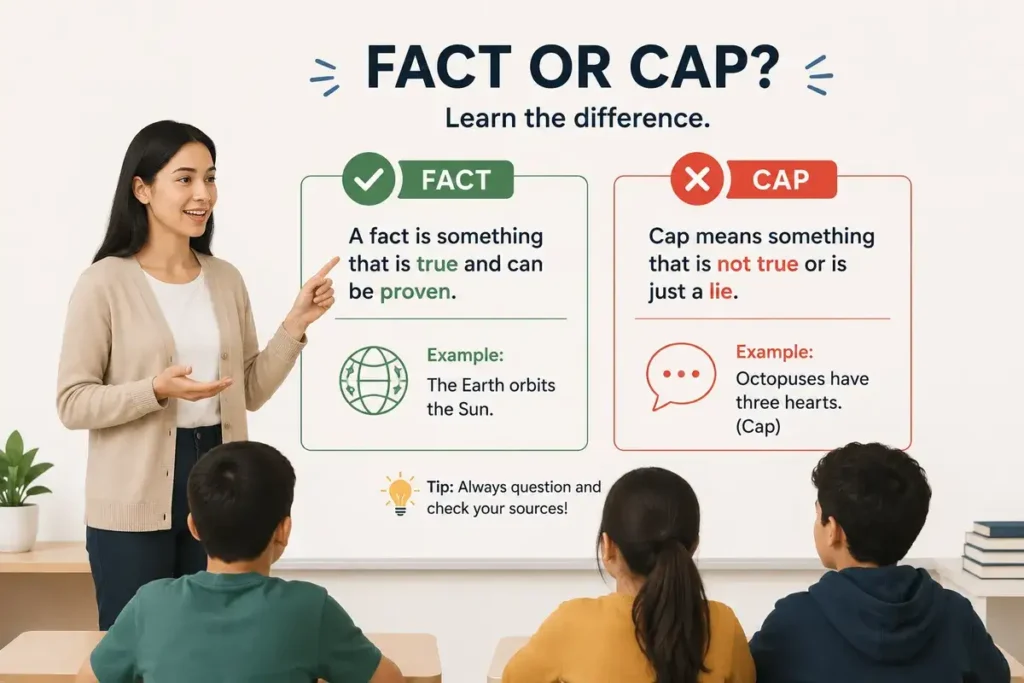
The phrase fact or cap is a good example.
What Fact Represents?
The word fact often symbolizes truth and certainty.
Honesty
Facts are connected to being truthful.
Example:
Giving correct information.
Trust
People trust facts because they can be checked and verified.
Knowledge
Facts help people learn and understand the world.
Reality
Facts represent what is real rather than imagined.
What Cap Represents?
The word cap often symbolizes doubt or disbelief.
Exaggeration
Many people use cap when someone makes an unbelievable claim.
False Information
Cap can refer to statements that are not true.
Skepticism
When people say “cap,” they are often questioning a claim.
Uncertainty
Cap can represent something that lacks proof.
Quick Symbolism Comparison Fact or Cap
| Word | Symbolic Meaning |
|---|---|
| Fact | Truth, honesty, knowledge |
| Cap | Falsehood, doubt, exaggeration |
This simple comparison makes the meaning easier to remember.
Related Words to Fact or Cap You Should Know
Learning related vocabulary helps you understand the phrase better.
Truth
Something that is real or correct.
Example:
“The truth finally came out.”
Honest
Telling the truth.
Example:
“She gave an honest answer.”
Reality
Things that actually exist.
Example:
“Reality can be surprising.”
Evidence
Information that proves something.
Example:
“The evidence supports the claim.”
Lie
A false statement.
Example:
“He told a lie.”
False
Not true.
Example:
“That information is false.”
Exaggeration
Making something seem bigger or better than it really is.
Example:
“That sounds like an exaggeration.”
Claim
A statement someone says is true.
Example:
“He made a surprising claim.”
These words often appear in discussions about facts and truth.
Use of Fact or Cap in Daily English
The phrase fact or cap is mostly used in casual conversations.
It is especially common among younger speakers.
Real-Life Examples
- You finished the project in one hour? Fact or cap?
- No cap, that was the best movie I’ve seen all year.
- That’s cap. Nobody believes that story.
- Fact. She really won the competition.
- Are you serious or is that cap?
- No cap, I studied for six hours yesterday.
- That’s a fact. We checked the information.
- Sounds like cap to me.
- Fact. The team won the championship.
- No cap, this restaurant is amazing.
Online Usage
People often use the phrase in:
- TikTok comments
- Instagram posts
- YouTube videos
- Gaming chats
- Text messages
Because of this, many learners encounter the phrase online before hearing it in real life.
Common Mistakes When Comparing Fact or Cap
Many learners make similar mistakes.
Mistake 1: Thinking Cap Always Means a Hat
Cap can mean a hat.
But in slang, it can also mean a lie.
The meaning depends on context.
Mistake 2: Using Cap in Formal Writing
Incorrect:
“The witness gave cap information.”
Better:
“The witness gave false information.”
Cap is informal slang.
Mistake 3: Confusing No Cap
Some learners think no cap means no hat.
In slang, it means:
“I’m being honest.”
Mistake 4: Using Fact and Opinion Together
Not every statement is a fact.
Opinions are personal beliefs.
Examples:
Fact:
“Water boils at 212°F (100°C).”
Opinion:
“Chocolate ice cream is the best flavor.”
Understanding this difference helps avoid confusion.
Easy Correction Rule To Use Fact or Cap
Ask yourself:
“Is this true or not true?”
True = fact
Not true = cap
This simple question solves most confusion.
Fact Is Older Than Cap
The word fact has existed in English for hundreds of years.
People use it in:
- Education
- Science
- News
- Research
- Everyday conversations
The slang meaning of cap is much newer. It became popular through modern culture and social media. Because of this, fact appears in both formal and informal English, while cap mostly appears in informal English.
Final Teacher Explanation Fact or Cap
Imagine you are sitting in class and asking:
“Teacher, what does fact or cap mean?”
My answer would be very simple.
A fact is something true.
A cap is a slang word meaning something false or dishonest.
When people ask:
“Fact or cap?”
They are really asking:
“Is this true or not?”
The easiest way to remember the difference is this:
Fact = truth.
Cap = lie.
If you remember those two meanings, you will understand most situations where the phrase is used.
Quick Recap Fact or Cap
When comparing these words, the difference is simple.
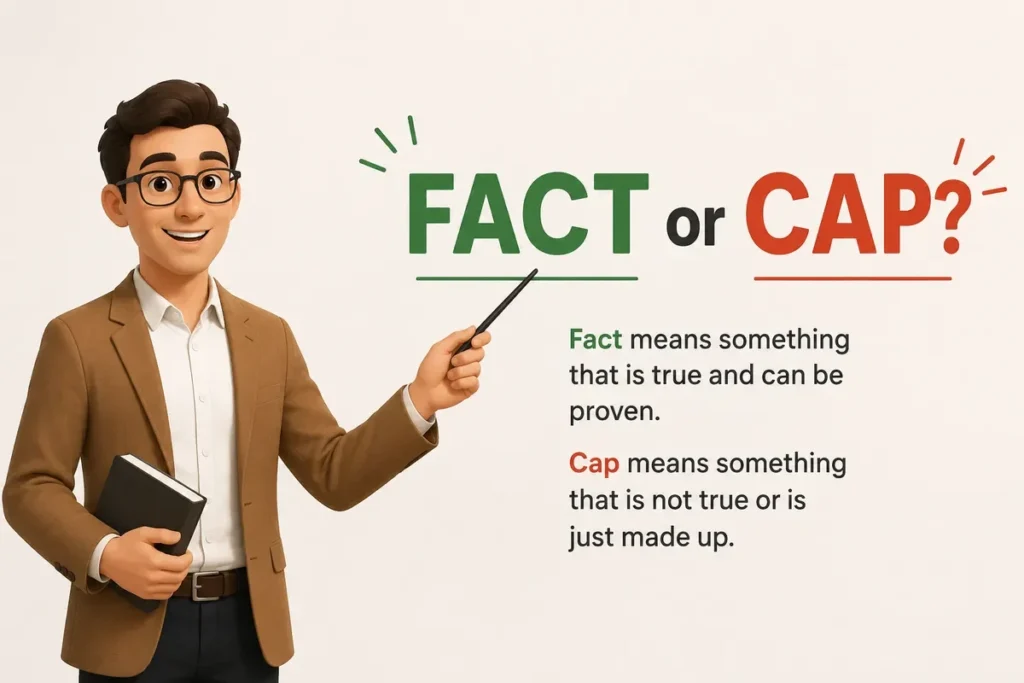
Fact means something true and supported by reality.
Cap is modern slang that means a lie or false statement.
Remember: fact = truth, cap = falsehood.
Conclusion
When comparing fact or cap, the difference comes down to truth and meaning. Fact refers to a true statement supported by evidence, while cap is modern slang for a false statement, exaggeration, or lie. Understanding this vocabulary, usage, and word choice helps you communicate more clearly in modern English and online conversations.
A simple way to remember the rule is that fact means truth and cap means falsehood. By focusing on the context of a statement, you can easily understand the intended meaning and avoid confusion when using modern slang and everyday English expressions.
Frequently Asked Questions
What does fact or cap mean?
It means “Is this true or false?”
What does cap mean in slang?
Cap means a lie or something that is not true.
What does no cap mean?
No cap means “I’m being honest” or “I’m telling the truth.”
Is cap a real English word?
Yes. Traditionally it means a hat, but in modern slang it can mean a lie.
Can I use cap in school essays?
No. Cap is informal slang and should usually be avoided in formal writing.
Why do people say fact or cap?
They use it to ask if a statement is true or false.
Is fact the opposite of cap?
Yes. In slang usage, fact represents truth while cap represents falsehood.
Why is fact or cap popular on social media?
The phrase is short, easy to understand, and useful for discussing claims and opinions.