
Many English learners get confused about emigrate vs immigrate because both words talk about moving from one country to another. They look similar, sound similar, and are often used in the same topic. That is why many people mix them up.
The good news is that understanding emigrate vs immigrate is easier than it looks. The biggest difference is perspective. One word focuses on leaving a country, while the other focuses on entering a new country.
If you often wonder about the difference between these two words, this guide will explain the meaning, usage, examples, and correct word choice in very simple English.
You may also find our explanation of organization or organisation helpful.
Simple Answer in One Look Emigrate vs Immigrate
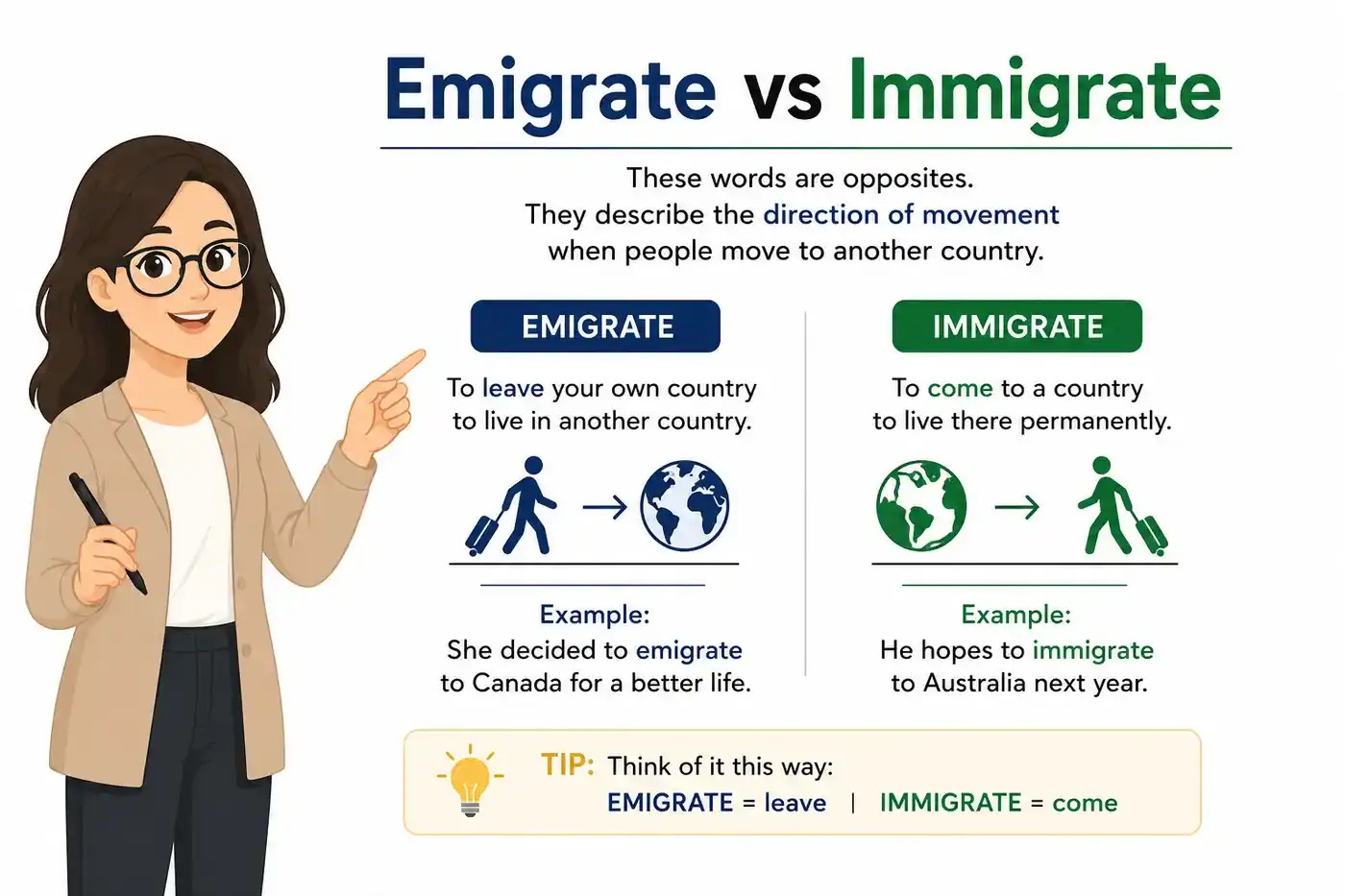
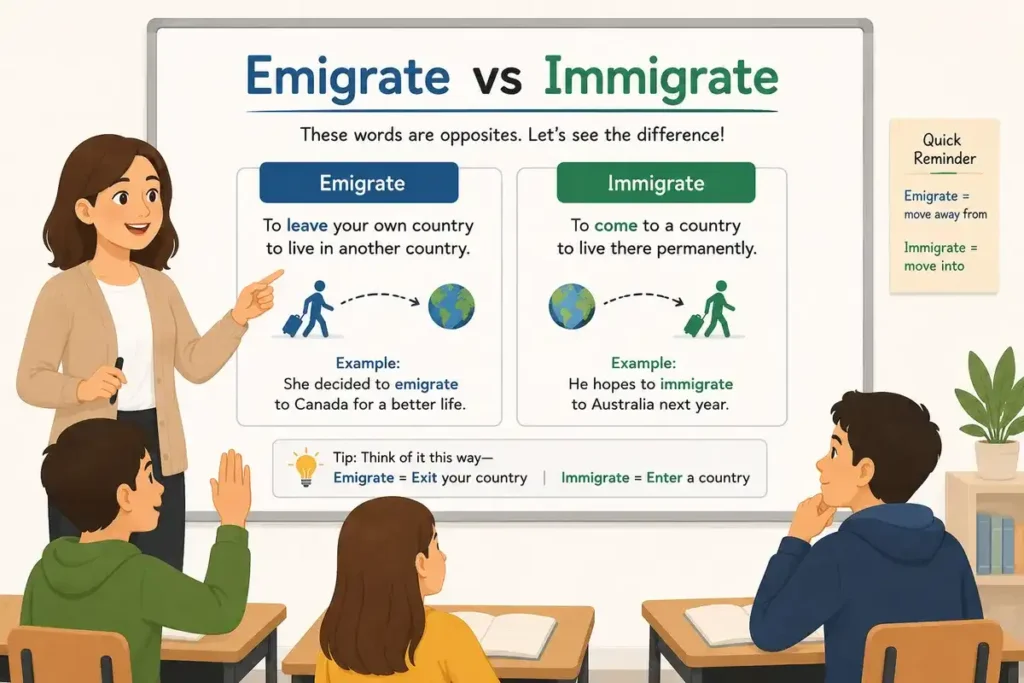
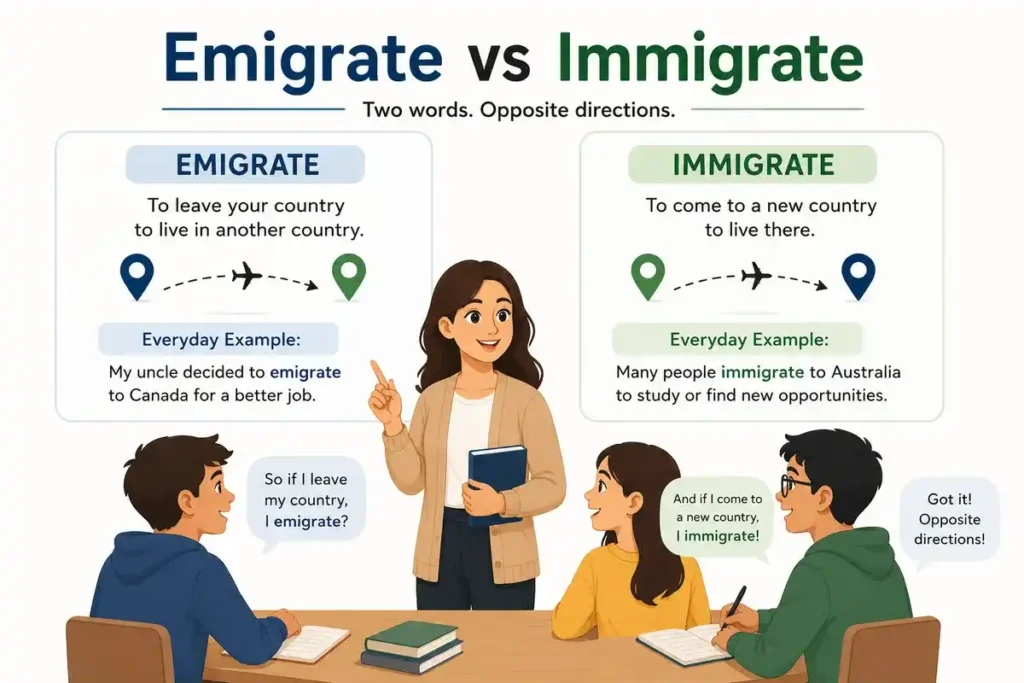
Emigrate means to leave your country to live somewhere else.
Immigrate means to enter a new country to live there.
Means of Emigrate vs Immigrate in Simple English
To understand these words, imagine a person moving from one country to another.
Example:
A woman moves from Pakistan to Canada.
Now we can describe this move in two ways.
Using Emigrate
If we focus on the country she leaves:
She emigrates from Pakistan.
This means she leaves Pakistan to live somewhere else.
Simple meaning:
Emigrate = go out of your home country
Think of exit.
Both words begin with E.
That makes emigrate easier to remember.
Using Immigrate
Now focus on the country she enters.
She immigrates to Canada.
This means she arrives in Canada to live there.
Simple meaning:
Immigrate = move into a new country
Think of in.
Both words begin with I.
That makes immigrate easy to remember.
One Move, Two Words
This is the most important rule.
One move can use both words.
Example:
- She emigrated from Pakistan.
- She immigrated to Canada.
Both sentences describe the same move.
Only the viewpoint changes.
Why People Mix These Words Emigrate vs Immigrate?
Many learners confuse emigrate vs immigrate for simple reasons.
They Look Very Similar
Compare them:
- emigrate
- immigrate
Only a few letters are different.
This makes them easy to confuse.
They Talk About the Same Situation
Both words describe moving between countries.
That overlap causes confusion.
People think they mean exactly the same thing.
They do not.
Perspective Changes Everything
This is the main reason people struggle.
You must ask:
Am I talking about leaving or arriving?
That decides the correct word.
Everyday Confusion Example
Sentence:
“My uncle moved to Australia.”
Which word should you use?
Answer:
It depends.
If talking about his old country:
He emigrated.
If talking about Australia:
He immigrated.
Clear Difference Emigrate vs Immigrate Explained Simply
The difference between emigrate vs immigrate becomes easy when you compare them side by side.
Emigrate
- Focuses on leaving
- Shows movement out
- Talks about home country
Example:
He emigrated from India.
Immigrate
- Focuses on arriving
- Shows movement in
- Talks about new country
Example:
He immigrated to Australia.
Easy Comparison Table
| Word | Meaning | Focus |
|---|---|---|
| Emigrate | Leave a country | Going out |
| Immigrate | Enter a country | Coming in |
Easy Memory Trick
Use this simple trick.
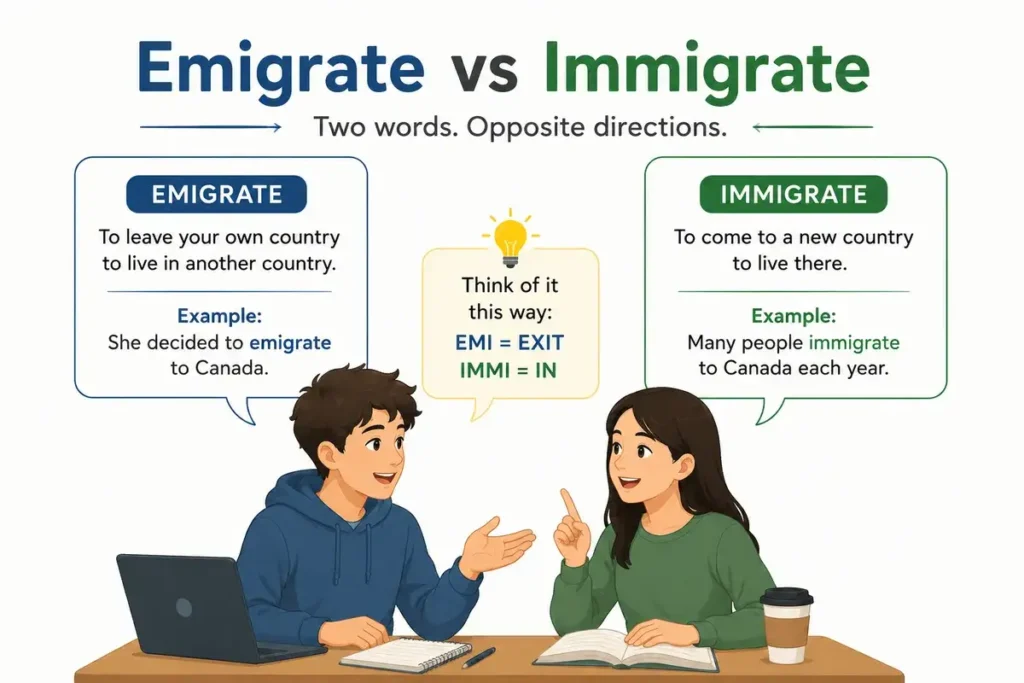
E = Exit = Emigrate
I = In = Immigrate
This trick helps many students remember the difference quickly.
Which Form Should You Use Emigrate vs Immigrate?
Use the correct word based on what you want to say.
Use Emigrate When Talking About Leaving
Ask:
Is the person leaving a country?
If yes, use:
✅ Emigrate
Examples:
- They emigrated from Syria.
- My grandparents emigrated from Italy.
Use Immigrate When Talking About Arriving
Ask:
Is the person entering a new country?
If yes, use:
✅ Immigrate
Examples:
- They immigrated to Germany.
- My friend immigrated to the United States.
Teacher Rule
Ask one simple question:
Leaving or arriving?
If leaving → emigrate
If arriving → immigrate
That solves most confusion.
Common Word Patterns
These words often appear with specific prepositions.
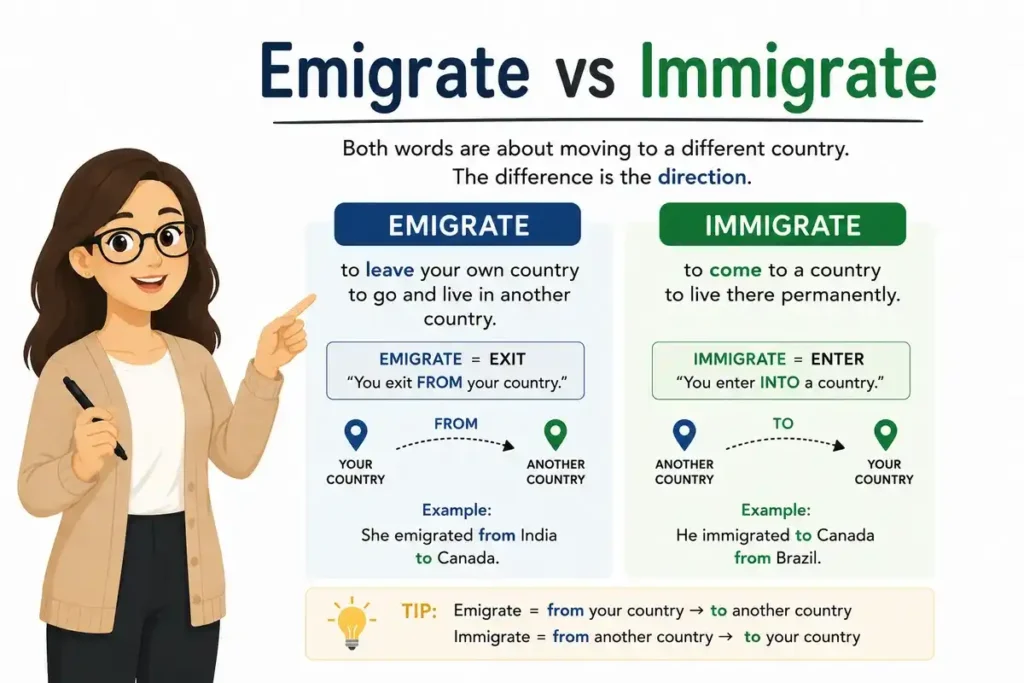
Emigrate From
Use:
emigrate from
Examples:
- She emigrated from Egypt.
- They emigrated from Brazil.
Immigrate To
Use:
immigrate to
Examples:
- He immigrated to Canada.
- They immigrated to France.
This pattern helps you write correctly.
Emigrate vs Immigrate Used in News and Daily Life
You often hear these words in:
- News reports
- Government documents
- Visa discussions
- Travel stories
- Family conversations
Example:
“Many workers immigrated for better opportunities.”
Example:
“Several families emigrated because of economic problems.”
These words are important in real-life communication.
Origin of Emigrate vs Immigrate
The words come from Latin roots.
Understanding the roots makes the meaning easier.
Emigrate Origin
The prefix e- means out.
That matches the meaning.
Out = leaving.
Immigrate Origin
The prefix im- means into.
That matches the meaning.
Into = entering.
Even the word origins teach the rule.
That is why the spelling matters.
Common Mistakes People Make About Emigrate vs Immigrate
Many learners make the same mistakes with emigrate vs immigrate.
Mistake 1: Using Them Like Synonyms
They are related but not identical.
Wrong thinking:
Emigrate = immigrate
Correct:
They describe different viewpoints.
Mistake 2: Forgetting Perspective
Always ask:
From where?
To where?
That fixes confusion.
Mistake 3: Wrong Prepositions
Wrong:
❌ immigrate from
❌ emigrate to
Better:
✅ emigrate from
✅ immigrate to
Mistake 4: Mixing Spoken and Written Meaning
In casual speech, people sometimes mix them.
In formal writing, the difference matters more.
Quick Practice
Choose the correct word.
- She moved out of Japan. She ______ from Japan.
- She moved into Canada. She ______ to Canada.
- They left Italy. They ______ from Italy.
Answers:
- emigrated
- immigrated
- emigrated
Practice helps the rule stick.
Deep Meaning, Culture, and Practical Use of Emigrate vs Immigrate
The words emigrate and immigrate are not just grammar words. They are deeply connected to real human stories. When people move from one country to another, they often carry hopes, dreams, fears, and memories. That is why these words appear in many stories, movies, books, and family conversations.
A migration story often includes:
- Leaving home
- Missing family
- Learning a new language
- Starting a new life
- Building a better future
For some people, emigration is a hard goodbye.
They leave behind:
- Friends
- Family
- Childhood memories
- Familiar places
That can feel emotional.
Immigration often represents a new beginning.
A person enters a new country with fresh hopes.
They may look for:
- Safety
- Education
- Jobs
- Freedom
- Opportunity
This is why migration stories are powerful.
They are stories about change.
In Movies and Books
Many famous stories include immigration themes.
A family moves to a new country. They struggle at first. Then they slowly adapt.
These stories help us understand courage and resilience.
That is why emigrate vs immigrate carries emotional meaning beyond dictionary definitions.
Biblical and Mythological Meaning of Emigrate vs Immigrate
The words themselves are modern, but the idea of moving from one place to another is very old.
The Bible contains many journeys.
People often moved because of famine, war, safety, or faith.
Movement for Survival
Families sometimes left their homes to survive difficult times.
This is similar to emigration.
They left one land to live elsewhere.
Movement Toward Promise
Many religious stories also include journeys toward hope.
This feels similar to immigration.
People entered new lands hoping for peace and blessings.
Mythological Journeys
Myths from many cultures also tell stories about travel.
Heroes often leave home and enter unknown places.
These journeys symbolize transformation.
So while the exact words emigrate and immigrate are modern, the human experience behind them is ancient.
Symbolism of Emigrate vs Immigrate Explained in Simple Words
These words also carry symbolic meaning.
They often represent life changes.
What Emigrate Represents?
Leaving the Past
Emigrate often symbolizes saying goodbye.
A person leaves what feels familiar.
That can include:
- Old habits
- Old routines
- Old environments
Courage to Leave
Leaving home is rarely easy.
Emigration often represents bravery.
It takes courage to start over somewhere new.
Change
Emigration symbolizes movement away from one chapter of life.
It often marks a major turning point.
What Immigrate Represents?
New Beginnings
Immigrate often symbolizes a fresh start.
It means entering a new environment.
Hope
Many people immigrate with dreams of a better future.
This makes immigration strongly connected with hope.
Growth
A new country often brings learning and growth.
People develop new skills and experiences.
Symbolism Comparison Emigrate vs Immigrate
| Word | Symbolic Meaning |
|---|---|
| Emigrate | Leaving, change, courage |
| Immigrate | Arrival, hope, new beginnings |
This comparison makes the difference easier to remember.
Related Words To Emigrate vs Immigrate You Should Know
Learning related words improves vocabulary and understanding.
Migration
Movement from one place to another.
Example:
“Migration happens for many reasons.”
Migrant
A person who moves to another place.
Example:
“He is a migrant worker.”
Immigration
The process of entering a new country.
Example:
“Immigration laws changed.”
Emigration
The process of leaving a country.
Example:
“Emigration increased last year.”
Relocation
Moving to a different place.
Example:
“The company offered relocation.”
Visa
Permission to enter or stay in a country.
Example:
“She applied for a visa.”
Citizenship
Legal membership in a country.
Example:
“He received citizenship.”
These words often appear in news and official documents.
Use of Emigrate vs Immigrate in Daily English
People use these words in many real-life situations.
Examples:
- My cousin emigrated from Pakistan last year.
- She immigrated to Canada for university.
- Many families emigrate for better jobs.
- Some people immigrate for safety.
- His grandparents immigrated to America.
- They emigrated from Turkey in 2012.
- She wants to immigrate after graduation.
- Their family emigrated during difficult times.
- Thousands immigrate every year.
- He emigrated to build a better future.
Spoken English Note
In casual speech, people sometimes say:
- moved abroad
- moved overseas
- moved to another country
These are simpler alternatives.
Why These Words Emigrate vs Immigrate Matter?
These words matter because migration shapes families and societies. Millions of people move across borders. Some move for work., some move for education, some move for safety. Language helps us describe these experiences clearly. That is why knowing the difference matters.
A Fun Way to Remember Emigrate vs Immigrate
Imagine two doors.
One door says:
EXIT
The other door says:
ENTER
When someone goes through the exit door, they emigrate.
When someone goes through the enter door, they immigrate.
This picture makes the difference easy to remember.
Common Questions Students Ask About Emigrate vs Immigrate
Is emigrate or immigrate correct?
Both can be correct.
Use emigrate when talking about leaving a country.
Use immigrate when talking about arriving in a new country.
Can one person emigrate and immigrate at the same time?
Yes.
The same move can be described with both words.
Example:
“Maria emigrated from Mexico.”
“Maria immigrated to Canada.”
Both sentences describe one move.
Do I use “from” or “to”?
A simple rule:
- Emigrate from
- Immigrate to
Examples:
- He emigrated from India.
- He immigrated to Canada.
Which word is more common?
Both are common.
The choice depends on what part of the move you are discussing.
If the conversation is about the old country, emigrate may be used.
If the conversation is about the new country, immigrate may be used.
Final Teacher Explanation
Imagine a student asks:
“Teacher, how do I remember emigrate or immigrate?”
I would say this.
Do not focus on the long spellings.
Focus on direction.
Ask:
Are we talking about leaving or entering?
If leaving, use emigrate.
If entering, use immigrate.
That is the whole rule.
Here is the easiest memory trick:
E = Exit = Emigrate
I = In = Immigrate
If you remember this, you will rarely confuse the words again.
Quick Recap Emigrate vs Immigrate
When comparing emigrate vs immigrate, the difference is simple.
Emigrate means leaving your country to live elsewhere, while immigrate means entering a new country to live there.
The move is the same. Only the viewpoint changes.
Conclusion
When comparing emigrate vs immigrate, the main difference is direction and perspective. Emigrate means leaving one country, while immigrate means entering another. Understanding this difference improves your vocabulary, usage, communication, and word choice.
A simple way to remember the rule is easy: E means exit, and I means in. Once you understand the meaning and context, using these words correctly becomes much easier in everyday English.
Frequently Asked Questions
What is the difference between emigrate and immigrate?
Emigrate means leaving a country. Immigrate means entering a new country.
Is emigrate or immigrate correct?
Both are correct. The right word depends on perspective.
How can I remember the difference?
Use this trick: E = Exit, I = In.
Can one move use both words?
Yes. The same move can be described using both words.
Why do people confuse these words?
They look similar and describe the same migration event.
Do I say immigrate from or immigrate to?
Use immigrate to.
Do I say emigrate from or emigrate to?
Use emigrate from.