
Many English learners get confused about used to vs would because both can talk about the past. At first, they may seem to mean the same thing. But they are not always interchangeable. Knowing the difference between used to vs would helps you speak and write more naturally.
The good news is that the rule is simple. Used to can describe past habits and past states. Would is mainly used for repeated past actions, not past states. Once you understand this one difference, choosing the right expression becomes much easier.
In this guide, you will learn the meaning of used to vs would, when to use each one, common mistakes, and real-life examples. Everything is explained in very simple English, just like a teacher would explain it in class.
Many English learners mix up similar-looking words such as Favourite vs Favorite.
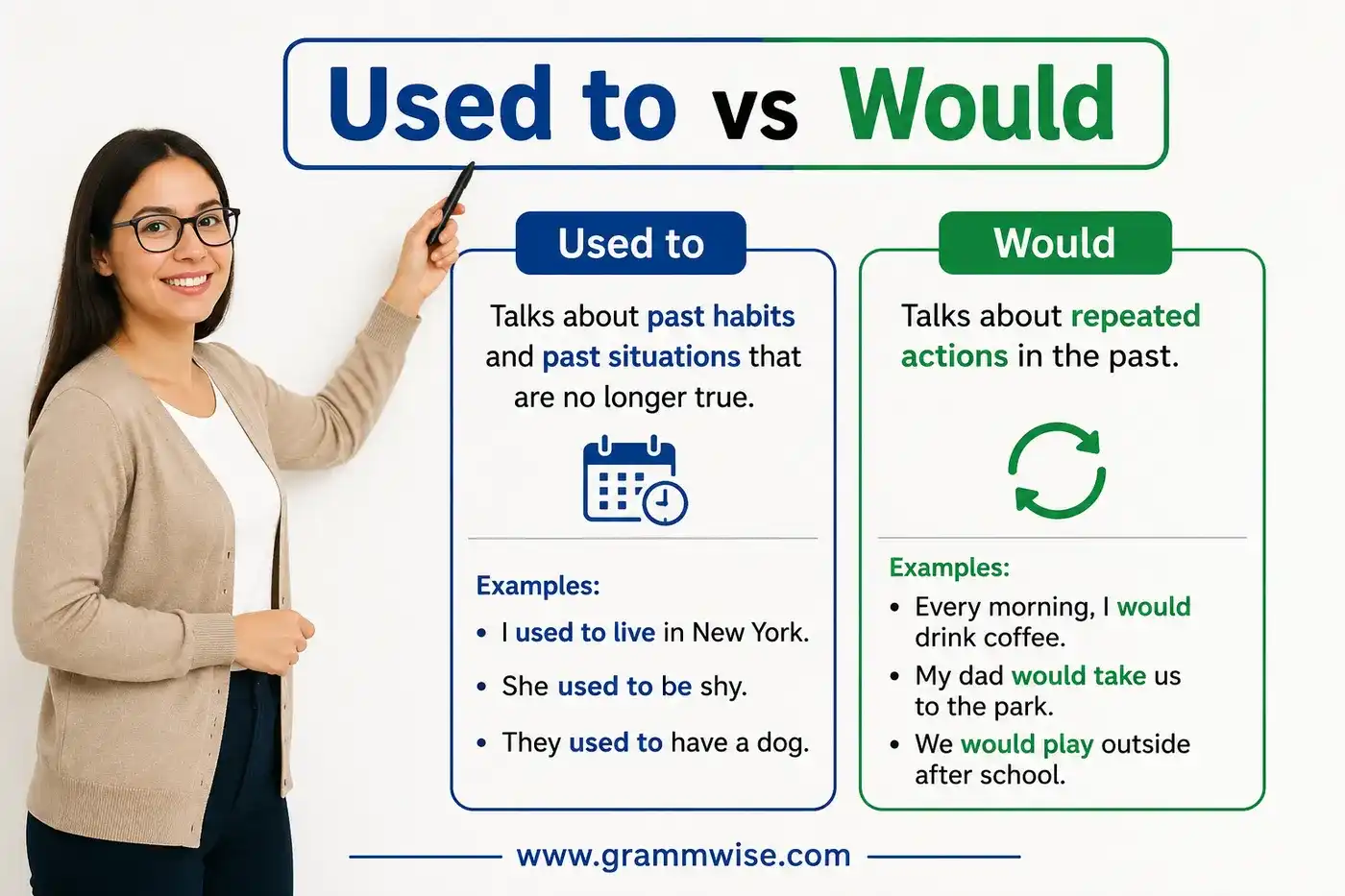
Simple Answer in One Look
- Used to = talks about past habits and past situations that are no longer true.
- Would = talks about repeated actions in the past, but not past situations or states.
Example:
✅ I used to live in New York.
❌ I would live in New York. (Incorrect)
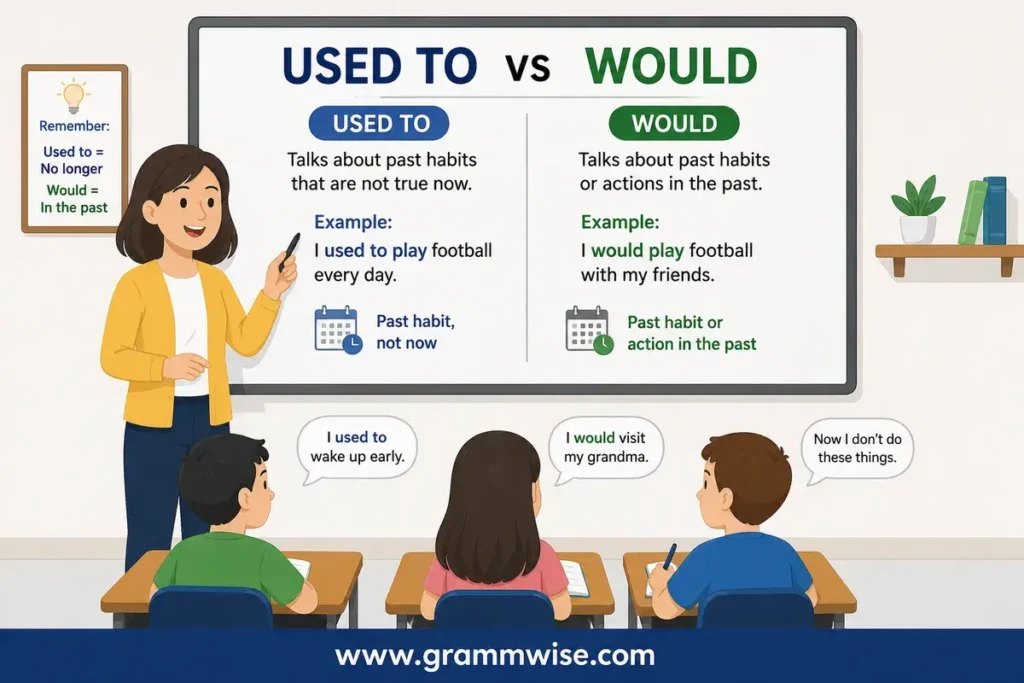
Used To vs Would: What This Means in Simple English?
Think about your childhood.
Maybe you played soccer every weekend.
You can say:
I used to play soccer every weekend.
You can also say:
Every weekend, I would play soccer with my friends.
Both sentences are correct because playing soccer is an action that happened many times.
Now think about where you lived.
You can say:
I used to live in Texas.
But you cannot say:
I would live in Texas.
Living is not a repeated action. It is a situation or state. Only used to works here.
Here is another example.
When I was young, I used to have long hair.
You cannot say:
I would have long hair.
Again, having long hair is a state, not a repeated action.
A simple way to remember this is:
- Used to talks about things that were true before but are not true now.
- Would talks about things someone did again and again in the past.
Why People Mix These Words “Used To vs Would”
People confuse used to vs would because many textbooks show both talking about the past.
Look at these sentences.
I used to visit my grandmother every Sunday.
I would visit my grandmother every Sunday.
Both are correct.
Because of examples like these, learners often think they can always replace one with the other.
But that is not true.
Now look at another example.
I used to own a small shop.
Can you replace it?
❌ I would own a small shop.
No.
Owning a shop is a state, not a repeated action.
Another reason for the confusion is that native speakers often tell stories using would.
For example:
Every summer, my family would drive to the beach. We would swim all day. We would eat ice cream before going home.
These are repeated actions in a story.
But before starting the story, a speaker might say:
We used to spend every summer at the beach.
Notice how used to introduces the past situation, while would describes the repeated actions inside that situation.
Clear Difference Between “Used To vs Would” Explained Simply
Here is an easy comparison.
Use used to when:
- talking about old habits
- talking about past routines
- talking about past situations
- talking about things that changed
Examples:
- I used to wear glasses.
- She used to be shy.
- We used to live nearby.
- My dad used to smoke.
Use would when:
- talking about repeated past actions
- telling stories about the past
- describing things people did many times
Examples:
- Every morning, Dad would make pancakes.
- My grandmother would tell funny stories.
- We would walk to school together.
- They would play cards after dinner.
Quick Comparison
| Used to | Would |
|---|---|
| Past habit | Past repeated action |
| Past state | No |
| Past situation | No |
| Shows something changed | Sometimes |
| Common in conversation | Very common |
Used To vs Would: Which Form Should You Use?
Ask yourself one simple question.
Is this an action or a situation?
If it is a situation, use used to.
Examples:
I used to know the answer.
She used to like coffee.
They used to own a restaurant.
He used to live in Canada.
These all describe states or situations.
If it is a repeated action, you may use either.
Examples:
Every Saturday we used to visit our grandparents.
Every Saturday we would visit our grandparents.
Both sound natural.
If there is no repeated action, do not use would.
Incorrect:
❌ She would be very shy.
Correct:
✅ She used to be very shy.
Easy Real-Life Sentences on “Used To vs Would”
Here are simple sentences you can use every day.
- I used to wake up at six every morning.
- My brother used to play basketball after school.
- My grandmother would bake cookies every Sunday.
- We would sit outside and watch the sunset.
- She used to have a blue bicycle.
- They used to work together.
- Every evening Dad would read us a story.
- We used to live near the park.
Practice saying these aloud. They sound natural and are common in everyday English.
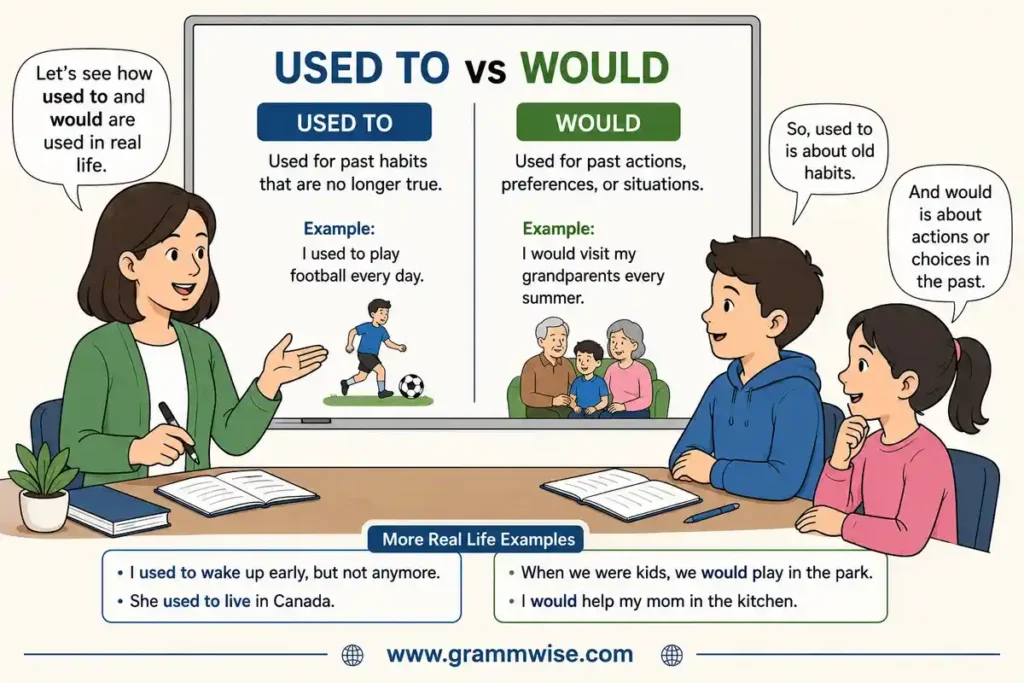
Used To vs Would: Where This Expression Comes From?
The phrase used to has been part of English for hundreds of years. Long ago, the word used meant being familiar with something through experience. Over time, English speakers began using used to to describe habits and situations that happened before but no longer happen today.
The word would comes from the old form of the verb will. At first, it showed willingness or intention. Later, English speakers also began using it to describe repeated actions in stories about the past.
That is why today:
- Used to often tells us what was true before.
- Would often tells us what people repeatedly did in the past.
Both have a long history, but they developed different jobs in modern English.
Used To vs Would: How This Word Is Understood in Culture and Stories?
When people tell stories about their childhood, they often use both used to and would. These expressions help listeners picture what life was like many years ago.
For example, someone might say:
We used to live in a small village.
This gives the background. It tells you where the family lived.
Then the speaker may continue:
Every evening, we would sit outside and watch the stars.
Now the story becomes more interesting because it describes a habit that happened again and again.
Books, movies, and family stories often use would after the background has already been explained. It helps the story sound warm and natural.
Imagine your grandfather telling you about his childhood.
He might say:
We used to have a small farm. Every morning, my brothers and I would feed the chickens before school.
Notice how used to introduces the past situation, and would describes the repeated actions.
People also use used to when talking about changes in life.
For example:
- I used to be afraid of dogs.
- She used to hate vegetables.
- They used to live next door.
These sentences show that life is different now.
That is why used to often brings a feeling of change or memory.
Would, on the other hand, often makes people think of routines and happy memories.
For example:
- Every Christmas, we would decorate the tree together.
- Every summer, we would visit our grandparents.
- My dad would read bedtime stories every night.
These examples help listeners imagine the same action happening many times.
That is why both expressions are common in stories, but they have different jobs.
Biblical and Mythological Meaning
There is no special biblical meaning or mythological meaning for used to or would. They are grammar expressions, not religious or symbolic words.
However, when people read the Bible or old stories, they may notice similar patterns.
For example, someone telling the story of a king might say:
- The king used to rule a large kingdom.
- Every morning, he would meet his advisors.
Here, used to explains the past situation, while would tells us about the king’s repeated actions.
The same idea appears in many old stories, fairy tales, and legends. The expressions simply help explain what people did and how they lived.
Symbolism of “Used To vs Would” Explained in Simple Words
Although used to and would are grammar expressions, people sometimes connect them with different feelings when telling stories.
What “Used To” Represents?
Used to often represents change.
It reminds us that something was true before but is not true anymore.
For example:
- I used to wear glasses.
- We used to live near the beach.
- My grandfather used to work as a teacher.
These sentences make people think about the past and how life has changed.
- Sometimes the momories are happy.
- Sometime they are sad.
- Sometimes they simply show that life moves forward.
What “Would” Represents?
Would often represents routine and memories.
It helps people picture actions happening over and over again.
For example:
- Every evening, Grandma would bake fresh bread.
- Dad would whistle while working.
- We would laugh for hours during family dinners.
When people hear these sentences, they can almost imagine the scene.
That is why many storytellers enjoy using would. It makes repeated actions sound smooth and natural.
A simple way to remember this is:
- Used to = life was different.
- Would = this happened again and again.
Related Words to “Used To vs Would” You Should Know
Learning a few related expressions will make used to vs would much easier to understand.
Be Used To
This means someone is familiar with something.
Example:
I am used to waking up early.
Get Used To
This means becoming familiar with something.
Example:
She is getting used to her new school.
Usually
This talks about a regular habit now.
Example:
I usually drink coffee before work.
Always
This means something happens every time.
Example:
He always checks his email before breakfast.
Often
This means something happens many times.
Example:
We often go to the library on Saturdays.
Habit
A habit is something you do regularly.
Example:
Reading before bed is a good habit.
Routine
A routine is your usual way of doing things every day.
Example:
My morning routine starts with a walk.
Past
The past means a time before now.
Example:
We can learn many lessons from the past.
How People Actually Use “Used To vs Would” in Daily English
Native speakers use used to and would in everyday conversations all the time.
Here are some natural examples.
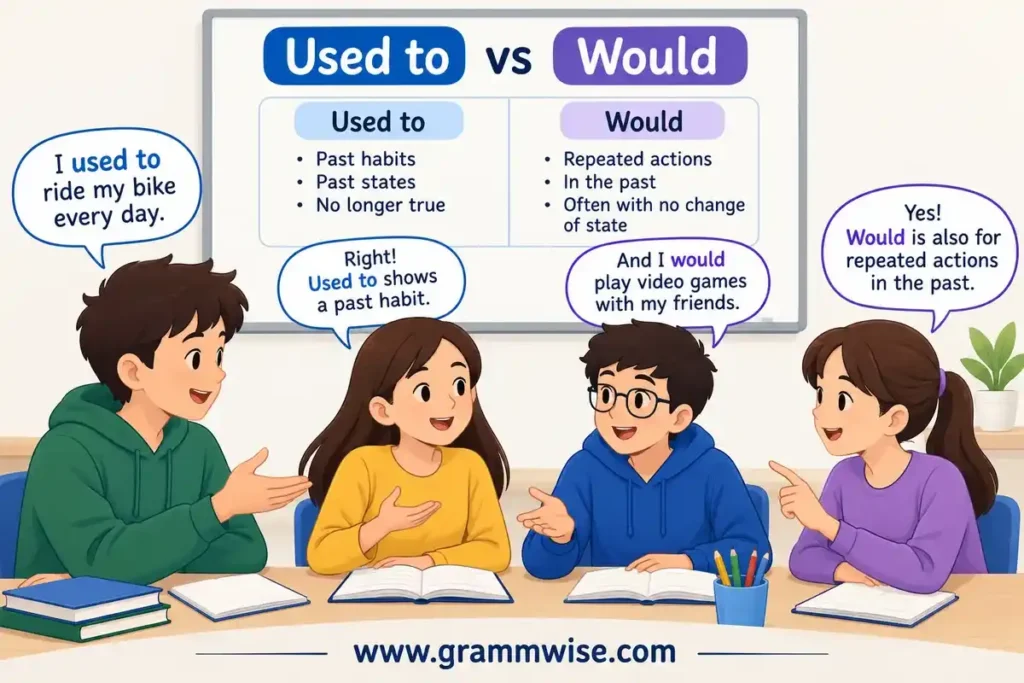
“I used to play video games every day, but now I’m too busy.”
“My mom would make pancakes every Sunday.”
“We used to live across the street from our school.”
“My grandfather would tell us funny stories after dinner.”
“I used to have a pet rabbit when I was a child.”
“Every winter, we would build a snowman together.”
“They used to own a small bookstore.”
“When we were kids, we would ride our bikes until sunset.”
“I used to be nervous before speaking in class.”
“My teacher would always smile when someone asked a question.”
These sentences sound natural because they match how native speakers describe memories and past experiences.
Common Mistakes People Make About “Used To vs Would”
Many English learners make the same mistakes with used to vs would. Once you know them, they are easy to avoid.
Mistake 1: Using “would” for a past state
❌ I would be shy when I was a child.
✅ I used to be shy when I was a child.
Being shy is a state, so use used to.
Mistake 2: Using “would” to describe where someone lived
❌ We would live in Boston.
✅ We used to live in Boston.
Living somewhere is a situation, not a repeated action.
Mistake 3: Forgetting the repeated action with “would”
❌ I would play soccer yesterday.
✅ I played soccer yesterday.
Would is for repeated past habits, not a single event.
Mistake 4: Thinking both expressions always mean the same thing
Many learners replace every used to with would.
That does not always work.
Remember this easy rule:
If it is a past situation or state, only used to is correct.
Mistake 5: Mixing “be used to” with “used to”
These are different expressions.
I used to play tennis. ✔
I am used to playing tennis. ✔
The first sentence talks about a past habit.
The second sentence means tennis feels normal to me now.
Final Teacher Explanation “Used To vs Would”
Imagine I am standing in front of a classroom.
A student asks, “Teacher, how do I remember used to vs would?”
I would answer like this.
Don’t try to memorize lots of grammar rules.
Just remember one simple question.
Are you talking about an action or a situation?
- If it is a situation, use used to.
- If it is a repeated action, you can usually use used to or would.
- If you are talking about where someone lived, what someone was like, or what someone had, choose used to.
- If you are talking about something people did again and again, would works well, especially when telling stories.
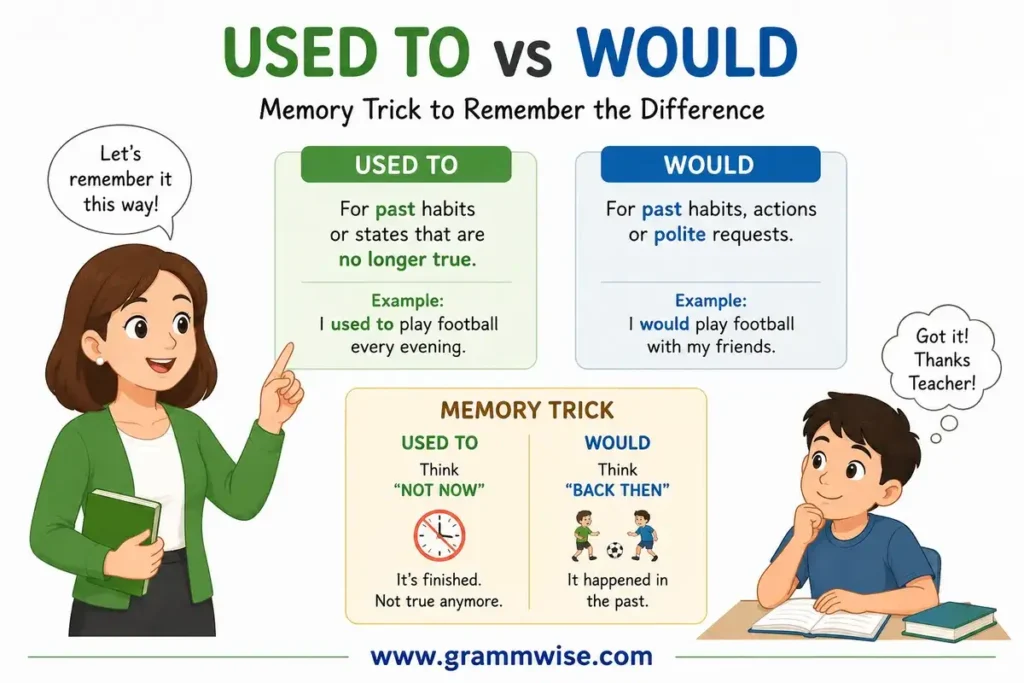
Here is the easiest memory trick.
Used to = life was different.
Would = this happened many times.
If you remember these two ideas, you will make the right choice most of the time.
Quick Recap
The difference between used to vs would is simple. Used to talks about past habits and past situations that are no longer true. Would talks about repeated actions in the past but not past states or situations.
When you are unsure, ask yourself whether you are describing a situation or a repeated action. This one question will help you choose the correct expression with confidence.
Conclusion
Understanding used to vs would becomes easy when you remember one simple rule. Used to describes past habits and past situations that are no longer true, while would describes repeated actions in the past. This small difference will help you speak and write English more naturally and confidently.
Keep practicing with real-life sentences, and soon choosing between these two expressions will feel natural. The more you read, listen, and use them in conversation, the easier it becomes to understand the difference every time.
Frequently Asked Questions (FAQs)
What is the difference between used to vs would?
Used to describes past habits and past situations. Would describes repeated past actions only.
Can I use used to and would in the same sentence?
Yes. Many native speakers do this when telling stories. Used to gives the background, and would describes repeated actions.
Is it correct to say “I would live in New York”?
No. Say I used to live in New York because living is a past situation, not a repeated action.
Can both expressions describe past habits?
Yes. Both used to and would can describe habits that happened many times in the past.
Why do people get confused between used to vs would?
People see both expressions talking about the past, so they think they always mean the same thing. The biggest difference is that would cannot describe past states or situations.
When should I use used to instead of would?
Use used to when talking about where someone lived, what someone was like, what someone had, or any situation that was true before but is not true now.
Can I use would in formal writing?
Yes. Would is correct in both formal and informal writing when describing repeated actions in the past.
Which is easier to remember Used To vs Would?
Remember this simple rule: Used to = past habits + past situations. Would = repeated past actions only. This is the easiest way to master used to vs would.