
Many English learners struggle with say vs tell. Both words are about speaking, but they are not used the same way. The good news is that the difference is simple when you learn one easy rule.
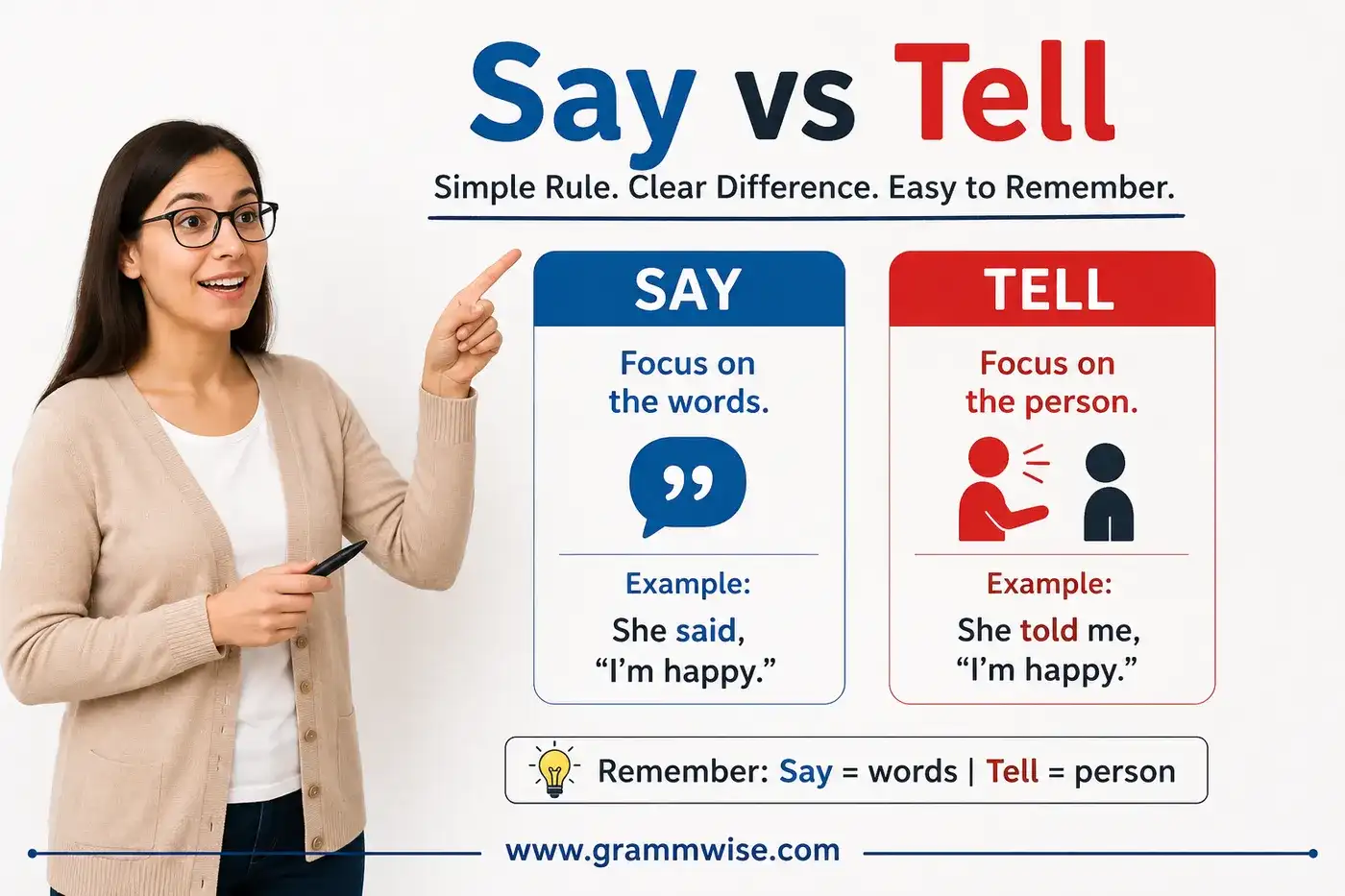
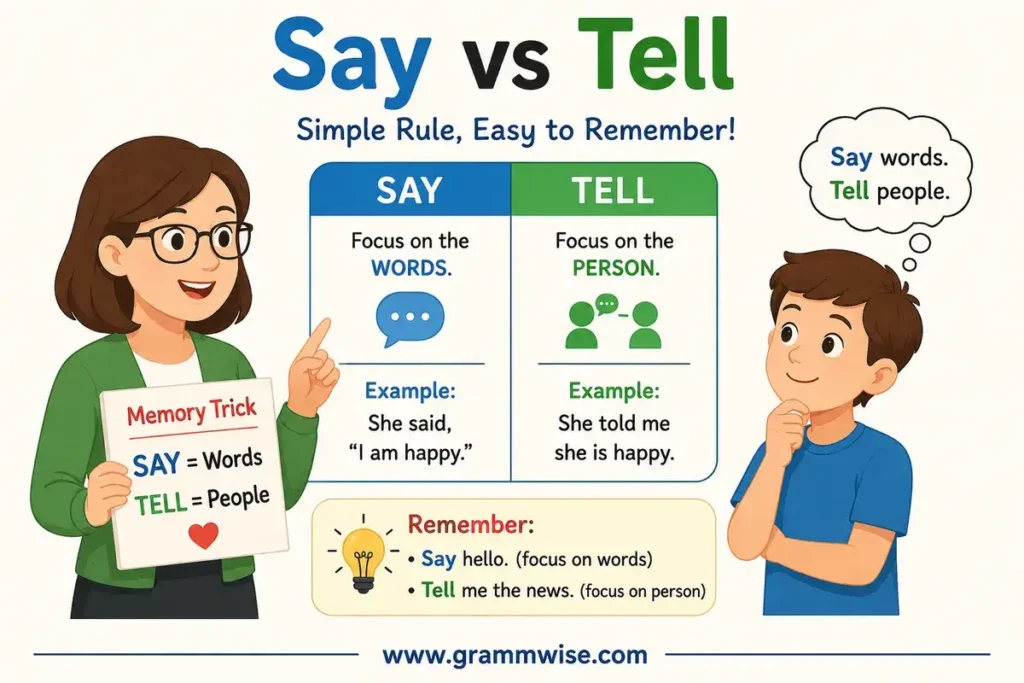
Use say when you focus on the words spoken. Use tell when you focus on the person receiving the message. For example, “She said hello” is correct, and “She told me hello” is also correct because tell includes the listener.
This guide will explain say vs tell in very simple English. You will learn the difference, see real-life examples, and understand which form to use in daily conversation, school, and writing.
English has many word pairs with subtle differences in meaning and usage like Make vs Do.
Simple Answer in One Look
Say = focus on the words.
Tell = focus on the person who hears the words.
| Word | Example |
|---|---|
| say | She said, “Good morning.” |
| tell | She told me, “Good morning.” |
Quick rule: say + words | tell + person
Meaning of “Say vs Tell” in Simple English
Think about a classroom.
A teacher speaks to students.
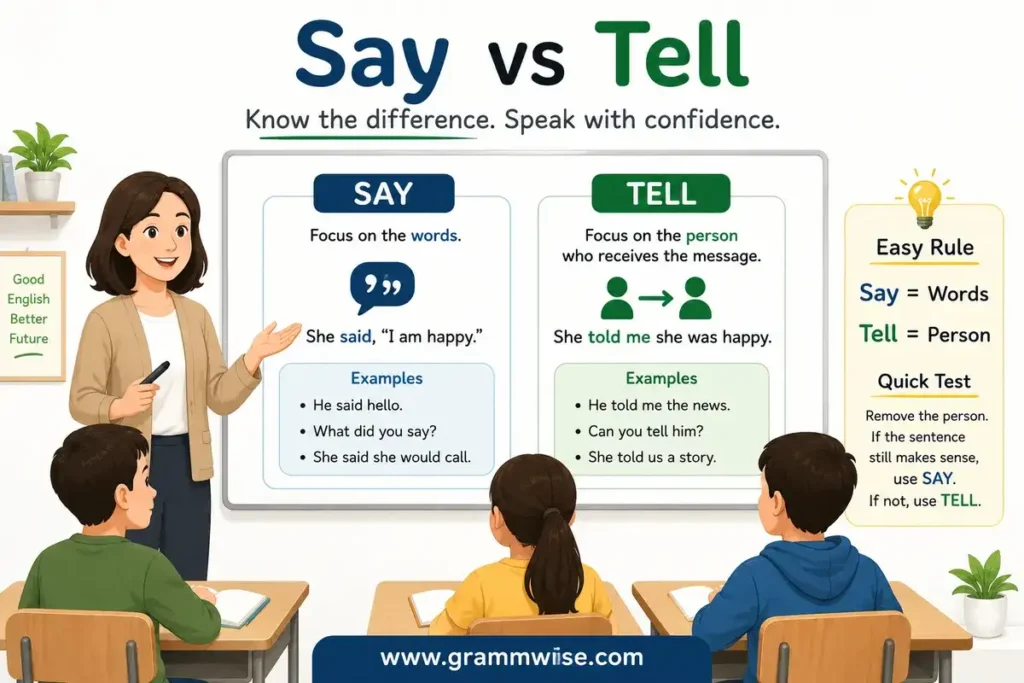
Say is about what the teacher says.
Tell is about who receives the message.
Examples:
- Say: “The teacher said, ‘Open your books.’”
- Tell: “The teacher told the students to open their books.”
Notice the difference.
- said → the words are important.
- told the students → the students are important.
This is the main idea behind say vs tell. If you remember this idea, most sentences become easy.
Say vs Tell: Why People Mix These Words?
People mix say and tell because both mean “speak” in a general way.
For example, these sentences look similar:
- “She said hello.”
- “She told me hello.”
Both are possible. The meaning is almost the same. But the structure changes.
Correct
- She said hello.
- She said hello to me.
- She told me hello.
Incorrect
- She told hello. ❌
- She said me hello. ❌
Many learners forget the listener after tell. They also forget to after say.
Easy memory trick:
- tell + person → tell me, tell him, tell the class
- say + to + person → say to me, say to him, say to the class
Clear Difference of “Say vs Tell” Explained Simply
SAY
Focus on the words
- say hello
- say thank you
- say something
- say a word
Examples
- He said, “I am tired.”
- Please say your name.
- She said nothing.
TELL
Focus on the listener
- tell me
- tell him
- tell the teacher
- tell a story
Examples
- He told me he was tired.
- Please tell the teacher your name.
- She told us the truth.
One-sentence memory trick
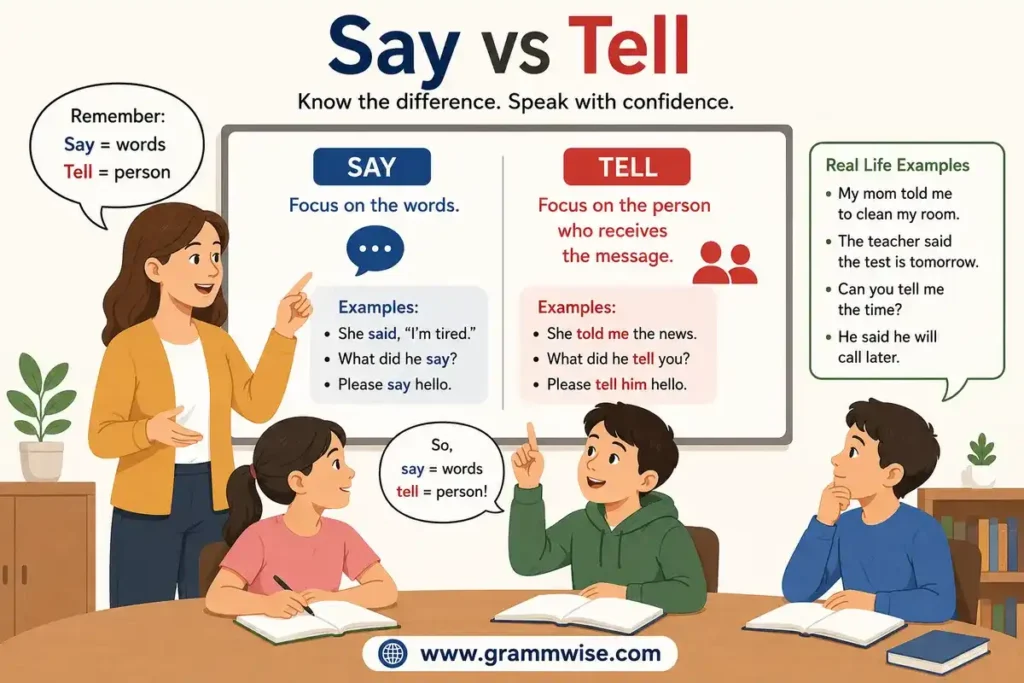
Say = words. Tell = person.
Say vs Tell: Which Form Should You Use?
Ask yourself one question:
Am I talking about the words or the listener?
Talking about the words → use SAY
- She said “thank you.”
- He said goodbye.
- What did you say?
Talking about the listener → use TELL
- She told me the answer.
- He told the class a joke.
- Can you tell us your name?
Fast classroom test
Try removing the listener.
“She told me the answer.”
Remove me:
“She told the answer.” ❌
It sounds wrong because tell usually needs a listener.
“She said the answer.” ✅
This sentence is complete because say can stand without a listener.
Easy Real-Life Sentences on “Say vs Tell”
These are natural everyday examples.
Say
“Please say that again.”
“She said she was busy.”
“Don’t say bad words.”
“What did he say?”
Tell
“Please tell me your name.”
“She told us the news.”
“Can you tell him the answer?”
“My father told me a story.”
Mini Practice
Choose the correct word:
- Can you ___ me the time? → tell
- What did she ___? → say
- Please ___ us the truth. → tell
- He didn’t ___ anything. → say
Say vs Tell: Where This Expression Comes From?
Say comes from an old English word that meant “speak” or “utter words.”
Tell originally meant “count” or “relate information.” Over time, it became the word we use for giving information to someone.
This old meaning helps explain the modern rule.
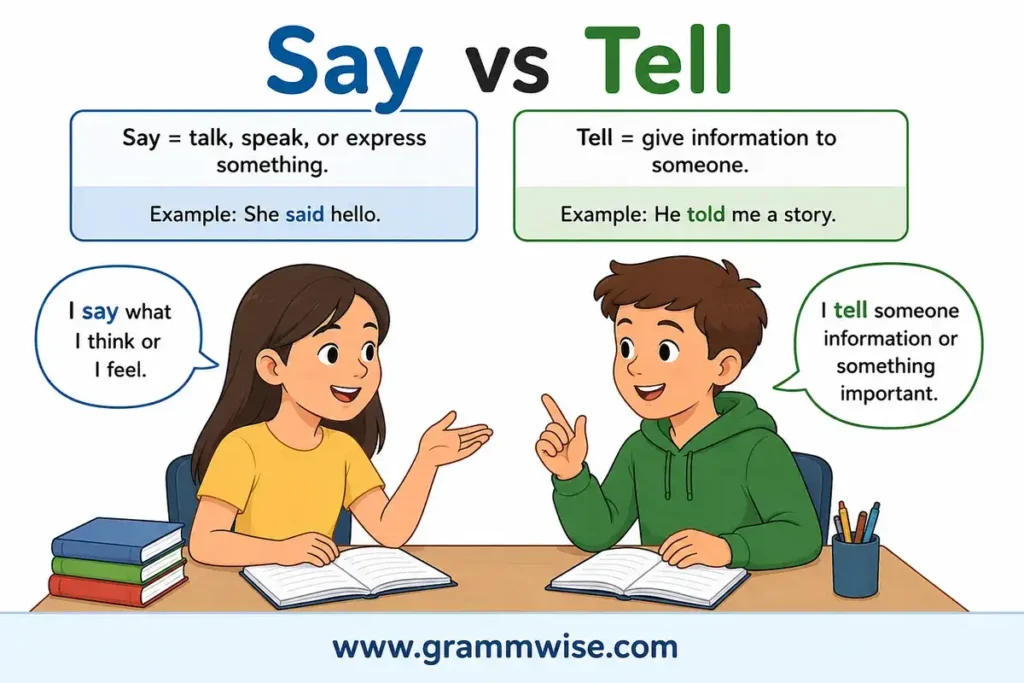
- say = produce words
- tell = give information to a person
That is why English often uses tell + person.
Quick Comparison Table
| Question | Use |
|---|---|
| Focus on the words? | say |
| Focus on the listener? | tell |
| Need “to” before a person? | say to someone |
| Need a person directly after the verb? | tell someone |
| Common phrase: “___ me the truth” | tell |
| Common phrase: “___ hello” | say |
One-Minute Rule “Say vs Tell”
Remember this sentence
“I say words. I tell people.”
Examples:
- I said “good morning.”
- I told my friend “good morning.”
If you can remember say = words and tell = people, you will avoid most mistakes in say vs tell.
How “Say vs Tell” Is Understood in Culture and Stories
People have shared ideas by speaking for thousands of years. That is why say and tell appear in stories from almost every culture. They help people pass on news, teach lessons, and share feelings.
In many stories, a person says something important before a big event happens. A king may say a few words to his people. A parent may say kind words to a child. A friend may say sorry after making a mistake. Here, the focus is on the words that are spoken.
The word tell often appears when someone gives information to another person. A grandparent tells a family story. A teacher tells students the answer. A guide tells visitors where to go. In these cases, the message is meant for someone.
Children also hear these words in bedtime stories.
“The princess said, ‘Thank you.'”
“The old man told the children a story.”
Even though both sentences are about speaking, they use different patterns. The first focuses on the spoken words. The second focuses on the people receiving the story.
Movies use these words in the same way.
A character may say, “I love you.”
Another character may tell a friend a secret.
Books, cartoons, and TV shows all follow the same simple rule. That is one reason learning say vs tell is helpful. Once you know the pattern, you will notice it everywhere.
People also use these words when sharing advice.
“My mother always tells me to be honest.”
“My father said that hard work brings success.”
These examples sound natural because English speakers follow the same rule every day.
Biblical and Mythological Meaning of “Say vs Tell”
The Bible uses both say and tell many times.
God often says something to people. The focus is on His words and messages.
People also tell others what they have heard. Prophets tell kings God’s message. Parents tell children about God’s teachings. Friends tell each other what happened.
In simple terms:
Say shows the spoken message.
Tell shows the act of giving that message to someone else.
Many old myths and legends follow the same idea.
A hero says brave words before a battle.
A wise person tells the hero what to do.
No matter which story you read, the basic meaning stays the same.
Symbolism of “Say vs Tell” Explained in Simple Words
What Say Represents?
The word say often represents speaking from the heart.
It can show thoughts, feelings and opinions.
When someone says something, they are putting ideas into words.
People may say thank you.
They may say sorry.
They may say yes or no.
These simple words can change a friendship, solve a problem, or make someone smile.
That is why say often represents expression.
What Tell Represents?
The word tell often represents sharing.
It means passing information from one person to another.
People tell stories.
They tell jokes.
They tell the truth.
Parents tell children how to stay safe.
Teachers tell students how to solve problems.
Doctors tell patients what medicine to take.
In many cultures, telling someone the truth is seen as a sign of honesty and trust.
Because of this, tell often represents guidance, teaching, and communication.
Related Words to “Say vs Tell” You Should Know
Speak means to use your voice to talk.
Talk means to have a conversation with someone.
Mention means to say something quickly without much detail.
Explain means to make something easy to understand.
Describe means to give details about someone or something.
Announce means to tell many people important news.
Inform means to give someone facts or information.
Ask means to say a question.
Reply means to answer someone.
Answer means to respond to a question.
Whisper means to speak very quietly.
Shout means to speak very loudly.
Learning these words will make your English stronger because they are all connected to speaking and sharing ideas.
Use of “Say vs Tell” in Daily English
Here are some natural examples you will hear every day.
- “Can you tell me the time?”
- “My teacher said we have homework.”
- “Please don’t tell anyone my secret.”
- “What did your brother say?”
- “My mom told me to clean my room.”
- “He said he would come later.”
- “My friend told us a funny story.”
- “Did she say your name?”
- “I forgot to tell you about the meeting.”
- “The doctor said everything looks fine.”
These are the kinds of sentences English speakers use every day at school, at work, at home, and with friends.
The more you hear them, the easier say vs tell becomes.
Common Mistakes People Make About “Say vs Tell”
Many learners make the same mistakes. The good news is that they are easy to fix.
❌ She said me the answer.
✅ She told me the answer.
Remember, tell is used before the listener.
❌ He told hello.
✅ He said hello.
Here, the focus is only on the words.
❌ My teacher said me to study.
✅ My teacher told me to study.
When giving advice to a person, use tell.
❌ She told to me the news.
✅ She told me the news.
Do not use to after tell before the listener.
❌ He said us the truth.
✅ He told us the truth.
Use tell when someone receives the information.
❌ Please tell hello to your parents.
✅ Please say hello to your parents.
The phrase say hello is a fixed expression in English.
A simple memory trick is this:
Say = words.
Tell = person.
If you remember these four words, you will avoid most mistakes.
Final Teacher Explanation
Think of yourself standing in front of two doors.
The first door is called Words.
The second door is called People.
If your sentence is mainly about the words someone speaks, walk through the say door.
If your sentence is mainly about the person receiving the message, walk through the tell door.
That simple picture can help you remember the difference every time you speak or write. You do not need to memorize dozens of grammar rules. Just ask yourself one easy question.
“Am I talking about the words or the listener?”
If it is the words, use say.
If it is the listener, use tell.
With practice, this choice will become natural. Read books. Watch English videos. Listen to conversations.
Soon you will notice that native speakers use this pattern all the time. The more examples you see, the more confident you will become.
Quick Recap “Say vs Tell”
The difference between say vs tell is simple.
Use say when you focus on the spoken words.
Use tell when you focus on the person who receives the message.
Remember this easy rule: Say words. Tell people.
Conclusion
Understanding say vs tell is much easier when you remember one simple idea. Use say when you focus on the words someone speaks, and use tell when you focus on the person receiving the message. This easy rule will help you avoid common mistakes and speak English with more confidence.
Keep practicing with real conversations, books, and everyday examples. The more you read and listen, the more natural these two words will feel. Soon, choosing between say and tell will become quick and easy in both speaking and writing.
Frequently Asked Questions
What is the difference between say and tell?
Say focuses on the words someone speaks. Tell focuses on the person receiving the message.
When should I use say?
Use say when you are talking about the spoken words or a quotation.
When should I use tell?
Use tell when someone receives information, advice, instructions, or a story.
Why do people confuse say vs tell?
Both words are about speaking, so they have similar meanings. The sentence pattern is what makes them different.
Is “say me” correct?
No. Say say to me or tell me, depending on the sentence.
Can I use both say and tell in the same conversation?
Yes. Native English speakers often use both words together because they have different jobs in a sentence.
Is tell always followed by a person?
Usually, yes. Most of the time, tell is followed by the listener, such as tell me, tell him, or tell the class.
How can I remember the difference easily?
Remember this simple classroom rule: Say words. Tell people. If you keep this in mind, choosing between say and tell becomes much easier.