
Many English learners get confused about make vs do because both words talk about actions. They seem similar, but they are not used in the same way. If you know one simple rule, choosing between make vs do becomes much easier.
The good news is that you do not need to memorize hundreds of grammar rules. You only need to understand what each word usually means and practice with common examples. That is exactly what this guide will help you do.
By the end of this lesson, you will know the difference between make vs do, understand which word is correct in different situations, and feel more confident when speaking and writing English.
English has many word pairs with subtle differences in meaning and usage such as Say vs Tell.
Simple Answer in One Look
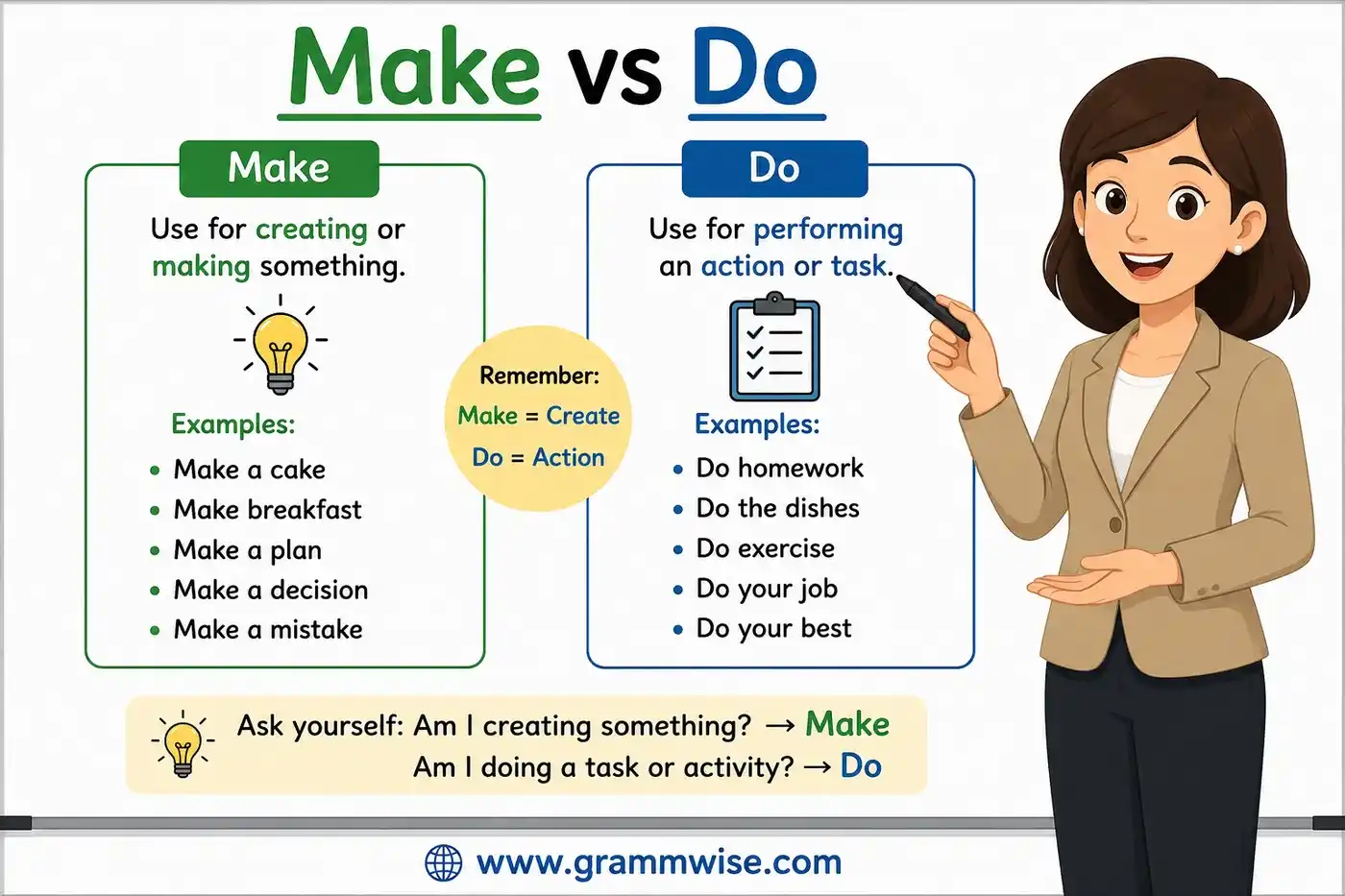
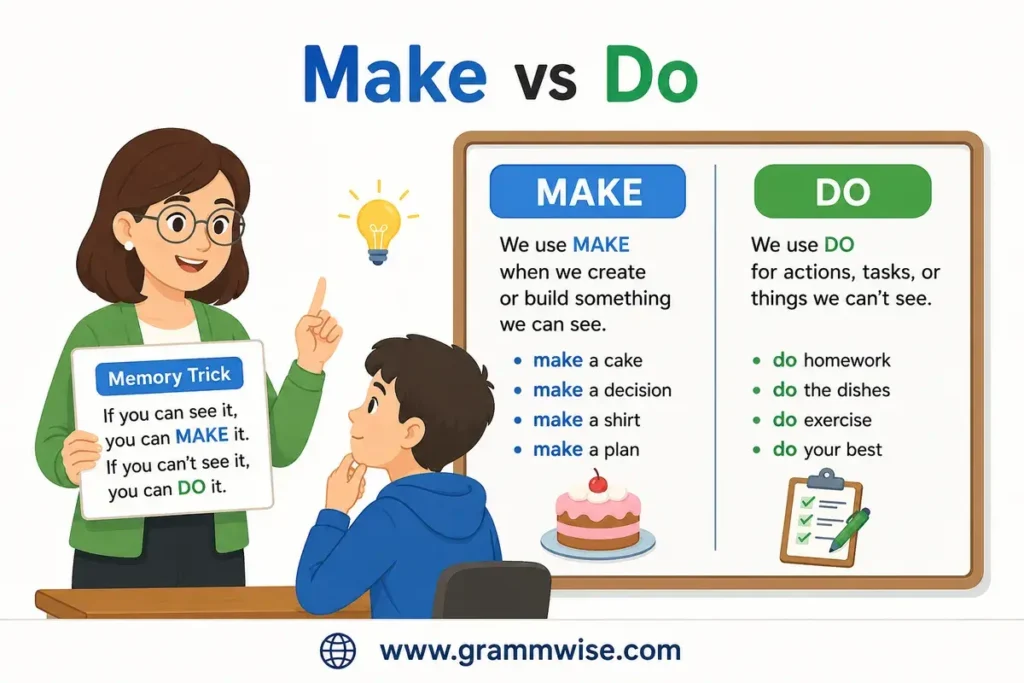
Make means to create, build, produce, or cause something.
Do means to perform an action, task, job, or activity.
Easy rule:
- Make = Create something
- Do = Perform an action
Meaning of “Make vs Do” in Simple English
Think about your daily life.
Every day you do many things.
- You do your homework.
- You do the dishes.
- You do your job.
These are actions or tasks.
Now think about creating something.
- You make breakfast.
- You make a cake.
- You make a card.
These things are created or produced.
That is the biggest difference. When you finish doing a task, nothing new may exist. When you make something, something new usually exists because of your action.
Imagine a school day.
You do your classwork.
Then you make a science project.
The classwork is an activity. The science project is something you create.
That is why English uses different words.
Here is another easy way to remember it.
Ask yourself:
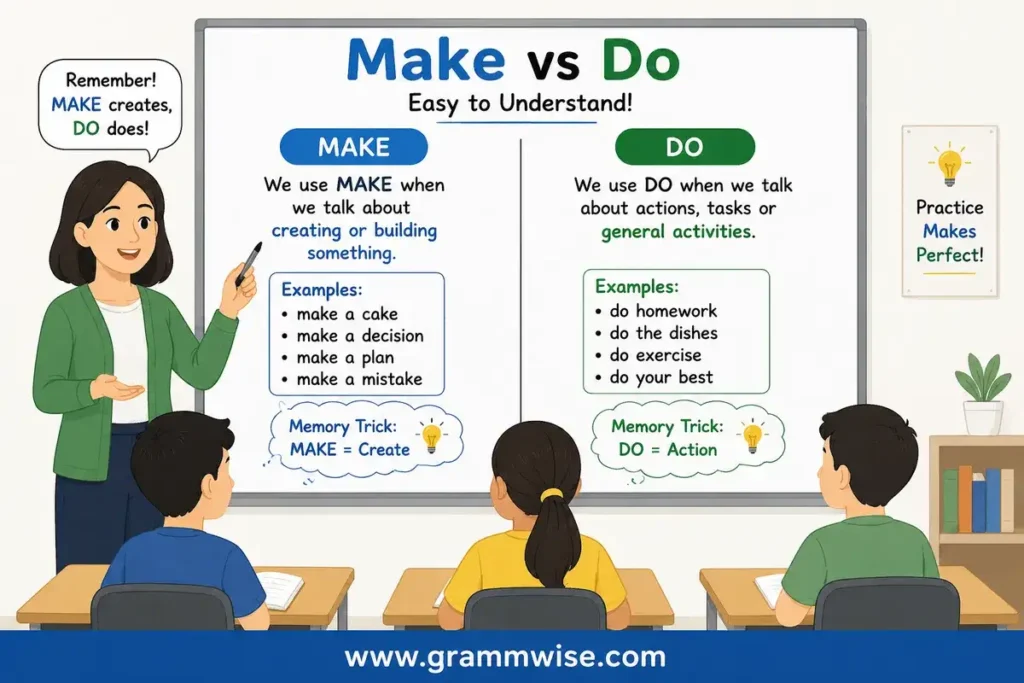
Am I creating something?
If yes, use make.
If not, and you are simply completing a task, use do.
This simple question helps in most situations.
Why People Mix These Words “Make vs Do”?
Many languages use only one word for both ideas. English uses two different words. That is why learners often ask about make vs do.
Another reason is that some expressions must simply be memorized.
For example:
We say:
- Make a decision.
- Make friends.
- Make a mistake.
But we say:
- Do homework.
- Do business.
- Do exercise.
There is no perfect rule for every phrase.
Some expressions became common many years ago and stayed that way. That is why reading and listening to English helps a lot.
People also mix these words because both can appear in similar situations.
For example:
“I will do dinner.”
This sounds strange in English.
The correct sentence is:
“I will make dinner.”
Why?
Because dinner is something you prepare.
Now look at another example.
“I will make my homework.”
This is incorrect.
Homework is a task.
So we say:
“I will do my homework.”
Small differences like these cause confusion.
The more examples you see, the easier they become.
Clear Difference of “Make vs Do” Explained Simply
Here is the easiest comparison.
| Make | Do |
|---|---|
| Create something | Perform an action |
| Produce something | Complete a task |
| Build something | Carry out work |
| Often has a result | Often describes the activity |
| Focuses on what is created | Focuses on the action |
Think of these examples.
Use Make when you create something.
- Make breakfast.
- Make coffee.
- Make a sandwich.
- Make a cake.
- Make a plan.
- Make a list.
- Make a drawing.
- Make a movie.
- Make a phone call.
- Make a promise.
Each example produces something.
Sometimes it is a physical object.
Sometimes it is an idea or result.
Use Do when you perform work or activities.
- Do homework.
- Do housework.
- Do the dishes.
- Do laundry.
- Do exercise.
- Do your job.
- Do business.
- Do research.
- Do your best.
- Do the cleaning.
These are actions.
Nothing new is necessarily created.
You simply complete the task.
Easy Memory Trick for “Make vs Do”
MAKE = CREATE
DO = TASK
This is the easiest way to remember make vs do.
Make vs Do: Which Form Should You Use?
Here are some simple rules you can follow.
Rule 1: Use make for food.
Correct:
- Make breakfast.
- Make lunch.
- Make dinner.
- Make tea.
- Make coffee.
Incorrect:
- Do breakfast.
- Do coffee.
Rule 2: Use do for work.
Correct:
- Do homework.
- Do housework.
- Do your work.
- Do your job.
Incorrect:
- Make homework.
- Make housework.
Rule 3: Use make when creating plans or choices.
Correct:
- Make a plan.
- Make a choice.
- Make a decision.
- Make a list.
Rule 4: Use do for everyday activities.
Correct:
- Do exercise.
- Do yoga.
- Do shopping. (British English often says this.)
- Do the washing.
Rule 5: Use common English expressions.
Some phrases simply belong together.
For example:
Correct:
- Make money.
- Make friends.
- Make progress.
- Make a promise.
- Make a mistake.
Correct:
- Do business.
- Do your duty.
- Do your best.
- Do work.
- Do chores.
Learning these common phrases makes your English sound natural.
Easy Real-Life Sentences on “Make vs Do”
Here are simple examples you can use every day.
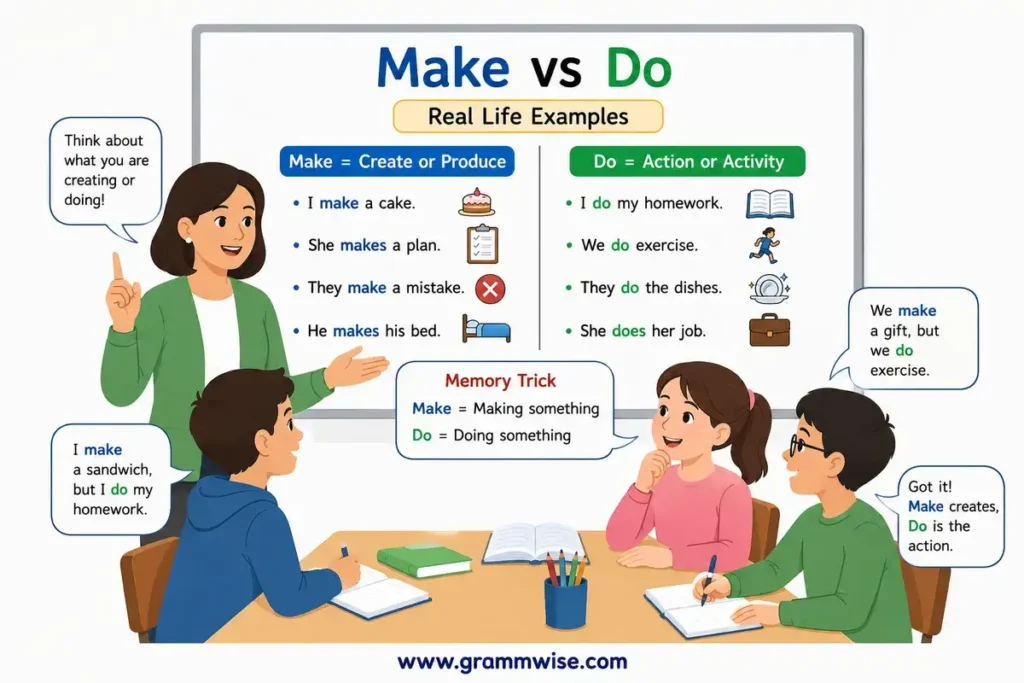
- I make breakfast every morning.
- My father makes coffee.
- We made a birthday cake yesterday.
- She made a beautiful painting.
- They made a new plan.
- Please make your bed.
- Can you make some tea?
- We made a snowman.
Now examples with do.
- I do my homework after school.
- My brother does the dishes.
- We do exercise every evening.
- She does her job very well.
- They do business together.
- Please do your chores.
- I need to do some cleaning.
- He always does his best.
Now compare them.
- I made a sandwich.
- I did my homework.
- She made a mistake.
- She did the laundry.
- We made a decision.
- We did the work.
Notice how natural each sentence sounds.
Make vs Do: Where This Expression Comes From?
Both make and do are very old English words.
People have used them for hundreds of years.
The word make came from old Germanic languages.
It has always meant to create, build, or produce something.
The word do also comes from old Germanic languages.
It has always meant to perform an action or complete a task.
Over time, English speakers created many common expressions with these two words.
That is why we now say:
- Make friends.
- Make money.
- Make a choice.
- Do homework.
- Do business.
- Do the dishes.
These expressions became part of everyday English.
Native speakers learn them naturally from childhood.
English learners usually learn them one phrase at a time.
The good news is that most expressions follow the same basic idea.
If something is created, make is usually correct.
If it is an activity or task, do is usually correct.
Once you understand this pattern, using make vs do becomes much easier.
Make vs Do: How This Expression Is Understood in Culture and Stories?
The difference between make vs do is not only about grammar. It also shows how people think about actions and results.
In many stories, movies, and books, people do something first. Then they make something because of that action.
For example:
A student does homework. Later, the student makes good grades.
A chef does the work in the kitchen. The chef makes a delicious meal.
A builder does hard work every day. The builder makes a new house.
This pattern appears in many cultures.
People often believe that hard work leads to good results.
You do the work.
You make the result.
That simple idea helps you remember these two words.
Parents also teach children this idea.
“You must do your chores.”
“You can make your room look nice.”
Teachers say:
“Do your best.”
“You can make a difference.”
The first sentence talks about effort.
The second talks about the result.
Many motivational quotes use these words in the same way.
For example:
- Do what is right.
- Make the world better.
- Do good things.
- Make people smile.
These expressions sound natural because they match the basic meanings of the two words.
Biblical and Mythological Meaning of “Make vs Do”
The Bible uses both ideas many times, although different English translations may use different wording.
The word make often appears when something is created. For example, God made the heavens and the earth. Here, make means to create.
The word do often appears when people perform actions.
Examples include:
- Do good.
- Do not fear.
- Do what is right.
- Do God’s will.
Here, do means to act.
This follows the same rule you learned earlier.
Make is connected with creation.
Do is connected with actions.
In mythology from different cultures, heroes also do brave things and make history. They perform actions. Those actions create lasting results.
So even in old stories, the difference stays almost the same.
Symbolism Explained in Simple Words
Words can also carry simple symbolic meanings.
What Make Represents?
Make often represents:
- Creation
- New beginnings
- Building something
- Growth
- Success
- Change
- Results
When someone says,
“I want to make a better future,”
they mean they want to create something good.
When someone says,
“She made history,”
it means she created something important that people will remember.
The word make often gives people a feeling of progress.
What Do Represents?
Do often represents:
- Action
- Effort
- Responsibility
- Daily work
- Practice
- Helping
- Taking steps
When someone says,
“Do your best,”
they mean to give your full effort.
When someone says,
“Do the right thing,”
they mean to choose the correct action.
The word do reminds us that results come from action.
Simple Comparison
Think of planting a tree.
You do the digging.
You do the watering.
Over time, you make a beautiful garden.
The actions come first.
The result comes later.
That is the easiest way to understand the symbolic difference.
Related Words to “Make vs Do” You Should Know
Learning related words makes make vs do even easier.
Create
To bring something new into existence.
Example:
She created a beautiful painting.
This is very close to make.
Build
To put something together.
Example:
They built a new school.
Like make, it means creating something.
Produce
To make something.
Example:
The factory produces cars.
It focuses on creating results.
Perform
To carry out an action.
Example:
The doctor performed the operation.
This is similar to do.
Complete
To finish a task.
Example:
Please complete your homework.
This also matches the idea of do.
Work
To spend time doing a job.
Example:
She works every weekday.
Many activities with do involve work.
Prepare
To get something ready.
Example:
She prepared dinner.
In everyday English, people often say:
She made dinner.
Accomplish
To finish something successfully.
Example:
He accomplished his goal.
This combines both ideas.
You do the work.
You make the result.
How People Actually Use “Make vs Do” in Daily English?
Here are common examples you will hear every day.
At home
“I’ll make dinner tonight.”
“Can you do the dishes?”
“My sister made a cake.”
“I have to do the laundry.”
At school
“I need to do my homework.”
“We made a science project.”
“Our teacher made a quiz.”
“I did all my classwork.”
At work
“We made a business plan.”
“I have a lot of work to do.”
“Our team made good progress.”
“She always does her job well.”
With friends
“We made new friends.”
“They made a promise.”
“Just do your best.”
“You made my day.”
Talking about mistakes
“I made a mistake.”
“What did you do?”
These are natural English expressions that native speakers use every day.
The more you hear them, the easier they become.
Common Mistakes People Make About “Make vs Do”
Many learners make the same mistakes.
Here are the most common ones.
Mistake 1
❌ I made my homework.
✔ I did my homework.
Homework is a task.
Use do.
Mistake 2
❌ I did breakfast.
✔ I made breakfast.
Breakfast is prepared or created.
Use make.
Mistake 3
❌ She did a mistake.
✔ She made a mistake.
This is a fixed English expression.
Always say make a mistake.
Mistake 4
❌ We made exercise.
✔ We did exercise.
Exercise is an activity.
Use do.
Mistake 5
❌ He did coffee.
✔ He made coffee.
Coffee is prepared.
Use make.
Mistake 6
❌ I made my job.
✔ I did my job.
A job is work.
Use do.
Mistake 7
❌ We did a cake.
✔ We made a cake.
A cake is created.
Use make.
Easy Memory Trick
Ask yourself two questions.
Did I create something?
If yes, choose make.
Am I doing a task or activity?
If yes, choose do.
This trick works in most everyday situations.
Final Teacher Explanation “Make vs Do”
Imagine I am standing in front of the classroom.
A student asks,
“Teacher, how can I remember make vs do without getting confused?”
My answer is always the same.
Do not try to memorize a long list first. Start with one simple idea.
Make means create.
Do means perform an action.
Every time you speak English, ask yourself one question.
“Am I creating something?”
If the answer is yes, use make.
If you are simply finishing work, use do.
Then practice with common English expressions.
Say them aloud.
- Make dinner.
- Make a plan.
- Make friends.
- Make money.
- Make a mistake.
Now practice these.
- Do homework.
- Do the dishes.
- Do your work.
- Do exercise.
- Do your best.
The more you use these phrases, the more natural they will feel. Even native speakers learn many of these expressions by hearing them again and again. So do not worry if you forget sometimes.
Keep reading, listening and practicing. Soon, choosing between make vs do will feel easy.
Quick Recap
The difference between make vs do is simple.
Use make when you create, build, prepare, or produce something. Use do when you perform a task, activity, job, or work. Remember this easy rule: Make = Create. Do = Action. If you keep that one idea in mind, you will choose the correct word most of the time.
Conclusion
The difference between make vs do is easy once you remember one simple rule. Use make when you create, build, prepare, or produce something, and use do when you perform a task, activity, or job. With regular practice, choosing between make vs do will become natural.
Keep using these words in everyday conversations, writing, and reading. The more common expressions you learn, the more confident your English will become. Start with the simple rule, practice often, and you’ll make fewer mistakes while doing better every day.
Frequently Asked Questions (FAQs)
What does make mean in simple words?
Make means to create, build, prepare, or produce something.
What does do mean in simple words?
Do means to perform a task, activity, or job.
What is the difference between make vs do?
Use make for creating something. Use do for completing work or actions.
Is it correct to say “make homework”?
No. The correct phrase is do homework.
Is it correct to say “do breakfast”?
No. The correct phrase is make breakfast.
Why do people get confused between make vs do?
Many languages use one word for both ideas, but English uses two different words.
Can I use both words in the same sentence?
Yes. For example: I did my homework and then made dinner.
How can I remember make vs do easily?
Remember this simple rule: Make = Create. Do = Perform an action. Ask yourself whether you are creating something or simply doing a task.