
Many English learners get confused about there vs they’re because these words sound exactly the same. They are called homophones, which means they have the same pronunciation but different meanings and spellings. If you understand one simple trick, you will never mix them up again.
The confusion between there vs they’re happens every day in school, at work, and even on social media. Many people type quickly and choose the wrong word without noticing. Luckily, the difference is easy to learn.
This guide explains there vs they’re in very simple English. By the end, you will know what each word means, when to use it, and how to remember the difference forever.
Keep learning with our easy grammar explanations.
Simple Answer in One Look
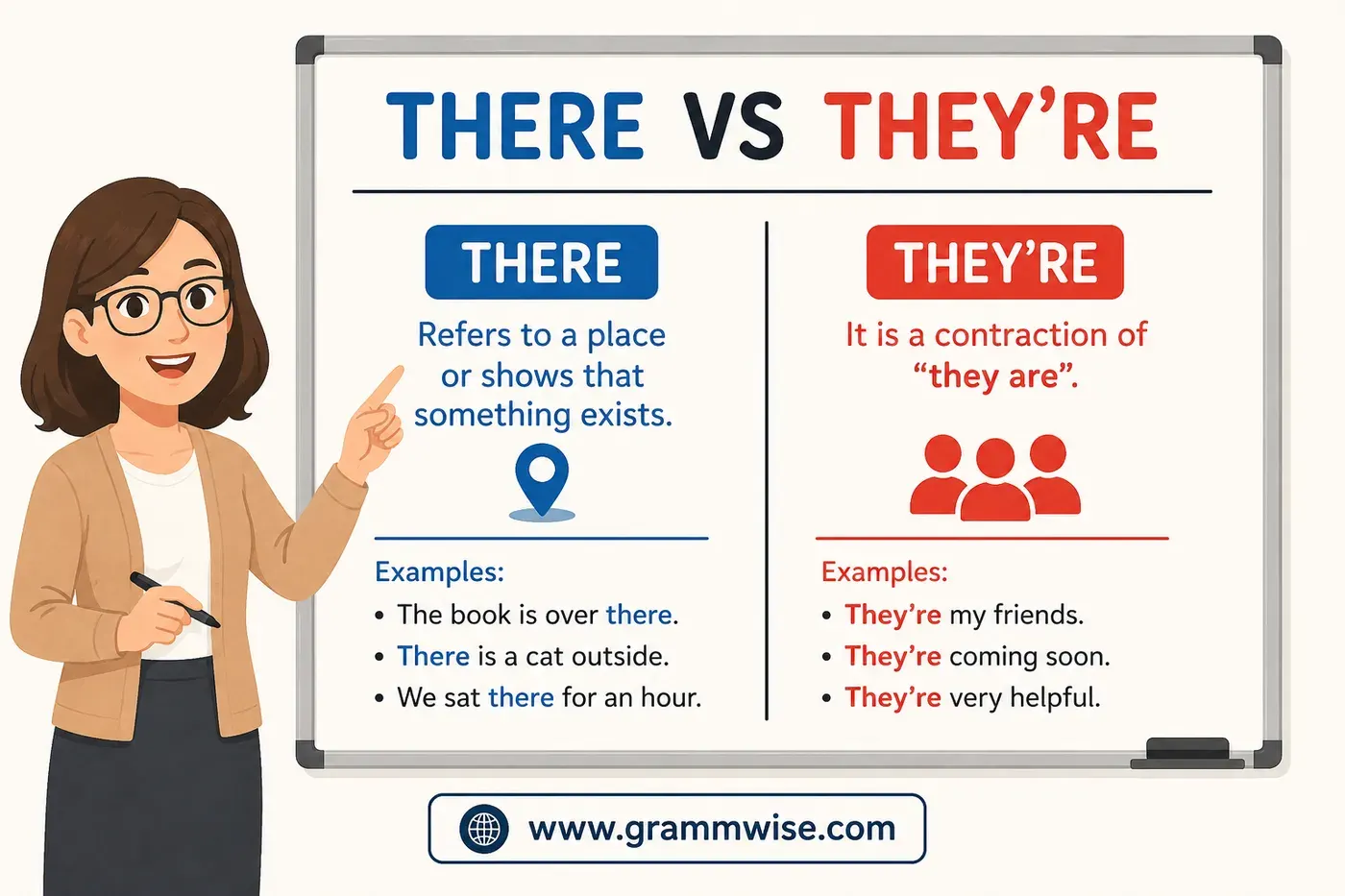
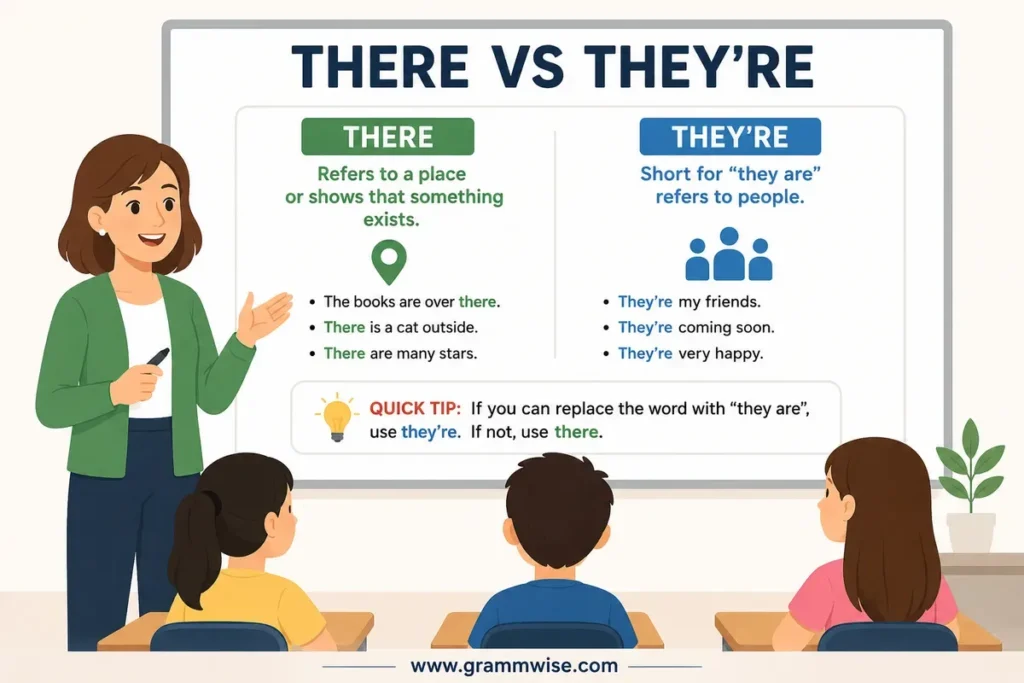
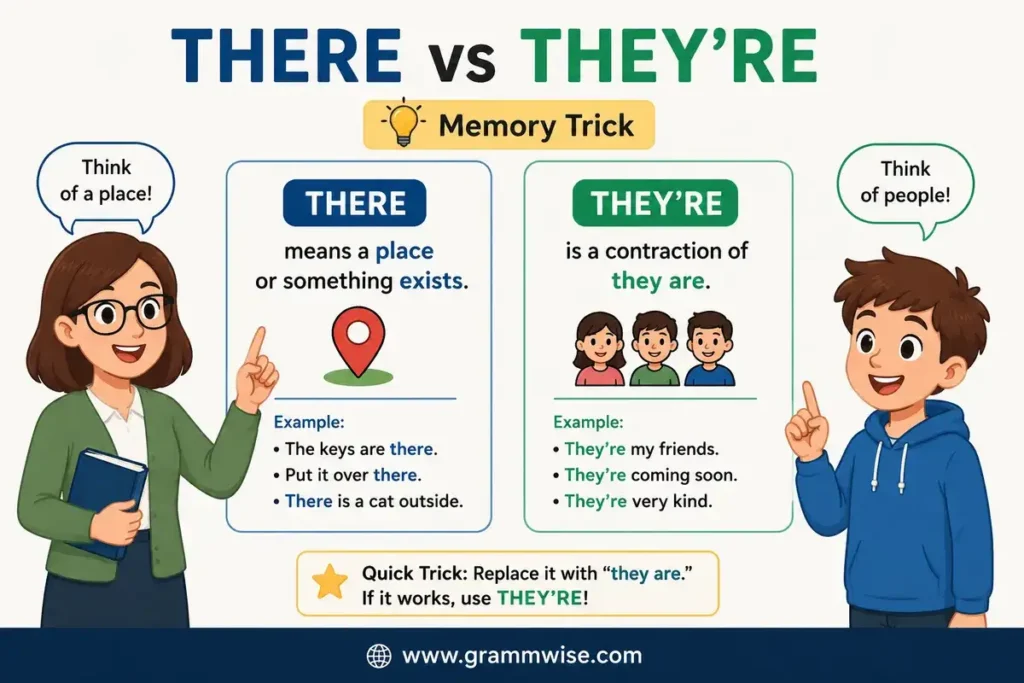
- There points to a place or shows that something exists.
- They’re is short for they are.
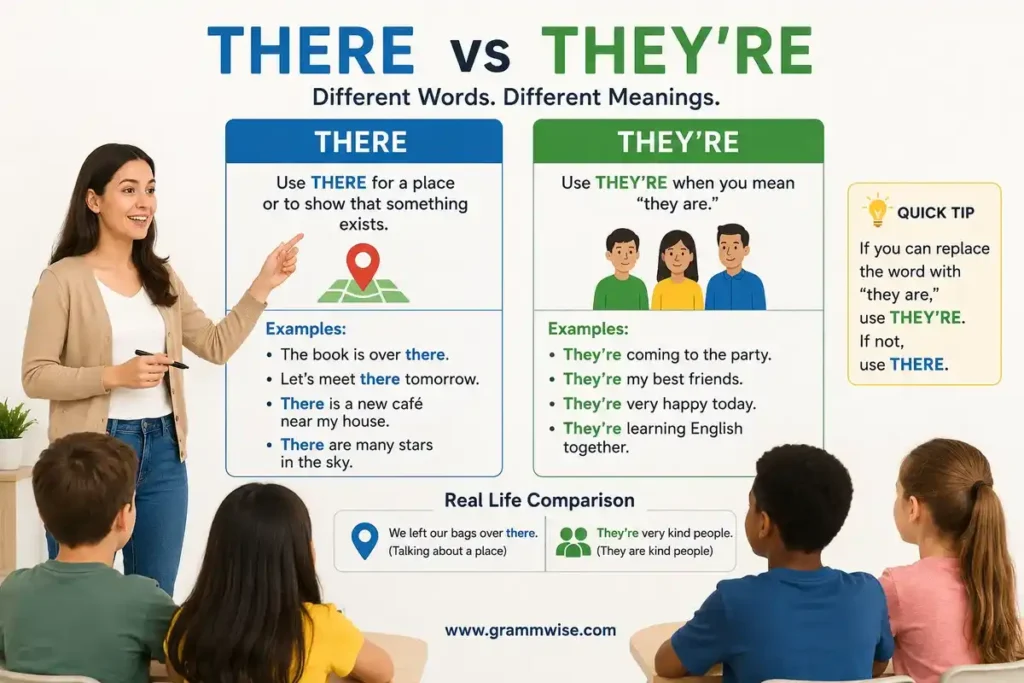
Quick tip: If you can replace the word with they are, then they’re is correct. If not, use there.
Meaning of There vs They’re in Simple English
Think of these two words as having different jobs.
What does there mean?
There usually talks about a place.
Examples:
- The keys are there.
- Put your shoes there.
- We sat there for an hour.
It can also tell us that something exists.
Examples:
- There is a cat outside.
- There are many books on the table.
- There was a loud noise last night.
In these sentences, there does not mean a place. It simply introduces the sentence.
What does they’re mean?
They’re is the short form of they are.
Examples:
- They’re my friends.
- They’re coming tomorrow.
- They’re happy today.
Whenever you see they’re, remember that it always means they are.
There vs They’re: Why People Mix These Words?
The biggest reason is simple.
Both words sound exactly the same when people speak.
Listen to these sentences:
- They’re waiting outside.
- There is someone outside.
The pronunciation is the same, but the meaning is different.
People also make mistakes because they type quickly. Spell check may not catch the error since both words are spelled correctly.
For example:
❌ There going home.
The computer sees there as a real word, so it may not warn you.
The correct sentence is:
✅ They’re going home.
Another reason is that many students learn these words by sound instead of meaning. Once you know what each word does, the confusion becomes much smaller.
Clear Difference of “There vs They’re” Explained Simply
Here is the easiest way to remember there vs they’re.
Use there when:
- Talking about a place
- Saying where something is
- Showing that something exists
Examples:
- Your backpack is there.
- We will meet there.
- There is plenty of food.
- There are five students in class.
Use they’re when:
- It means they are
Examples:
- They’re tired.
- They’re eating lunch.
- They’re ready for school.
- They’re watching TV.
Quick Comparison
| Word | Meaning | Easy Memory Trick |
|---|---|---|
| There | A place or something exists | Think of here inside there. Both talk about places. |
| They’re | They are | The apostrophe replaces the missing letter a in are. |
There vs They’re: Which Form Should You Use?
Ask yourself one simple question.
Can I replace the word with they are?
If the answer is yes, use they’re.
Example:
They’re playing soccer.
Replace it:
They are playing soccer.
The sentence still makes sense.
So they’re is correct.
Now look at this one.
The books are over there.
Replace it:
The books are over they are.
That makes no sense.
So there is correct.
This one question will help you choose the right word almost every time.
Easy Real-Life Sentences on “There vs They’re”
Here are some simple examples you may hear every day.
- The bus is over there.
- They’re waiting for us.
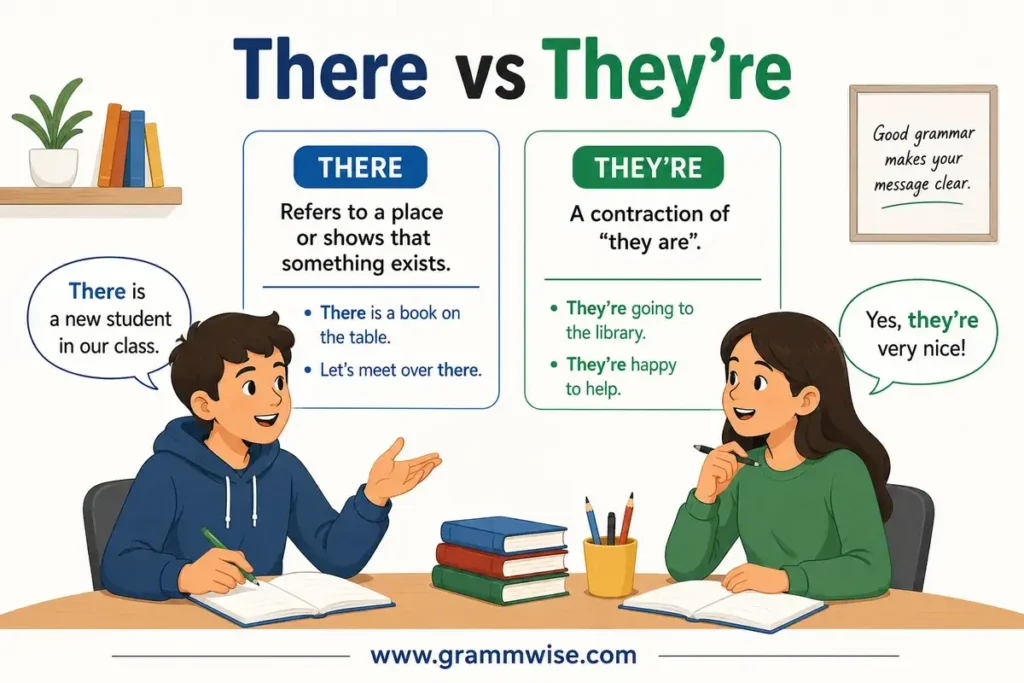
- There is a new student in our class.
- They’re very excited about the trip.
- Please sit there.
- There are cookies in the kitchen.
- They’re learning English together.
- Don’t stand there.
Try reading each sentence aloud. Then ask yourself why that word was used.
There vs They’re: Where This Word Comes From?
These words have different histories even though they sound alike.
There is a very old English word. People have used it for hundreds of years to point to places or show that something exists.
They’re is much newer. It is simply a shorter way of writing they are. English speakers often combine words to make speaking and writing faster.
Other common short forms include:
- I’m = I am
- You’re = You are
- We’re = We are
- They’re = They are
This is why the apostrophe is important. It shows that letters have been removed.
How “There vs They’re” Is Understood in Culture and Stories
The difference between there vs they’re is mostly about good writing, not culture. Still, these words appear in books, movies, songs, and everyday conversations all the time.
When writers use there, they often describe a place or help readers imagine a scene.
Examples:
- There was a small house on the hill.
- There were flowers everywhere.
- The treasure was hidden over there.
In these examples, there helps readers picture what is happening.
They’re appears when writers talk about people and what they are doing.
Examples:
- They’re laughing together.
- They’re looking for the answer.
- They’re ready for the adventure.
Stories become easier to understand when the correct word is used. A small spelling mistake can confuse readers, even if the sentence sounds right when spoken.
That is why good writers always check there vs they’re before they publish their work.
Biblical and Mythological Meaning of “There vs They’re”
Neither there nor they’re has a special biblical or mythological meaning.
However, both words appear many times in English translations of the Bible because they are common English words.
For example:
- There often tells where something happened.
- They’re may appear in modern English translations as a short form of they are in dialogue or simple writing.
In myths and legends, these words are not symbols by themselves. They simply help tell the story clearly.
So, when learning there vs they’re, think of them as everyday English words rather than words with special religious or mythical meanings.
Symbolism of “There vs They’re” Explained in Simple Words
Although these words are not symbols, people sometimes connect them with simple ideas because of how they are used.
What There Represents?
The word there often makes people think about:
- A place
- A destination
- A location
- Something waiting ahead
- Something that exists
Examples:
- We’ll meet there.
- There is hope.
- There are many chances to learn.
The word often gives readers a feeling of location or possibility.
What They’re Represents?
The word they’re reminds us of people.
It usually shows:
- A group of people
- Teamwork
- Family
- Friends
- Actions happening now
Examples:
- They’re helping each other.
- They’re celebrating together.
- They’re learning every day.
A simple way to remember this is:
- There points somewhere.
- They’re talks about people.
That small difference makes choosing the correct word much easier.
Related Words You Should Know
Learning a few related words will make there vs they’re much easier.
Their
Their shows ownership.
Example:
- Their house is beautiful.
- Their teacher is kind.
This is the third word that many learners confuse with there and they’re.
Here
Here means this place.
Example:
- Sit here.
- Come here.
Notice that here and there both talk about places.
They
They means more than one person or thing.
Example:
- They play soccer.
- They live nearby.
They Are
This is the full form of they’re.
Example:
- They are happy.
- They are waiting outside.
Those
Those points to things that are farther away.
Example:
- Those books are mine.
Where
Where asks about a place.
Example:
- Where are my shoes?
Learning these words together helps you understand how English works in daily conversations.
Use of “There vs They’re” in Daily English
You will hear there and they’re every single day.
Here are some natural examples.
Using There
- Please put your bag over there.
- There is a new restaurant near my house.
- There are only two cookies left.
- We parked the car there.
- Is there enough time?
Using They’re
- They’re coming after school.
- They’re watching a movie tonight.
- They’re very friendly.
- They’re cleaning the classroom.
- I think they’re right.
Here are a few short conversations.
Conversation 1
A: Where is my phone?
B: It’s over there.
Conversation 2
A: Who are those students?
B: They’re my classmates.
Conversation 3
A: Is there any milk left?
B: Yes, there is.
Conversation 4
A: Are your parents home?
B: Yes, they’re inside.
Conversation 5
A: Where should we sit?
B: Let’s sit over there.
These examples sound natural because they are the kinds of sentences English speakers use every day.
Common Mistakes People Make About “There vs They’re”
Many people make the same mistakes when writing there vs they’re.
Here are the most common ones.
Mistake 1
❌ There going to school.
✅ They’re going to school.
Remember:
Can you say they are going to school?
Yes.
So use they’re.
Mistake 2
❌ They’re is a cat outside.
✅ There is a cat outside.
This sentence tells us something exists.
Use there.
Mistake 3
❌ Put your shoes they’re.
✅ Put your shoes there.
The sentence talks about a place.
Choose there.
Mistake 4
❌ There my best friends.
✅ They’re my best friends.
Replace it:
They are my best friends.
It works perfectly.
Mistake 5
Mixing all three words.
❌ Their going over there because there friends are waiting.
Correct version:
✅ They’re going over there because their friends are waiting.
Notice the difference:
- They’re = They are
- There = Place
- Their = Ownership
This is probably the most common mistake English learners make.
Final Teacher Explanation
Imagine you are sitting in my classroom.
I write two sentences on the board.
They’re playing outside.
The ball is over there.
Now I ask one simple question.
Can you replace the word with they are?
If yes, write they’re.
If no, ask another question.
Am I talking about a place or saying that something exists?
If yes, write there.
You do not need to memorize long grammar rules. You only need to remember these two easy ideas.
They’re = They are.
There = Place or something exists.
Read books, write short sentences, and practice every day. After a little practice, choosing between there vs they’re will become natural.
Even native English speakers make mistakes sometimes. The good news is that this mistake is easy to fix once you know the simple rule.
There vs They’re: Quick Recap
The difference between there vs they’re is simple.
Use there when talking about a place or when saying that something exists.
Use they’re whenever you mean they are.
Remember this quick trick:
If you can replace it with “they are,” choose “they’re.” Otherwise, choose “there.”
Conclusion
Understanding there vs they’re becomes much easier once you know the simple rule. Use there for a place or to show that something exists, and use they’re whenever you mean they are. With regular practice, choosing the correct word will soon become a habit.
Keep reading, writing, and checking your sentences as you learn. A few minutes of practice each day will help you avoid common mistakes and write clear, confident English in school, at work, and in everyday conversations.
Frequently Asked Questions (FAQs)
What does there mean in simple words?
There usually means a place or tells us that something exists.
What does they’re mean?
They’re is the short form of they are.
Why do people confuse there vs they’re?
They sound exactly the same when spoken, but they have different meanings and spellings.
How can I remember the difference?
Replace they’re with they are. If the sentence still makes sense, they’re is correct. If not, use there.
Can I use there and they’re in the same sentence?
Yes.
Example:
They’re waiting over there.
Is they’re correct in formal writing?
Yes. It is correct in most types of writing. If you want a more formal style, you can write they are instead.
Which is correct: “There going home” or “They’re going home”?
They’re going home is correct because it means they are going home.
What is the easiest way to learn there vs they’re?
Practice with short sentences every day. Ask yourself whether the word means they are or points to a place. This simple habit will help you choose the correct spelling without thinking too hard.