
Many English learners get confused about fewer vs less because both words talk about a smaller amount of something. They seem similar, but they are not always used in the same way. Choosing the correct word can make your English sound clearer and more natural.
If you have ever wondered about fewer vs less, you are not alone. Students often ask which word is correct because they hear both in everyday conversations. The good news is that the basic rule is easy to learn.
In this guide, you will learn the difference between fewer vs less, when to use each one, simple memory tricks, and real-life examples. By the end, you will know exactly which word fits your sentence.
If you enjoy learning word differences, you may also like our guide on implied and inferred.
Simple Answer in One Look
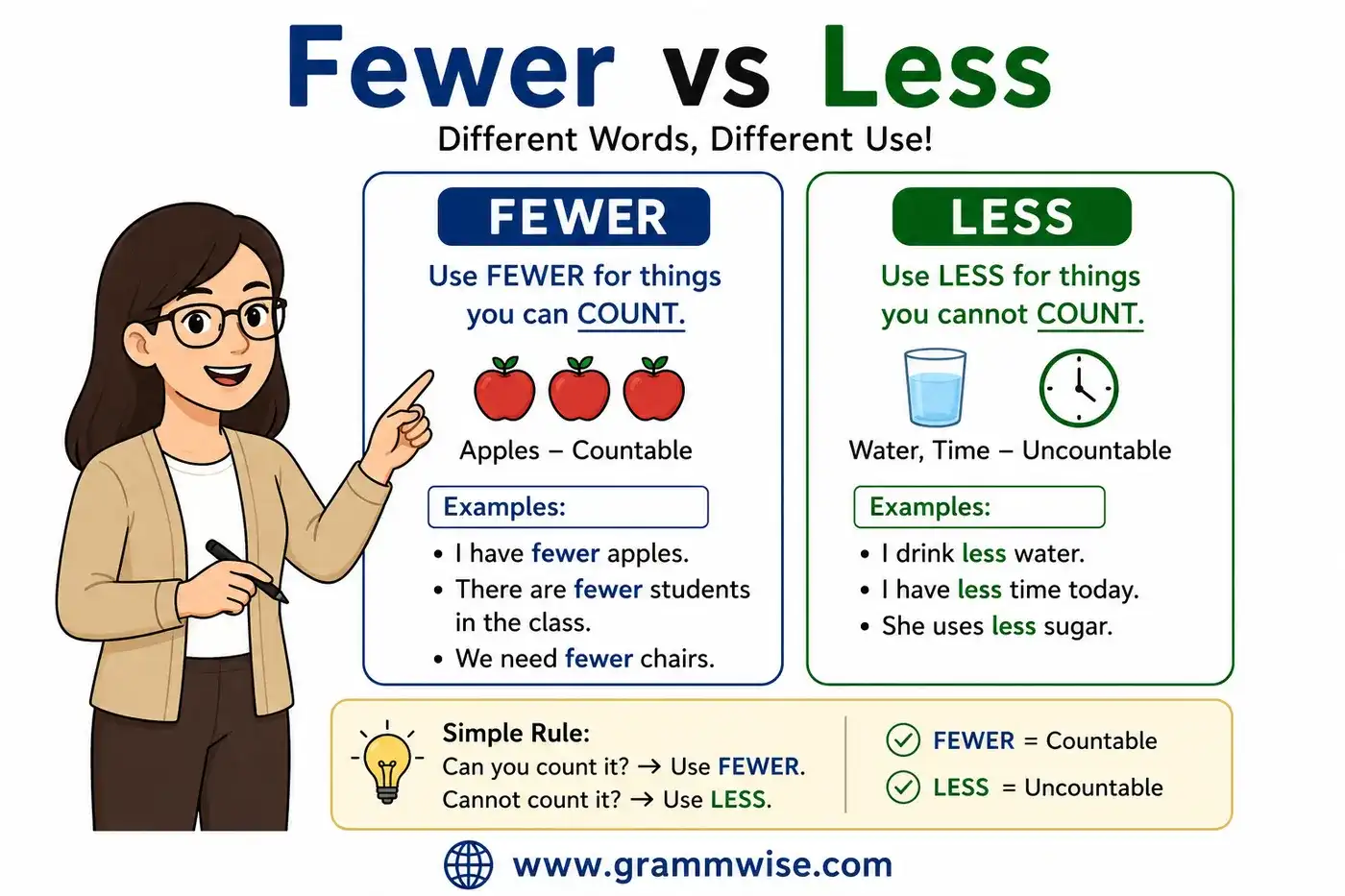
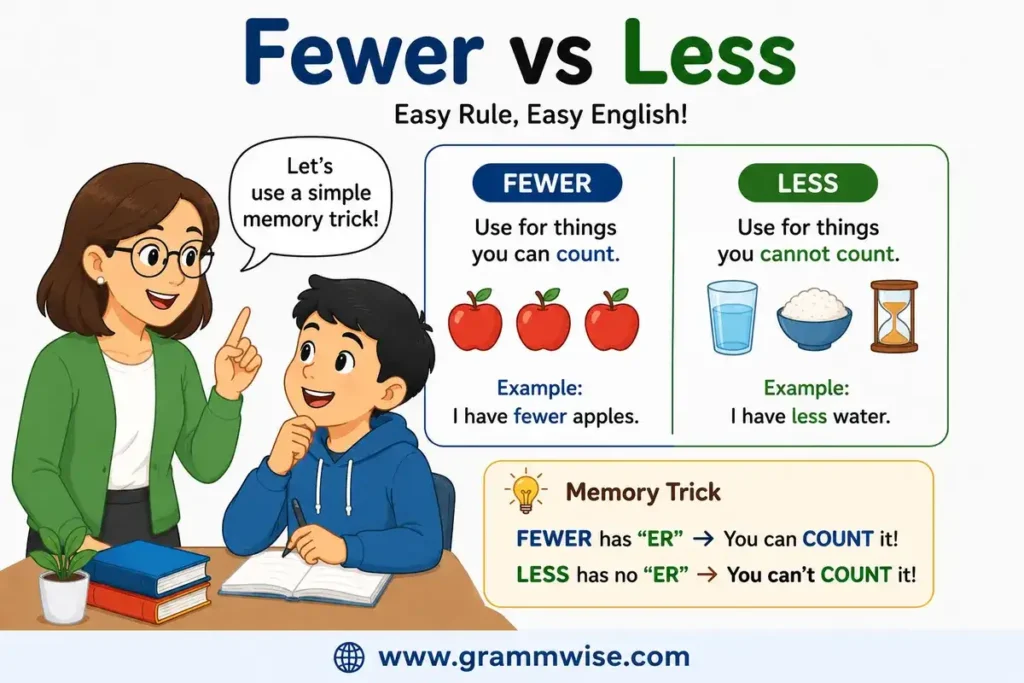
Use fewer for things you can count.
Use less for things you cannot count.
Meaning of Fewer vs Less in Simple English
Both fewer and less mean “not as much as before.”
The difference depends on what you are talking about.
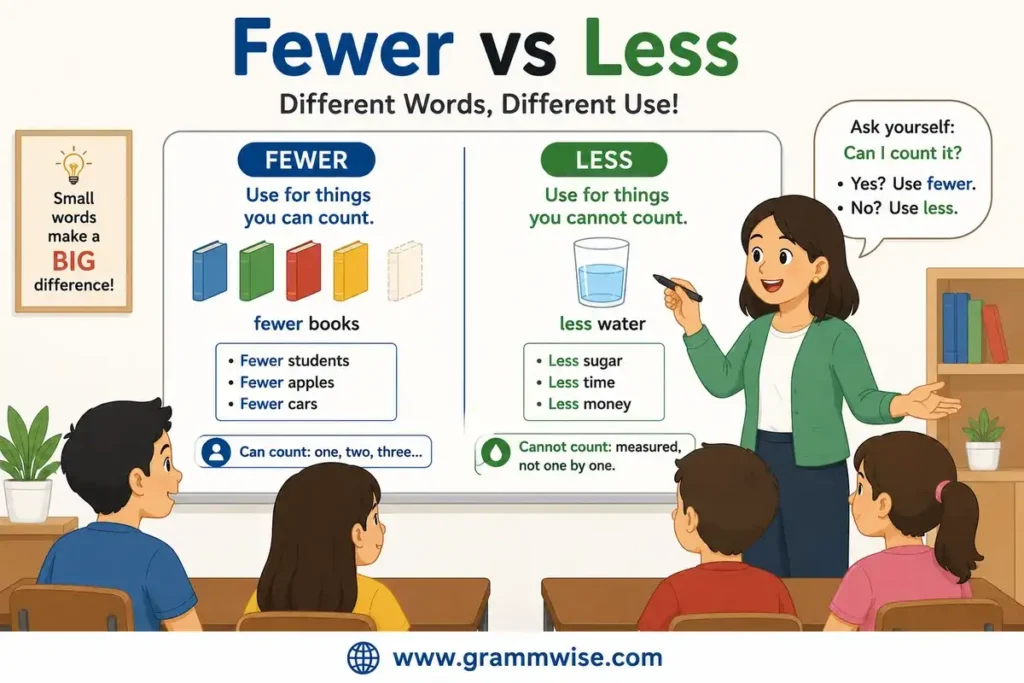
Use fewer when you can count the items one by one.
For example:
- Fewer books
- Fewer students
- Fewer apples
- Fewer cars
You can count all of these.
One book.
Two books.
Three books.
That is why fewer is correct.
Now look at less.
Use less for things you cannot count one by one.
For example:
- Less water
- Less milk
- Less sugar
- Less time
You cannot count water or time as separate items without using another unit.
That is why less is the correct choice.
Think about these examples.
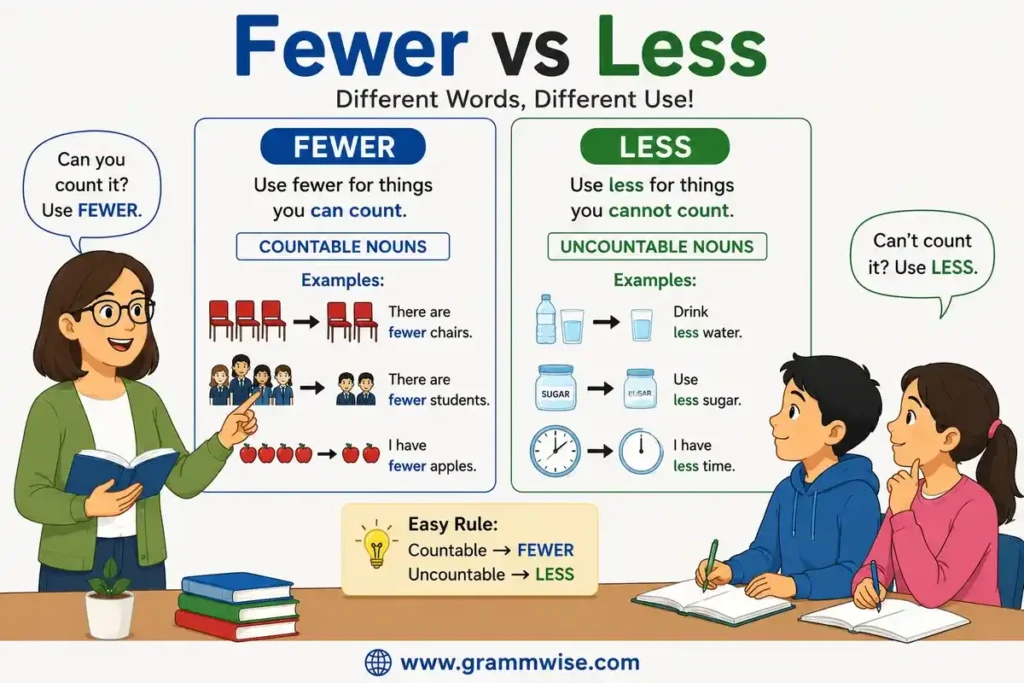
- There are fewer chairs in this room.
- There is less noise today.
The first sentence talks about chairs, which you can count.
The second sentence talks about noise, which you cannot count.
This is the easiest way to remember the difference.
Fewer vs Less: Why People Mix These Words?
Many people confuse fewer and less because both words mean a smaller amount.
They also hear both words in daily conversations.
Sometimes people even use the wrong one without noticing.
For example:
❌ There are less books on the shelf.
✅ There are fewer books on the shelf.
Another example:
❌ I need fewer water.
✅ I need less water.
The mistake happens because people focus on the idea of “smaller” instead of asking whether the thing can be counted.
Advertisements and signs can also confuse people.
For example, some stores say “10 items or less.”
Many grammar teachers say “10 items or fewer” is more accurate because items can be counted.
Even so, “10 items or less” has become very common in everyday English.
That is why learners sometimes hear both versions.
Clear Difference of Fewer vs Less Explained Simply
The easiest rule is to ask one question.
Can I count it?
If the answer is yes, use fewer.
If the answer is no, use less.
Use Fewer
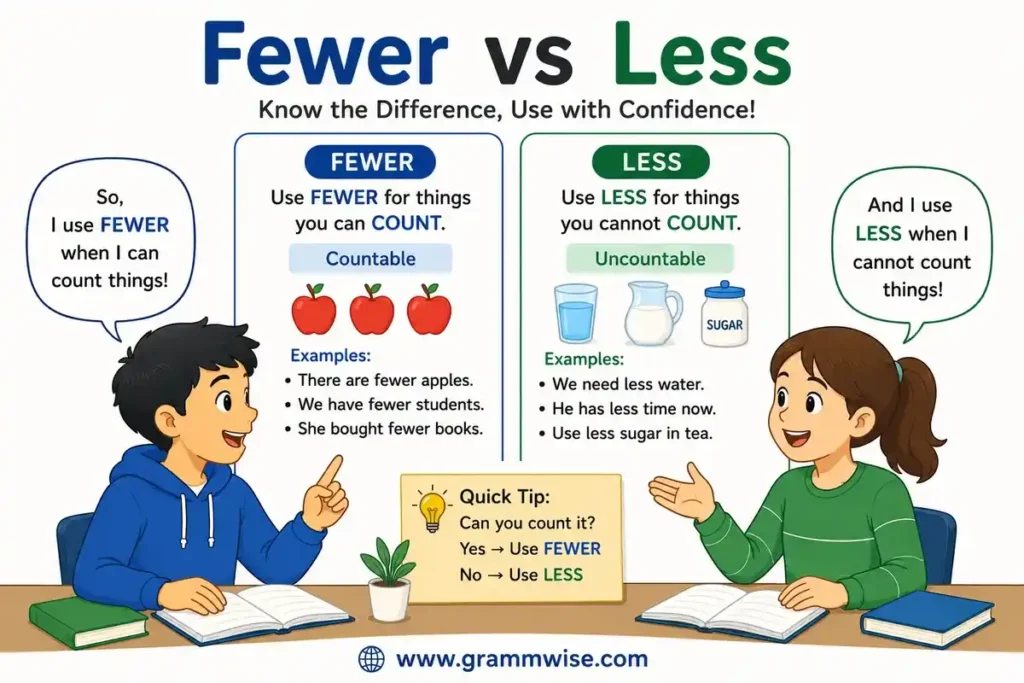
Use fewer for things you can count.
Examples include:
- Books
- Pens
- Students
- Cars
- Cookies
- Trees
- Animals
Example sentences:
- We have fewer chairs today.
- Fewer people came to the meeting.
- She bought fewer apples this week.
Use Less
Use less for things you cannot count easily.
Examples include:
- Water
- Milk
- Time
- Money
- Air
- Sand
- Rice
Example sentences:
- We need less water.
- I have less time today.
- There is less traffic this morning.
Easy Comparison Table Fewer vs Less
| Fewer | Less |
|---|---|
| Countable things | Uncountable things |
| Fewer books | Less water |
| Fewer students | Less time |
| Fewer cookies | Less sugar |
| One, two, three | Cannot count one by one |
The rule becomes much easier when you ask, “Can I count it?”
Fewer vs Less: Which Form Should You Use?
Choosing between fewer and less is simple.
Ask yourself one question.
Can I count the thing?
If yes, choose fewer.
Examples:
- Fewer toys
- Fewer birds
- Fewer questions
- Fewer flowers
If no, choose less.
Examples:
- Less rain
- Less coffee
- Less work
- Less energy
Here is a simple memory trick.
Fewer is for things you can count with your fingers.
Less is for things you measure instead of count.
If you remember this idea, you will usually choose the correct word.
Easy Real-Life Sentences on Fewer vs Less
Here are some examples using fewer.
- There are fewer students today.
- We planted fewer trees this year.
- She bought fewer oranges.
- My brother has fewer toys now.
- Fewer people visited the park.
- We made fewer mistakes.
- There are fewer birds in the garden.
Now look at examples using less.
- Please use less salt.
- I have less free time today.
- There is less milk in the fridge.
- We need less sugar for this recipe.
- He spends less money now.
- The room has less light.
- There was less traffic this morning.
Reading these examples will help you remember which word fits each sentence.
Fewer vs Less: Where This Word Comes From
The words fewer and less have been part of English for hundreds of years.
The word less comes from Old English and has always meant a smaller amount.
The word fewer developed later to describe a smaller number of things that people can count.
Over time, English speakers began using each word in different situations.
Today, the simple rule is still the same.
Use fewer for countable things.
Use less for things you cannot count easily.
How “Fewer vs Less” Is Understood in Culture and Stories
The words fewer and less appear in books, newspapers, TV shows, and everyday conversations. People use them to compare amounts, but they are used in different ways.
The word fewer is often used when talking about things people can count. A story might say there were fewer people in a town after a storm or fewer trees in a forest after a fire. These examples help readers understand that the number of things became smaller.
The word less is usually used when talking about things that cannot be counted one by one. A writer may say there was less hope, less rain, or less time left. These ideas are measured rather than counted.
Although many people use fewer and less correctly, it is also common to hear mistakes in everyday speech. That is why learning the simple rule will make your English sound more natural.
Biblical and Mythological Meaning of Fewer vs Less
The words fewer and less do not have special meanings in the Bible.
However, the Bible often talks about having less of something, such as less food during hard times or less wealth than others. These examples teach lessons about kindness, sharing, and trusting God.
In old stories and myths, people may have fewer soldiers, fewer chances, or less power during difficult times. These words simply describe smaller amounts or numbers.
Their meanings stay the same whether they appear in a modern book or an ancient story.
Symbolism of Fewer vs Less Explained in Simple Words
What Fewer Represents?
The word fewer often represents:
- A smaller number
- Simplicity
- Careful choices
- Saving resources
- Being organized
For example, someone may choose fewer clothes or fewer toys because they want a simpler life.
What Less Represents?
The word less often represents:
- A smaller amount
- Saving time
- Using less energy
- Less stress
- Better balance
People often say they want less worry, less pollution, or less waste because these changes can improve life.
Although the meanings are different, both words help describe something becoming smaller.
Related Words to “Fewer vs Less” You Should Know
Learning similar words will help you understand fewer vs less even better.
More
The opposite of fewer and less. It means a larger number or amount.
Many
Used with things you can count.
Example: Many books.
Much
Used with things you cannot count.
Example: Much water.
Several
Means more than a few but not many.
Some
Means a certain amount or number.
Amount
Used for things that cannot be counted easily.
Number
Used for things that can be counted.
Enough
Means as much or as many as needed.
Use of Fewer vs Less in Daily English
Here are some everyday examples using fewer.
- We have fewer students today.
- She bought fewer bananas this week.
- There are fewer cars on the road.
- We made fewer mistakes today.
- Fewer people visited the museum.
- The new class has fewer children.
- He owns fewer books than his brother.
- We planted fewer flowers this year.
Now look at examples using less.
- I need less sugar in my tea.
- We have less time today.
- She drinks less coffee now.
- There is less snow this winter.
- Please use less water.
- He spends less money than before.
- We had less homework today.
- There is less traffic on Sundays.
Notice how fewer is used with things you can count, while less is used with things you measure.
Common Mistakes People Make About Fewer vs Less
Many learners make small mistakes with fewer and less.
Here are the most common ones.
Mistake 1: Using less with countable things
❌ There are less chairs.
✅ There are fewer chairs.
Since chairs can be counted, use fewer.
Mistake 2: Using fewer with uncountable things
❌ I need fewer water.
✅ I need less water.
Water cannot be counted by itself, so use less.
Mistake 3: Forgetting to ask the simple question
Before choosing the word, ask yourself:
Can I count it?
If yes, choose fewer.
If no, choose less.
Mistake 4: Copying everyday signs
Many stores use signs like “10 items or less.”
Although this is common, many grammar teachers prefer “10 items or fewer” because items can be counted.
Mistake 5: Guessing instead of thinking
Many learners choose a word without thinking about its meaning.
Taking one extra second to ask whether something is countable will help you choose correctly.
Final Teacher Explanation
Imagine we are in class together.
I write two words on the board.
Fewer
Less
Then I ask one easy question.
“Can you count it?”
If you can count it one by one, use fewer.
If you cannot count it without measuring it, use less.
Think about these examples.
Books?
You can count them.
Use fewer.
Water?
You measure it.
Use less.
That is the whole rule.
You do not need to memorize long grammar lessons.
Just remember one question:
Can I count it?
If you remember that simple idea, you will almost always choose the correct word.
Final Thought “Fewer vs Less”
If you are choosing between fewer vs less, remember this easy rule.
Use fewer for things you can count, like books, apples, or students. Use less for things you cannot count easily, like water, time, or sugar. Thinking about whether you can count something makes the correct choice simple.
Conclusion
Understanding fewer vs less is simple once you know the basic rule. Use fewer for things you can count, such as books, students, or apples. Use less for things you cannot count easily, such as water, time, or sugar. Asking yourself, “Can I count it?” will help you choose the correct word every time.
The more you practice with real-life examples, the more natural these words will become. Keep the simple counting rule in mind, and you will write and speak English with greater confidence and accuracy.
Frequently Asked Questions (FAQs)
What is the difference between fewer and less?
Fewer is used for things you can count. Less is used for things you cannot count.
Which is correct: fewer or less?
Both are correct. The right word depends on whether the thing can be counted.
When should I use fewer?
Use fewer with countable nouns like books, chairs, students, and apples.
When should I use less?
Use less with uncountable nouns like water, milk, time, and money.
Why do people confuse fewer vs less?
Both words mean a smaller amount, so many people forget to check whether the noun can be counted.
Can I say “10 items or less”?
Many people say it, but many grammar teachers prefer “10 items or fewer” because items can be counted.
How can I remember the difference between fewer vs less?
Ask yourself, “Can I count it?” If yes, use fewer. If no, use less.
Do native English speakers ever mix up fewer and less?
Yes. Many native speakers use them incorrectly in casual conversation, but using the correct rule makes your English clearer and more accurate.