
Many English learners get confused about except vs accept because the two words sound almost the same. Even native English speakers sometimes mix them up when writing. The good news is that learning except vs accept is much easier than it seems. Once you understand what each word means, choosing the correct one becomes simple.
These two words have different meanings, even though they sound similar. One word is about leaving something out, while the other is about saying yes or receiving something. Knowing this difference will help you speak and write English with more confidence.
In this guide, you will learn the meaning of except and accept in very simple English. You will also see easy examples, common mistakes, and helpful tips that you can remember every day.
You might also find our comparison of similar confusing word pairs useful.
Simple Answer in One Look
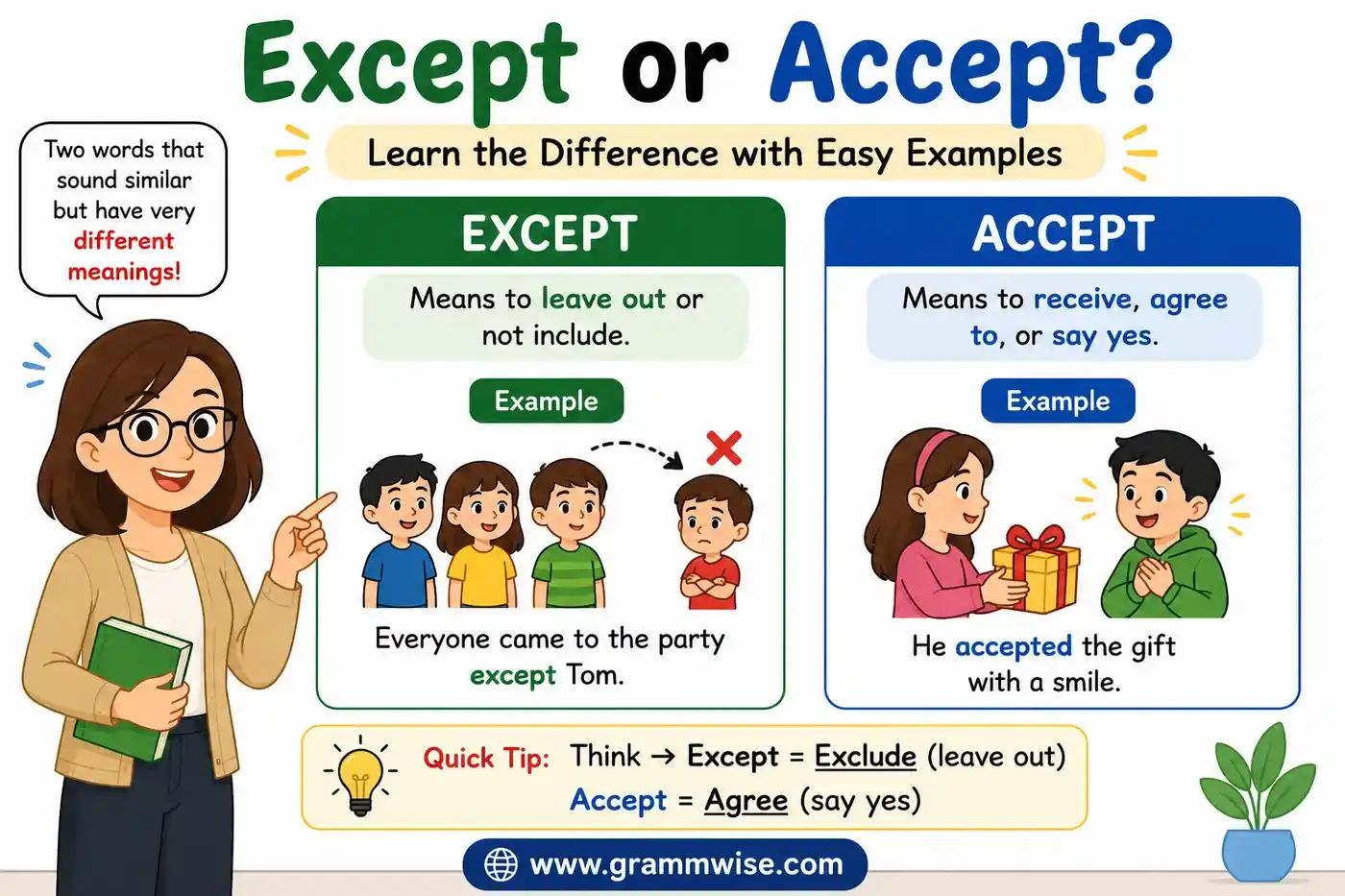
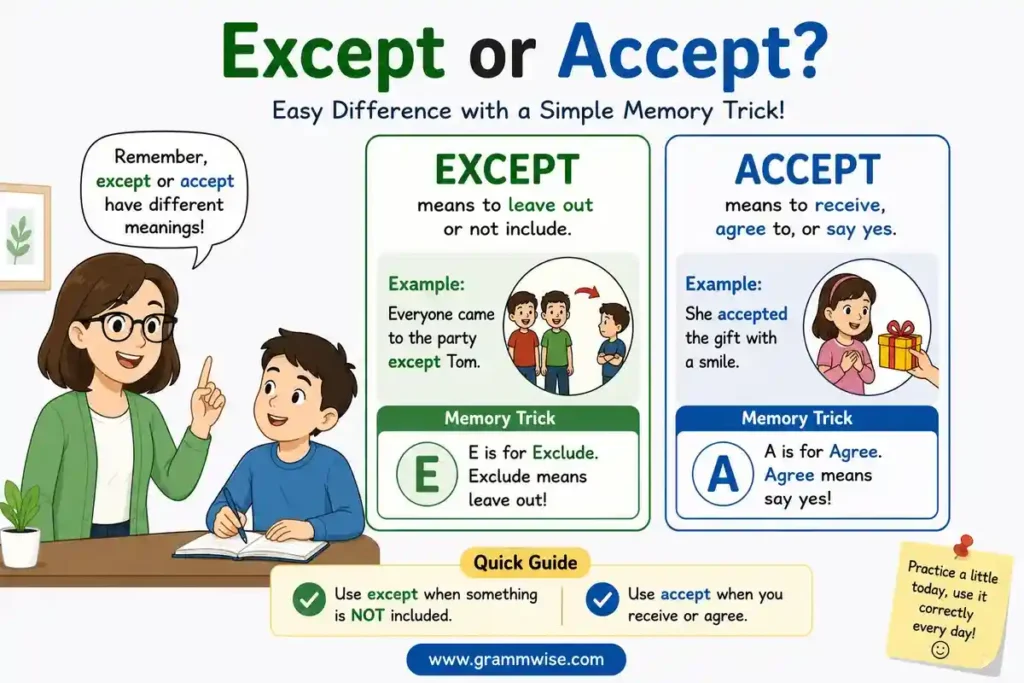
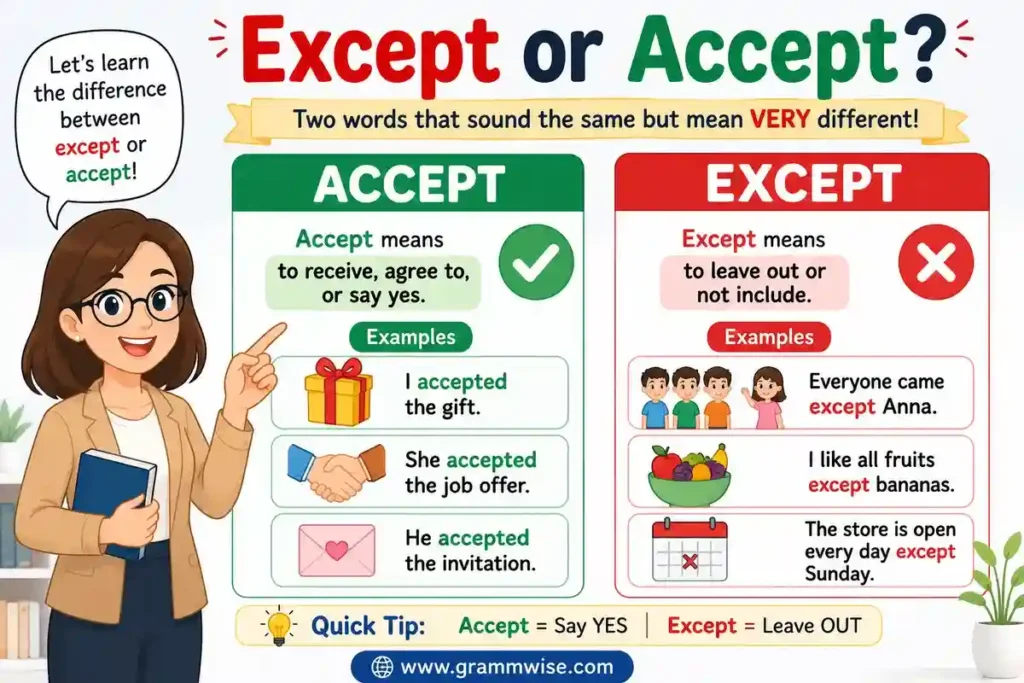
Accept means to receive, agree to, or say yes.
Except means to leave out or not include.
Remember this simple rule:
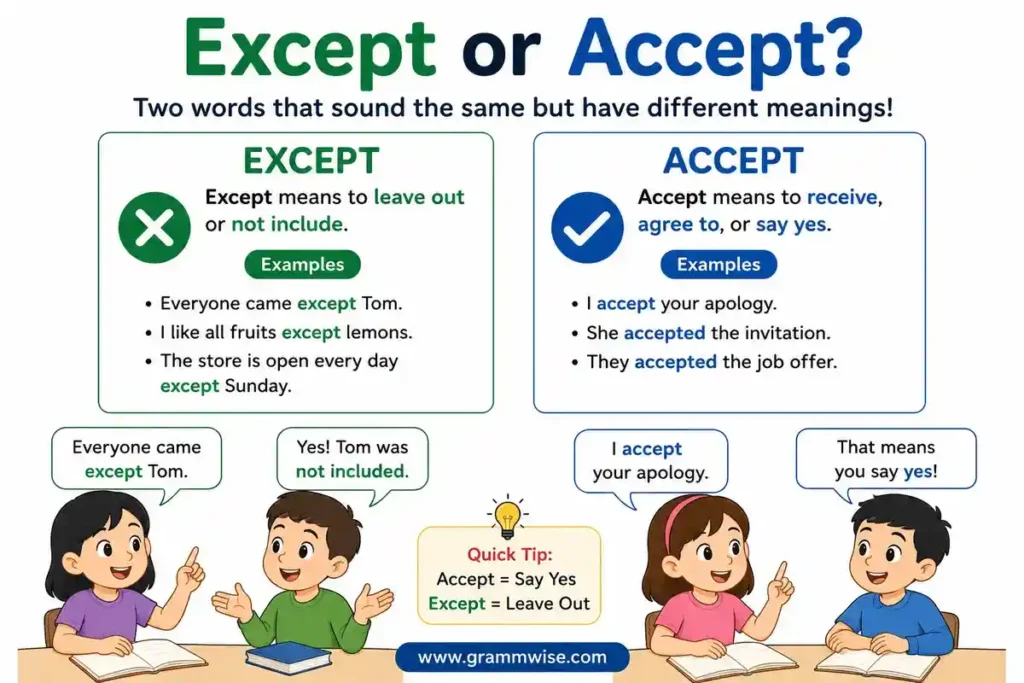
- Accept = Say yes.
- Except = Leave out.
Meaning of Except vs Accept in Simple English
Think about someone giving you a gift.
If you smile and take the gift, you accept it.
You are saying yes.
Examples:
- I accepted the gift.
- She accepted the invitation.
- They accepted the job offer.
Now think about making a list of students.
Everyone is on the list except one student.
That student is not included.
Examples:
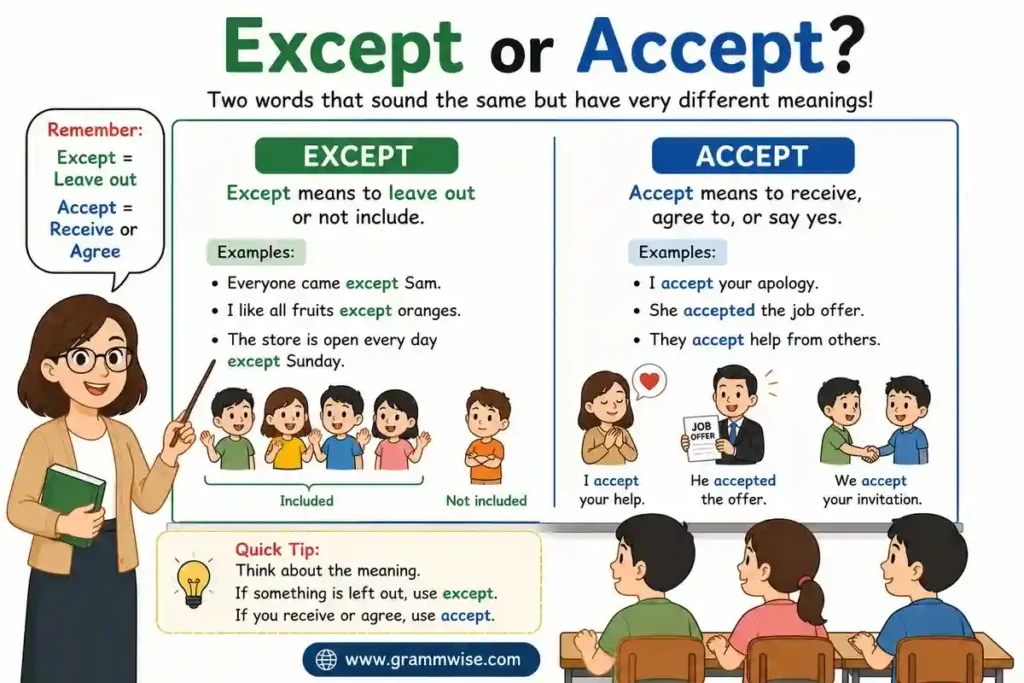
- Everyone came except Tom.
- I like all fruits except lemons.
- The store opens every day except Sunday.
One word means yes.
The other means not included.
That is the biggest difference.
Except vs Accept: Why People Mix These Words?
Many people confuse except vs accept because the words sound very similar. When you hear them in a conversation, it can be hard to know which spelling is correct.
For example, someone may say,
“I accept your apology.”
If you only hear the sentence, you may think the word is except because the pronunciation is close.
Another reason is that both words have similar letters.
The only big difference is the first vowel.
- Accept starts with A.
- Except starts with E.
Because of this, many learners accidentally type the wrong word.
The good news is that their meanings are completely different.
Once you know the meaning, choosing the right spelling becomes much easier.
Clear Difference of Except vs Accept Explained Simply
Here is the easiest way to understand except vs accept.
Accept
Use accept when you:
- Receive something.
- Agree with something.
- Say yes.
- Allow something.
Examples:
- I accept your help.
- She accepted the prize.
- We accepted the invitation.
- He accepted the new job.
Think about opening your hands to receive something.
That is accept.
Except
Use except when you:
- Leave something out.
- Do not include someone.
- Talk about one thing that is different.
Examples:
- Everyone passed except Jack.
- I eat every vegetable except onions.
- The shop is open every day except Monday.
Think about removing one item from a group.
That is except.
Easy Comparison of Except vs Accept
Accept
- Say yes
- Receive
- Agree
- Allow
Except
- Leave out
- Not include
- Other than
- Excluding
One word welcomes something.
The other word leaves something out.
Except vs Accept: Which Form Should You Use?
Ask yourself one simple question.
Are you receiving something or agreeing with someone?
If yes, use accept.
Examples:
- I accepted the offer.
- She accepted my apology.
- They accepted the award.
Now ask another question.
Are you talking about leaving someone or something out?
If yes, use except.
Examples:
- Everyone finished except me.
- All the lights are on except one.
- I like every color except brown.
This simple question helps you choose the correct word almost every time.
Easy Memory Trick for Except vs Accept
Here is a trick many students remember.
Accept has the letter A.
Think of A as Agree.
If you agree or say yes, use accept.
Except has the letter E.
Think of E as Exclude.
If something is excluded or left out, use except.
This small trick helps many learners remember the correct spelling.
Easy Real-Life Sentences on Except vs Accept
Here are some everyday examples.
- I accept your apology.
- She accepted the gift with a smile.
- We accepted the invitation.
- Please accept this award.
- Everyone came except Ben.
- I eat everything except mushrooms.
- The library is open every day except Sunday.
- Nobody knew the answer except the teacher.
Read these sentences aloud. Notice how each word has a different meaning.
Use of Except vs Accept in Grammar
Accept as a Verb
The word accept is usually a verb.
It tells us that someone receives or agrees to something.
Examples:
- I accepted the job.
- She accepted the invitation.
- We accepted the rules.
- They accepted our offer.
- He accepted the challenge.
Every example shows someone saying yes or receiving something.
Except as a Preposition
Most of the time, except is used before a person or thing that is not included.
Examples:
- Everyone laughed except Anna.
- I finished all my homework except math.
- Every room is clean except the kitchen.
It helps show the one thing that is different from the rest.
Except as a Conjunction
Sometimes except joins two ideas together.
Examples:
- I would go except I have to work.
- Everything was perfect except the weather was cold.
This use is less common in everyday conversation, but you may still see it in books or formal writing.
Common Phrases with Accept
These phrases are very common in English.
Accept an apology
You forgive someone.
Example:
I accepted his apology.
Accept an invitation
You agree to attend an event.
Example:
She accepted our wedding invitation.
Accept responsibility
You admit that something is your duty or your mistake.
Example:
He accepted responsibility for the accident.
Accept defeat
You admit that you have lost.
Example:
The team accepted defeat with respect.
Accept the truth
You believe something is true, even if it is difficult.
Example:
She finally accepted the truth.
Common Phrases with Except
Here are common expressions using except.
Everyone except
Example:
Everyone except Alex arrived on time.
All except
Example:
All except one student finished the test.
Nothing except
Example:
There was nothing except silence.
Anywhere except
Example:
I want to travel anywhere except there.
Every day except
Example:
The shop is open every day except Sunday.
These phrases appear often in daily English.
Except vs Accept Used in Everyday Situations
Imagine these simple situations.
At School
Your teacher gives you an award.
You smile and take it.
You accept the award.
At a Birthday Party
Everyone gets cake except one child who is allergic.
That child is except the group receiving cake.
At Work
Your manager offers you a new position.
You agree.
You accept the offer.
At Home
Everyone watches the movie except your little brother because he is asleep.
He is not included.
Except vs Accept: Where This Word Comes From?
The word accept comes from an old Latin word that means “to receive” or “to take willingly.” Over many years, English kept the same basic idea. Today, accept still means to receive, agree, or say yes.
The word except also comes from Latin. Its early meaning was “to take out” or “leave out.” That meaning has stayed almost the same for hundreds of years. Today, we use except whenever we talk about someone or something that is not included.
How Except vs Accept Is Understood in Culture and Stories?
Words often carry feelings as well as meanings. The words except and accept appear in many stories, conversations, movies, and books because they describe common parts of life.
The word accept usually has a positive feeling. It often shows kindness, trust, respect, or agreement. When someone accepts a gift, an apology, or an invitation, they are showing that they are open to receiving it.
For example:
- A friend accepts your apology after an argument.
- A student accepts an award at school.
- A family accepts a new neighbor into the community.
In many stories, accepting something can show growth. A character may accept the truth, accept a difficult situation, or accept another person. These moments often help the story move forward.
The word except has a different purpose. It helps people point out something that is different or left out.
For example:
- Everyone was happy except one person.
- Every light was on except the kitchen light.
- All the children played outside except Lily.
In stories, except helps readers notice something important. The one person or thing that is left out often becomes part of the story.
Both words are common because they describe situations people experience every day.
Biblical and Mythological Meaning of Except vs Accept
The word accept appears many times in the Bible because people often accept God’s guidance, accept forgiveness, or accept help from others.
The idea behind the word is simple. It means receiving something with an open heart.
For example, people are encouraged to accept wisdom, love, and kindness.
The word except is also used in many Bible translations. It usually means “unless” or “leaving something out.”
For example, a sentence may explain that something will happen except under certain conditions.
Neither word has a special mythological meaning on its own.
Instead, both words keep their simple everyday meanings.
One is about receiving.
The other is about leaving something out.
Symbolism of Except vs Accept Explained in Simple Words
What Accept Represents?
The word accept often represents:
- Kindness
- Trust
- Welcome
- Forgiveness
- Friendship
- Growth
- Understanding
When someone;
- accepts another person, it often shows love and respect.
- accepts a challenge, it shows courage.
- accepts the truth, it shows honesty.
Because of this, accept is often connected with positive emotions.
What Except Represents?
The word except often represents:
- Difference
- Limits
- Choice
- Special attention
- Separation
When someone says, “Everyone except Sam,” your attention goes to Sam.
The word helps us notice the person or thing that is different from the rest. It does not always have a negative meaning. It simply tells us that something is not included.
Related Words to Except vs Accept You Should Know
Learning related words makes English easier.
Receive
To get something.
Example:
She received a letter yesterday.
Agree
To say yes to an idea.
Example:
I agree with you.
Approve
To officially say yes.
Example:
The school approved the plan.
Welcome
To happily receive someone.
Example:
We welcomed our new neighbor.
Exclude
To leave someone or something out.
Example:
The rule excludes visitors.
Include
To make someone or something part of a group.
Example:
Please include my name on the list.
Leave Out
To not include something.
Example:
You forgot to leave out the sugar.
Besides
Sometimes it means “other than.”
Example:
Nobody besides Emma knew the answer.
Knowing these words will help you better understand except or accept in different situations.
Use of Except vs Accept in Daily English
Here are some examples you may hear every day.
“Please accept my apology.”
“I accepted the job yesterday.”
“Can you accept this package for me?”
“Everyone came except Jake.”
“I like every season except winter.”
“The store is open every day except Monday.”
“She accepted the invitation right away.”
“No one knew the answer except our teacher.”
“He accepted the prize with a smile.”
“Everyone agreed except one person.”
These examples show how common these words are in daily English.
Common Mistakes People Make About Except vs Accept
Many learners make the same mistakes. The good news is that they are easy to fix.
Mistake 1
❌ Please except this gift.
✅ Please accept this gift.
Remember:
If someone receives something, use accept.
Mistake 2
❌ Everyone accept Ben came to the party.
✅ Everyone except Ben came to the party.
Remember:
If someone is left out, use except.
Mistake 3
❌ I except your apology.
✅ I accept your apology.
You are agreeing.
Use accept.
Mistake 4
❌ All the students accept Mia finished the test.
✅ All the students except Mia finished the test.
Mia is not included.
Use except.
Mistake 5
Thinking both words have the same meaning.
They do not.
One means to receive or agree.
The other means to leave out.
Always think about your meaning before choosing the word.
Final Teacher Explanation on Except vs Accept
Imagine we are finishing today’s English lesson.
I write two words on the board.
Accept
Except
Then I ask one simple question.
“Are you saying yes, receiving something, or agreeing?”
If your answer is yes, choose accept.
Next, I ask another question.
“Are you talking about leaving someone or something out?”
If your answer is yes, choose except.
That is the easiest way to remember the difference. You do not need difficult grammar rules. Just remember these two simple ideas.
Accept means receive.
Except means leave out.
Practice using both words in short sentences every day. Soon, you will know which one to use without stopping to think.
Final Thought Except vs Accept
Accept means to receive, agree, or say yes.
Except means to leave out or not include.
If you remember accept = receive and except = leave out, you will choose the correct word almost every time.
Conclusion
Understanding except or accept becomes easy when you remember the meaning behind each word. Use accept when someone receives, agrees, or says yes. Use except when someone or something is left out or not included. This simple rule will help you avoid common writing mistakes.
Keep reading, writing, and speaking these words in everyday English. The more you practice, the more confident you will become. Small lessons like this can make a big difference in your English skills over time.
Frequently Asked Questions
What does accept mean in simple words?
Accept means to receive something, agree with it, or say yes.
What does except mean in simple words?
Except means to leave someone or something out of a group.
Which is correct: except vs accept?
Both words are correct. Use accept when you receive or agree. Use except when something is not included.
Why do people confuse except vs accept?
They sound very similar, but they have different spellings and meanings.
Can I use both words in the same sentence?
Yes.
Example: “Everyone except Sarah accepted the invitation.”
How can I remember the difference between except vs accept?
Think of accept as agree or receive.
Think of except as exclude or leave out.
Is accept always a verb?
Yes. Accept is mainly used as a verb because it describes an action like receiving or agreeing.
Is except used in everyday English?
Yes. People use except every day when talking about something or someone that is not included.