
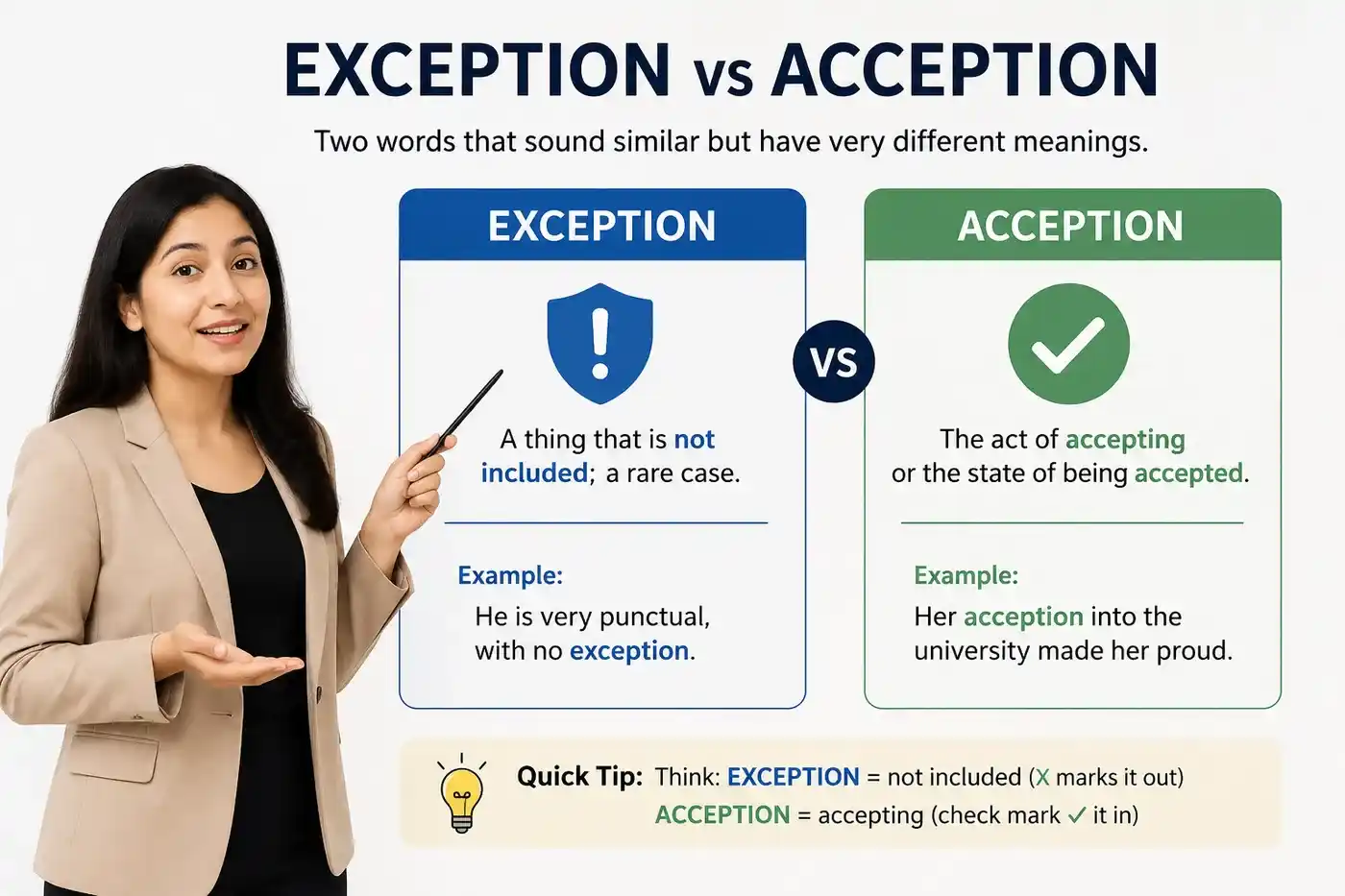
Many English learners search for exception vs acception because the two words look very similar. At first glance, they seem like different forms of the same word. This often makes people wonder which one is correct and how each word should be used.
The truth is that both exception and acception are real English words. However, they do not mean the same thing. One word is very common in everyday English, while the other is rare and mostly used in specialized language discussions.
If you are confused about exception vs acception, this simple guide will help you understand the difference, meaning, spelling, and correct usage in easy English.
For more commonly confused words, see our article on dissatisfied or unsatisfied.
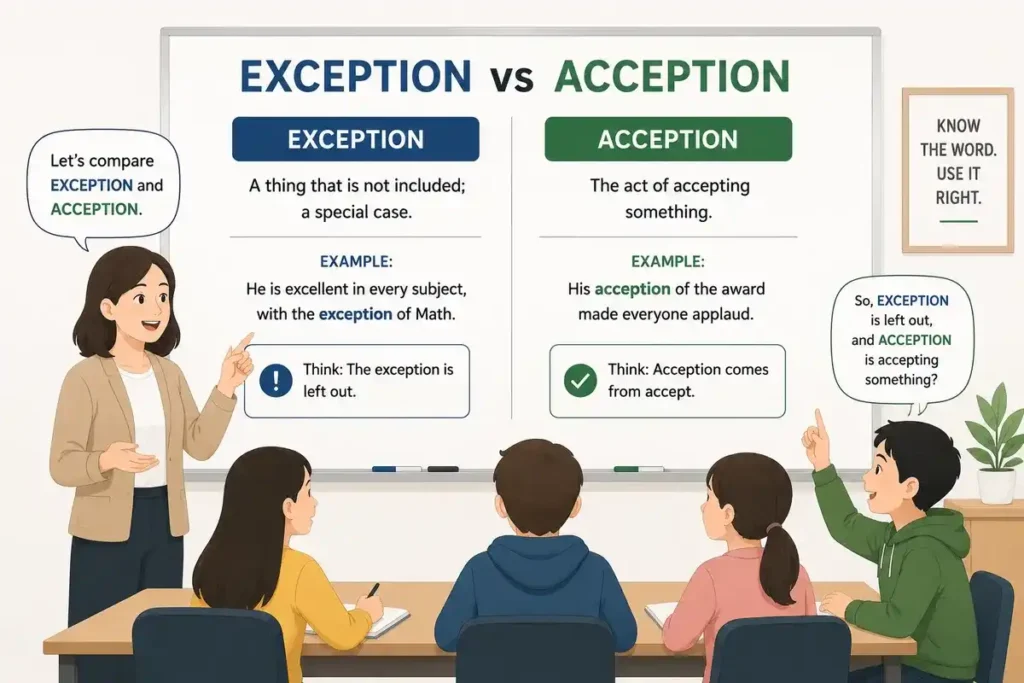
Simple Answer in One Look Exception vs Acception
- Exception means something that does not follow a general rule.
- Acception means a specific meaning or sense of a word, but it is rarely used in everyday English.
Means of Exception vs Acception in Simple English
To understand exception vs acception, it helps to learn each word separately.
Simple Mean of Exception
An exception is something that is different from the normal rule.
Think about a classroom rule. A teacher says: “Everyone must submit homework by Friday.” Then the teacher allows one sick student to submit it on Monday. That student is an exception.
The rule applies to everyone else, but not to that one case.
More examples:
- Most stores close at 9 PM, but this store is an exception.
- Everyone passed the test except Tom. Tom is the exception.
- Dogs are not allowed here, with one exception: service dogs.
In simple words:
Exception = something outside the normal rule.
Simple Mean of Acception
Acception is much less common.
It refers to a particular meaning of a word. Some words have more than one meaning. For example, the word “bank” can mean:
- A place that holds money
- The side of a river
Each meaning can be called an acception of the word. Most people never use this word in daily conversation. Instead, they simply say:
- meaning
- definition
- sense
In simple words:
Acception = a specific meaning of a word.
Confusion In Exception vs Acception
Many learners confuse exception vs acception because the words look almost identical. Compare them:
- exception
- acception
Only a few letters are different. When words have similar spelling, people often assume they have related meanings. That is exactly what happens here.
Similar Sound
Another reason is pronunciation. When spoken quickly, the words can sound somewhat alike to learners. This can make it harder to remember which word is which.
Similar Word Family
The confusion becomes even stronger because English contains words such as:
- accept
- accepted
- acceptance
- except
- exception
Many students accidentally connect the wrong words together. For example some people think;
accept → acception
This seems logical. But English vocabulary does not always follow simple patterns.
Rare Usage of Acception
One of the biggest reasons for confusion is that acception is rarely used. Most people see exception regularly. They may not know that acception is actually a separate word with a different meaning. Because of this, many writers accidentally use one when they mean the other.
Clear Difference in Exception vs Acception
The easiest way to understand exception vs acception is through a simple comparison.
Exception
Meaning: Something that does not follow a rule.
Used Often?
Yes.
Common in daily English?
Yes.
Example: “Everyone came to the party except Jake. Jake was the exception.”
Acception
Meaning: A specific meaning of a word.
Used Often?
No.
Common in daily English?
No.
Example: “In one acception, the word refers to a physical object.”
Quick Comparison Table Exception vs Acception
| Word | Meaning | Common? |
|---|---|---|
| Exception | Something outside a rule | Yes |
| Acception | A particular meaning of a word | No |
Easy Memory Trick Exception vs Acception
Look at the first part of each word.
Exception contains “except.”
Think: “Except means leaving something out.”
So an exception is something outside the normal rule.
Acception is connected to meanings and interpretations of words.
This simple trick helps many students remember the difference.
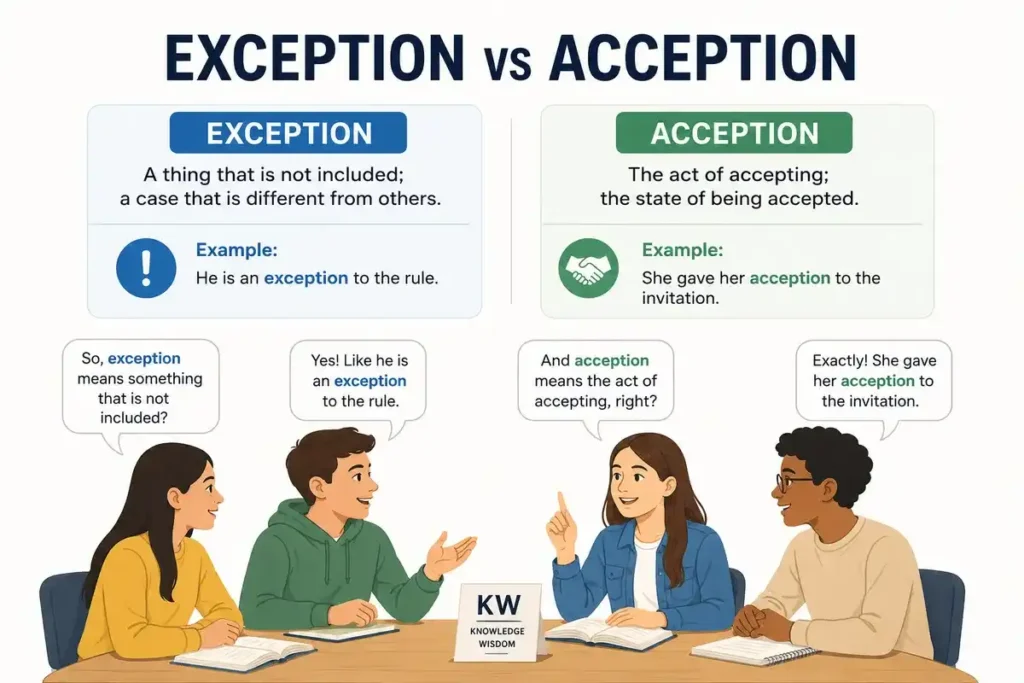
Exception vs Acception: Which Form We Should Use?
For most people, the answer is easy. Use exception. It is the word you will need in normal English conversations, school assignments, emails, books, and everyday writing.
Use Exception When Talking About Rules
Examples:
- Every student must wear a uniform, with one exception.
- The restaurant opens daily without exception.
- She was the only exception.
These are common uses.
Use Acception When Talking About Meanings
This word appears mainly in:
- language studies
- dictionaries
- discussions about word meanings
- academic writing
Example: “This acception of the word appeared in older texts.”
Most native English speakers rarely use this word. Many may never use it at all.
The Simple Rule to Use Exception vs Acception
Ask yourself: “Am I talking about a rule or a meaning?”
- If you are talking about a rule, use exception.
- If you are talking about a meaning of a word, use acception.
That simple question solves most confusion.
Easy Real-Life Sentences About Exception vs Acception
Here are examples using exception.
- Everyone was invited except Sam.
- Sam was the exception.
- This rule has no exceptions.
- She made an exception for her friend.
- Most birds can fly, but penguins are an exception.
- The store closes every day without exception.
- He follows every rule without exception.
- There is one exception to that policy.
Now look at examples using acception.
- This acception of the word is uncommon.
- The dictionary lists several acceptions.
- One acception refers to an old meaning.
- That acception is rarely used today.
- Linguists sometimes discuss different acceptions of a word.
Notice something important.
- The exception examples sound normal and familiar.
- The acception examples sound much more specialized.
That is because exception is common while acception is rare.
Common Situations Where Exception Is Used
You will often see exception in everyday life.
School
“All students must attend, with one exception.”
Workplace
“There is one exception to the company rule.”
Sports
“Every player practiced except one.”
Family Rules
“No phones at dinner, with one exception.”
Travel
“Everyone needs a ticket without exception.”
These examples show how useful and common this word is.
Common Situations Where Acception Is Used
The word acception appears much less often. You may find it in:
Dictionaries
Writers may discuss different acceptions of a word.
Language Research
Experts sometimes compare old and modern acceptions.
Historical Writing
Older texts may use a word in a different acception.
Meaning Analysis
Some scholars study how acceptions change over time.
Outside these areas, most people simply say:
- meaning
- definition
- sense
instead of acception.
Origin of These Words Exception vs Acception
Learning a little history can make the difference easier to remember.
Origin of Exception
The word exception comes from Latin roots connected to the idea of taking something out. That matches its modern meaning. An exception is something removed from a general rule.
For example: “Everyone must follow the rule.”
Then one case is taken out. That case becomes the exception.
Origin of Acception
The word acception also comes from Latin roots. Its meaning developed around the idea of receiving or understanding something in a certain way. Over time, it became connected to a particular meaning of a word.
Today, this meaning survives mostly in language studies and dictionaries.
Why One Became More Common?
Language changes over time. People found exception useful in everyday life. So it remained common. Meanwhile, people began using words such as:
- meaning
- definition
- sense
instead of acception.
As a result, acception became rare. This explains why many learners know exception but have never heard of acception.
Deep Meaning, Culture, and Practical Use of Exception vs Acception
When people hear the word exception, they usually think about rules and situations that are different from what is expected. Stories often use exceptions to make things interesting.
For example, imagine a story where every dragon breathes fire. Then one dragon breathes ice. That dragon becomes the exception. The character stands out because it is different from the others.
This idea appears in many books, movies, and fairy tales. A hero may be the exception. A special rule may have one exception. A person may achieve something that nobody expected. These situations help create excitement and surprise.
The word acception is very different. Most people do not use it when talking about stories. Instead, it appears more often when people discuss language and meanings. Writers, dictionary makers, and language experts may talk about different acceptions of a word.
Because of this, exception has a much stronger presence in everyday culture than acception.
People Like Exceptions
People are naturally interested in things that are unusual. When something breaks a pattern, people pay attention.
For example:
- A tiny dog that acts like a guard dog.
- A child who solves a difficult problem.
- A player who breaks a sports record.
These examples feel special because they are exceptions. That is one reason the word appears so often in daily life.
Biblical and Mythological Meaning Exception vs Acception
The word exception does not have a major symbolic meaning in most religious texts. However, the idea behind it appears often. Many stories include special people chosen for unique purposes. These people are sometimes seen as exceptions because they do not follow the usual pattern.
For example:
- A leader chosen from an unexpected background.
- A person receiving special protection.
- Someone overcoming impossible odds.
The word exception may not always appear, but the idea is there.
Acception in Religious Writing
The word acception appears occasionally in older religious and historical texts. In these cases, it often refers to the way something is understood or accepted. Modern readers rarely encounter this usage. Most modern translations use simpler language. Because of this, acception remains uncommon even in religious discussions today.
Mythological Examples Exception vs Acception
Many myths include exceptional characters.
- A hero may possess unusual strength.
- A creature may have powers unlike others of its kind.
These figures become memorable because they are exceptions.
The concept of acception is much less common in mythology because myths focus more on actions and characters than on word meanings.
Symbolism of Exception vs Acception Explained in Simple Words
Words sometimes carry symbolic meanings beyond their dictionary definitions. Understanding these ideas can make the difference between exception vs acception easier to remember.
What Exception Represents?
The word exception often symbolizes uniqueness.
Being Different
An exception stands apart from the crowd. It represents something unusual or special. Example;
A student who achieves something remarkable may be described as an exception.
Breaking a Pattern
Exceptions remind us that rules do not always fit every situation. This can symbolize flexibility and fairness.
Individual Strength
Many stories celebrate people who become exceptions by overcoming challenges. Because of this, the word can sometimes suggest determination and success.
What Acception Represents?
The word acception is connected to meaning and understanding.
Different Ways of Understanding
An acception shows that one word can carry multiple meanings. This represents communication and interpretation.
Growth of Language
As language changes, words gain new acceptions. This makes acception a symbol of language development.
Quick Symbolism Comparison Exception vs Acception
| Word | Symbolic Idea |
|---|---|
| Exception | Uniqueness, difference, special cases |
| Acception | Meaning, interpretation, understanding |
This comparison can help you remember the difference more easily.
Related Words to Exception vs Acception You Should Know
Learning related words to Exception vs Acception helps build a stronger vocabulary.
Except
Means not including someone or something.
Example: “Everyone came except Sarah.”
Exceptional
Means unusually good or special.
Example: “She did an exceptional job.”
Exceptionally
Means in an unusually high or special way.
Example: “He performed exceptionally well.”
Accept
Means to receive or agree with something.
Example: “I accept your apology.”
Accepted
Means approved or received.
Example: “Her application was accepted.”
Acceptance
Means approval or agreement.
Example:”The school sent an acceptance letter.”
Meaning
The idea a word communicates.
Example: “What is the meaning of this word?”
Definition
A clear explanation of a word.
Example: “The dictionary provides a definition.”
Sense
One possible meaning of a word.
Example: “The word has several senses.”
These related words help show how exception and acception belong to different word groups.
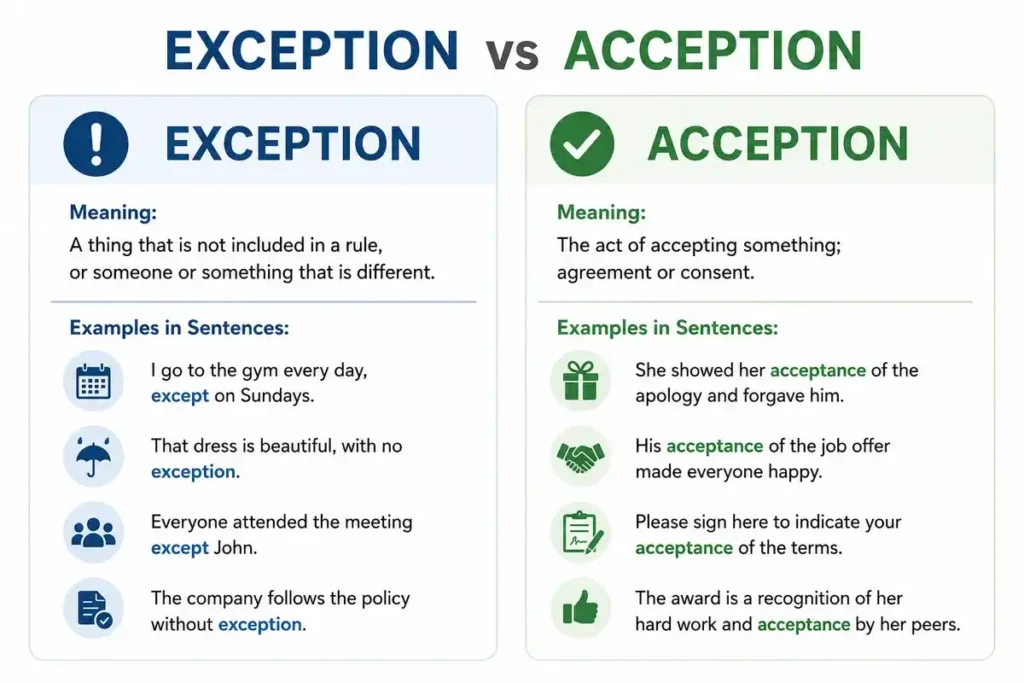
Daily Use of Exception vs Acception in English Language
Most English speakers use exception regularly. They rarely use acception. Here are common examples;
Talking About Rules
“There is one exception to the policy.”
Talking About School
“Everyone passed except one student.”
Talking About Work
“The manager made an exception.”
Talking About Sports
“He was the exception to the team’s rule.”
Talking About Family
“My parents made an exception for my birthday.”
Talking About Travel
“All passengers need identification without exception.”
Talking About Good Performance
“Her work is exceptional.”
Talking About Word Meanings
“This acception of the term is outdated.”
Talking About Dictionaries
“The dictionary lists several acceptions.”
Talking About Language History
“That acception was common centuries ago.”
Notice that everyday conversations mostly use exception-related words. Acception appears mainly in discussions about language itself.
Common Mistakes People Make About Exception vs Acception
Many learners make similar mistakes when comparing exception vs acception.
Mistake 1: Thinking Acception Is a Misspelling
Some people believe acception is incorrect. It is actually a real English word. It is simply much less common.
Mistake 2: Using Acception for Rules
Incorrect: “There is one acception to the rule.”
Correct: “There is one exception to the rule.”
Rules use exception.
Mistake 3: Using Exception for Meanings
Incorrect: “This exception of the word is old.”
Correct: “This acception of the word is old.”
Word meanings use acception.
Mistake 4: Mixing Up Accept and Except
Incorrect: “I except your apology.”
Correct: “I accept your apology.”
These words sound somewhat similar but have very different meanings.
Mistake 5: Assuming Similar Spelling Means Similar Meaning
Many English words look alike but mean different things. Exception and acception are a good example. Always focus on the meaning, not just the spelling.
Easy Correction Rule Exception vs Acception
Ask yourself: “Am I talking about a rule or a meaning?”
Rule = exception
Meaning = acception
This simple question prevents most mistakes.
Quick Practice Exception vs Acception
Choose the correct word.
- There is one ___ to the rule.
- This ___ of the word is outdated.
- Penguins are an ___ to the rule.
- The dictionary lists another ___.
Answers:
- acception
- exception
- acception
- exception
Exception Is More Common Than Acception
Many learners wonder why one word is common while the other is rare. The answer is simple. People discuss rules and exceptions every day.
Examples include:
- school rules
- workplace rules
- family rules
- laws
- policies
Because these situations happen often, the word exception remains very useful. Acception deals with word meanings. Most people do not discuss word meanings every day.
As a result, acception appears much less frequently. That is why many native speakers know exception well but may never use acception themselves.
Final Teacher Explanation Exception vs Acception
Imagine you are sitting in class and asking:
“Teacher, what is the difference between exception and acception?”
My answer would be simple.
- An exception is something that does not follow a normal rule.
- An acception is a particular meaning of a word.
That is the entire difference.
Most of the time, you will use exception because it appears in daily conversations, schoolwork, books, and business writing. The word acception is real, but it is much less common. You will mainly see it in dictionaries, language studies, and discussions about word meanings.
Whenever you feel confused, remember this easy rule:
“Rules use exception. Meanings use acception.“
That one sentence can help you remember the difference for years.
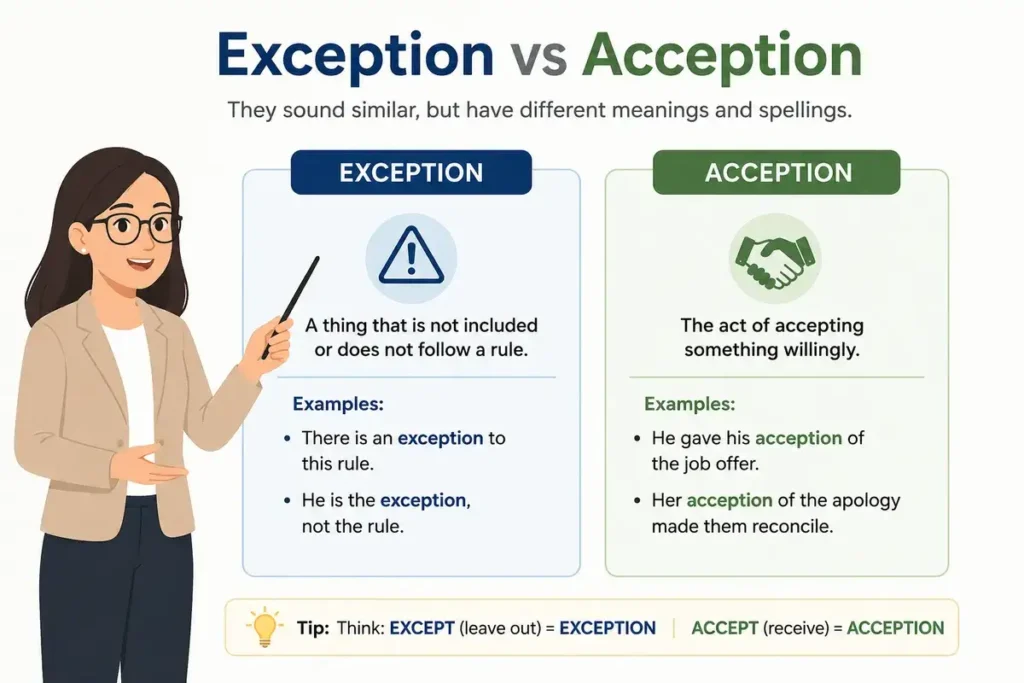
Quick Recap Exception vs Acception
When comparing exception vs acception, both words are correct English words.
- Exception means something that does not follow a rule.
- Acception means a particular meaning or sense of a word.
To remember the difference, think:
Rules = exception. Meanings = acception.
Conclusion
When comparing exception vs acception, the main difference is their meaning and usage. Exception refers to something outside a rule, while acception refers to a particular meaning of a word. Understanding this common English vocabulary confusion helps you choose the correct word in both writing and conversation.
The easiest way to remember the difference is simple: rules use exception, meanings use acception. Keeping this rule in mind will improve your word choice, spelling accuracy, and overall confidence in English.
Frequently Asked Questions
What is the difference between Exception vs Acception?
Exception means something outside a rule. Acception means a particular meaning of a word.
Which is more common, Exception vs Acception?
Exception is much more common in everyday English.
Is acception a real English word?
Yes. It is a real word, but it is rarely used outside language discussions.
When should I use exception?
Use exception when talking about rules, policies, or situations that are different from the norm.
When should I use acception?
Use acception when talking about a specific meaning of a word.
Why do people confuse Exception vs Acception?
The words look similar, and many learners assume they have related meanings.
Can exception and acception replace each other?
No. They have different meanings and should not be used interchangeably.
What is the easiest way to remember the difference between Exception vs Acception?
Remember this rule: Rules use exception. Meanings use acception.