
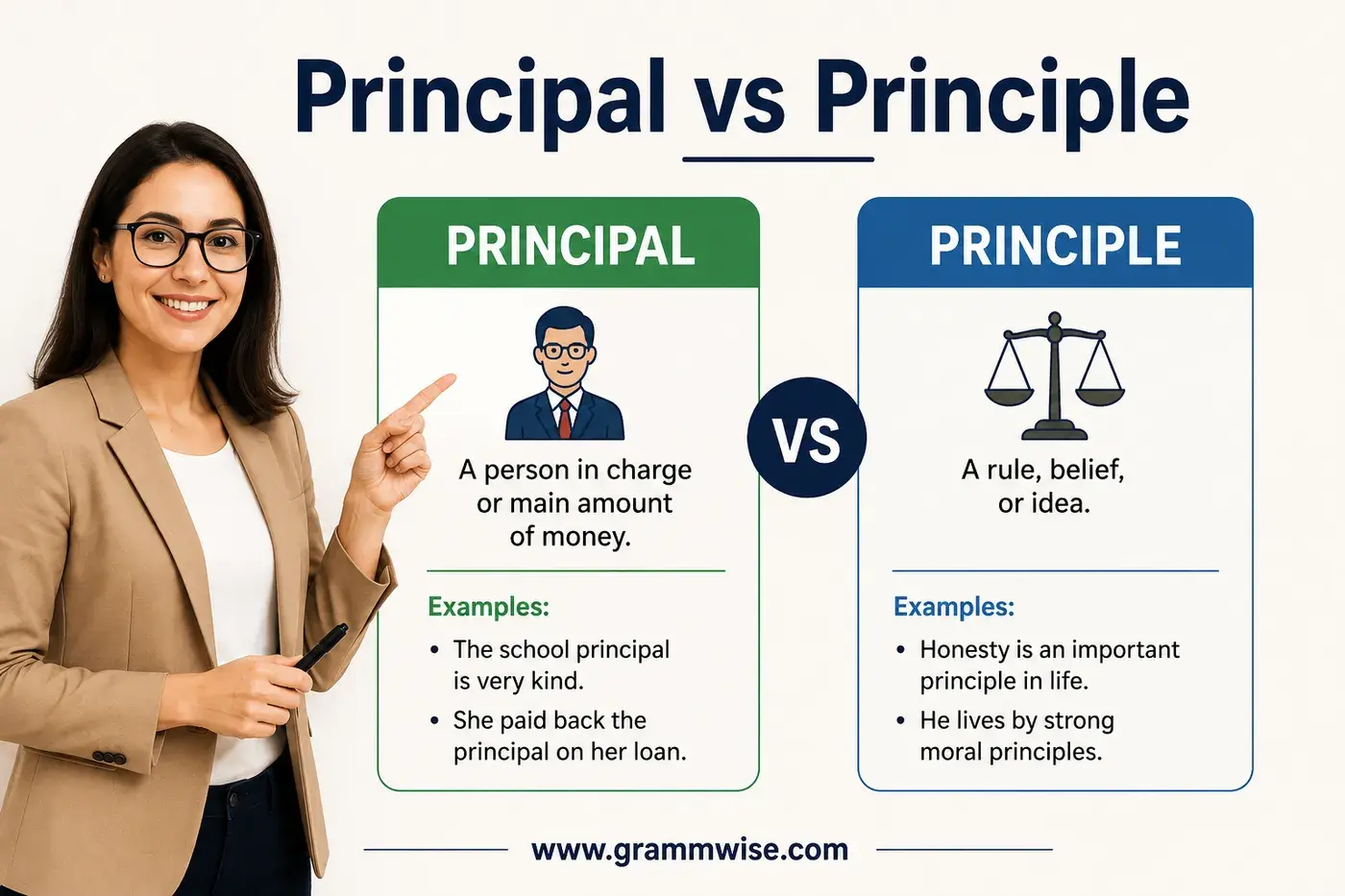
Many students feel confused about principal vs principle. You may see both words in books, school notes, or emails. They look almost the same. They sound almost the same. But they do not mean the same thing.
As a teacher, I see this confusion every year. Students ask, “Which one is correct?” The answer depends on what you want to say. One word is about a person or money. The other word is about a rule or belief.
In this lesson, I will explain principal vs principle in very simple English. I will talk to you like I talk to my students in class. Step by step. Short and clear. By the end, you will know the difference and feel confident using the right word.
If homophones confuse you, explore more examples in our grammar guides.
Simple Answer in One Look
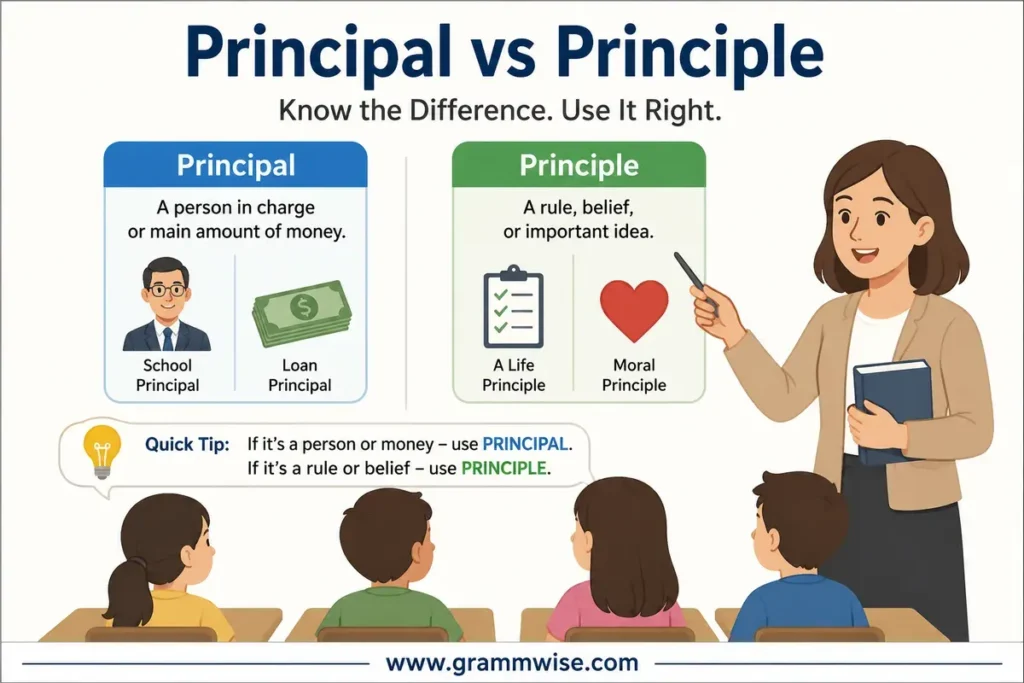
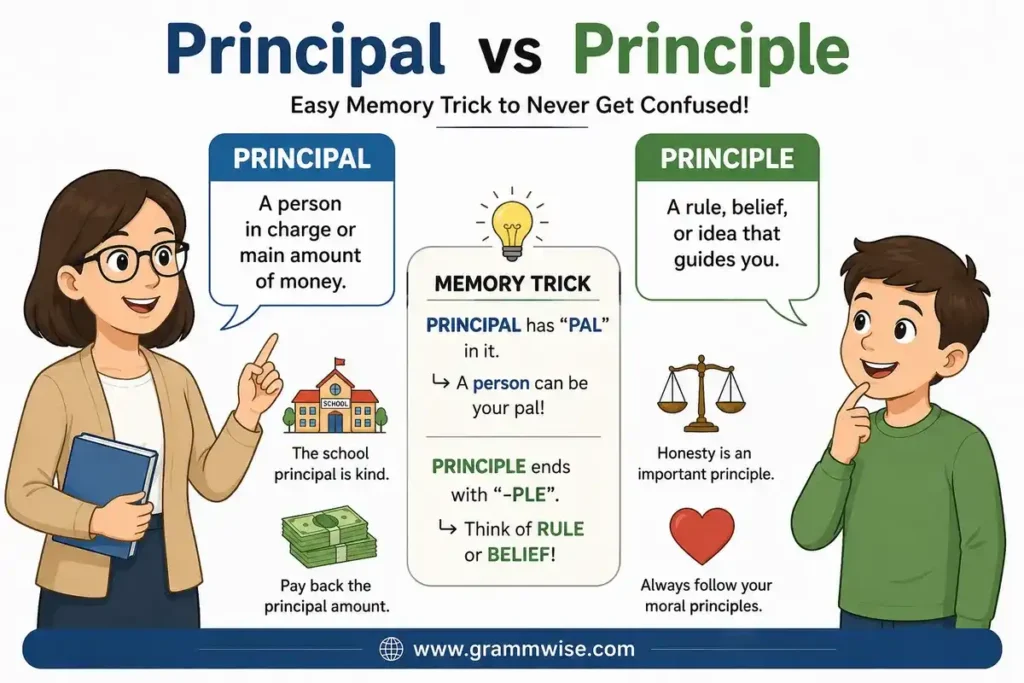
Principal is a person or money.
Principle is a rule, idea, or belief.
Meaning Principal vs Principle in Simple English
Let’s slow down and look at each word.
The word principal is usually a noun. It often means a person in charge or a main amount of money. Think about school. The principal is the head of the school. This person makes big decisions. Students and teachers follow their rules.
Now think about money. The principal is the original amount of money before interest is added. If you borrow money from a bank, the first amount is called the principal.
The word principle is different. It means a rule, idea, or belief that guides how someone acts. For example, honesty is a principle. Being kind is a principle. These are ideas that help people decide what is right or wrong.
So in principal vs principle, one word is about who or how much, and the other is about what you believe.
Why People Mix These Words Principal vs Principle?
People mix up principal vs principle for a few simple reasons.
First, they sound almost the same when spoken. In normal conversation, you may not hear the difference clearly.
Second, they look very similar when written. Only one letter changes in the middle. When typing fast, many people choose the wrong one.
Third, both words are used in school and learning. You hear “school principal” and also hear about “moral principles.” This makes the confusion stronger.
Here is a common real-life mistake:
Someone writes, “Honesty is my main principal.”
This is wrong because honesty is a belief, not a person.
Another example:
Someone writes, “The principle called a meeting.”
This is also wrong because a belief cannot call a meeting. A person can.
These small mistakes happen every day. The good news is that the fix is easy.
Clear Difference of Principal vs Principle Explained Simply
Here is a very simple way to see the difference between principal vs principle.
Principal:
- A person in charge (school principal)
- Money amount (loan principal)
- Can act or be counted
Principle:
- A rule or belief
- A guiding idea
- Cannot act like a person
A helpful memory tip:
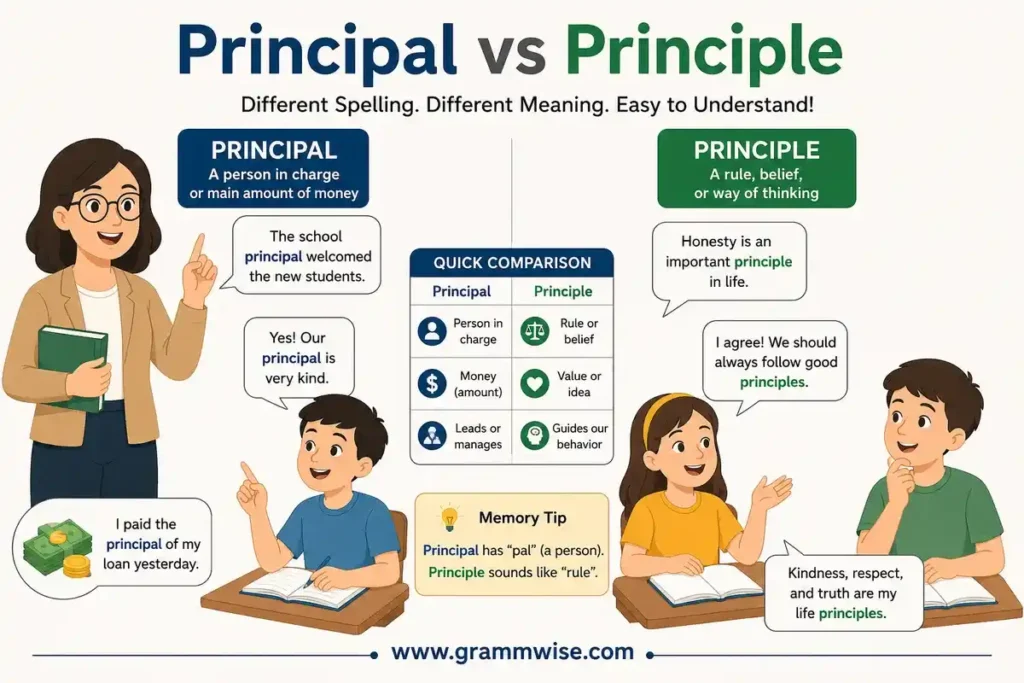
Principal has “pal” in it.
A principal can be your pal because they are a person.
Principle ends with “le.”
Think of “rule” or “belief” living inside your mind.
This small trick helps many students remember the correct word.
Principal vs Principle: Which Form Should You Use?
Ask yourself one simple question before choosing.
Am I talking about a person or money?
If yes, use principal.
Am I talking about a rule, idea, or belief?
If yes, use principle.
You do not need to think about grammar terms. Just think about meaning.
If the word can lead, manage, or have a job, it is principal.
If the word talks about how to live or what is right, it is principle.
This rule works in almost every case.
Easy Real-Life Sentences of Principal vs Principle You Can Use
Here are some simple sentences you can copy and use.
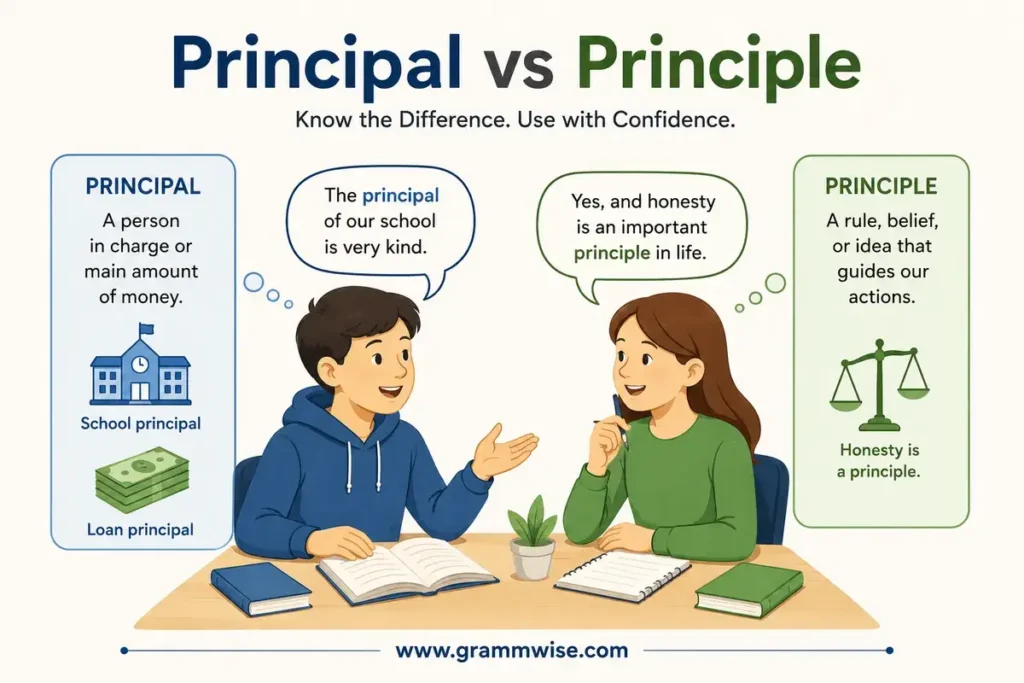
- The school principal spoke to the students.
- Our principal is very kind and fair.
- She paid back the principal on her loan.
- Honesty is an important principle in life.
- He lives by strong moral principles.
- The principal approved the new school rules.
- Hard work is a key principle for success.
Read them slowly. Notice how each word fits the meaning.
Principal vs Principle: Where This Word Pair Comes From?
Both words come from Latin, but they changed over time.
The word principal comes from a Latin word that means “first” or “main.” That is why it is used for the main person or the main amount of money.
The word principle also comes from the same root, but its meaning moved toward ideas and rules. Over time, English speakers used it for beliefs and values instead of people.
Even though they share history, their meanings are now clearly different.
How This Word Is Understood in Culture and Stories
In stories, movies, and daily talk, principal vs principle shows up more than people notice.
The word principal often appears as a role. In school stories, the principal is the strict person, the kind leader, or the fair judge. Many children’s books show the school principal as someone who teaches lessons, not just rules. This makes students see the principal as a guide, not just a boss.
In money stories, the principal is shown as the “starting point.” When characters borrow money or invest, the principal is the base. It is the amount that everything grows from.
The word principle is used in stories to show values. Heroes often follow strong principles. Villains often break principles. When a character refuses to lie, cheat, or hurt others, stories say they are acting on principle.
So in culture, principal feels like a position or base, while principle feels like a moral compass.
Biblical and Mythological Meaning of Principal vs Principle
In the Bible and old stories, the word principle fits more than principal.
Biblical teachings talk a lot about principles. Ideas like honesty, kindness, faith, and justice are all principles. They guide how people should live and treat others. For example, “love your neighbor” is a principle. It is not a person. It is a rule for life.
The word principal does not appear much in a spiritual way. When it does, it usually means something like “main” or “first.” For example, the main part of something.
So in spiritual or moral stories, principle is the word you will see more often.
In mythology, these two words connect to different ideas, even though they sound alike.
Principal in mythology is linked to rank and importance.
It points to the main god, chief ruler, or highest power.
For example, the principal god is the one in charge, like the king of the gods.
So here, principal means the most important being.
Principle in mythology is linked to cosmic rules and beliefs.
It means the laws of nature, moral balance, or universal order.
Ideas like truth, justice, fate, and balance are principles in myths.
These principles guide how gods and humans should act.
Comparison Table: Principal vs Principle
| Point of Comparison | Principal | Principle |
|---|---|---|
| Basic meaning | A person in charge or main amount of money | A rule, belief, or idea |
| Used for | People and money | Values and morals |
| Example role | School leader | Life rule |
| Can act or decide | Yes | No |
| Easy memory tip | Has pal (a person) | Think of rule or belief |
Symbolism of Principal vs Principle Explained in Simple Words
What Principal Represents?
Principal represents leadership, authority, and foundation.
A principal stands for someone who is responsible. This person leads others. In money, the principal represents the base amount. It is the starting point.
Emotionally, principal feels solid and official. It feels like structure, order, and control.
What Principle Represents?
Principle represents values, beliefs, and inner rules.
A principle lives inside a person. It guides choices. It helps people decide right from wrong.
Emotionally, principle feels personal. It feels like honesty, courage, and fairness.
So when thinking about principal vs principle, one stands outside you, and the other lives inside you.
Related Words You Should Know
Here are some related words that connect to principal vs principle.
Leader
A person who guides others.
Rule
A set instruction people follow.
Belief
Something you feel is true and right.
Value
An idea that matters to you.
Interest
Extra money added to the principal.
Ethics
Rules about right and wrong behavior.
Authority
Power to make decisions.
These words help you understand the ideas around both terms.
Use of Principal vs Principle in Daily English
Here are real-life examples you may hear every day.
- The principal called my parents today.
- Our school principal retired last year.
- She paid the principal before the interest.
- Honesty is my strongest principle.
- He refused to lie because of his principles.
- The principal welcomed new students.
- Kindness is a basic human principle.
- The bank explained the loan principal clearly.
This is how people really speak and write.
Common Mistakes People Make About Principal vs Principle
Many people make the same mistakes with principal vs principle.
Mistake 1:
“Honesty is my main principal.”
Correction:
Honesty is my main principle.
Mistake 2:
“The principle will talk to us.”
Correction:
The principal will talk to us.
Mistake 3:
Mixing both words in the same sentence incorrectly.
Correction:
Check meaning first. Person or belief?
The fix is always the same. Stop and think for one second.
Practice Test: Choose the Correct Word Principal vs Principle
Fill in the blank with principal or principle.
- The school _______ announced a holiday.
- Honesty is an important _______ in life.
- She paid the loan _______ before interest.
- Our _______ welcomed new students.
- He never breaks his moral _______.
- The bank explained the _______ amount clearly.
Answers
- principal
- principle
- principal
- principal
- principle
- principal
Final Teacher Explanation
Let me explain this one last time like I do in class.
If you can shake hands with it, it is principal.
If it guides your heart, it is principle.
Principal is real, visible, and active.
Principle is invisible, personal, and guiding.
Do not rush. Think about meaning, not spelling.
Once you understand the idea, the spelling becomes easy.
Final Thought Principal vs Principle
Principal = a person or main amount of money.
Principle = a rule, belief, or value.
This is the clear and simple difference.
Conclusion
Understanding principal vs principle becomes easy when you focus on meaning, not spelling. One word points to a person or money, while the other points to a rule or belief. This small pause in thinking helps you choose the right word every time.
As your teacher, my advice is simple. Read the sentence, ask what you mean, and then write. With practice, this confusion disappears, and your English becomes clearer and more confident.
Frequently Asked Questions
What does principal mean in simple words?
It means a leader or the main amount of money.
What does principle mean in simple words?
It means a rule or belief you follow.
Which is correct: principal vs principle?
Both are correct. Use the one that matches your meaning.
Why do people get confused between them?
They look and sound almost the same.
Can I use both words in writing?
Yes, if the meaning is correct.
Is school principal a person?
Yes. The school principal is the head of the school.
Is honesty a principle?
Yes. Honesty is a belief or value.
How can I remember the difference easily?
Principal has “pal.” A principal is a person.