
Many English learners get confused about their vs there because the two words sound exactly the same. Even though they are pronounced alike, they have different meanings and different uses. Learning the difference between their vs there will help you avoid one of the most common writing mistakes in English.
The good news is that these words are easy to understand once you know what each one means. You only need a simple rule and a little practice. After that, choosing the correct word becomes much easier.
If you have ever wondered which is correct, their vs there, this guide will explain everything in simple English with clear examples that you can use every day.
Small spelling changes can create big meaning differences. Learn our guide.
Simple Answer in One Look
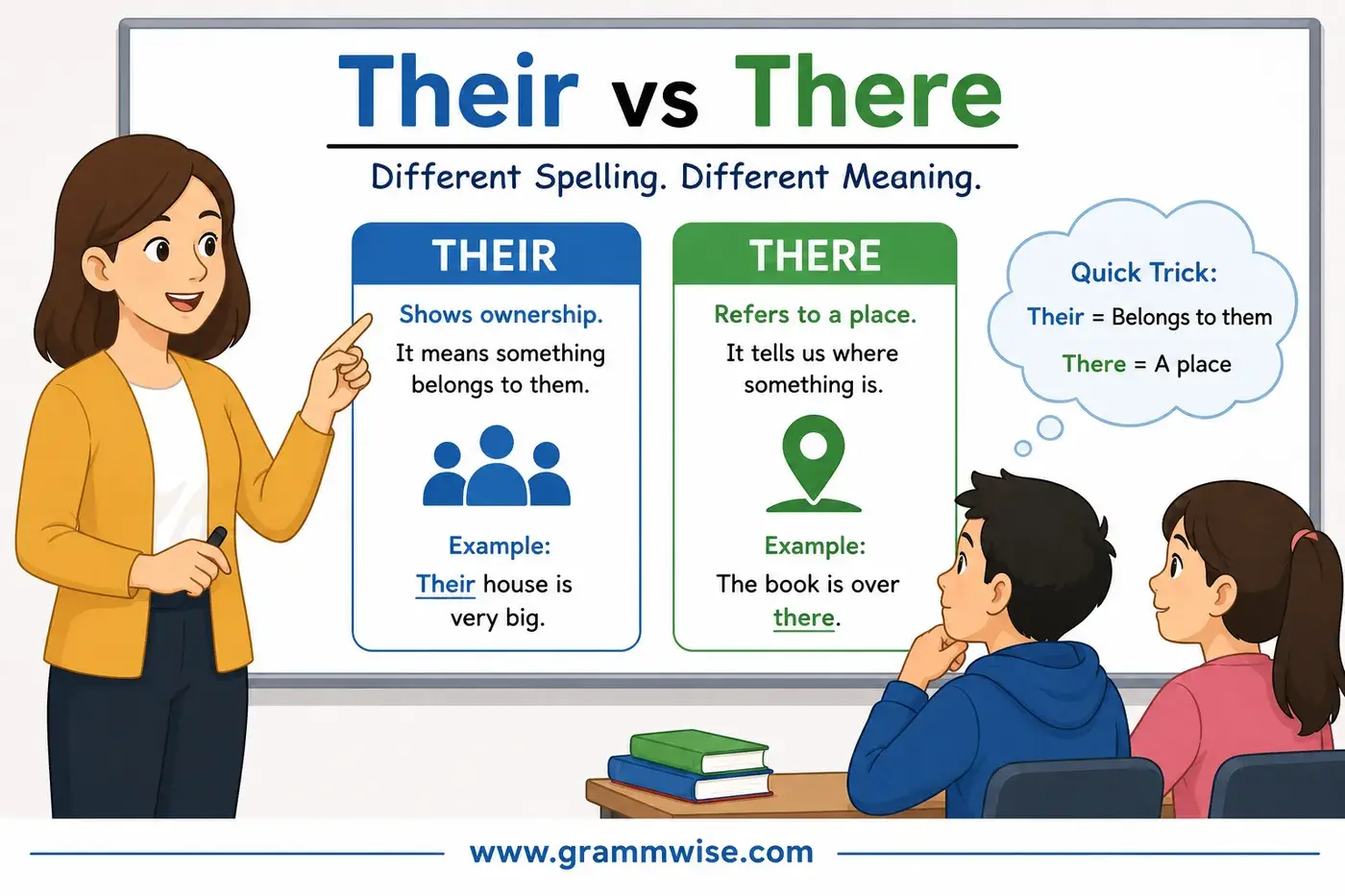
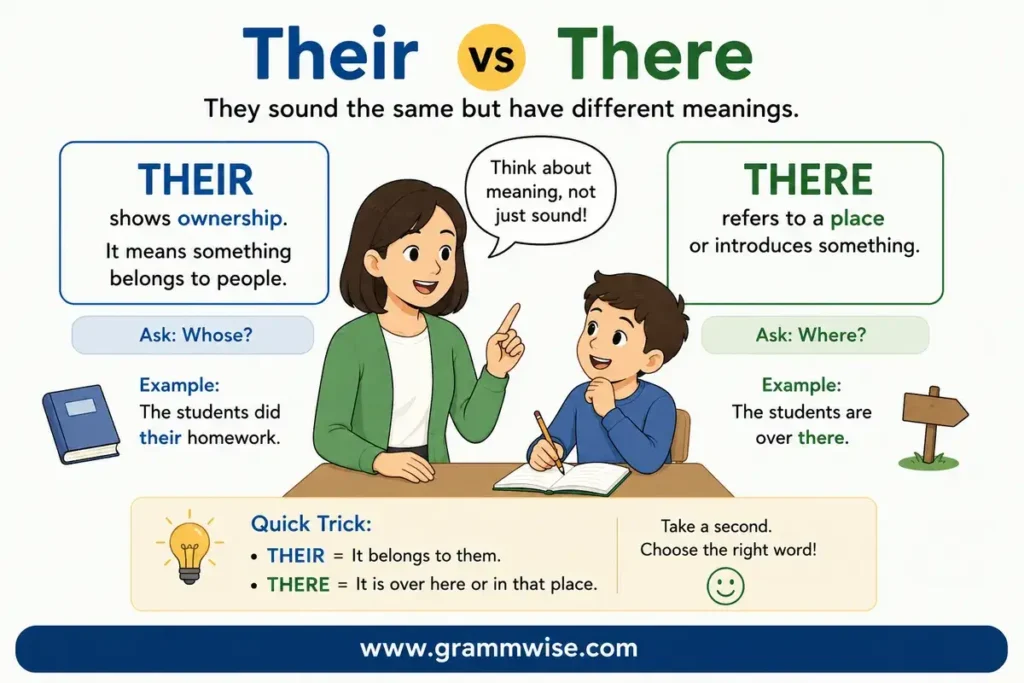
Their shows that something belongs to people.
There talks about a place or introduces something.
Meaning of Their vs There in Simple English
Think about these two sentences.
- “The students forgot their books.”
- “The students are waiting there.”
The first sentence tells us the books belong to the students. The second sentence tells us where the students are. That is the biggest difference.
Their is about ownership.
There is about location or pointing to a place.
Here is another example.
- “The children washed their hands.”
- “The children are playing over there.”
In the first sentence, the hands belong to the children. In the second sentence, there tells us where they are playing.
Imagine you are pointing across the room. You might say, “Your backpack is over there.”
Now imagine you are talking about your friends. You could say, “Their backpacks are on the floor.”
The backpacks belong to your friends.
That is why their is the correct choice.
These two words may sound alike, but they do different jobs.
One shows ownership.
The other shows a place.
Once you remember this simple idea, you will make fewer mistakes.
Why People Mix These Words Their vs There?
Many people confuse their and there because they are homophones. Homophones are words that sound the same but have different meanings and spellings.
When you hear someone speak, you cannot always tell which word they mean. You understand the meaning from the rest of the sentence.
For example, listen to this sentence.
“They left their bags there.”
You hear the same sound twice. But each word has a different meaning.
Another reason people mix these words is fast typing. Many writers know the correct word, but they accidentally choose the wrong spelling. Spell check may not catch the mistake because both words are real English words.
For example,
“Their is my school.”
Every word is spelled correctly. But the sentence is still wrong because the wrong word was chosen.
People also confuse these words because they learn pronunciation before spelling. Since both words sound the same, they naturally think they can be used the same way. They cannot.
Each word has its own meaning. Learning that meaning is the easiest way to remember the difference.
Clear Difference of Their vs There Explained Simply
Here is an easy comparison.
| Their | There |
|---|---|
| Shows ownership | Shows a place |
| Means something belongs to someone | Means in or at a place |
| Answers “Whose?” | Answers “Where?” |
| Used before a thing that belongs to people | Used to point to a location or begin a sentence |
Think about these examples.
Use their
- Their house is beautiful.
- Their teacher is kind.
- Their lunch is ready.
- Their dog likes to run.
In every sentence, something belongs to someone.
Use there
- The bus is over there.
- There is a bird in the tree.
- Put your shoes there.
- We will meet there after school.
Each sentence talks about a place or introduces something.
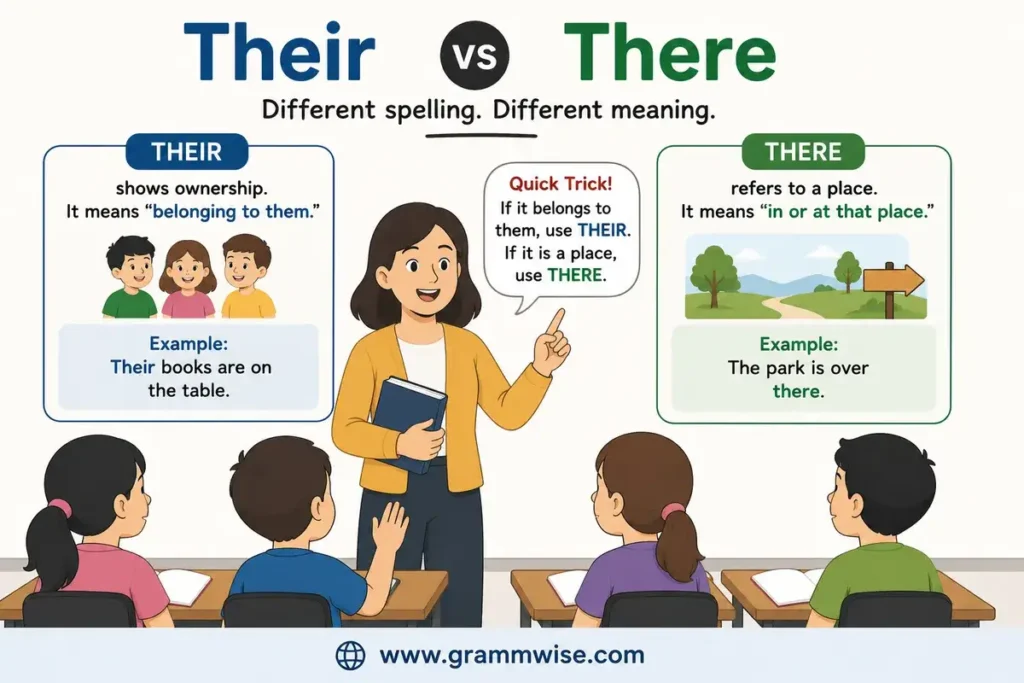
A simple way to remember this is:
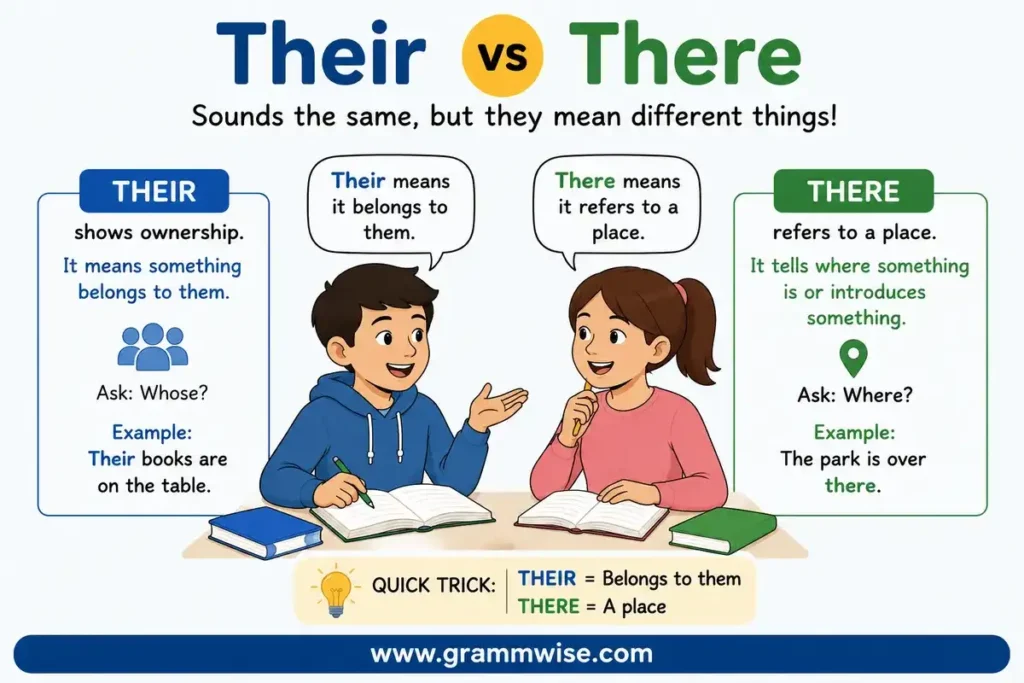
Their = belongs to them.
There = a place.
Their vs There: Which Form Should You Use?
Ask yourself one easy question.
Am I talking about something that belongs to people?
If the answer is yes, use their.
Examples:
- Their classroom is clean.
- Their parents are waiting.
- Their pencils are on the desk.
Now ask another question.
Am I talking about a place or pointing somewhere?
If the answer is yes, use there.
Examples:
- Please sit there.
- The keys are there.
- There are many books in the library.
This simple rule works almost every time. You do not need difficult grammar rules. Just think about the meaning.
If it belongs to someone, choose their.
If it tells where something is, choose there.
Easy Memory Tricks to Remember Their vs There
Here are some easy ways to remember the difference.
Trick 1
Look at the word their.
It contains the word heir.
An heir receives something.
That helps you remember that their is connected with ownership.
Trick 2
Look at there.
It begins with here.
Both words are about places.
If you can replace the word with here, you probably need there.
Example:
The park is there.
The park is here.
Both words talk about location.
Trick 3
Ask yourself,
“Does this belong to someone?”
If yes, use their.
If not, and you are talking about a place, use there.
Easy Real-Life Sentences on Their vs There You Can Use
Here are some simple sentences you will hear every day.
Using Their
- Their teacher is very friendly.
- Their house is near the park.
- Their baby is sleeping.
- Their phones are charging.
- Their car is new.
- Their family enjoys traveling.
- Their garden looks beautiful.
- Their homework is finished.
Using There
- Please wait there.
- There is a cat under the table.
- We will eat there tonight.
- Your backpack is over there.
- There are five apples in the basket.
- My grandparents live there.
- Look over there.
- There was a rainbow after the rain.
Read these examples slowly.
Notice how their always shows ownership.
Notice how there always talks about a place or introduces something.
Common Mistakes People Make About Their vs There
Here are mistakes many learners make.
Wrong
There dog is very friendly.
Correct
Their dog is very friendly.
The dog belongs to someone.
Wrong
Their is a new student.
Correct
There is a new student.
You are introducing someone.
Wrong
Please put your shoes their.
Correct
Please put your shoes there.
You are talking about a place.
Wrong
I like there new house.
Correct
I like their new house.
The house belongs to them.
Quick Practice of Their vs There
Choose the correct word.
- _____ parents are waiting outside.
Answer:
Their.
- Please stand over _____.
Answer:
There.
- _____ is a bird on the roof.
Answer:
There.
- I like _____ new bicycles.
Answer:
Their.
- We will meet _____ after lunch.
Answer:
There.
If you answered all five correctly, you already understand the basic difference.
Related Words That Can Cause Confusion
While learning their vs there, you may also see another word.
They’re
This is short for they are.
Example:
They’re coming to school.
You can replace it with:
They are coming to school.
If the sentence still makes sense, they’re is correct.
Now compare all three.
Their = belongs to them.
There = place or location.
They’re = they are.
Remembering these meanings helps you avoid one of the most common English writing mistakes.
Where These Words Their vs There Come From?
The words their and there have been part of English for hundreds of years.
The word their came from old Scandinavian languages. It was used to show that something belonged to people. The word there comes from Old English. It has always been connected with places and locations.
Even though these words sound the same today, they have different histories and different meanings. That is why English keeps both words. Each one has an important job.
Learning the history is not necessary to use them correctly, but it helps explain why they are spelled differently.
How This Word Is Understood in Culture and Stories
The words their and there appear in almost every type of English writing. You will find them in children’s books, school stories, novels, newspapers, and everyday conversations.
Even though these words are small, they help make sentences clear.
When a story talks about a family, friends, or a team, the word their is often used to show that something belongs to them.
For example:
“The children packed their bags before the trip.”
Here, the bags belong to the children.
The word there is also common in stories because writers often describe places.
For example:
“There was a small house near the river.”
This sentence tells readers where something is or introduces something new.
When people tell stories, they naturally use both words many times. One helps show ownership. The other helps describe places and settings.
Although these words are simple, using the correct one makes writing much easier to understand.
Biblical and Mythological Meaning of Their vs There
The Bible does not give special meanings to the words their and there. They are everyday English words that help build sentences.
In many Bible translations, their is used to show that something belongs to a group of people. For example, it may describe their homes, their families, or their faith.
The word there is often used to describe a place. It may tell readers where an event happened or where people traveled.
The same idea appears in many old myths and legends. Heroes travel there to a distant land. People protect their families or kingdoms.
These words help tell the story clearly, but they do not carry special symbolic meanings by themselves.
Symbolism of Their vs There Explained in Simple Words
What Their Represents?
The word their often represents belonging, family, teamwork, and shared responsibility.
It reminds us that people own things, care for one another, and work together.
Examples include:
- Their home
- Their dreams
- Their future
- Their friendship
- Their success
In many stories, their helps show that people share something important.
What There Represents?
The word there often represents a place, a destination, or a new beginning.
It answers simple questions like:
- Where is it?
- Where should we go?
- Where did it happen?
Examples include:
- Meet me there.
- There is hope.
- There was a beautiful garden.
Many stories begin with there because it introduces people, places, or events.
This makes it an important word for storytelling.
Related Words to Their vs There You Should Know
Learning a few related words makes their vs there much easier to remember.
They’re
They’re is short for they are.
Example:
They’re ready for school.
Them
Them refers to a group of people or things.
Example:
Please help them.
Theirs
Theirs means something belongs to them, but it stands alone.
Example:
The blue car is theirs.
Here
Here means this place.
Example:
Come here.
It is the opposite of there.
Where
Where asks about a place.
Example:
Where is my backpack?
Those
Those points to things that are farther away.
Example:
Those books are mine.
These
These points to things that are close.
Example:
These cookies taste great.
Use of Their vs There in Daily English
Native English speakers use their and there every day.
Here are some natural examples.
- “Their house is just around the corner.”
- “I left my bike there.”
- “Their children love reading books.”
- “There is plenty of time.”
- “We parked the car over there.”
- “Their teacher gave them extra homework.”
- “There are many birds in the park.”
- “I’ll meet you there after work.”
- “Their dog likes to chase balls.”
- “There was a long line outside the store.”
Notice how their always tells who owns something.
Notice how there tells where something is or introduces a sentence.
Common Mistakes People Make About Their vs There
These mistakes happen often, even to native English speakers.
Mistake 1: Using there instead of their
Wrong:
There parents are waiting.
Correct:
Their parents are waiting.
The parents belong to them.
Mistake 2: Using their instead of there
Wrong:
Please stand their.
Correct:
Please stand there.
You are talking about a place.
Mistake 3: Forgetting about they’re
Many learners only remember their and there.
They forget that they’re also exists.
Wrong:
Their going home.
Correct:
They’re going home.
You can replace it with:
They are going home.
Mistake 4: Choosing the word because it sounds right
Since all three words sound alike, many people write the first spelling that comes to mind.
Instead, think about the meaning.
That will help you choose the correct word.
Mistake 5: Not checking your writing
Reading your sentence one more time can help you catch mistakes.
Ask yourself:
Does this word show ownership?
Or does it talk about a place?
The answer tells you which spelling to use.
Final Teacher Explanation
Imagine today’s English lesson is ending.
Here is the easiest way to remember everything.
- If something belongs to people, use their.
- If you are talking about a place or introducing something, use there.
- If you mean they are, use they’re.
Do not worry if these words seemed confusing before. Almost every English learner makes this mistake at first. The important thing is to think about the meaning before you write.
Ask yourself a simple question.
“Does it belong to someone?”
If yes, write their.
“Am I talking about a place?”
If yes, write there.
“Can I replace it with ‘they are’?”
If yes, write they’re.
This small habit will help you write more clearly and confidently. The more you practice reading and writing, the easier these words will become.
Soon, you will choose the correct spelling without even thinking about it.
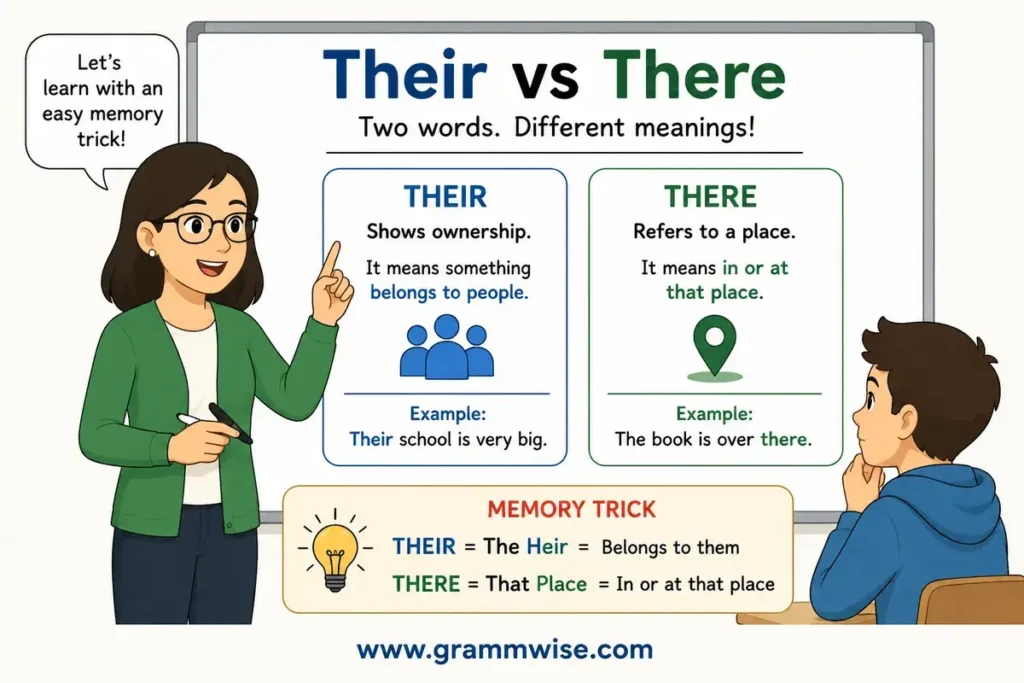
Quick Recap Their vs There
Their shows that something belongs to people.
There talks about a place or introduces something.
Remember this easy rule: Their = belongs to them. There = a place. They’re = they are.
Conclusion
Understanding their vs there becomes easy when you remember what each word does. Their shows that something belongs to people, while there refers to a place or introduces something. Keeping this simple difference in mind will help you write and speak English more accurately.
Practice using both words in everyday sentences until they become a natural habit. A quick check before you write can prevent common mistakes and improve your confidence. With regular practice, choosing the correct word will soon feel easy.
Frequently Asked Questions (FAQs)
What does their mean in simple words?
Their means something belongs to a group of people.
What does there mean?
There tells where something is or introduces something in a sentence.
What is the difference between their vs there?
Their shows ownership, while there refers to a place or location.
Why do people confuse their vs there?
They sound exactly the same but have different meanings and spellings.
Can I use their and there in the same sentence?
Yes. For example: “Their school is over there.”
Is there a simple trick to remember the difference?
Yes. Think their = belongs to them and there = here or a place.
What is the difference between their, there, and they’re?
Their shows ownership, there refers to a place, and they’re means they are.
Which word should I use in formal writing?
Use the word that matches your meaning. Their, there, and they’re are all correct when used in the right sentence.