
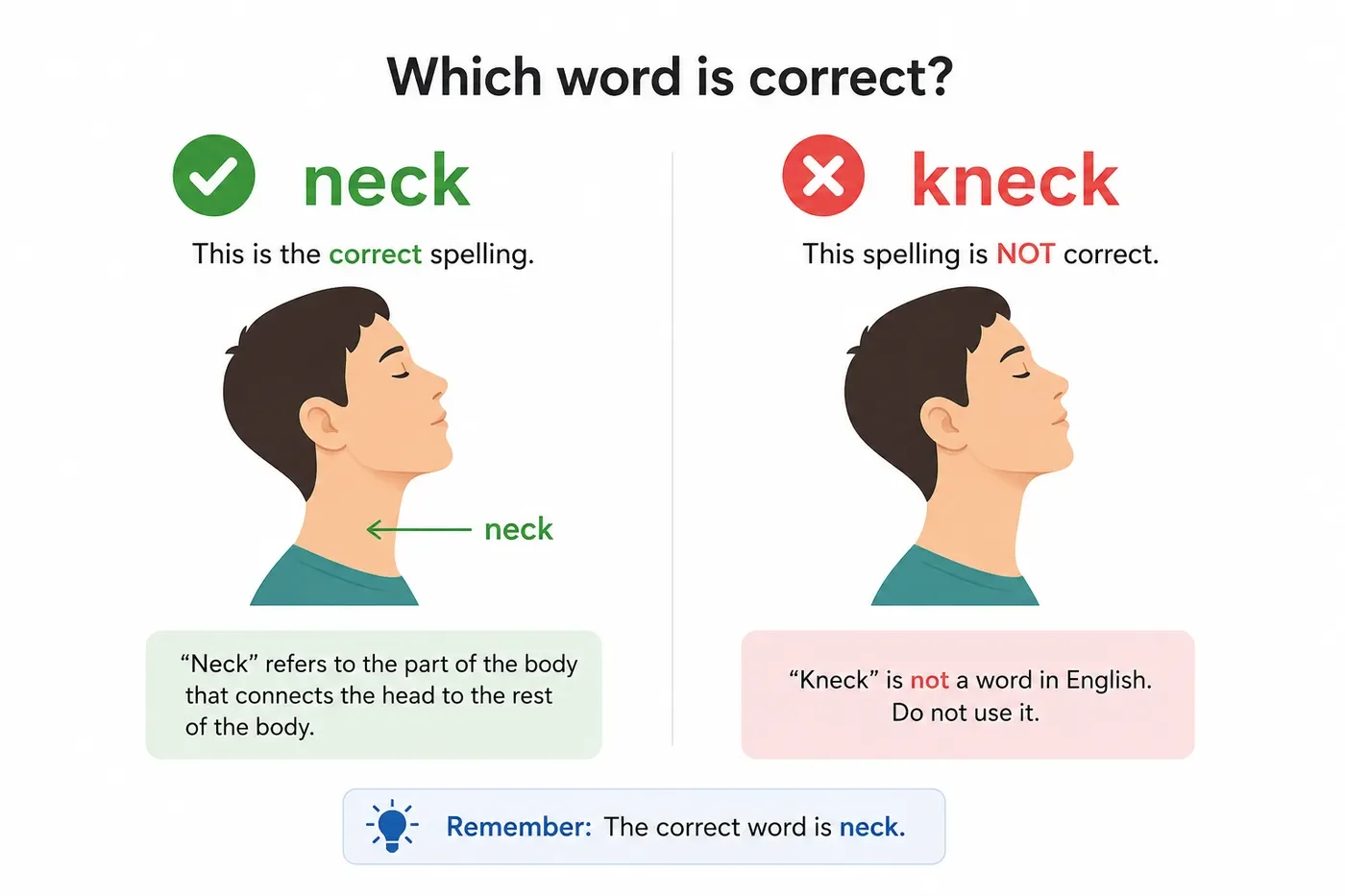
Many English learners get confused about kneck or neck because the two words look very similar. When people see both spellings online, they often wonder which one is correct and which one should be used in writing.
The short answer is simple. Neck is the correct English word. Kneck is not a standard English spelling. In almost all situations, you should use neck.
If you have ever searched for kneck or neck, this guide will help you understand the difference in very easy English. By the end, you will know which spelling to use and why people sometimes get confused.
Want to learn more confusing word pairs? Read our guide.
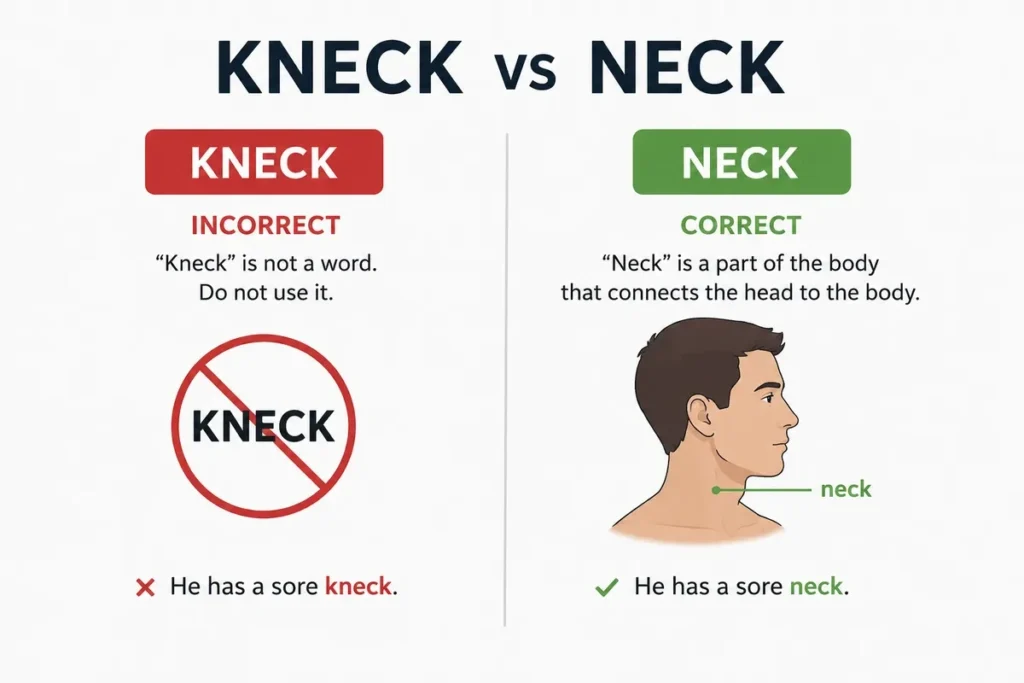
Simple Answer in One Look Kneck or Neck
Neck is the correct English word.
Kneck is considered a misspelling in modern English.
If you are writing about the body part that connects the head to the shoulders, always use neck.
Means of Kneck or Neck in Simple English
The word neck is a common English noun. It is the part of your body between your head and your shoulders.
For example:
- My neck hurts after sleeping badly.
- She wore a scarf around her neck.
- He turned his neck to look behind him.
Most people use this word every day without thinking about it because it is a normal part of everyday English. When people write kneck, they usually mean neck. The extra letter k does not belong there in standard English spelling.
Think of it this way:
✅ neck
❌ kneck
The correct form is very easy to remember once you see it a few times.
Why People Mix These Words Kneck or Neck
Many English spelling mistakes happen because some words look like other English words. People often wonder about kneck or neck because English has several words that start with the letters kn.
Examples include:
- knife
- knee
- knight
- knock
- knit
In these words, the letter k is written but not spoken.
For example:
- knife sounds like “nife”
- knee sounds like “nee”
- knock sounds like “nock”
Because of these examples, some learners think neck should also start with kn. That is where the confusion begins. A person may think: “If knee starts with kn, maybe neck should start with kn too.” But English does not work that way. Some words use kn, while many others simply start with n.
For example:
- neck
- nest
- need
- near
- name
None of these words need a silent k. That is why neck remains the correct spelling.
A Common Typing Mistake
Sometimes people type very fast. They accidentally add a k at the beginning of the word. This creates kneck. In most cases, it is simply a spelling mistake rather than a different word.
Confusion From Old Texts
Very old English writing sometimes used spellings that looked different from modern English. A learner may find unusual spellings online and think they are still correct today. Modern English dictionaries use neck, not kneck.
Clear Difference Kneck or Neck Explained Simply
When comparing kneck or neck, the difference is easy.
Neck
- Correct English spelling
- Found in dictionaries
- Used in books and schools
- Used in everyday speech and writing
- Refers to the body part between the head and shoulders
Kneck
- Not standard English
- Usually a spelling mistake
- Not used in normal modern writing
- Should generally be avoided
Here is a simple comparison table:
| Word | Correct? | Used Today? |
|---|---|---|
| Neck | Yes | Yes |
| Kneck | No | No |
If you are unsure, choose neck every time.
Which Form Should You Use Kneck or Neck?
The rule is simple. Use neck in all normal writing. You should use it when talking about;
- The human body
- Animals
- Clothing around the neck
- Expressions that include the word neck
Examples:
- giraffe neck
- neck pain
- neck muscles
- neck scarf
- neck injury
All of these use the spelling neck.
A Simple Memory Trick Kneck or Neck
Remember the sentence: Your neck needs only one letter at the beginning.
The word starts with N. There is no silent K. Whenever you see kneck, remove the k and write neck.
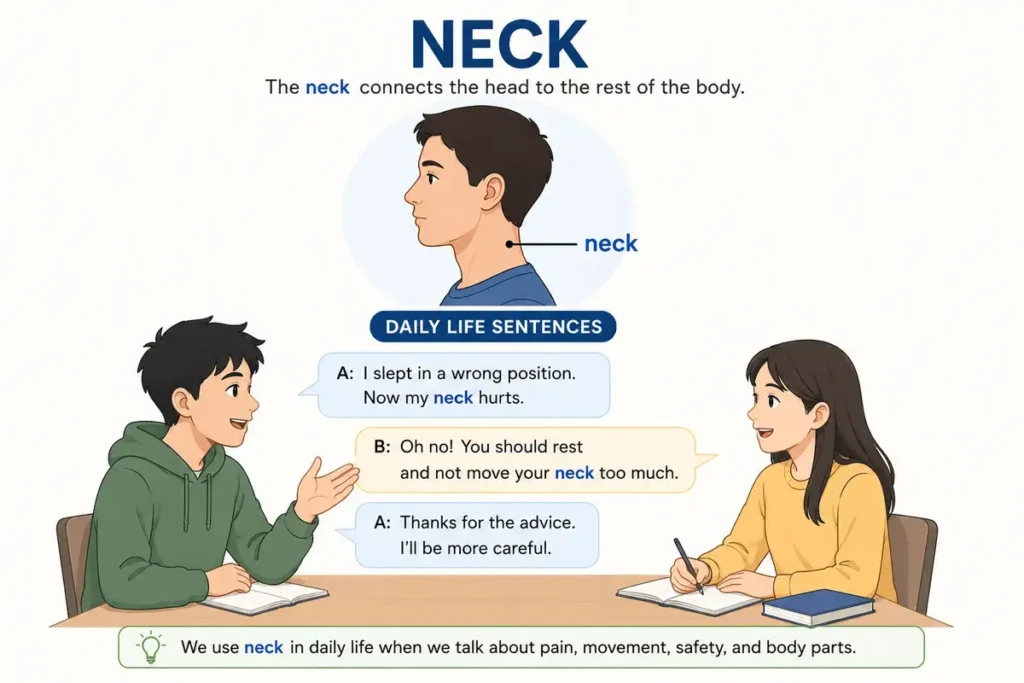
Easy Real-Life Sentences About Kneck or Neck
Here are some simple examples that show the correct use of neck.
- My neck feels stiff this morning.
- The baby rested her head on her mother’s neck.
- He wore a tie around his neck.
- She turned her neck to see the bird.
- The giraffe has a very long neck.
- I put sunscreen on my neck.
- The dog wore a tag around its neck.
- He rubbed his neck after working all day.
Notice that every sentence uses neck, not kneck.
Everyday Conversation Examples
Friend: What happened?
You: My neck hurts a little.
Friend: Why are you wearing a scarf?
You: My neck feels cold.
Friend: What animal has a long neck?
You: A giraffe.
These are natural examples that native English speakers use every day.
Common Expressions With the Word Neck
The word neck appears in many English expressions. Learning these expressions can help you understand everyday conversations.
Pain in the Neck
Meaning: An annoying person or thing.
Example: “My broken printer is a pain in the neck.”
This does not mean actual neck pain. It means something is bothering you.
Neck and Neck
Meaning: Two people or teams are very close in a race or competition.
Example: “The runners were neck and neck until the finish line.”
Up to Your Neck
Meaning: Very busy or deeply involved in something.
Example: “I am up to my neck in homework.”
Stick Your Neck Out
Meaning: Take a risk.
Example: “He stuck his neck out to help his friend.”
These expressions are common in spoken and written English.
Origin of This Word Kneck or Neck
The word neck is very old. It comes from ancient forms of English spoken hundreds of years ago. Long before modern English existed, people used similar words to describe the body part that connects the head and the body.
Over time, English changed. Many words changed their spelling and pronunciation. The word neck stayed fairly simple and kept a form close to what we use today. That is why modern dictionaries still use neck. The spelling kneck never became the standard spelling in modern English.
Why Some English Words Keep Silent Letters?
People often ask: “If neck does not have a silent k, why do words like knee and knife have one?”
The answer comes from history. Many old English words were pronounced differently long ago. In earlier forms of English, speakers often pronounced both sounds in words that started with kn. As pronunciation changed, the k became silent. The spelling stayed the same.
That is why we still write:
- knee
- knife
- knight
- knock
Even though we do not pronounce the k. The word neck followed a different path. It never kept that silent k spelling in modern English. So today we simply write neck.
How Dictionaries Treat Neck
Every major English dictionary recognizes neck as the standard spelling.
Dictionaries define it as: “The part of the body connecting the head to the shoulders.”
You will find neck in:
- school books
- newspapers
- novels
- websites
- business writing
- academic writing
You will not normally find kneck listed as a correct modern spelling. This is another reason why choosing neck is always the safest option.
Why Correct Spelling Matters Kneck or Neck?
Some people think a small spelling mistake does not matter. Sometimes that is true in casual texting. But correct spelling helps readers understand you quickly.
Imagine writing: “My kneck hurts.”
Most readers will understand your meaning. However, they may notice the mistake.
Writing: “My neck hurts.” looks correct and professional.
Correct spelling helps with:
- school assignments
- emails
- job applications
- blog posts
- social media content
- business communication
A small correction can make your writing much stronger.
Quick Practice Kneck or Neck
Choose the correct spelling.
- My ___ hurts.
- The giraffe has a long ___.
- She wore a necklace around her ___.
- He turned his ___ to the left.
Answers:
- neck
- neck
- neck
- neck
Every answer uses neck. That is because kneck is not the standard English spelling.
One Final Rule to Remember Kneck or Neck
When you see kneck or neck, choose neck.
It is the correct spelling used by native speakers, teachers, dictionaries, and professional writers. That simple rule will help you avoid mistakes every time.
Deep Meaning, Culture, and Practical Use of Kneck or Neck
The word neck is more than just a body part. People use it in many stories, sayings, and everyday conversations.
In many cultures, the neck is seen as an important part of the body because it connects the head and the rest of the body. Without the neck, the head could not move easily. Because of this connection, people often use the word neck when talking about strength, support, movement, and direction.
For example, when someone says: “Hold your head high.”
The neck helps make that action possible. The saying is really about confidence and pride. Many stories also use the neck to show emotions.
A character may:
- Bow their neck to show respect.
- Turn their neck away to show fear.
- Stretch their neck to see something important.
These actions help readers understand how a character feels. Children’s stories often mention animals with special necks.
Examples include:
- Giraffes with long necks.
- Swans with graceful necks.
- Dinosaurs with huge necks.
These descriptions help create clear pictures in the reader’s mind.
When people search for kneck or neck, they are usually interested in spelling. But understanding how neck appears in culture helps you see why the word is so common in English.
Biblical and Mythological Meaning Kneck or Neck
The word neck appears in many old religious and historical writings. In some parts of the Bible, the neck is connected with ideas such as:
- Strength
- Pride
- Humility
- Obedience
For example, a person with a “stiff neck” may be described as someone who refuses to listen or change. This does not mean the person’s neck is physically stiff. It is a symbolic way of describing behavior.
In other passages, bows of the neck can show respect, honor, or submission.
Neck in Mythology
Many myths from different cultures mention creatures with unusual necks.
Some stories include:
- Dragons with long necks
- Serpents with powerful necks
- Giant birds with elegant necks
These descriptions often make the creature seem stronger, wiser, or more impressive. The exact meaning changes from story to story, but the neck often represents power, movement, and control.
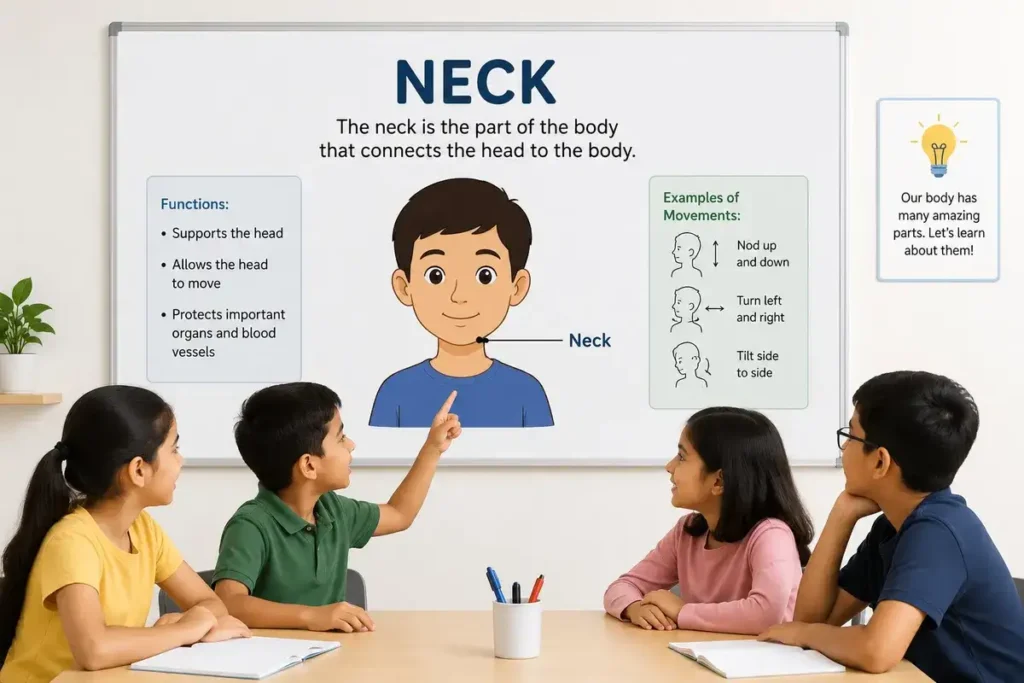
Symbolism of Kneck or Neck Explained in Simple Words
When people talk about symbolism, they mean that something represents a bigger idea. The word neck can carry symbolic meanings in stories and culture.
What Neck Represents?
The correct word is neck, and it can symbolize several ideas.
Connection
The neck joins the head and body together. Because of this, it can represent connection and balance.
Support
The neck supports the head every day. That is why it can symbolize strength and support.
Flexibility
A healthy neck moves in many directions. Because of this, some people see it as a symbol of adaptability.
Direction
The neck allows the head to turn. In stories, this can represent choosing a path or looking toward the future.
What Kneck Represents?
When comparing kneck or neck, it is important to remember that kneck is not a standard English word. Because it is generally a misspelling, it does not have a recognized symbolic meaning in modern English. If you see symbolic discussions online, they almost always refer to neck, not kneck.
Symbolic Comparison Kneck or Neck
| Word | Symbolic Meaning |
|---|---|
| Neck | Connection, support, movement, balance |
| Kneck | No standard symbolic meaning |
Related Words to Kneck or Neck You Should Know
Learning related words can help improve your English vocabulary.
Neckline
The edge of a shirt or dress around the neck area.
Example: “The dress has a round neckline.”
Necklace
A piece of jewelry worn around the neck.
Example: “She received a gold necklace.”
Necktie
A long piece of cloth worn around the neck, often with formal clothing.
Example: “He wore a blue necktie.”
Turtleneck
A sweater with fabric that covers the neck.
Example: “She wore a black turtleneck.”
Neck Pain
Pain felt in the neck area.
Example: “I have neck pain after sitting too long.”
Neck Muscle
A muscle located in the neck.
Example: “He stretched his neck muscles.”
Neck Brace
A support device worn around the neck after some injuries.
Example: “The doctor gave him a neck brace.”
Redneck
A special English word used mostly in the United States.
Its meaning depends on context and should be used carefully because some people may find it offensive.
Use of Kneck or Neck in Daily English
Native speakers use neck all the time. Here are common examples you may hear every day;
Talking About Health
“My neck feels sore today.”
“I slept wrong and hurt my neck.”
Talking About Clothing
“Your scarf looks nice around your neck.”
“That shirt has a comfortable neck.”
Talking About Animals
“The giraffe’s neck is very long.”
“The swan stretched its neck.”
Talking About Movement
“He turned his neck quickly.”
“She looked over her neck.”
Talking About Sports
“The players were neck and neck.”
This means the competition was very close.
Talking About Work
“I am up to my neck in work.”
This means someone is extremely busy.
Talking About Risk
“He stuck his neck out for his team.”
This means he took a risk to help others.
Talking About Annoyance
“Fixing this computer is a pain in the neck.”
This means the task is annoying.
These examples show how often English speakers use the word neck in both literal and figurative ways.
Common Mistakes People Make About kneck or neck
Many learners make the same mistakes when dealing with kneck or neck. Here are the most common ones.
Mistake 1: Writing Kneck
Incorrect: “My kneck hurts.”
Correct: “My neck hurts.”
Always remove the extra k.
Mistake 2: Copying Other Misspellings
Sometimes people see mistakes online and think they are correct. Not everything on the internet follows proper spelling rules. Check trusted dictionaries when unsure.
Mistake 3: Thinking Every N Word Needs KN
Some learners notice words such as:
- knee
- knife
- knight
Then they assume other words should also start with kn. That is not true. English spelling must be learned word by word.
Mistake 4: Mixing Up Neck and Necklace
A necklace goes around the neck. They are connected words, but they are not the same thing.
Correct: “I wear a necklace around my neck.”
Mistake 5: Forgetting Idiom Meanings
Expressions such as:
- pain in the neck
- neck and neck
- stick your neck out
often have meanings that are different from the body part itself. Understanding these expressions helps you sound more natural.
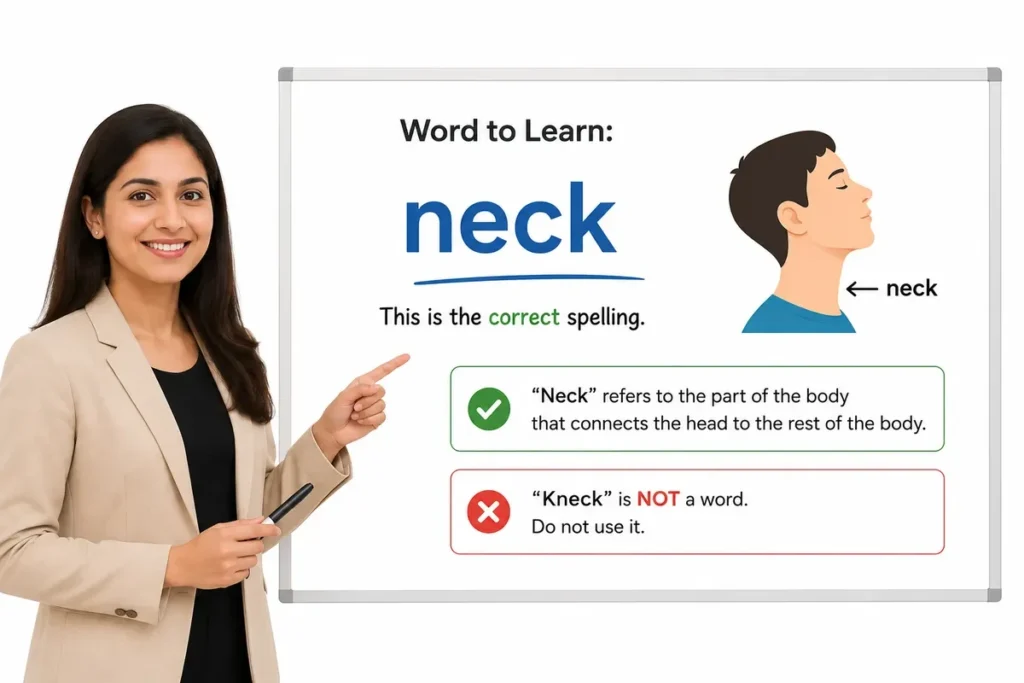
Final Teacher Explanation Kneck or Neck
Imagine you are sitting in my classroom and asking:
“Teacher, which is correct: kneck or neck?”
My answer would be simple.
Use neck.
That is the correct English spelling. The word refers to the body part between the head and shoulders. The spelling kneck is usually just a mistake.
People sometimes become confused because English contains words like:
- knee
- knife
- knight
These words begin with kn, but neck does not. The easiest rule to remember is this:
If you are talking about the body part, write neck.
That rule works almost every time. You will see neck in books, schools, newspapers, websites, and everyday conversations. You will not normally see kneck used as a correct modern English word. When in doubt, choose neck. That choice will keep your writing correct and clear.
Quick Recap Kneck or Neck
If you are wondering about kneck or neck, the correct spelling is neck. Neck is the standard English word for the body part between the head and shoulders. Kneck is generally a misspelling and should not be used in normal writing.
Remember this simple rule: Always use neck, not kneck.
Conclusion
When comparing kneck or neck, the correct spelling is neck. It is the standard English word used for the body part between the head and shoulders. The spelling kneck is generally a mistake and should be avoided in everyday, academic, and professional writing.
A simple way to remember this rule is that neck starts with N, not KN. If you use neck in your writing, you will be following correct English spelling and communicating clearly with your readers.
Frequently Asked Questions
What does neck mean in simple words?
Neck is the body part that connects your head to your shoulders.
Is it correct to use kneck or neck?
Use neck. It is the correct English spelling.
Why do people get confused between kneck or neck?
People see words like knee and knife and think neck should also start with kn.
Is kneck a real English word?
No. In modern English, kneck is usually considered a spelling mistake.
Can I use kneck in formal writing?
No. Use neck in school, business, and everyday writing.
When should I use the word neck?
Use it when talking about the body part or common expressions such as “neck and neck.”
What does neck and neck mean?
It means two people or teams are very close in a race or competition.
How can I remember the correct spelling Kneck or Neck?
Remember this simple sentence:
Your neck needs only one letter at the beginning.