
Many people get confused about bogey or bogie because both spellings are real words. That is what makes this pair tricky. If you search for bogey or bogie, you may see both used in books, sports, trains, and even stories about monsters.
The short answer is simple: both bogey and bogie are correct, but they are used in different situations. The meaning changes based on context. In some places, the difference is about spelling style. In others, the two words mean completely different things.
This guide will explain bogey or bogie in very simple English. You will learn the meaning, spelling, usage, and real-life examples so you know which word to use.
If homophones confuse you, explore more examples in our grammar guides.
Simple Answer in One Look Bogey or Bogie
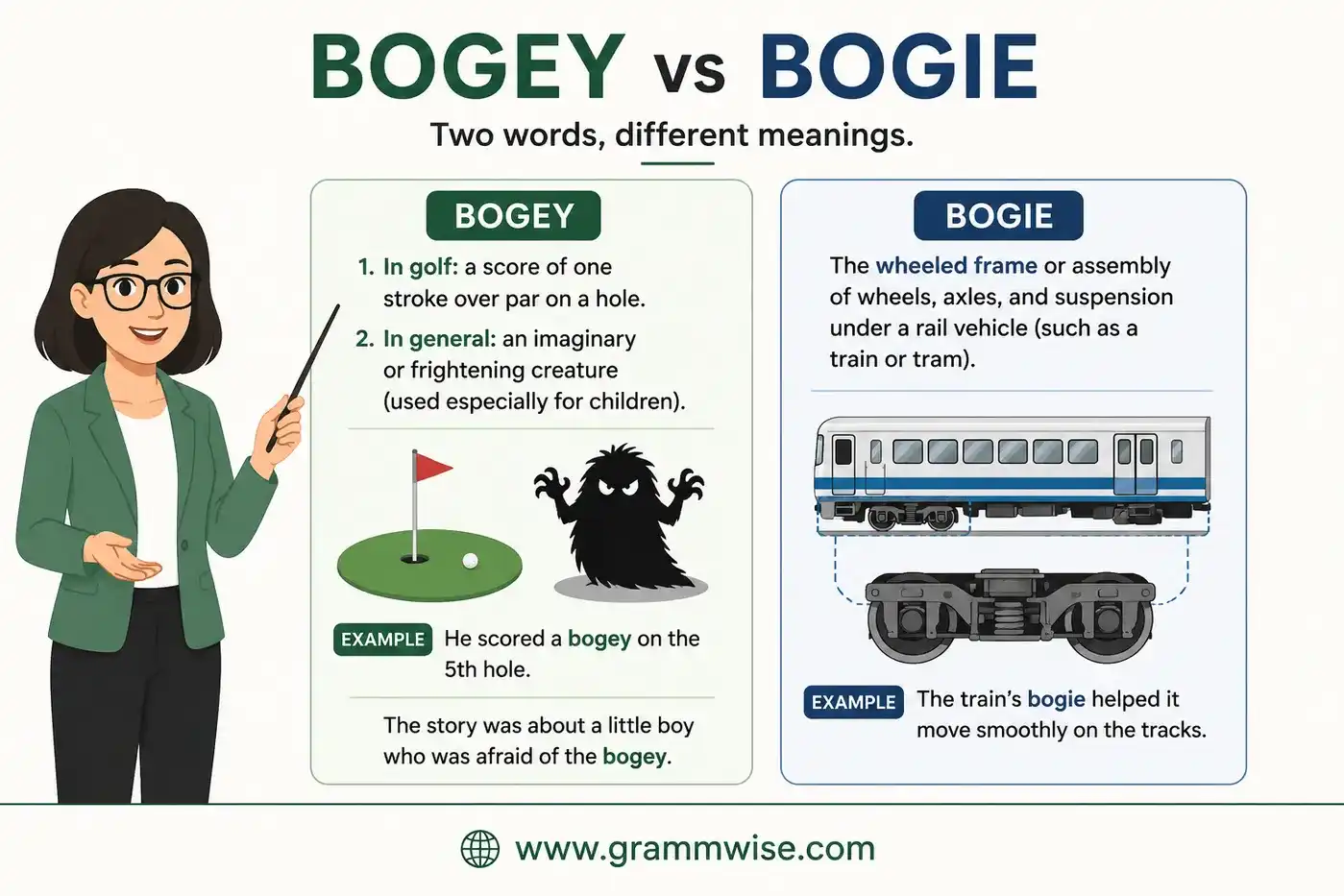
Bogey is commonly used in golf and sometimes for something scary or worrying.
Bogie is often used for a train wheel frame or as a spelling variant in some English dialects.
Means of Bogey or Bogie in Simple English
Think of these as two similar-looking words with different jobs.
Bogey
Bogey usually means one of these things:
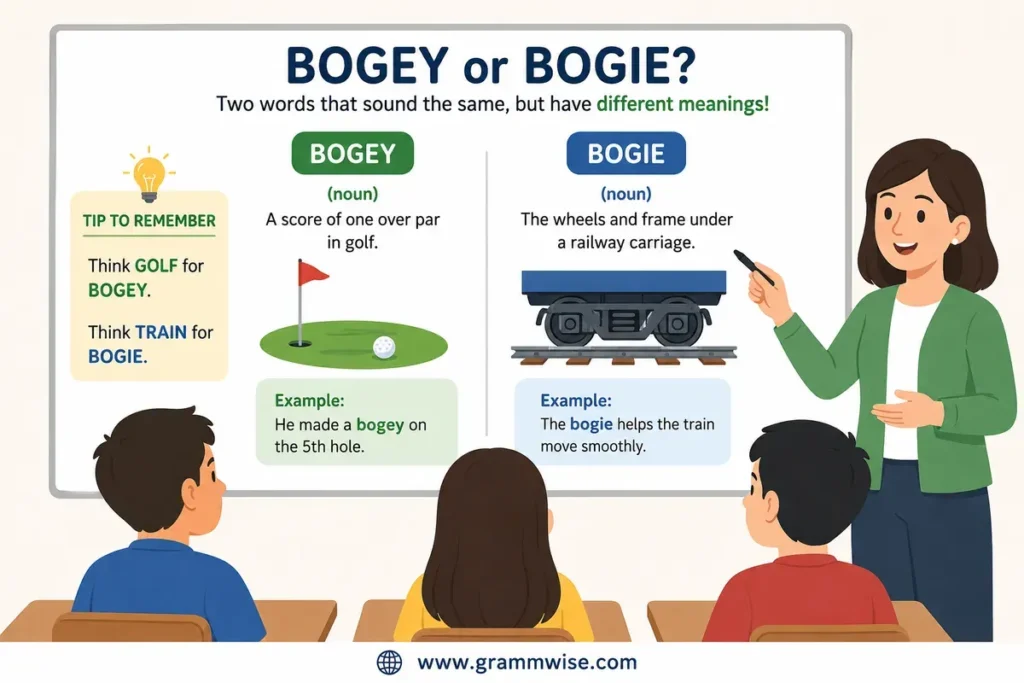
- In golf: one stroke over the expected score
- Something scary or feared
- Something causing worry or trouble
Example:
“I got a bogey on hole five.”
Example:
“The idea of failure became his bogey.”
Bogie
Bogie often means:
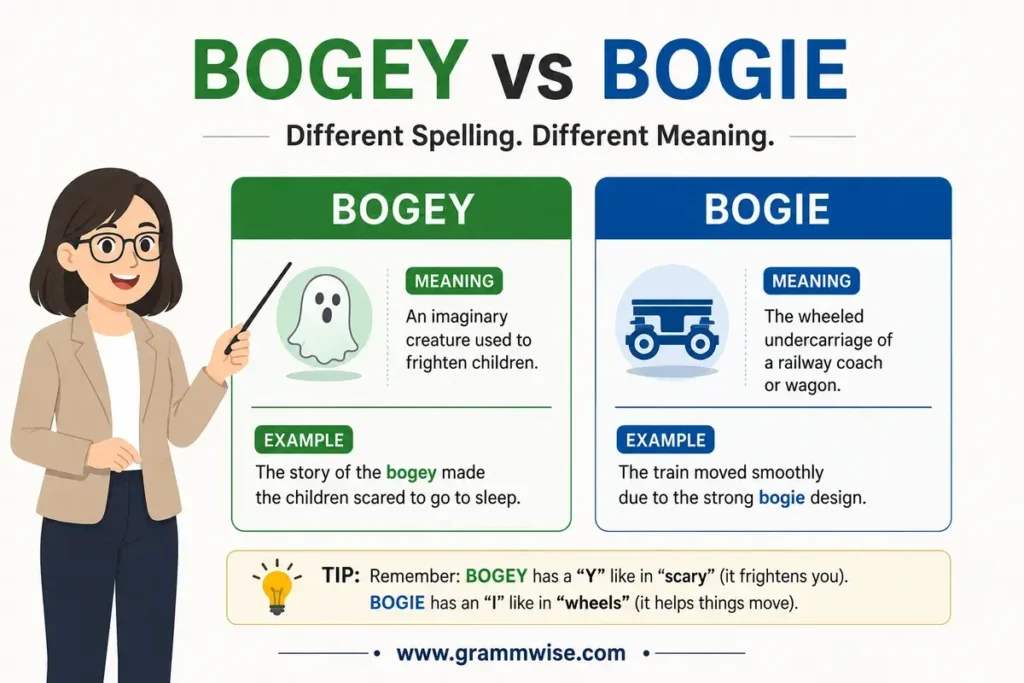
- A wheel frame under a train car
- A spelling variation of bogey in some places
- Sometimes an old word for ghost or scary figure
Example:
“The train bogie needed repair.”
Why People Mix These Words Bogey or Bogie
People mix these words for one simple reason.
They look almost the same.
Only one letter changes:
- bogey
- bogie
That small spelling change can easily confuse readers and writers.
Another reason is regional spelling.
British English sometimes uses one form more often in certain meanings, while other places prefer the other form.
Some people also hear the word before seeing it written. Since both sound similar, spelling becomes confusing.
Clear Difference of Bogey or Bogie Explained Simply
Here is the easiest way to remember the difference between bogey or bogie.
Use bogey when talking about:
- Golf scores
- Fear
- Worries
- Something scary
Examples:
- She scored a bogey.
- Public speaking is his bogey.
Use bogie when talking about:
- Trains
- Railway parts
- Wheel assemblies
Examples:
- The train bogie was damaged.
- Engineers checked the bogie.
Quick Comparison Bogey or Bogie
| Word | Main Meaning | Common Use |
|---|---|---|
| Bogey | Golf score / fear | Sports, daily English |
| Bogie | Train wheel frame | Railways, engineering |
Which Form Should You Use Bogey or Bogie?
Use this simple rule.
Choose bogey if:
You are talking about golf or something frightening.
Choose bogie if:
You are talking about trains or railway equipment.
If you are unsure, check the sentence context.
Ask yourself:
“Am I talking about sports, fear, or trains?”
That usually gives the answer.
Easy Real-Life Sentences on Bogey or Bogie You Can Use
Here are simple examples.
- I made a bogey on the last hole.
- One bogey ruined his golf score.
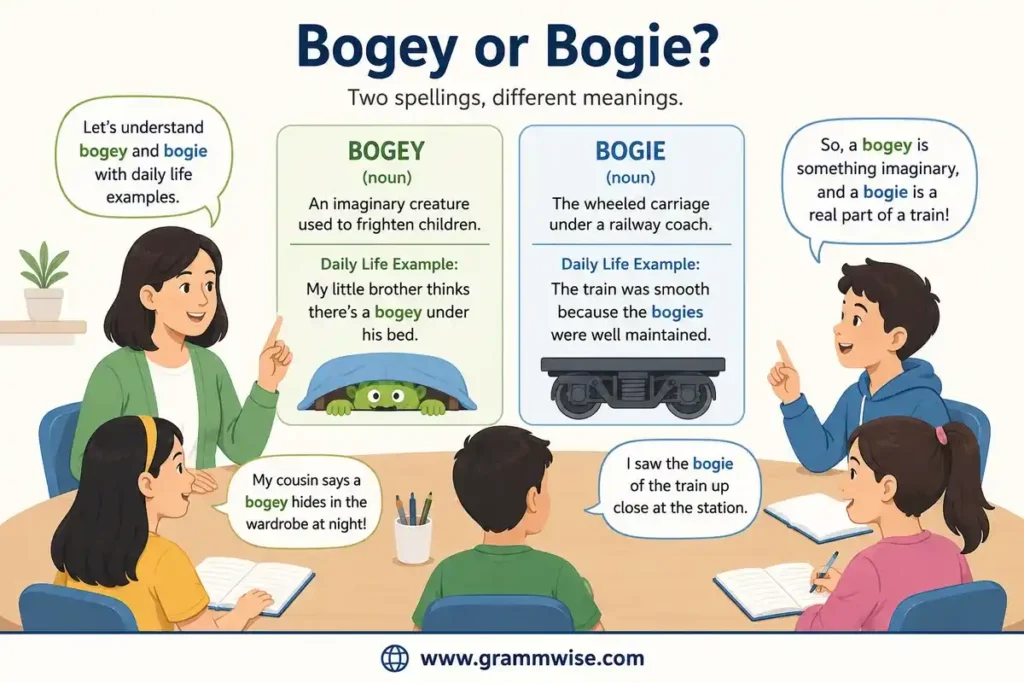
- Darkness was a childhood bogey for him.
- She fears failure more than success.
- The train bogie needed cleaning.
- Workers replaced the damaged bogie.
- The railway team inspected every bogie.
- He avoided another bogey in golf.
Where This Word Comes From?
The word has interesting roots.
Bogey comes from older English words connected to ghosts or scary beings. Long ago, adults used similar words to scare children, like a “boogeyman.”
That is why bogey can still carry a scary feeling.
Later, golfers started using bogey as a scoring term.
Bogie became common in railway language. Engineers used it for the wheeled frame under train cars.
So both words have different paths in English history.
Transition to Deeper Meaning
Now that you understand the basic difference between bogey or bogie, we can go deeper. These words also carry cultural meaning, emotional symbolism, and practical use in everyday English.
Role of This Word Bogey or Bogie in Culture and Stories
Words often carry feelings beyond dictionary meaning.
Bogey is strongly linked with fear and mystery.
In many stories, a bogey is something unseen. It may not be real, but people fear it anyway. Parents sometimes used scary imaginary figures to warn children not to misbehave.
That is why words like “bogeyman” became popular.
Bogeyman
A bogey often represents hidden fear.
It may be:
- fear of failure
- fear of darkness
- fear of losing
Bogie, on the other hand, feels practical and mechanical. It is linked to movement, trains, and transport.
Rail transport
So culturally, one word feels emotional while the other feels technical.
Biblical and Mythological Meaning of Bogey or Bogie
There is no direct biblical word called bogey or bogie.
The Bible
But the idea of hidden fear appears often in religious stories.
People fear things they cannot see:
- evil
- danger
- darkness
- uncertainty
In mythology, many cultures created scary beings to explain fear.
Examples include ghosts, spirits, or monsters.
Ghost
In that sense, bogey connects with myth because both represent fear of the unknown.
Bogie has no strong mythological meaning. It mainly stays in engineering language.
Symbolism Explained in Simple Words
What Bogey Represents?
Bogey often represents:
- fear
- worry
- challenge
- pressure
In golf, a bogey can symbolize a small mistake.
Golf
It does not mean total failure. It simply means you did slightly worse than expected.
That idea matters in life too.
Sometimes a bogey is just a small setback.
What Bogie Represents?
Bogie often represents:
- movement
- support
- balance
- structure
A train cannot move properly without a working bogie.
That makes bogie a symbol of support and stability.
One word feels emotional.
The other feels mechanical.
That is the big difference.
Related Words You Should Know
Bogeyman
A scary imaginary creature used to frighten children.
Bogeyman
Par
A standard score in golf.
Golf
Birdie
One stroke under par in golf.
Golf
Double Bogey
Two strokes over par.
Golf
Chassis
The main supporting structure of a vehicle.
Wheel Assembly
Parts that help a wheel move correctly.
Usage of Bogey or Bogie in Daily English
Here are real spoken examples.
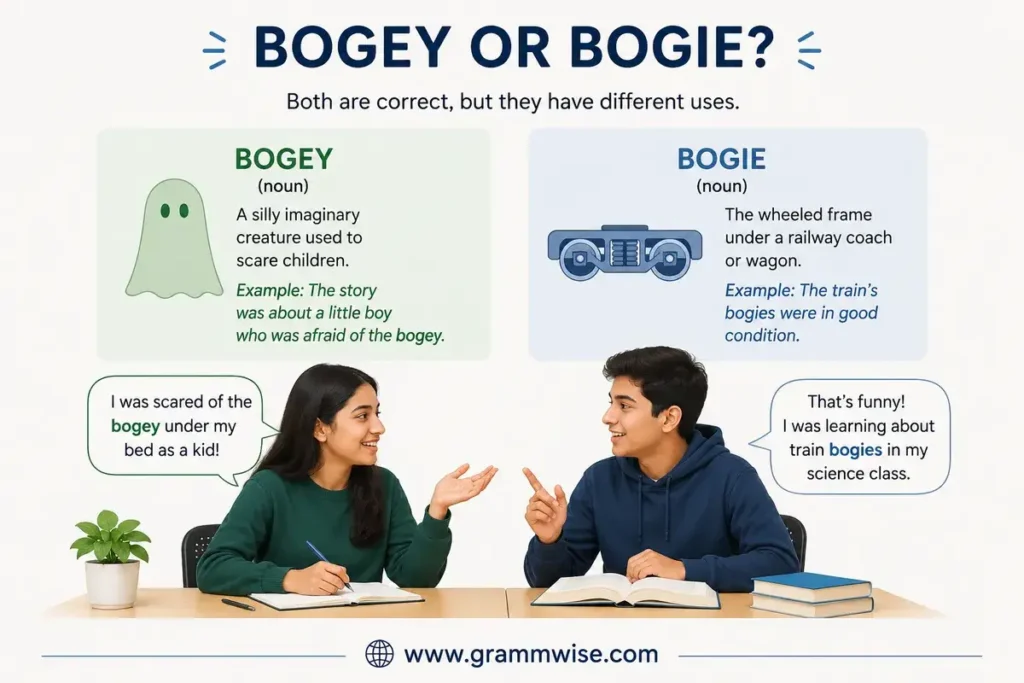
- I scored a bogey on hole nine.
- That exam became my biggest bogey.
- Fear of speaking is her bogey.
- The train stopped because of a bad bogie.
- Engineers replaced the bogie this morning.
- Don’t let small mistakes become your bogey.
- One bogey did not ruin the game.
- The bogie needed maintenance.
These are natural examples of real usage.
Common Mistakes People Make About Bogey or Bogie
Mistake 1: Using bogie in golf
Wrong: I got a bogie on hole six.
Better: I got a bogey on hole six.
Golf usually uses bogey.
Mistake 2: Using bogey for train parts
Wrong: The bogey broke under the train.
Better: The bogie broke under the train.
Railway context usually uses bogie.
Mistake 3: Thinking one spelling is always wrong
Many people think only one spelling is correct.
That is false.
Both are correct in the right context.
Final Teacher Explanation
Here is the easiest classroom explanation.
When comparing bogey or bogie, do not focus only on spelling.
Focus on meaning.
If the sentence talks about golf, fear, or worries, choose bogey.
If the sentence talks about railway parts, choose bogie.
The context tells you everything.
That is the key rule.
Quick Recap Bogey or Bogie
Bogey and bogie are both correct words.
Use bogey for golf or fear.
Use bogie for train wheel systems.
The right choice depends on context.
Conclusion
Understanding bogey or bogie becomes easy when you focus on context. The main difference is simple: bogey relates to golf or fear, while bogie relates to railway systems and movement.
Knowing this difference improves spelling, vocabulary, word choice, and communication. Once you understand the meaning and usage of each word, choosing the correct form becomes natural.
Frequently Asked Questions (FAQs)
Is bogey or bogie correct?
Both are correct. The correct choice depends on meaning.
What does bogey mean in golf?
It means one stroke over par.
What does bogie mean?
It usually means a train wheel frame.
Is bogey a scary word?
Sometimes yes. It can mean something frightening.
Why do people confuse bogey or bogie?
Because they look and sound very similar.
Can both be used in writing?
Yes, if the context is correct.
Is bogie used in American English?
Yes, especially in railway language.