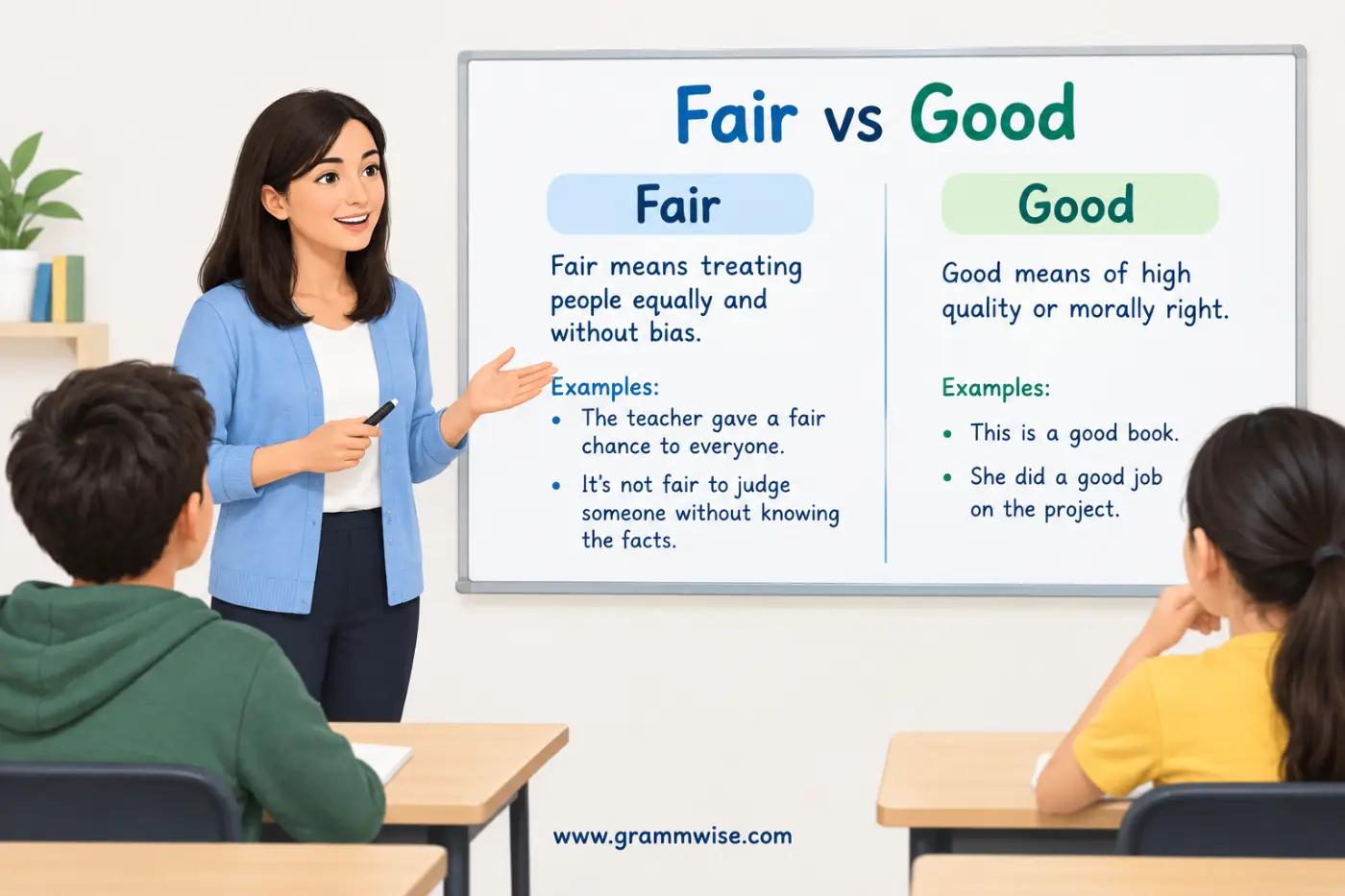
If you are confused about fair vs good, you are not alone. These two words are common in everyday English, but they do not always mean the same thing. We often use both words to describe quality, results, behavior, or situations.
The simple difference is this: fair usually means acceptable, reasonable, or average, while good usually means positive, satisfactory, or better than average. The exact meaning can change depending on the sentence.
For example, if someone says, “The movie was fair,” they usually mean the movie was okay but not especially good. If they say, “The movie was good,” they mean they liked it or thought it had a satisfactory quality.
Is it moulding or molding? Learn which spelling is British and which is American.
Fair vs Good: Simple Answer in One Look
Here is the easiest way to understand fair vs good:
| Word | Simple Meaning | Example |
|---|---|---|
| Fair | Acceptable, reasonable, or average | The food was fair. |
| Good | Positive, satisfactory, or better than average | The food was good. |
Fair often suggests that something is okay but not excellent.
Good usually gives a more positive opinion.
So, if you are rating something, “good” is generally a stronger compliment than “fair.”
For example:
- The test was fair. = The test was reasonable and not unfair.
- The test was good. = This sentence is less natural if you are talking about if the test was fair to students, but it could mean the test itself was well made.
- The movie was fair. = The movie was okay or average.
- The movie was good. = The movie was enjoyable or satisfactory.
This shows why context matters when comparing fair vs good.
What Does “Fair” Mean in Simple English?
The word fair has several meanings in English. This is one reason learners sometimes find it confusing.
When we use fair to describe quality, it can mean acceptable or average.
For example:
“The restaurant was fair.”
This usually means the restaurant was okay. The food may not have been terrible, but the speaker was not giving it a strong compliment.
But fair can also mean reasonable and just.
For example:
“That is a fair price.”
Here, fair does not mean “average.” It means the price is reasonable.
Another example is:
“The teacher gave everyone a fair chance.”
Here, fair means equal and reasonable.
So, when you see the word fair, do not always translate it as “average.” Look at the context.
Fair as “Average or Acceptable”
When talking about quality, fair can mean something is not bad, but not especially good either.
Examples:
- The movie was fair.
- His performance was fair.
- The food was fair.
- My English is fair.
- The weather was fair.
In these examples, the speaker is usually saying that the thing was acceptable but not excellent.
Fair as “Reasonable or Just”
Fair can also describe something that treats people equally.
Examples:
- The decision was fair.
- That is a fair rule.
- Everyone deserves a fair chance.
- The teacher was fair to all the students.
- We need a fair solution.
Here, fair is about justice or equal treatment, not quality.
What Does “Good” Mean in Simple English?
Good is one of the most common words in English.
It usually describes something that is positive, satisfactory, useful, enjoyable, or of good quality.
For example:
“The movie was good.”
This tells us that the speaker liked the movie or thought it was satisfactory.
You can use good to talk about many things:
- good food
- good weather
- good work
- good grades
- good behavior
- good ideas
- good results
- good students
- good decisions
Examples:
“She did a good job.”
“The food was good.”
“He is a good student.”
“That was a good idea.”
In each sentence, good gives a positive meaning.
Fair vs Good: The Clear Difference
The easiest way to understand fair vs good is to think about a simple quality scale.
A basic scale might look like this:
Poor → Fair → Good → Very Good → Excellent
On this scale, fair is usually below good.
If a teacher says your work is fair, the teacher may mean that your work is acceptable but needs improvement.
If the teacher says your work is good, that is a stronger positive comment.
Compare these:
“Your work is fair.”
This suggests your work is okay, but there is room for improvement.
“Your work is good.”
This suggests your work meets a good standard.
However, remember that this scale is not a strict rule for every use of fair. Fair can also mean “just” or “reasonable.”
For example:
“The teacher gave us a fair test.”
Here, fair does not mean the test was average. It means the test was reasonable and gave students an equal chance.
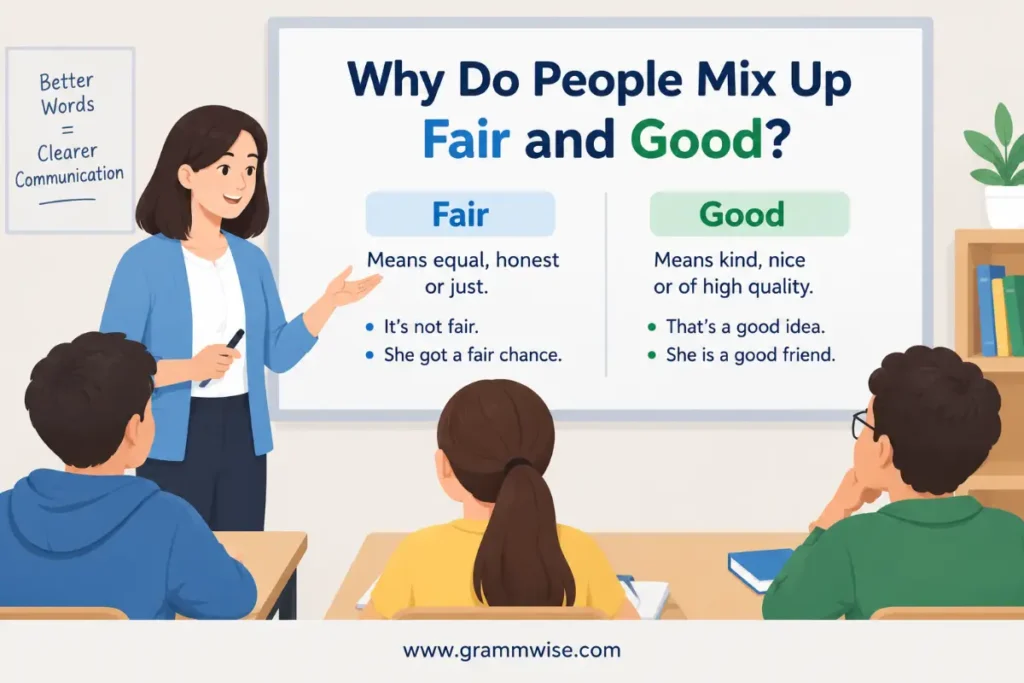
Why Do People Mix Up Fair and Good?
People often mix up fair vs good because both words can describe something positively.
Neither word normally means something is completely terrible.
For example:
“The food was fair.”
The speaker probably did not hate the food.
But:
“The food was good.”
The speaker is clearly giving a more positive opinion.
Another reason for confusion is that fair has more than one meaning.
Consider these sentences:
“The price is fair.”
“The quality is fair.”
The first sentence means the price is reasonable.
The second sentence can mean the quality is average or acceptable.
So, the meaning of fair depends strongly on what it describes.
Fair vs Good When Rating Quality
One of the most common uses of these words is when people rate something.
Imagine you visit a restaurant.
You might say:
“The food was fair.”
This means the food was acceptable, but you probably were not very impressed.
You could also say:
“The food was good.”
This gives a more positive opinion.
You might continue with:
“The service was good, but the food was only fair.”
This is a very natural comparison.
It tells the listener that the service was satisfactory or positive, while the food was only average.
Another example:
“His performance was fair, but her performance was good.”
The two performances were acceptable, but the second one was stronger.
Which One Should You Use?
Use fair when you want to say that something is reasonable, acceptable, average, or just.
Use good when you want to give a positive opinion or say that something has satisfactory or better-than-average quality.
Ask yourself what you mean.
If you mean “reasonable or just,” use fair.
“That is a fair decision.”
If you mean “positive or satisfactory,” use good.
“That is a good decision.”
If you mean “average or acceptable,” you can use fair.
“The movie was fair.”
If you want to give a stronger positive opinion, use good.
“The movie was good.”
Easy Real-Life Sentences With “Fair”
Here are some simple examples of fair in everyday English:
- The price is fair.
The price is reasonable. - The teacher gave us a fair test.
The test was reasonable and not unfair. - His performance was fair.
His performance was acceptable but not excellent. - The food was fair.
The food was okay but not especially good. - Everyone should get a fair chance.
Everyone should have an equal opportunity. - That sounds like a fair deal.
The deal sounds reasonable. - My results were fair.
My results were acceptable or average. - She made a fair decision.
Her decision was reasonable and just.
Notice how fair changes meaning depending on the sentence.
Easy Real-Life Sentences With “Good”
Now look at good in everyday English:
- The food was good.
The food was enjoyable or satisfactory. - You did a good job.
Your work was successful or satisfactory. - He is a good student.
He behaves well and performs well as a student. - That is a good idea.
The idea is useful or positive. - We had a good time.
We enjoyed ourselves. - She got good results.
Her results were positive or strong. - This book is good.
The book is enjoyable or well made. - You have good English.
Your English is at a positive or strong level.
Fair vs Good in School
Teachers may use both words when talking about a student’s work.
For example:
“Your answer is fair.”
This can mean the answer is acceptable but could be improved.
“Your answer is good.”
This gives the student a more positive message.
A teacher might also say:
“Your work is fair, but you need to explain your answer more clearly.”
Here, fair means the work meets a basic level but still needs improvement.
If the teacher says:
“Your work is good. Keep practicing.”
The message is more positive.
This is why students should not always treat fair and good as exact synonyms.
Fair vs Good for People
Both words can sometimes describe people, but they do different jobs.
For example:
“She is a fair teacher.”
This means she treats students reasonably and equally.
It does not mean that she is an average teacher.
Now compare:
“She is a good teacher.”
This means she teaches well or has positive qualities as a teacher.
The difference is clear:
Fair teacher = treats students justly.
Good teacher = teaches well or is a positive teacher.
You can even use both:
“She is a good and fair teacher.”
This means she teaches well and treats students fairly.
Fair Does Not Always Mean “Not Good”
This is a very important point.
When fair means “reasonable” or “just,” it is not a lower level of good.
For example:
“That is a fair price.”
The speaker is not saying the price is bad.
They are saying the price is reasonable.
Likewise:
“The judge made a fair decision.”
This does not mean the decision was an average decision. It means the decision was just or reasonable.
So, always look at the meaning of fair before comparing it with good.
A Simple Memory Trick
Here is an easy way to remember fair vs good:
Fair = okay, reasonable, or just.
Good = positive, satisfactory, or enjoyable.
When talking about quality, remember this simple scale:
Poor → Fair → Good → Very Good → Excellent
But when talking about justice, think:
Fair = equal and reasonable.
For example:
Fair price = reasonable price
Fair chance = equal chance
Fair decision = just decision
Good food = enjoyable food
Good work = satisfactory or strong work
Good idea = useful or positive idea
The Quick Rule to Remember
If you are comparing the quality of something, fair usually suggests “okay” or “average,” while good gives a more positive opinion.
If you are talking about justice, equality, or reasonableness, fair has a different meaning.
So remember:
Fair can mean reasonable or average.
Good usually means positive or satisfactory.
That small difference will help you choose the right word in most everyday situations.
How “Fair” and “Good” Are Understood in Culture and Stories
The word fair has been used in English for a very long time, and it appears in many types of writing and speech.
In everyday English, fairness is often connected with treating people equally. A fair teacher gives students equal opportunities. A fair rule applies to everyone. A fair decision does not give one person an unfair advantage.
This idea is common in stories, children’s books, movies, and school lessons.
For example, a story may have a character who wants a fair chance. This usually means the character wants the same opportunity as everyone else.
The word good is also very common in stories. It often describes a person who behaves kindly or makes positive choices.
We often hear expressions such as:
- a good person
- a good friend
- a good teacher
- a good choice
- a good decision
In many stories, good can describe positive behavior, while fair can describe how someone treats others.
For example:
“The king was good and fair.”
This means the king was kind or morally positive and also treated people reasonably.
So, the two words can work together without having the same meaning.
Biblical and Mythological Meaning
Neither fair nor good has one special grammar meaning in the Bible or mythology. Both words are normal English words that can appear in translations and retellings.
The word good is often used in religious writing to describe positive qualities, actions, or moral behavior.
For example, English religious texts may use good when discussing good deeds, good people, or what is considered morally right.
The word fair can also appear when talking about justice or equal treatment.
The important point is that the meaning still depends on context.
If fair means “just,” it is connected to reasonable and equal treatment.
If good means “morally positive,” it describes a positive quality or action.
So, do not assume that fair and good are interchangeable just because both can sound positive.
Symbolism Explained in Simple Words
Words can carry ideas beyond their basic dictionary meanings.
What “Fair” Represents
When fair means “just,” it often represents:
- equality
- justice
- balance
- reasonable treatment
- equal opportunity
Think of a teacher giving every student the same chance to answer a question.
That is fair.
Think of a competition where everyone follows the same rules.
That is fair.
Think of a price that seems reasonable for what you are buying.
That can also be called fair.
So, the idea behind this meaning of fair is often balance and reasonable treatment.
When fair describes quality, however, it can represent something different. It may simply mean acceptable or average.
What “Good” Represents
The word good often represents:
- positive quality
- success
- usefulness
- kindness
- satisfaction
- approval
For example:
“That was a good idea.”
The speaker approves of the idea.
“She is a good friend.”
The speaker thinks she has positive qualities as a friend.
“You did a good job.”
The speaker is praising the person’s work.
So, good often communicates approval or a positive judgment.
Related Words You Should Know
Understanding related words can make fair vs good much easier.
Fairness — the quality of treating people equally and reasonably.
Fairly — in a reasonable or just way; it can also mean “quite” in some contexts.
Unfair — not reasonable or not treating people equally.
Goodness — the quality of being good, kind, or morally positive.
Better — a comparative form of good, used when comparing two things.
Best — the superlative form of good, used for the highest level among three or more things.
Poor — a word that can describe low quality or a weak result.
Average — something that is around the usual or middle level.
These related words help you build a clearer quality scale:
Poor → Fair → Good → Very Good → Excellent
Remember that this scale mainly applies when fair is being used to describe quality.
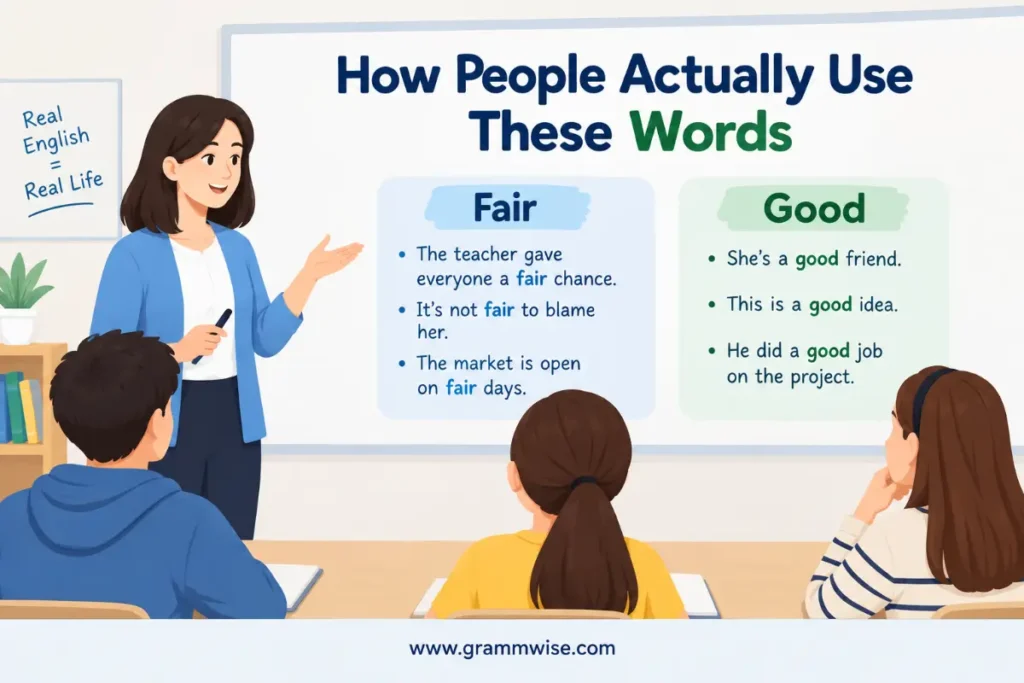
How People Actually Use “Fair” in Daily English?
Let’s look at some natural examples.
Example 1: Talking About a Price
“I think $20 is a fair price.”
Here, fair means reasonable.
The speaker thinks the price is neither too high nor unreasonable.
Example 2: Talking About a Chance
“Everyone deserves a fair chance.”
Here, fair means equal and reasonable.
The sentence is about opportunity, not quality.
Example 3: Talking About a Teacher
“Our teacher is very fair.”
This means the teacher treats students equally and makes reasonable decisions.
Example 4: Talking About Quality
“The movie was fair.”
Here, fair can mean the movie was okay or average.
The speaker is not giving it a strong compliment.
Example 5: Talking About a Deal
“That sounds like a fair deal.”
Here, fair means reasonable.
Example 6: Talking About Weather
“We had fair weather yesterday.”
Depending on context, fair weather can mean pleasant or clear weather.
This is another reminder that fair has several meanings.
How People Actually Use “Good” in Daily English
Now compare these examples with good.
Example 1: Food
“The food was good.”
The speaker enjoyed the food or thought it was satisfactory.
Example 2: Work
“You did a good job.”
This is praise. The speaker is happy with the work.
Example 3: Ideas
“That’s a good idea.”
The speaker thinks the idea is useful or sensible.
Example 4: People
“He is a good friend.”
The speaker thinks he is kind, helpful, loyal, or positive as a friend.
Example 5: Results
“She got good results.”
Her results were positive or strong.
Example 6: Experience
“We had a good time.”
The experience was enjoyable.
These examples show how flexible good is in everyday English.
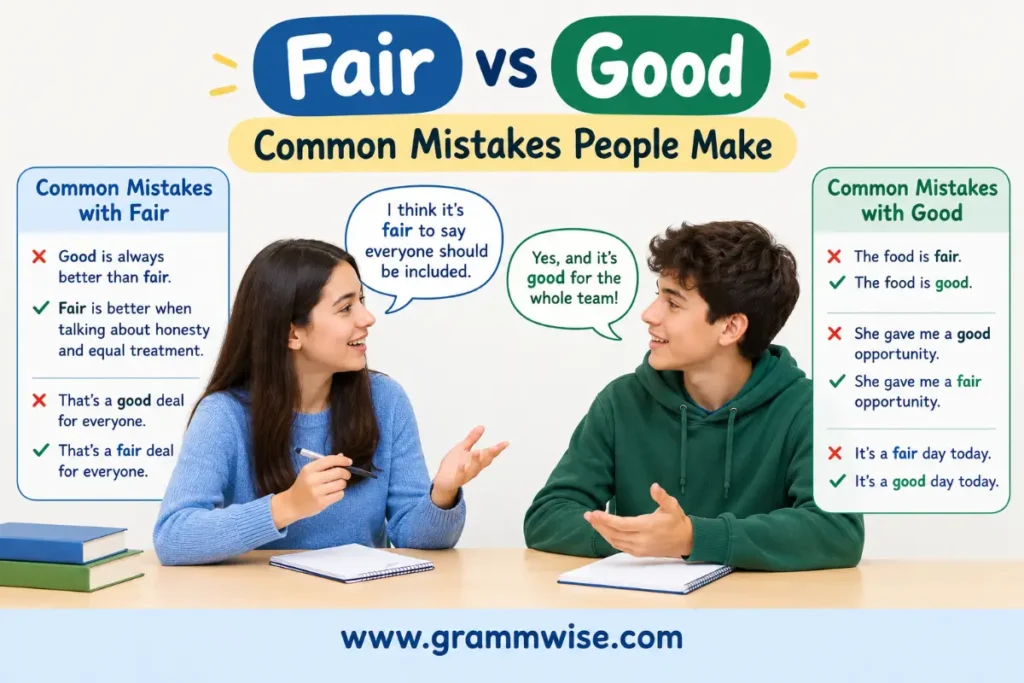
Fair vs Good: Common Mistakes People Make
Learners often make a few common mistakes when using these words.
Mistake 1: Thinking Fair Always Means Average
This is one of the biggest mistakes.
Fair can mean average when describing quality, but it can also mean reasonable or just.
For example:
“The movie was fair.”
Here, it may mean average.
But:
“The teacher was fair.”
This usually means the teacher treated people equally and reasonably.
The meaning changes with context.
Mistake 2: Treating Fair and Good as Exact Synonyms
These words can overlap in some situations, but they are not exact synonyms.
Compare:
“The food was fair.”
and
“The food was good.”
The first sounds like the food was acceptable or average.
The second sounds more positive.
So, changing fair to good can change the speaker’s opinion.
Mistake 3: Using Good When You Mean Just
Suppose someone asks:
“Was the decision fair?”
If you answer:
“Yes, it was good.”
That does not clearly answer the question.
If you mean that the decision was reasonable and just, say:
“Yes, it was fair.”
Fair is the better word when the focus is on equal treatment or justice.
Mistake 4: Thinking Fair Is Always a Negative Word
Fair is not necessarily negative.
For example:
“That is a fair price.”
This is a positive or approving statement.
The speaker is saying that the price is reasonable.
Likewise:
“She gave me a fair chance.”
This is also positive.
So, fair is not simply a weaker or negative version of good.
Mistake 5: Using Fair and Good Without Checking the Context
Always ask what you are trying to say.
Do you mean:
reasonable? → fair
equal? → fair
just? → fair
average? → fair can work
positive? → good
satisfactory? → good
enjoyable? → good
This simple check can prevent many mistakes.
Fair vs Good in Questions
These words also appear in different kinds of questions.
You might ask:
“Was the price fair?”
This asks if the price was reasonable.
You might ask:
“Was the movie good?”
This asks if the movie was enjoyable or satisfactory.
Notice that the questions focus on different things.
You would not normally use good to ask if someone received equal treatment.
For example:
“Was the teacher fair?”
This asks if the teacher treated students reasonably.
But:
“Was the teacher good?”
This asks if the teacher was effective or positive in some way.
Both questions are correct, but they ask for different information.
Fair vs Good: A Simple Comparison
Here is a quick way to remember the main differences:
| Situation | Use “Fair” | Use “Good” |
|---|---|---|
| Reasonable price | Yes | Sometimes, but less exact |
| Equal treatment | Yes | No |
| Just decision | Yes | Not the main word |
| Average quality | Yes | Not usually |
| Positive quality | Sometimes | Yes |
| Enjoyable experience | Sometimes | Yes |
| Praise for work | Less common | Yes |
| Kind or positive person | Not usually | Yes |
The most important thing is to understand the meaning you want to communicate.
Can “Fair” and “Good” Be Used Together?
Yes.
Sometimes a sentence can naturally contain both words.
For example:
“The teacher is good and fair.”
This means the teacher is effective or positive and treats students equally.
Another example:
“The price is fair, and the product is good.”
Here, the price is reasonable, while the product has good quality.
This is a useful example because it clearly shows that the words describe different things.
Fair vs Good: Which Word Sounds More Positive?
When talking about quality, good usually sounds more positive than fair.
For example:
“My performance was fair.”
This sounds like the performance was acceptable but could be better.
“My performance was good.”
This sounds like the performance was successful or satisfactory.
But when fair means “just” or “reasonable,” it is not useful to place it on a simple good-to-bad scale.
For example:
“The judge made a fair decision.”
This does not mean the decision was average. It means the decision was reasonable or just.
This distinction is one of the most important things to remember about fair vs good.
Final Teacher Explanation
If I were explaining fair vs good to a student in a classroom, I would make it very simple.
First, remember that fair has more than one meaning.
When fair describes quality, it can mean okay or average.
“The movie was fair.”
When fair describes treatment, rules, prices, or decisions, it often means reasonable or just.
“The teacher was fair.”
The word good is usually easier.
It normally gives a positive meaning.
“The movie was good.”
“She did a good job.”
“He is a good friend.”
“That is a good idea.”
So, when you are choosing between these words, do not only ask, “Which word sounds better?”
Ask:
What exactly do I want to say?
If you mean reasonable, equal, or just, choose fair.
If you mean positive, satisfactory, enjoyable, or high quality, choose good.
And if you are describing quality, remember:
Poor → Fair → Good → Very Good → Excellent
That one little scale can help you remember the difference.
Quick Recap Fair vs Good
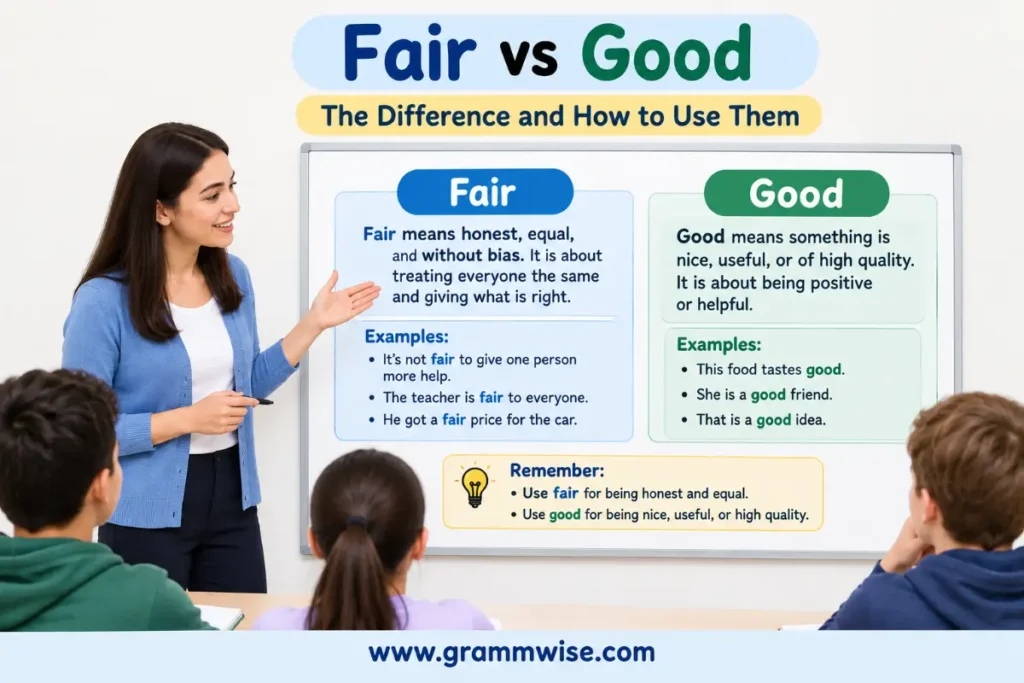
The difference between fair vs good depends on the meaning of fair. When describing quality, fair usually means acceptable or average, while good gives a more positive opinion.
But fair can also mean reasonable, equal, or just. Use fair for a fair price, fair chance, or fair decision. Use good for good food, good work, a good idea, or a good experience.
The easiest rule is:
Fair = reasonable, just, or sometimes average.
Good = positive, satisfactory, or enjoyable.
Conclusion
Understanding fair vs good becomes easy when you know what each word means. Fair can mean reasonable, just, or average, while good usually describes something positive, satisfactory, or enjoyable.
Remember the simple rule: use fair when you mean reasonable or just, and use good when you want to describe positive quality. With these meanings in mind, you can choose the right word naturally in everyday English.
FAQs
1. Is fair better than good?
When describing quality, good usually suggests a higher level than fair. But fair can also mean reasonable or just, so the two words are not always on the same scale.
2. Does fair mean average?
Sometimes. When fair describes quality, it can mean acceptable or average. But fair can also mean reasonable, equal, or just.
3. Is “fair” a positive word?
It can be. “Fair” can describe reasonable prices, equal opportunities, and just decisions. It can also mean only average when describing quality.
4. What is the difference between a fair teacher and a good teacher?
A fair teacher treats students equally and reasonably. A good teacher teaches well and has positive qualities. A teacher can be both fair and good.
5. Can I say “the food was fair”?
Yes. It can mean the food was acceptable or average. However, “the food was good” gives a more positive opinion.
6. What is the opposite of fair?
It depends on the meaning. When fair means just or reasonable, the opposite is usually unfair. When fair means average quality, words such as poor or bad may be used depending on the context.
7. What is the opposite of good?
The common opposite of good is bad. In some situations, poor can also describe something with low quality.
8. What is an easy way to remember fair vs good?
Remember: fair can mean “reasonable or just,” and it can also mean “average.” Good usually means something is positive, satisfactory, enjoyable, or of good quality.