
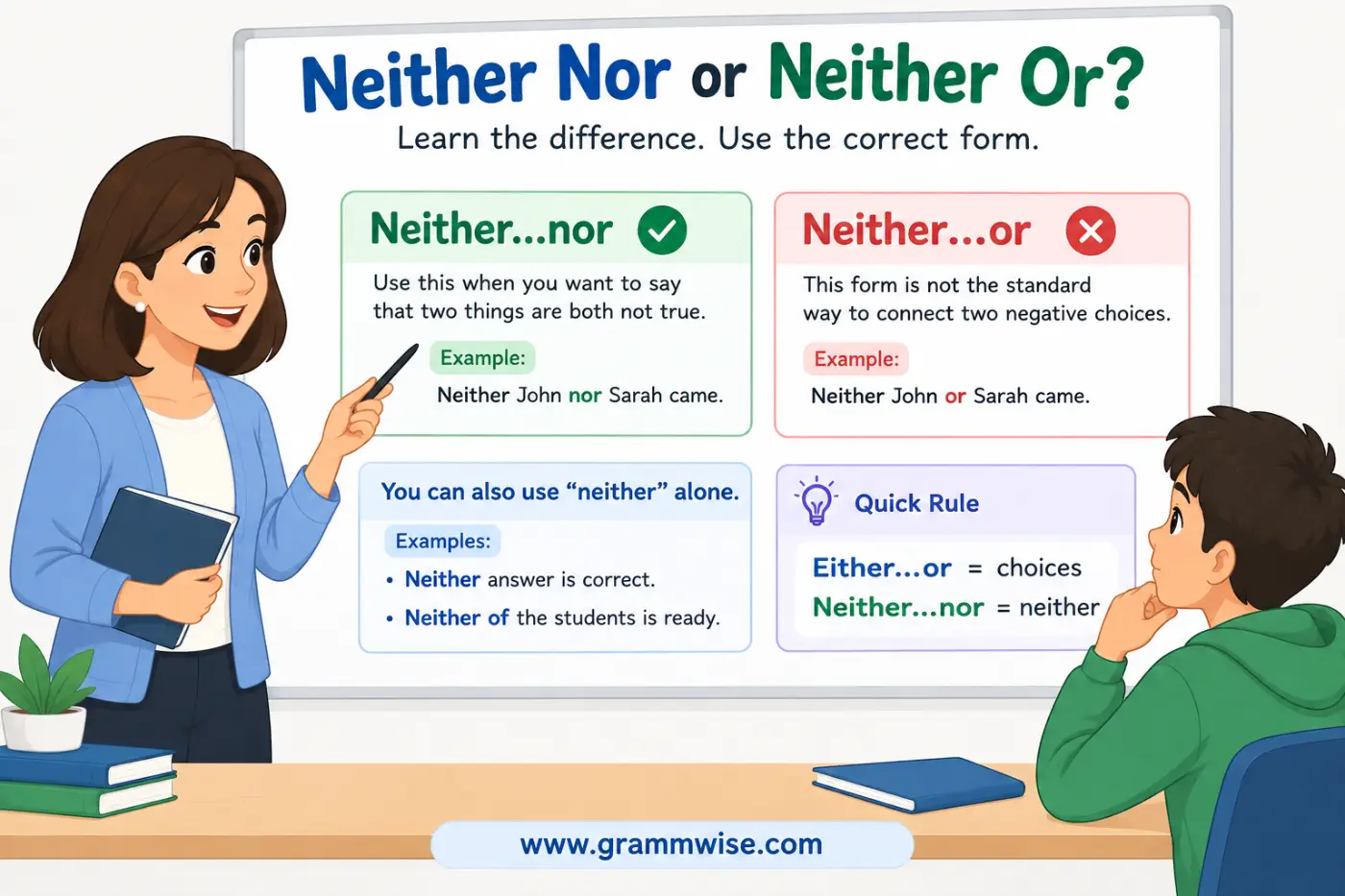
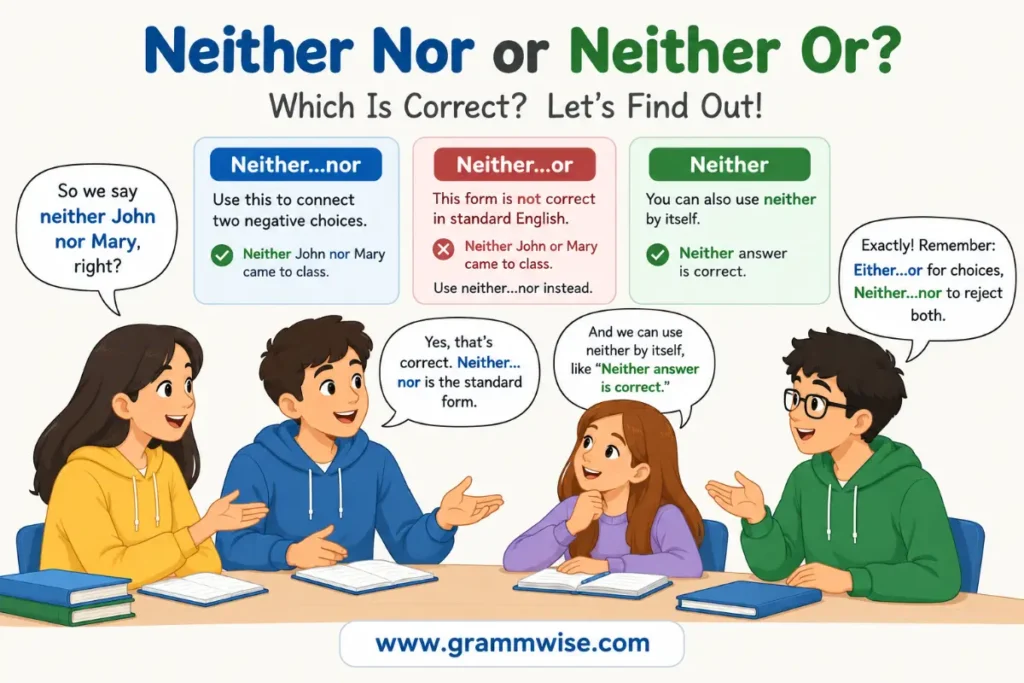
Many English learners ask, “Neither Nor or Neither Or — which one is correct?” The simple answer is that neither…nor is the standard pair used when you want to say that two things are both not true. For example, “Neither John nor Sarah came to class.” We normally do not use neither…or in this structure.
The word neither can also be used by itself. For example, “Neither answer is correct.” So you do not always need nor after neither. But when you connect two choices or two people with neither, the usual pattern is neither…nor.
This guide explains the difference between neither nor or neither or in very simple English. You will learn what each form means, which is correct, how to use neither…nor, common mistakes, and many real-life examples.
Is it your welcome or you’re welcome? Learn the correct response and avoid this common mistake.
Simple Answer in One Look
Neither…nor is the standard form when you are connecting two negative choices.
Example:
- Neither Tom nor Mike was at school.
Neither…or is not the normal standard pattern for connecting two negative choices.
You can also use neither by itself:
- Neither answer is correct.
So remember:
Neither + A + nor + B
What Does This Means in Simple English?
The easiest way to understand neither…nor is to think:
Not A + Not B
For example:
Neither Ali nor Ahmed likes coffee.
This means:
- Ali does not like coffee.
- Ahmed does not like coffee.
So neither…nor tells us that both choices are negative.
Here is another example:
Neither the blue shirt nor the black shirt fits me.
This means:
- The blue shirt does not fit me.
- The black shirt does not fit me.
The word neither introduces the first choice.
The word nor introduces the second choice.
That is why these two words often work together.
The basic pattern
Neither + first choice + nor + second choice
Examples:
- Neither John nor Mary came.
- Neither tea nor coffee is available.
- Neither answer is correct.
- Neither the bus nor the train was on time.
This pattern is simple once you see how it works.
What Does “Neither” Mean?
Neither means not one and not the other when you are talking about two people or things.
Imagine that you have two cakes. One cake is chocolate. The other cake is vanilla.
Someone asks:
“Which cake do you want?”
You say:
Neither.
This means you do not want the chocolate cake, and you do not want the vanilla cake.
Another example:
“I have two pens. Do you want the blue one or the black one?”
You say:
Neither. I have my own pen.
Again, neither means not the first one and not the second one.
This is different from either, which is often used when one of two choices is possible.
Compare:
Either = one or the other.
Neither = not one and not the other.
For example:
- You can choose either shirt.
- You can choose neither shirt.
The first sentence says both shirts are possible choices.
The second says you do not want either shirt.
What Does “Nor” Mean?
Nor is commonly used to introduce the second negative choice after neither.
Think of nor as the partner of neither.
For example:
Neither Sam nor David plays tennis.
The sentence tells us that Sam does not play tennis and David does not play tennis.
Another example:
Neither my mother nor my father drives.
This means both people do not drive.
The pair is:
neither…nor
This is one of the most common patterns to learn.
Why Do People Mix Up “Neither Nor or Neither Or”?
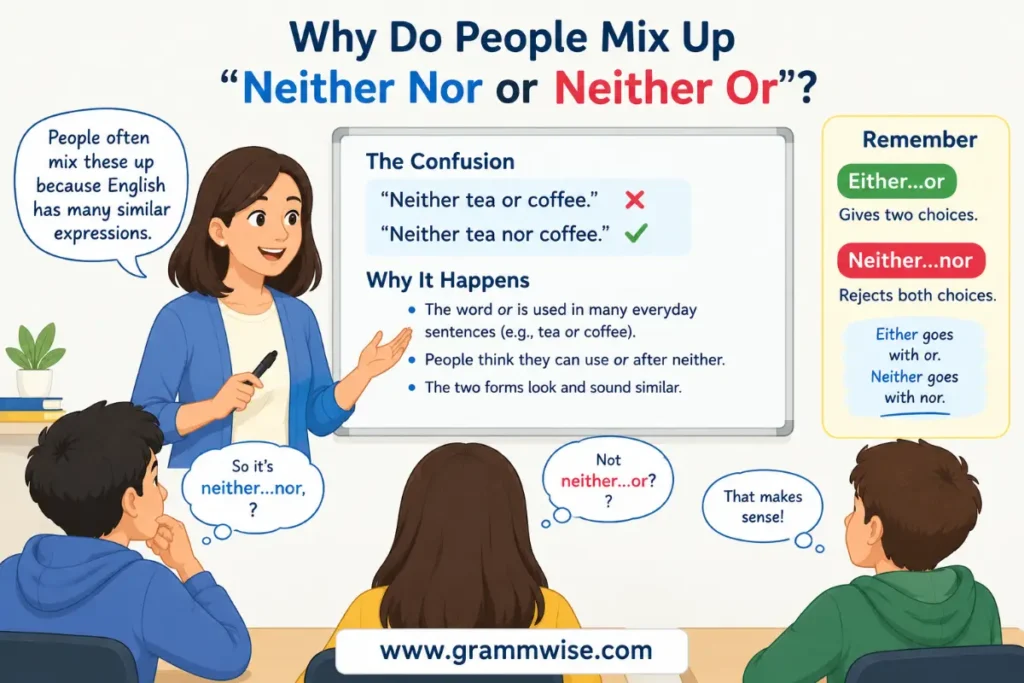
The confusion usually happens because English learners know the word or very well.
They see two choices and naturally think:
A or B
For example:
- Do you want tea or coffee?
- Is John coming or is Mike coming?
- Should I call today or tomorrow?
So learners may think they can simply put neither before the choices:
❌ Neither tea or coffee.
But standard English normally uses:
✅ Neither tea nor coffee.
The word neither changes the pattern.
When you use neither to connect two negative choices, nor is normally its matching word.
Think of it as a team:
Either…or
Neither…nor
These pairs are easy to remember.
Either…Or vs Neither…Nor
This is one of the best ways to understand the difference.
Either…or
Either…or gives two possible choices.
Example:
You can have either tea or coffee.
This means tea is one choice and coffee is another choice.
Neither…nor
Neither…nor rejects both choices.
Example:
You can have neither tea nor coffee.
This means you cannot have tea, and you cannot have coffee.
Look at the pattern:
Either → or
Neither → nor
This is a very useful memory rule.
Clear Difference Explained Simply
Here is the difference in a quick table.
| Expression | Meaning | Example |
|---|---|---|
| either…or | One of two choices | You can choose either tea or coffee. |
| neither…nor | Not the first and not the second | I want neither tea nor coffee. |
| neither | Not one or the other | Neither answer is correct. |
| or | Gives choices | Do you want tea or juice? |
| nor | Usually introduces another negative choice | Neither Tom nor Jack came. |
The most important pair is:
Neither…nor
Which Form Should You Use?
When you are connecting two negative choices, use:
Neither…nor
For example:
✅ Neither Sarah nor Emma came to the party.
Not:
❌ Neither Sarah or Emma came to the party.
Here are more examples:
✅ Neither the red car nor the blue car is available.
❌ Neither the red car or the blue car is available.
✅ Neither my brother nor my sister likes spicy food.
❌ Neither my brother or my sister likes spicy food.
The rule is simple:
Use “nor” after “neither” when you connect two choices.
Can You Use “Neither” Without “Nor”?
Yes.
This is an important point. You do not always have to use nor after neither.
For example:
Neither answer is correct.
There are two answers, and both are incorrect.
You could also say:
Neither student knew the answer.
This means both students did not know the answer. Here, neither is used by itself.
Another example:
Neither option works for me.
There are two options, and neither one works.
So there are two common patterns:
Neither + noun
Example:
- Neither answer is correct.
Neither + A + nor + B
Example:
- Neither John nor Mary is here.
This distinction makes the rule much clearer.
How to Use “Neither…Nor” in a Sentence
The basic sentence pattern is:
Neither + A + nor + B + verb
For example:
Neither Tom nor Jack plays soccer.
A and B are Tom and Jack.
The sentence says neither person plays soccer.
Here are more examples:
- Neither Anna nor Lisa likes fish.
- Neither the dog nor the cat is outside.
- Neither my phone nor my tablet works.
- Neither the teacher nor the students were ready.
- Neither the red pen nor the blue pen belongs to me.
The two parts should be connected clearly.
Easy Real-Life Sentences on Neither-Nor
Here are simple examples you might hear or use in everyday English.
- Neither John nor Mary is coming.
- Neither tea nor coffee sounds good.
- Neither answer is correct.
- Neither of us knows the answer.
- Neither my brother nor I can swim.
- Neither shirt fits me.
- Neither the bus nor the train has arrived.
- Neither option is cheap.
These sentences show how common neither can be in normal conversation.
“Neither of” Is Also Correct
Another useful structure is:
Neither of + two or more people or things
Examples:
- Neither of the answers is correct.
- Neither of my parents is home.
- Neither of us knows what happened.
- Neither of them wants to go.
- Neither of these shoes fits me.
Notice that we do not need nor in these sentences. The word of creates a different structure.
Compare:
Neither John nor Sarah came.
and:
Neither of them came.
Both sentences tell us that John and Sarah did not come.
The structure is simply different.
Neither Nor vs Neither Of
These forms are easy to confuse.
Neither…nor
Use this when you name two choices separately.
Neither Ali nor Ahmed came to school.
Neither of
Use this when you refer to a group of two or more people or things.
Neither of them came to school.
Compare:
Neither the red car nor the blue car is available.
Neither of the cars is available.
Both sentences have a similar meaning. The first names the two cars. The second refers to them as a group.
Neither…Nor for People
You can use neither…nor with people’s names.
Examples:
- Neither David nor Peter was there.
- Neither Sarah nor Emily wants to leave.
- Neither Jack nor Tom knows the answer.
- Neither my mother nor my father speaks Spanish.
- Neither my sister nor my brother likes basketball.
This is very common in both spoken and written English.
Neither…Nor for Things
You can also use it with objects and ideas.
Examples:
- Neither the phone nor the computer is working.
- Neither the red dress nor the blue dress is available.
- Neither plan sounds good.
- Neither option will solve the problem.
- Neither the book nor the movie was interesting.
The rule stays the same.
Neither + first thing + nor + second thing
Neither…Nor for Actions
The structure can also connect actions.
For example:
She neither called nor texted me.
This means she did not call me, and she did not text me.
Another example:
He neither smiled nor spoke.
This means he did not smile, and he did not speak.
Here, neither…nor connects two actions.
More examples:
- She neither complained nor argued.
- He neither called nor emailed.
- They neither laughed nor smiled.
- I neither asked nor answered.
This is another useful form to recognize.
Neither…Nor With Adjectives
You can sometimes use neither…nor to connect descriptions.
For example:
The movie was neither funny nor exciting.
This means the movie was not funny and not exciting.
Another example:
The room was neither clean nor comfortable.
It was not clean, and it was not comfortable.
More examples:
- The test was neither easy nor difficult.
- The food was neither hot nor cold.
- The lesson was neither long nor boring.
- The answer was neither simple nor clear.
This gives you another natural way to use the expression.
Common Mistake: “Neither…Or”
One of the biggest mistakes is using or after neither.
Incorrect:
❌ Neither John or Mike came.
Correct:
✅ Neither John nor Mike came.
Incorrect:
❌ Neither tea or coffee is available.
Correct:
✅ Neither tea nor coffee is available.
Incorrect:
❌ Neither the blue shirt or the black shirt fits.
Correct:
✅ Neither the blue shirt nor the black shirt fits.
The reason is simple.
Neither and nor are the standard pair.
Common Mistake: Double Negatives
Another mistake happens when people add another negative word.
For example:
❌ I don’t want neither tea nor coffee.
This sentence has an unnecessary double negative in standard English.
A clearer version is:
✅ I want neither tea nor coffee.
Or:
✅ I don’t want either tea or coffee.
Both express the same basic idea.
Compare:
I want neither tea nor coffee.
I don’t want either tea or coffee.
Both mean you do not want tea and you do not want coffee.
For simple writing, choose one clear negative structure.
Neither…Nor vs Not…Either
These two structures can have similar meanings.
Neither…nor
I like neither tea nor coffee.
Not…either
I don’t like tea or coffee.
In many situations, you can also say:
I don’t like either tea or coffee.
The important point is that neither…nor is a standard paired structure.
It is especially useful when you want to clearly show that both choices are rejected.
Subject-Verb Agreement Made Simple
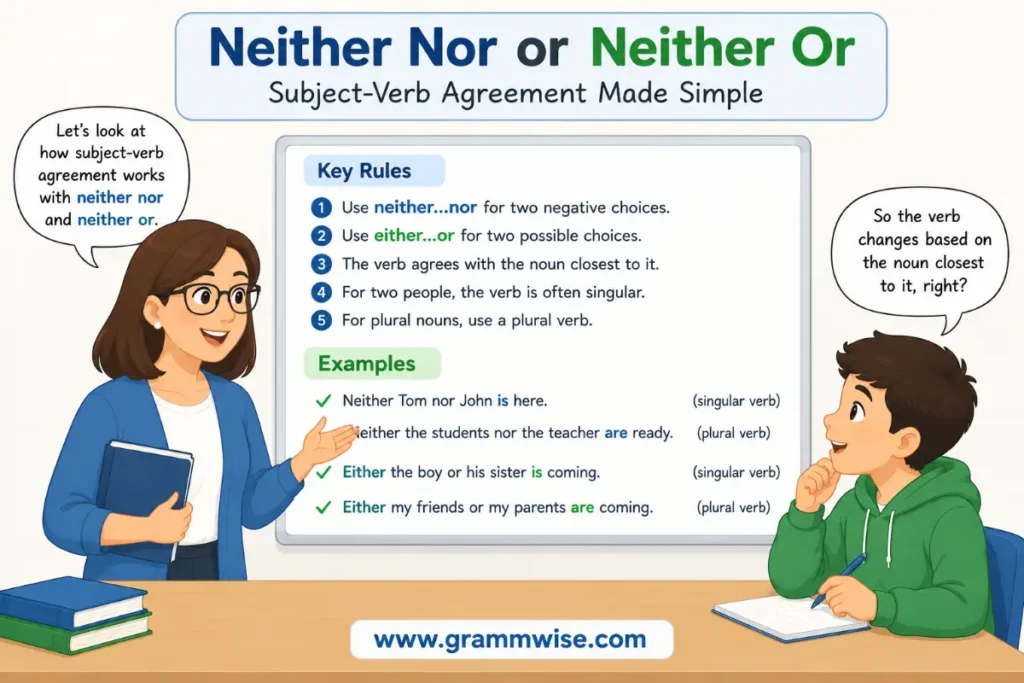
Sometimes learners wonder which verb to use after neither…nor.
For simple sentences, you will often see:
Neither John nor Mary is here.
Both names refer to one person each, and the sentence uses is.
You may also see sentences where the subjects differ in number:
Neither the teacher nor the students are ready.
Here, students is plural and comes closest to the verb, so are is commonly used.
For everyday English, the easiest approach is to write the sentence clearly and avoid making the structure more complicated than necessary. When possible, you can also rewrite a sentence to make it easier to understand. The main lesson is not to let verb choice distract you from the basic rule:
Neither…nor connects two negative choices.
A Simple Memory Trick
Here is a trick you can remember easily:
Either goes with or.
Neither goes with nor.
Think of them as two pairs:
Either + or
Neither + nor
For example:
Either Ali or Ahmed will help.
One of them will help.
Neither Ali nor Ahmed will help.
Both of them will not help.
You can remember it like a classroom rhyme:
Either–or gives a choice.
Neither–nor says no to both.
This small trick can help you choose the correct word quickly.
Mini Practice Quiz
Choose the correct word.
- Neither John ___ Peter came to class.
- Neither tea ___ coffee is available.
- You can choose either red ___ blue.
- Neither answer is correct. Is this sentence correct?
- Neither of them ___ ready.
- Neither Sarah ___ Emma wants to leave.
- I want neither pizza ___ pasta.
- Neither the bus ___ the train arrived.
Answers
- nor
- nor
- or
- Yes
- is
- nor
- nor
- nor
The pattern should now be easy to see.
Either → or
Neither → nor
Quick Review
Before moving to the deeper part of this topic, remember these key points:
- Neither…nor is the standard pair for two negative choices.
- Neither…or is not the normal standard pattern.
- Neither can be used alone.
- Neither of is another common structure.
- Either…or is used for two possible choices.
- Neither…nor means not the first choice and not the second.
- Neither can describe two things when both are rejected.
- Nor normally follows neither when two choices are joined.
The easiest rule is still the best one:
Either goes with or. Neither goes with nor.
How This Expression Is Understood in Culture and Stories?
The expression neither…nor is common in everyday English, but you can also find it in books, stories, news reports, speeches, and other types of writing.
In stories, writers often use neither…nor when they want to show that a character rejects two choices.
For example:
Neither the king nor the queen knew the secret.
This tells us that both people did not know the secret.
A story might also say:
The traveler had neither food nor water.
This means the traveler had no food and no water. The expression can make a sentence short and clear. Instead of saying:
“The traveler did not have food, and the traveler did not have water.”
we can simply say:
The traveler had neither food nor water.
This is one reason the expression is useful in storytelling.
You may also hear neither…nor when people describe a situation where two things are both missing, unwanted, or unavailable.
For example:
Neither the door nor the window was open.
The sentence gives the reader a quick picture of the whole situation.
In everyday American English, neither…nor can sound a little more careful or formal than some other ways of saying the same thing. However, it is still very normal and natural.
For example:
I don’t want either one.
is very common in conversation.
So is:
I want neither one.
Both can work, but the first may sound more casual in some situations.
Biblical and Mythological Meaning
There is no special biblical or mythological meaning attached to the grammar pattern neither…nor.
The words neither and nor simply carry their normal English meanings when they appear in religious or ancient stories.
For example, a translation might describe a person who has neither food nor shelter. The meaning is simply that the person has no food and no shelter.
You may also find the pattern in stories about heroes, kings, gods, or ordinary people:
Neither the hero nor the king could solve the problem.
This does not give the expression a special symbolic meaning. It is simply a way to connect two negative ideas.
Older English writing may contain many examples of neither…nor because the pattern has been used in English for a very long time.
The main lesson for English learners is simple:
Neither…nor has the same basic meaning in stories, religious writing, and everyday English: not the first and not the second.
Symbolism Explained in Simple Words
The grammar pattern itself does not have a fixed symbol or special emotional meaning.
However, in stories and normal conversation, neither…nor can help show rejection, absence, or two things being left out.
What Neither..Nor Represents
Neither…nor can represent the idea of both choices being rejected.
For example:
Neither the red door nor the blue door was open.
Both doors are unavailable.
The pattern gives us a clear feeling that there is no choice between the two.
Another example:
Neither the hero nor the villain won.
The result excludes both people.
What Either..Or Represents
Either…or represents a different idea.
It usually gives two possible choices.
For example:
You can take either the red road or the blue road.
Here, one of the two roads is available.
So the basic contrast is:
Either…or = a choice between two
Neither…nor = both choices are rejected
This is why these pairs are useful.
They allow speakers to show if they are choosing from two options or rejecting both.
Related Words You Should Know
Learning a few related words will make neither…nor easier to use.
Either
Usually means one of two choices.
Example: You can choose either shirt.
Neither
Means not one and not the other.
Example: Neither shirt fits me.
Or
Connects choices.
Example: Do you want tea or coffee?
Nor
Usually connects another negative choice after neither.
Example: Neither tea nor coffee is available.
Both
Means the two things together.
Example: Both students passed the test.
Each
Means every one of two or more people or things considered separately.
Example: Each student received a book.
None
Means zero from a group.
Example: None of the students were late.
Any
Can refer to one or more choices, depending on the sentence.
Example: You can choose any color.
Either…or
Used to present two possible choices.
Example: Either John or Mike will help.
Neither…nor
Used to reject both choices.
Example: Neither John nor Mike will help.
These words are connected because they help us talk about choices, groups, and amounts.
How People Actually Use It in Daily English?
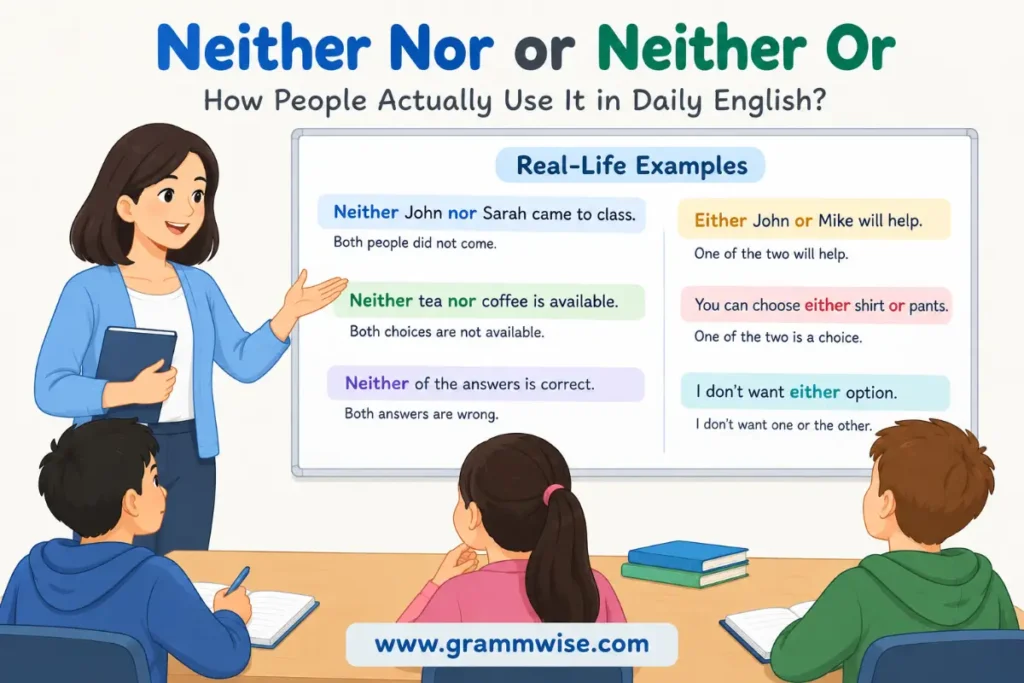
You can hear neither…nor in many normal situations.
At school
Neither Ali nor Ahmed finished the homework.
The sentence tells us that both students did not finish it.
At home
Neither my brother nor my sister is home.
Both people are away.
At a restaurant
I want neither soup nor salad.
The speaker does not want either choice.
While shopping
Neither the blue shirt nor the black shirt fits me.
Both shirts are the wrong fit.
Talking about food
Neither my mother nor my father eats meat.
Both people do not eat meat.
Talking about transportation
Neither the bus nor the train has arrived.
Both forms of transportation are still missing.
Talking about plans
Neither Saturday nor Sunday works for me.
Both days are unsuitable.
Talking about school subjects
Neither math nor science is my favorite subject.
The speaker does not choose either subject as a favorite.
Talking about entertainment
Neither the movie nor the show was interesting.
The speaker did not find either one interesting.
Talking about two people
Neither John nor Sarah knows the answer.
Both people do not know it.
These examples show that neither…nor is not limited to formal writing. You can use it in many everyday conversations.
How to Use “Neither” in Short Answers
Sometimes neither appears as a short answer.
For example:
A: Which shirt do you want?
B: Neither.
This means the person does not want either shirt.
Another example:
A: Do you want tea or coffee?
B: Neither, thanks.
This is very natural in conversation.
You can also use neither when agreeing with a negative statement.
For example:
A: I don’t like spicy food.
B: Neither do I.
This means:
I don’t like spicy food either.
This use is very common in spoken English.
“Neither Do I” Explained Simply
One useful expression is:
Neither do I.
You use it when someone says something negative and you want to say that the same thing is true for you.
For example:
A: I don’t like coffee.
B: Neither do I.
Both people do not like coffee.
Another example:
A: I can’t swim.
B: Neither can I.
This means both people cannot swim.
You may also hear:
Neither am I.
Example:
A: I’m not ready.
B: Neither am I.
This means both people are not ready.
These expressions are common in everyday English.
Neither Nor in Questions
You can also see neither…nor in questions.
For example:
Did neither John nor Mary come?
This asks if both John and Mary failed to come.
Another example:
Does neither option work for you?
This as both options are unsuitable.
However, in casual conversation, people may use simpler wording.
For example:
Don’t either of these options work for you?
The important point is that neither…nor can appear in questions, but the sentence should still be clear.
Neither Nor in Negative Sentences
This is an area where learners need to be careful.
Because neither already gives a negative meaning, you usually do not need another negative word.
For example:
❌ I don’t want neither option.
Better:
✅ I want neither option.
Or:
✅ I don’t want either option.
The second sentence uses either with the negative word don’t.
This gives us two useful patterns:
I want neither option.
I don’t want either option.
Both mean that the speaker does not want option one or option two.
Neither Nor vs Either Or
These expressions are easy to compare.
Either…or
Use it when there are two possible choices.
You can have either cake or ice cream.
There are two choices.
Neither…nor
Use it when both choices are rejected.
I want neither cake nor ice cream.
There are two choices, but the speaker wants neither.
Think of a simple traffic-light idea:
Either…or → choose
Neither…nor → reject both
This makes the difference easier to remember.
Neither vs None
These words can also confuse learners.
Use neither when you are talking about two things.
Neither of the two answers is correct.
Use none when you are talking about three or more things, or a group in general.
None of the answers are correct.
For simple learning, remember:
Neither = two
None = three or more / a group
For example:
- Neither of my two brothers is here.
- None of my friends are here.
This is a useful basic distinction.
Neither vs Both
These words have opposite ideas.
Both means the two things are included.
Neither means both are excluded.
Compare:
Both John and Mike came.
John came.
Mike came.
Now:
Neither John nor Mike came.
John did not come.
Mike did not come.
This is a very clear way to understand the difference.
Neither vs Either
These two words are also opposites in many situations.
Either can mean one of two.
Neither means not one and not the other.
Compare:
Either answer could be correct.
At least one choice may work.
Neither answer is correct.
Both choices are wrong.
Another example:
You can choose either dress.
One of the two dresses is acceptable.
You can choose neither dress.
Both dresses are rejected.
Common Mistakes People Make
Mistake 1: Using “or” after “neither”
❌ Neither Tom or Jack came.
✅ Neither Tom nor Jack came.
Remember:
Neither → nor
Mistake 2: Using “and” after “neither”
❌ Neither Tom and Jack came.
✅ Neither Tom nor Jack came.
The standard pair is neither…nor, not neither…and.
Mistake 3: Using a double negative
❌ I don’t want neither answer.
✅ I want neither answer.
Or:
✅ I don’t want either answer.
Choose one negative structure.
Mistake 4: Confusing “either” and “neither”
❌ Neither one means one of the two.
Correct understanding:
Either = one or the other.
Neither = not one or the other.
Mistake 5: Forgetting “of”
Sometimes learners say:
❌ Neither of students came.
A better sentence is:
✅ Neither of the students came.
Use the, my, these, or another suitable word before the noun when using neither of.
Mistake 6: Using “neither” for a large group
For two choices, neither is natural.
For a larger group, none may be the better choice.
For example:
Neither of the two students answered.
But:
None of the students answered.
The second sentence refers to a group of students, not just two.
Final Teacher Explanation
If I were teaching neither nor or neither or in a classroom, I would write four words on the board:
Either — Or
Neither — Nor
Then I would tell my students to remember them as pairs.
If you are giving two choices, use:
either…or
If you are rejecting both choices, use:
neither…nor
For example:
Either John or David will come.
This means one of them will come.
Now:
Neither John nor David will come.
This means both will not come.
The word neither can also stand alone.
Neither answer is correct.
And you can use neither of:
Neither of the answers is correct.
So you have three useful patterns:
Neither + noun
Neither + A + nor + B
Neither of + group
The one form you should be careful with is neither…or. When neither connects two choices, standard English normally uses nor, not or.
The easiest memory trick is still:
Either goes with or.
Neither goes with nor.
Once you remember these pairs, this common English problem becomes much easier.
Quick Recap
The standard expression is neither…nor, not neither…or, when you connect two negative choices. Neither means not one and not the other, while nor introduces the second negative choice.
Remember: either…or = choices, and neither…nor = neither choice. You can also use neither alone, as in “Neither answer is correct.”
Conclusion
Understanding neither nor or neither or is simple once you remember the correct pair. When connecting two negative choices, use neither…nor, not neither…or. You can also use neither by itself or with neither of.
The easiest rule to remember is either…or and neither…nor. Use either…or for choices, and use neither…nor when both choices are rejected. With a little practice, this pattern will become natural in your everyday English.
Frequently Asked Questions
Is it “neither nor” or “neither or”?
The standard pair is neither…nor when connecting two negative choices.
Can I use “neither” by itself?
Yes. For example: Neither answer is correct.
Is “neither or” grammatically correct?
It is not the normal standard pattern for connecting two choices. Use neither…nor instead.
What is the difference between either and neither?
Either usually presents one of two choices. Neither means not one and not the other.
Is it “neither John or Mary” or “neither John nor Mary”?
Use neither John nor Mary.
Can I say “neither of them”?
Yes. Neither of them means that both people or things are excluded.
What is the difference between “neither…nor” and “either…or”?
Either…or gives two possible choices. Neither…nor rejects both choices.
Is “Neither do I” correct?
Yes. It is a common way to agree with a negative statement, such as “I don’t like coffee.” — “Neither do I.”