
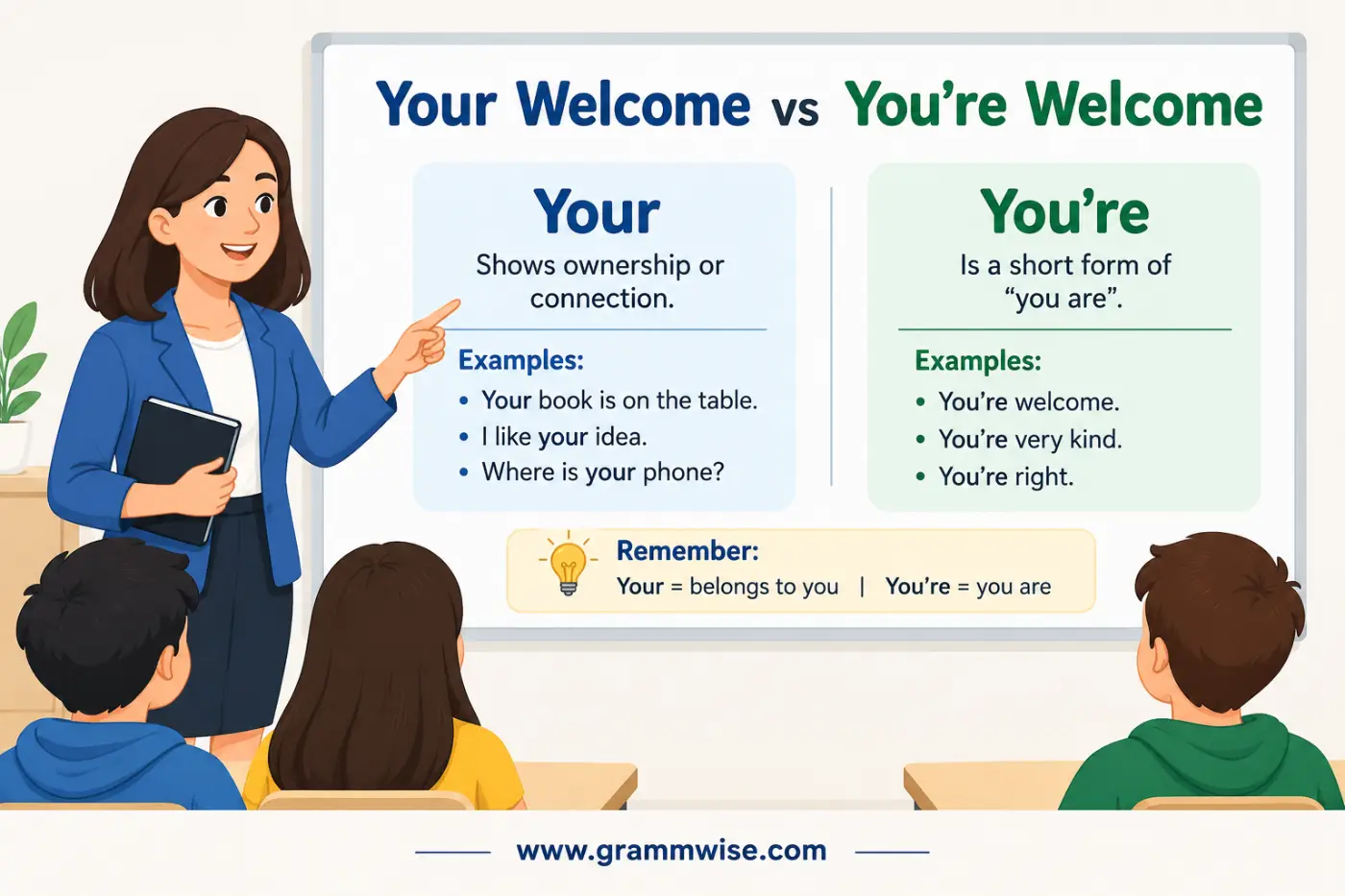
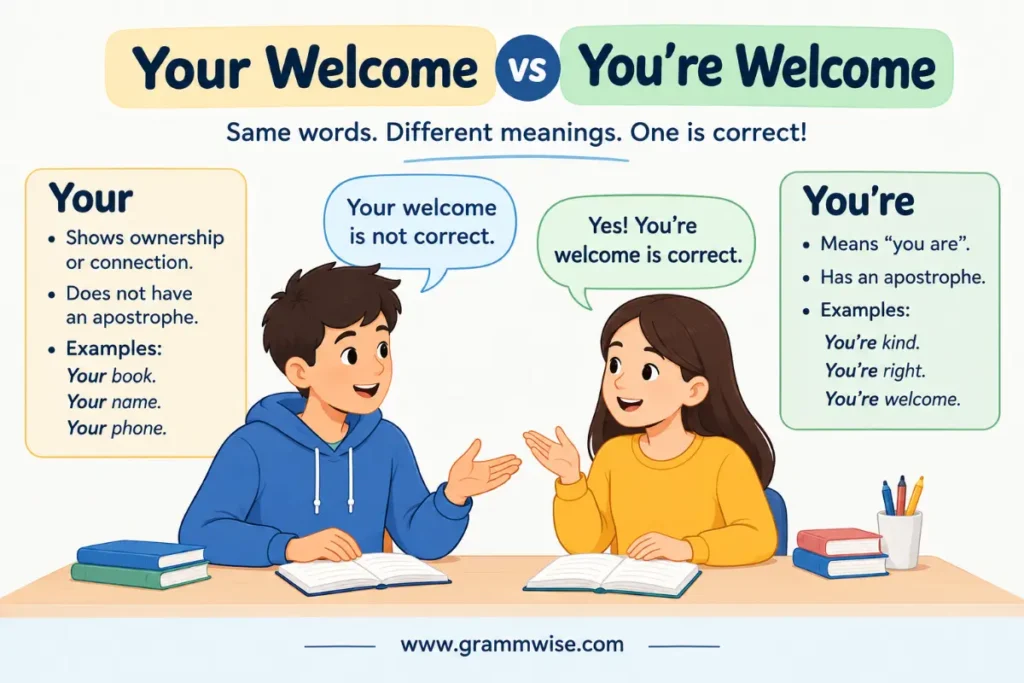
If you are wondering whether your welcome vs you’re welcome is correct, the answer is simple: “You’re welcome” is the correct phrase when you are replying to someone who says “Thank you.” “Your welcome” is usually incorrect in this situation.
The confusion happens because your and you’re sound very similar when people speak quickly. But they have different meanings. Your shows that something belongs to someone, while you’re is the short form of you are.
Once you understand this small difference, choosing between your welcome vs you’re welcome becomes easy. In this guide, we will look at the meanings, examples, common mistakes, and simple memory tricks you can use in everyday English.
Is the phrase take affect or take effect? Learn the correct expression and why effect is right.
Simple Answer in One Look
“You’re welcome” is correct when you reply to someone who says “Thank you.”
“Your welcome” is not correct for this meaning because your shows ownership.
Example:
“Thank you for your help.”
“You’re welcome!”
What Does This Means in Simple English?
Let’s look at the two words separately.
What Does “Your” Mean?
Your means that something belongs to you or is connected to you.
For example:
- Where is your book?
- I like your shirt.
- What is your name?
- Please bring your phone.
- Is this your car?
In each sentence, your points to something that belongs to or is connected with the person being spoken to.
Think of your as a word that answers this idea:
“Does it belong to you?”
If yes, your may be the right word.
What Does “You’re” Mean?
You’re is a short form of you are.
For example:
- You’re happy. = You are happy.
- You’re kind. = You are kind.
- You’re ready. = You are ready.
- You’re welcome. = You are welcome.
This gives us a very easy test.
When you see you’re, try replacing it with you are.
If the sentence still makes sense, you’re is probably correct.
Try the Test
You’re welcome.
Replace you’re with you are:
You are welcome.
That makes sense.
Now try:
Your welcome.
Replace your with you are:
You are welcome.
The words technically form a sentence, but that is not what your means. In the normal phrase used after “Thank you,” the correct spelling is you’re welcome.
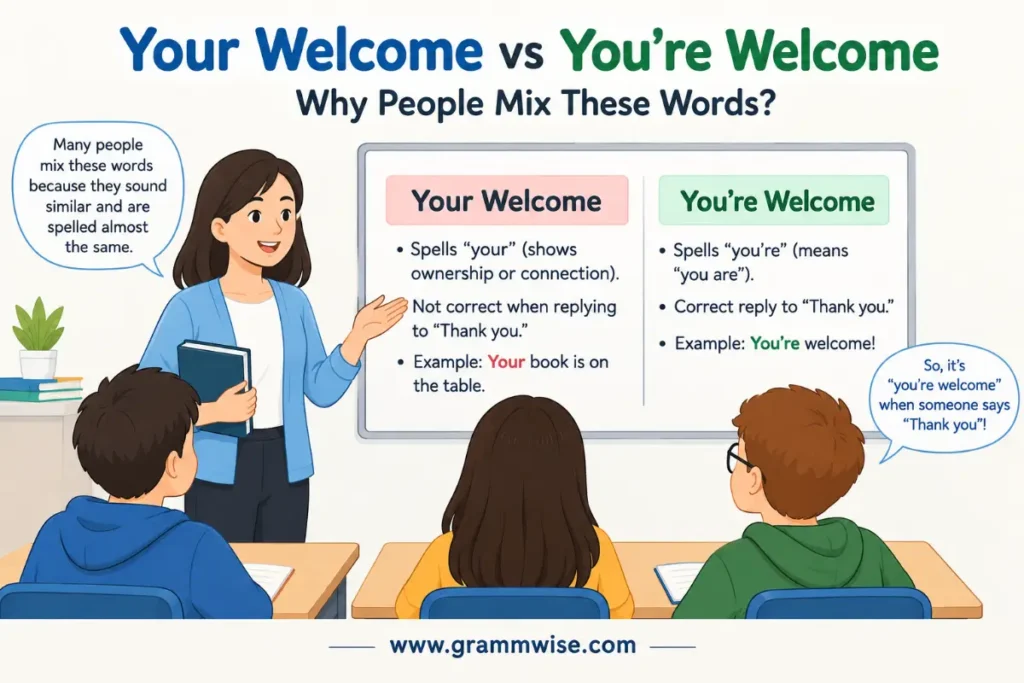
Why People Mix These Words your welcome vs you’re welcome?
The main reason people confuse your and you’re is pronunciation. In everyday speech, your and you’re can sound very similar. When people speak quickly, the difference may be hard to hear.
For example:
- your book
- you’re ready
Both can sound similar to a learner.
There is another reason. People often write what they hear. If someone hears “you’re welcome,” they may remember the sound but not remember that you’re contains an apostrophe. This is especially common when English learners are writing messages, emails, comments, or social media posts quickly.
The good news is that the difference is easy to learn.
Remember:
Your = belongs to you
You’re = you are
That one rule solves most of the confusion.
Clear Difference Explained Simply
Here is the easiest comparison.
| Your | You’re |
|---|---|
| Shows ownership or connection | Means “you are” |
| Does not contain an apostrophe | Contains an apostrophe |
| Your book | You’re happy |
| Your name | You’re welcome |
| Your car | You’re correct |
Look at these examples
Your phone is ringing.
Here, the phone belongs to or is connected with you.
You’re late.
Here, you’re means you are late.
Your answer is correct.
Here, your describes the answer connected to you.
You’re correct.
Here, you’re means you are correct.
The meanings are different even though the words can sound alike.
Your Welcome vs You’re Welcome Which Form Should You Use?
When someone says:
“Thank you.”
The correct reply is:
“You’re welcome.”
This is the standard expression.
Example 1
Person A: Thank you for helping me.
Person B: You’re welcome.
Example 2
Person A: Thanks for the ride.
Person B: You’re welcome.
Example 3
Person A: Thank you so much.
Person B: You’re very welcome.
The phrase “you’re welcome” is short for “you are welcome.”
It is a polite response to thanks.
When Should You Use “Your”?
Use your when something belongs to or relates to the person you are talking to.
Examples:
- Your bag is on the chair.
- I like your idea.
- Please check your email.
- Where is your sister?
- Did you bring your homework?
You would not use your in the normal phrase “Thank you → You’re welcome.”
Easy Memory Trick
Here is a simple teacher trick.
Remember: “You’re” Has “Are” Hidden Inside
Think:
You’re = You Are
So:
You’re welcome = You are welcome
If you can replace you’re with you are, use you’re.
For example:
You’re my friend.
→ You are my friend. ✅
You’re welcome.
→ You are welcome. ✅
You’re very kind.
→ You are very kind. ✅
Now remember:
Your = Your thing
For example:
- Your book
- Your house
- Your phone
- Your name
This is an easy way to remember the difference.
Easy Real-Life Sentences You Can Use
Let’s look at natural examples.
Sentences with “You’re”
- You’re welcome.
- You’re very kind.
- You’re doing a great job.
- You’re right.
- You’re ready to go.
- You’re my best friend.
- You’re always helpful.
- You’re invited to the party.
In all these examples, you’re means you are.
For example:
You’re right.
means:
You are right.
Sentences with “Your”
- Your phone is on the table.
- I like your new shoes.
- Where is your brother?
- Please bring your book.
- Your food is ready.
- What is your address?
- I enjoyed your story.
- Your answer is correct.
Here, your shows a connection to the person.
What Does “You’re Welcome” Actually Mean?
The phrase “you’re welcome” is a polite response after someone thanks you.
For example:
“Thank you for your help.”
“You’re welcome.”
The phrase tells the other person that you are happy to help and that they do not need to feel that they owe you something for your kindness.
It is one of the most common polite expressions in English.
You can use it with friends, family, classmates, teachers, coworkers, customers, and strangers.
Common variations
You may also hear:
- You’re very welcome.
- You are very welcome.
- You’re most welcome.
- You’re welcome anytime.
- You’re absolutely welcome.
The simple “You’re welcome” is enough in most situations.
Can “Your Welcome” Ever Be Correct?
This is an interesting question.
“Your welcome” can technically appear in a sentence if welcome is being used as a noun and your shows ownership.
However, this is uncommon and has a different meaning.
For example:
Your welcome was very warm.
Here, welcome means an act of greeting or receiving someone. The sentence means that the welcome you gave someone was warm and friendly.
Another example might be:
Your welcome made me feel comfortable.
Again, your means the welcome belonged to or came from you.
But when you are replying to “Thank you,” do not write “Your welcome.”
Write:
“You’re welcome.”
This small difference is useful because it shows why spelling matters.
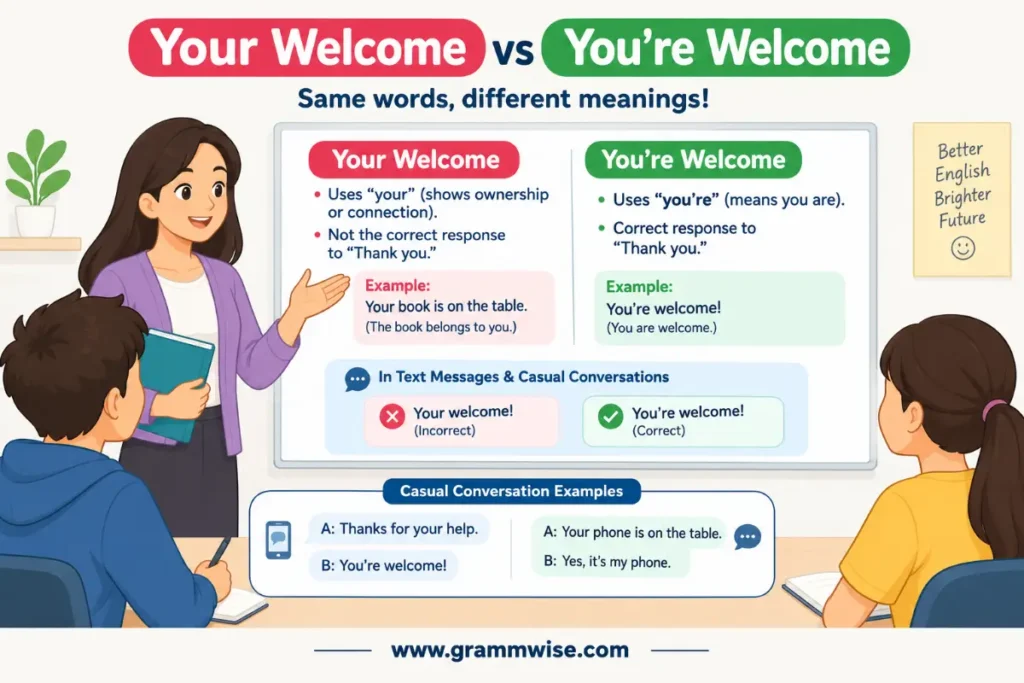
Your Welcome vs You’re Welcome in Text Messages
Text messages often make this mistake very common.
Someone may write:
Thanks for helping me!
The correct reply is:
You’re welcome!
Not:
Your welcome!
You may also see people type ur welcome in very informal texting. This is an abbreviation, but it is not standard English. For schoolwork, professional messages, emails, and formal writing, use you’re welcome.
Example of a casual conversation
Sam: Thanks for sending me the notes.
Alex: You’re welcome!
Sam: You really helped me.
Alex: No problem!
This is natural everyday English.
Your vs. You’re: More Simple Examples
Sometimes the best way to learn a word difference is to see many short examples.
Example 1
Your dog is cute.
Here, the dog belongs to or is connected with you.
You’re very lucky.
Here, you’re means you are.
Example 2
I like your jacket.
The jacket belongs to you.
You’re wearing a nice jacket.
You are wearing it.
Example 3
Your answer is correct.
The answer is connected with you.
You’re correct.
You are correct.
Example 4
Your food is ready.
The food is yours.
You’re ready to eat.
You are ready.
These examples show how one small apostrophe changes the meaning.
A Simple Test You Can Use Every Time
Whenever you are confused about your welcome vs you’re welcome, use the “you are” test.
Step 1: Find “you’re”
If you have written you’re, expand it.
You’re = you are
Step 2: Read the sentence again
If it still makes sense, you’re is likely correct.
Example:
You’re welcome.
→ You are welcome.
It makes sense. ✅
Example:
You’re my teacher.
→ You are my teacher.
It makes sense. ✅
Step 3: Check “your”
If the word means something belongs to or relates to the person, use your.
Example:
Your pencil is broken.
The pencil belongs to you. ✅
Your answer looks good.
The answer is connected with you. ✅
This test is quick and works in many situations.
Where This Expression Comes From?
The word welcome is an old English word. It has long been connected with the idea of being received kindly or being accepted.
Over time, “You’re welcome” became a common polite response to “Thank you.”
The full form is:
You are welcome.
English speakers often shorten you are to you’re in normal conversation.
The apostrophe in you’re shows that letters have been removed from you are.
So:
You are → You’re
This is why the phrase is spelled you’re welcome, not your welcome, when responding to thanks.
Moving From the Basic Rule to Everyday Use
Now you know the main difference between your welcome vs you’re welcome. The key is not the sound of the words. The key is their meaning.
Your talks about something connected to you.
You’re means you are.
When someone says “Thank you,” the natural response is “You’re welcome.”
Your Welcome vs You’re Welcome: How This Word Is Understood in Culture and Stories?
The phrase “you’re welcome” is a very common part of polite English. People use it after someone says “thank you.” You can hear it at home, at school, at work, in stores, and in everyday conversations.
In many English-speaking cultures, saying thank you is a normal way to show appreciation. The other person often answers with you’re welcome to accept that thanks politely.
For example:
“Thank you for helping me.”
“You’re welcome.”
The phrase can sound warm and friendly. It can also be more formal depending on the situation.
Friends may say:
- You’re welcome!
- No problem!
- Sure!
- Anytime!
In a more formal situation, someone might say:
- You’re very welcome.
- You are most welcome.
The exact response can change, but you’re welcome remains one of the clearest and safest choices.
The word your has a different role in English. It often appears when people talk about someone’s things, family, ideas, or actions.
For example:
- your book
- your house
- your family
- your idea
- your answer
So when you see your, think about something connected to you.
When you see you’re, think:
you are.
This simple difference works in stories, conversations, emails, school assignments, and almost every other type of writing.
Biblical and Mythological Meaning
Your and you’re do not have special biblical or mythological meanings. The word welcome, however, is connected to an old idea found in many cultures: receiving someone kindly.
Stories from different cultures often show people welcoming guests into their homes. A host may offer food, shelter, or a kind greeting. This idea of welcoming others is common in many traditions.
The exact phrase “you’re welcome” is a modern English expression used as a response to thanks. It should not be confused with any special religious meaning.
For English learners, the main lesson is still simple:
Your = connected to you.
You’re = you are.
That rule matters much more than any cultural or historical connection.
Symbolism Explained in Simple Words
Words can sometimes remind us of bigger ideas.
What “You’re Welcome” Represents
The phrase “you’re welcome” can represent:
- Kindness
- Politeness
- Helpfulness
- Respect
- Friendly communication
When someone thanks you and you say “you’re welcome,” you are responding politely.
For example:
“Thank you for carrying my bag.”
“You’re welcome.”
The phrase shows that you are accepting the person’s thanks.
What “Your” Represents
Your is connected with:
- Belonging
- Ownership
- Personal connection
- Relationships
For example:
- Your phone means the phone belongs to or is connected with you.
- Your family means the family connected with you.
- Your idea means an idea that came from you or belongs to you.
So the two forms have very different jobs.
| Your | You’re |
|---|---|
| Shows connection or ownership | Means “you are” |
| Your book | You’re welcome |
| Your house | You’re kind |
| Your answer | You’re correct |
| Your idea | You’re ready |
This simple comparison can help you remember the difference.
Related Words You Should Know
Understanding a few related words can make your welcome or you’re welcome even easier.
You
You refers to the person or people being spoken to.
Example: You are my friend.
Your
Your shows that something belongs to or is connected with you.
Example: Where is your bag?
You’re
You’re is the short form of you are.
Example: You’re very helpful.
Welcome
Welcome can mean being received in a friendly way. It is also used as a polite response to thanks.
Example: You’re welcome.
Thanks
Thanks is a common informal way to say thank you.
Example: Thanks for your help.
Thank You
Thank you is a polite expression used to show appreciation.
Example: Thank you for the gift.
Appreciation
Appreciation means showing that you are thankful for something.
Example: She showed her appreciation with a kind message.
Gratitude
Gratitude means feeling or showing thankfulness.
Example: He expressed his gratitude to his teacher.
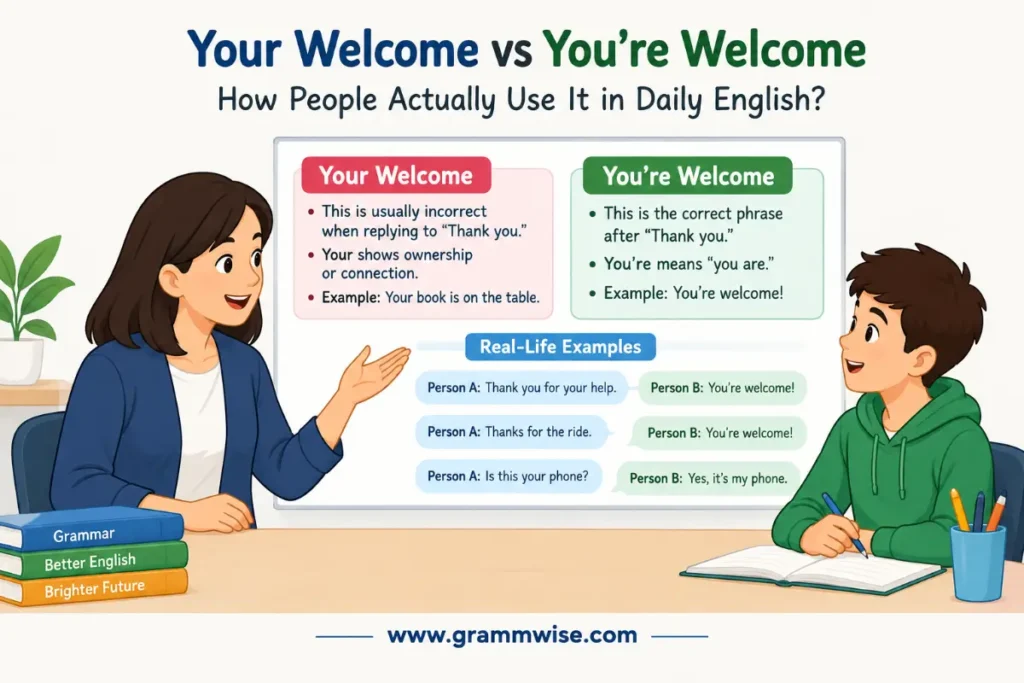
How People Actually Use It in Daily English?
The phrase “you’re welcome” is very easy to use in real conversations.
At School
Student: Thank you for explaining the lesson.
Teacher: You’re welcome.
With a Friend
Friend: Thanks for sending me the notes.
You: You’re welcome!
At Work
Coworker: Thank you for helping with this project.
Coworker: You’re welcome.
At Home
Child: Thanks for making breakfast.
Parent: You’re welcome.
In a Store
Customer: Thank you for your help.
Worker: You’re welcome.
In a Text Message
Friend: Thanks for reminding me about the meeting.
You: You’re welcome!
Talking About Belongings
Your is used when talking about something connected to another person.
- Is this your jacket?
- Where is your phone?
- I like your new shoes.
- Your bag is on the chair.
These examples are not about replying to thanks.
Using “You’re” as “You Are”
- You’re very kind.
- You’re doing well.
- You’re right.
- You’re ready.
- You’re my best friend.
Try replacing you’re with you are in each sentence. The meaning stays the same.
Common Mistakes People Make
Mistake 1: Writing “Your Welcome” After “Thank You”
This is the most common mistake.
❌ Thank you for helping me.
❌ Your welcome.
✅ Thank you for helping me.
✅ You’re welcome.
The correct phrase is you’re welcome.
Mistake 2: Thinking “Your” Means “You Are”
It does not.
Your shows a connection or belonging.
Example:
Your book is on the table.
It does not mean:
You are book.
That sentence does not make sense.
Mistake 3: Forgetting the Apostrophe
You’re has an apostrophe because it is a shortened form of you are.
You are → You’re
The apostrophe shows that some letters have been removed.
Mistake 4: Using “You’re” Before a Noun
Be careful with sentences like this:
❌ You’re book is here.
If you mean the book belongs to the person, use:
✅ Your book is here.
But:
✅ You’re holding the book.
Here, you’re means you are.
Mistake 5: Using “Your” Before an Adjective
Look at this example:
❌ Your very kind.
If you mean you are very kind, write:
✅ You’re very kind.
But:
✅ Your kindness is wonderful.
Here, your correctly shows a connection to the person.
A Quick Classroom Trick
Imagine your teacher writes two words on the board:
YOUR
YOU’RE
Then the teacher gives you two questions.
Question 1
Can I replace the word with you are?
If yes, use you’re.
You’re welcome.
→ You are welcome. ✅
You’re late.
→ You are late. ✅
Question 2
Does the word show that something belongs to or is connected with you?
If yes, use your.
- Your pencil
- Your house
- Your answer
This trick is useful because you can use it even when you are writing quickly.
Your Welcome vs You’re Welcome in Formal Writing
In formal writing, spelling the phrase correctly is especially important. If you write an email to a teacher, customer, manager, or client, use:
You’re welcome.
For example:
Thank you for your kind message. You’re welcome, and I’m glad I could help.
Avoid:
Your welcome.
The second version is a common spelling mistake when the intended meaning is a polite response to thanks.
The same rule applies to school assignments and professional writing.
Your vs. You’re in Common Expressions
You can learn the difference faster by remembering common phrases.
Common phrases with “your”
- your name
- your car
- your family
- your job
- your idea
- your answer
- your friend
- your home
- your phone
- your question
Common phrases with “you’re”
- you’re welcome
- you’re right
- you’re wrong
- you’re ready
- you’re late
- you’re early
- you’re kind
- you’re funny
- you’re correct
- you’re invited
There is a useful pattern here.
Your normally comes before a thing or person connected to you.
You’re normally works as you are.
Final Teacher Explanation
If I were teaching this lesson in a classroom, I would give you just two rules.
Rule 1: Your = belongs to you or is connected to you.
Examples:
- your book
- your house
- your mother
- your idea
Rule 2: You’re = you are.
Examples:
- you’re happy
- you’re ready
- you’re kind
- you’re welcome
Now think about the question:
“Thank you!”
What should you say?
“You’re welcome!”
Why?
Because you’re means you are.
So the full sentence is:
You are welcome.
That makes sense.
If you write “your welcome,” you are using the word that normally shows belonging or connection. That is not the standard spelling of the polite response.
One tiny apostrophe can make a big difference.
Whenever you are unsure, use the you are test. If you are works, choose you’re. If you are showing ownership or connection, choose your.
Quick Recap Your Welcome vs You’re Welcome
When someone says “Thank you,” the correct response is “You’re welcome.” Here, you’re means you are.
Use your when something belongs to or is connected with someone: your book, your car, your idea. Remember: Your = belongs to you; You’re = you are.
Conclusion
Understanding your welcome vs you’re welcome is easy once you remember one simple rule. You’re means you are, so “You’re welcome” is the correct response when someone says “Thank you.” Your shows ownership or connection, as in “your book” or “your name.”
The best memory trick is simple: Your = belongs to you, You’re = you are. Use this quick test whenever you are unsure, and you can avoid this common English mistake in your writing and everyday conversations.
Frequently Asked Questions
Is “your welcome” or “you’re welcome” correct?
“You’re welcome” is correct when responding to someone who says “thank you.”
Why is “you’re welcome” correct?
Because you’re is short for you are. The phrase means “you are welcome.”
When should I use “your”?
Use your when something belongs to or is connected with someone, such as your book or your name.
When should I use “you’re”?
Use you’re when you mean you are, such as you’re kind or you’re ready.
Why do people confuse your and you’re?
They can sound very similar when spoken, so people sometimes choose the wrong spelling when writing.
Can “your welcome” ever be correct?
Yes, but only in a different sentence where your shows a connection to the noun welcome. It is not the correct response to “thank you.”
Is “you’re welcome” okay in formal writing?
Yes. “You’re welcome” is standard English and can be used in both everyday and professional communication.
What is the easiest way to remember your vs. you’re?
Remember: Your = belongs to you. You’re = you are. Use “you’re welcome” after someone says “thank you.”