
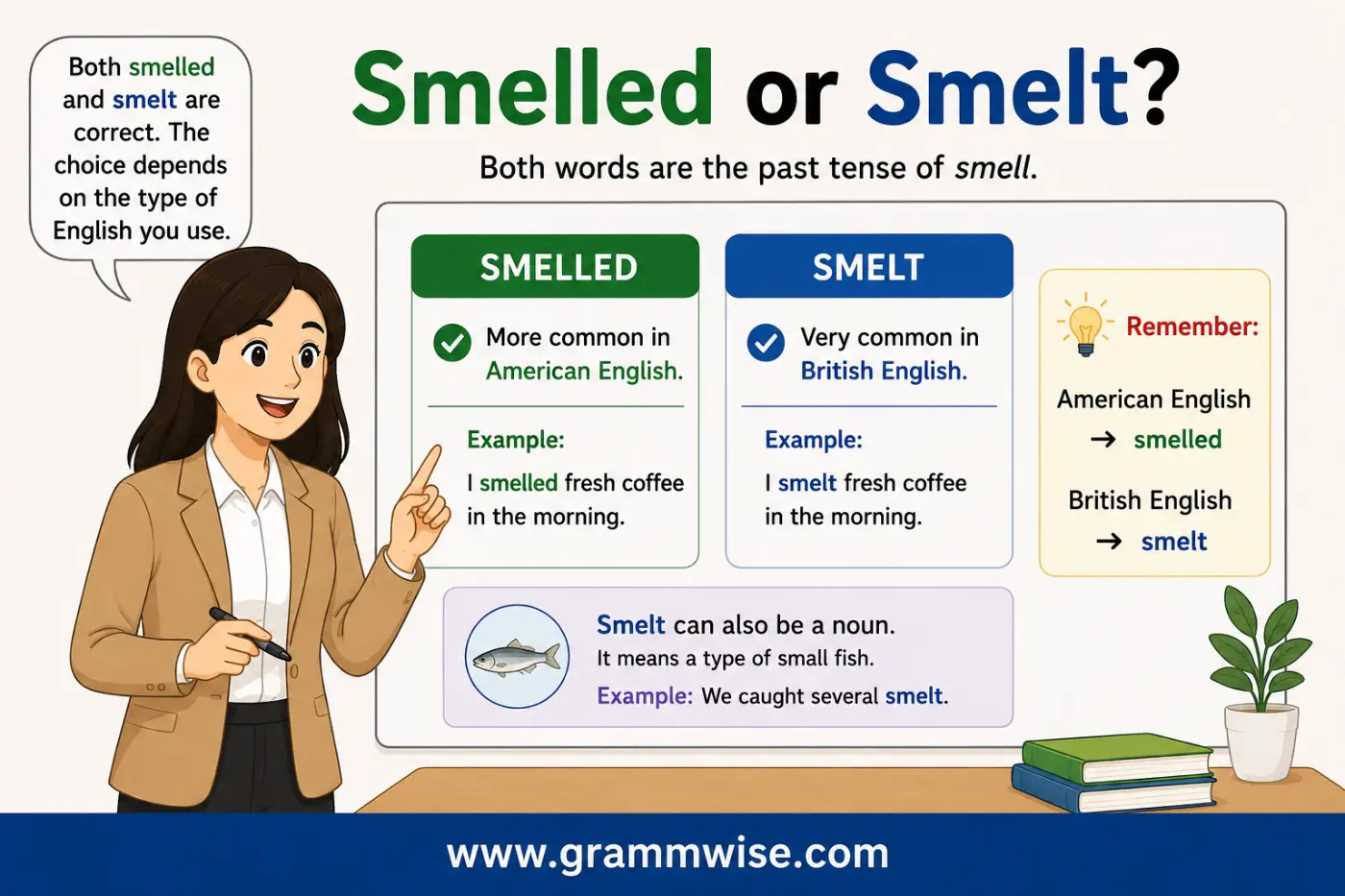
Many English learners wonder whether smelled or smelt is the correct word. The good news is that both are correct. The main difference is where they are used and which form of English a speaker follows.
Smelled is more common in American English. Smelt is very common in British English and is also used in other varieties of English. Both forms are the past tense and past participle of the verb smell. So, if you are writing for a US audience, smelled is usually the safer choice.
In this guide, you will learn the difference between smelled or smelt in very simple English. You will see clear examples, learn when to use each form, and discover an easy memory trick. By the end, you will know which form to choose in American and British English.
If you enjoy learning word differences, you may also like our guide on commonly confused words woah or whoa.
Simple Answer in One Look
Smelled and smelt are both correct.
Use smelled more often in American English.
Use smelt commonly in British English and some other varieties of English.
Quick tip: If you are writing in standard US English, choose smelled.

What Does Smelled or Smelt Means in Simple English?
The word smell can be used in several ways.
It can mean to notice a scent with your nose.
For example:
- I smell fresh bread.
- She smells the flowers.
- The room smells nice.
It can also describe the scent of something.
For example:
- The cake smells delicious.
- The milk smells bad.
- Your jacket smells like smoke.
When we talk about something that happened in the past, the verb smell changes.
There are two common past forms:
smell → smelled
smell → smelt
Both are correct.
For example:
- I smelled the flowers.
- I smelt the flowers.
Both sentences mean that I noticed the flowers’ scent in the past. The choice usually depends on the type of English you are using.
Why People Mix These Words Smelled or Smelt?
People often get confused because English has many verbs with two accepted past forms.
For example:
- dreamed / dreamt
- learned / learnt
- burned / burnt
- spelled / spelt
- smelled / smelt
This can make English learners wonder which form they should use. The confusion becomes stronger when learners read British and American English at the same time.
An American book may say:
She smelled the roses.
A British book may say:
She smelt the roses.
A learner may think that one sentence must be wrong.
It is not.
Both forms are correct.
The difference is mainly a matter of English variety and style.
Why Does American English Prefer “Smelled”?
American English usually prefers the -ed form.
So Americans commonly write:
- smelled
- learned
- dreamed
- burned
- spelled
British English often keeps some shorter forms ending in -t:
- smelt
- learnt
- dreamt
- burnt
- spelt
There are exceptions, and British speakers also use many -ed forms. But smelt is very normal in British English.
Clear Difference Smelled or Smelt Explained Simply
Here is an easy comparison of smelled or smelt.
| Smelled | Smelt |
|---|---|
| Correct | Correct |
| More common in American English | Very common in British English |
| Also used in other English varieties | Also used in some other varieties |
| Past form of smell | Past form of smell |
| Example: I smelled the flowers. | Example: I smelt the flowers. |
The meaning is usually the same.
Smelled = smelt
The biggest difference is the style of English being used.
Easy Real-Life Sentences on Smelled or Smelt
Here are some natural examples with smelled.
- I smelled fresh bread in the kitchen.
- She smelled the flowers in the garden.
- The room smelled like coffee.
- He smelled smoke outside.
- The food smelled delicious.
- My shoes smelled terrible after the game.
- I smelled something strange in the refrigerator.
- The cookies smelled wonderful.
Now look at the same ideas with smelt.
- I smelt fresh bread in the kitchen.
- She smelt the flowers in the garden.
- The room smelt like coffee.
- He smelt smoke outside.
- The food smelt delicious.
These sentences are also correct, especially in British English.

Smelled or Smelt: Which Form Should You Use?
If you are writing in American English, use smelled.
For example:
- I smelled something strange.
- She smelled the fresh bread.
- The room smelled clean.
- He smelled smoke in the kitchen.
If you are writing in British English, smelt is a natural choice.
For example:
- I smelt something strange.
- She smelt the fresh bread.
- The room smelt clean.
- He smelt smoke in the kitchen.
You do not need to worry that one form is “wrong.”
Instead, think about consistency.
If your article, essay, or story uses American English, smelled will usually fit better.
If you are writing in British English, smelt may sound more natural.
Easy Memory Trick
Here is a simple way to remember the difference.
Think:
American English → smelled
British English → smelt
You can remember the American form by thinking about the common -ed ending.
For example:
- learned
- dreamed
- smelled
The British form often uses the shorter -t ending:
- learnt
- dreamt
- smelt
One important point: this is a general guide, not an absolute rule. British speakers can use smelled, and American speakers may understand or sometimes use smelt in certain contexts.
But for simple US English writing, smelled is the best choice.
Smelled or Smelt: Where This Word Comes From?
The verb smell is an old English word. English speakers have used it for hundreds of years to talk about noticing or having a scent. Over time, English developed more than one way to form the past tense of some verbs.
That is why we have forms such as:
- smelled and smelt
- learned and learnt
- burned and burnt
- dreamed and dreamt
American English often moved toward the regular -ed forms.
British English kept many of the shorter -t forms.
Neither form is a spelling mistake when used correctly.
This is one reason English can sometimes feel confusing. Different English-speaking countries can use different forms of the same word.
Is “Smelt” Ever a Different Word?
Yes.
There is also a noun called smelt.
A smelt is a type of small fish.
For example:
The fishermen caught several smelt.
This is completely different from the verb smelt meaning “smelled.”
In the sentence:
She smelt the flowers.
smelt is the past form of smell.
In:
They caught a smelt.
smelt is the name of a fish.
Context tells you which meaning is intended.
For everyday grammar questions about smelled or smelt, however, the important point is that both can be past forms of smell.
A Simple Rule to Remember
If you are writing for an American audience:
smell → smelled
If you are writing for a British audience:
smell → smelt is very common.
But remember that British English also uses smelled, so the choice is not completely fixed. The most important thing is to choose one style and use it consistently.
For example, if your article uses American spellings such as color, favorite, and learned, then smelled will usually fit better.
If your writing uses British forms such as colour, favourite, and learnt, then smelt may fit better.
How This Word Is Understood in Culture and Stories?
The words smelled and smelt appear in many English stories, songs, and conversations. They help people describe memories because smells often remind us of special moments.
For example, a story might say:
“She smelled fresh bread as she walked home.”
This sentence helps readers imagine a warm and happy feeling.
A British writer might write:
“He smelt smoke before anyone else noticed.”
The meaning is exactly the same. The writer simply uses British English.
Smells are often connected with emotions for example;
- The smell of flowers may remind someone of spring.
- The smell of cookies may remind someone of childhood.
- The smell of rain may remind someone of a favorite place.
That is why the verb smell is common in stories. It helps readers picture a scene without seeing it.
In everyday life, American speakers usually say smelled, while many British speakers naturally say smelt. Neither sounds strange in the right variety of English.
Biblical and Mythological Meaning of Smelled or Smelt
The words smelled and smelt do not have special meanings by themselves in the Bible or mythology.
However, smell is important in many religious and traditional stories. Pleasant smells are often connected with good things like flowers, perfumes, or offerings. Bad smells can represent danger or decay.
For example, many old stories describe people smelling smoke, sweet perfumes, or fresh plants. These details help readers imagine the scene more clearly.
Whether a writer chooses smelled or smelt, the meaning stays the same. The choice simply depends on the style of English.
Symbolism Explained in Simple Words
What “Smelled” Represents
The word smelled often represents:
- Memory
- Feelings
- Discovery
- Experience
- Everyday life
- Senses
For example:
“I smelled my grandmother’s cookies.”
This sentence is not only about food. It may also remind the speaker of family and happy memories.
Another example:
“He smelled smoke.”
Here, smelled represents noticing something important before seeing it.
What “Smelt” Represents
The word smelt carries the same meaning when it is used as the past form of smell.
It may also represent:
- Memory
- Feelings
- Discovery
- British English style
For example:
“She smelt the sea air.”
This creates the same picture as:
“She smelled the sea air.”
The only real difference is the English variety.
Remember that smelt can also be a noun.
For example:
“We caught a smelt.”
Here, smelt is the name of a small fish, not the past tense of smell.
Related Words You Should Know
Learning related words makes smelled or smelt easier to understand.
Smell
The present form of the verb.
Example: I smell fresh coffee.
Smelled
The common American English past form.
Example: I smelled flowers.
Smelt
The common British English past form.
Example: I smelt flowers.
Scent
A pleasant smell.
Example: The flowers have a sweet scent.
Aroma
A rich or pleasant smell, often from food.
Example: The aroma of bread filled the room.
Fragrance
A pleasant smell, especially from perfume or flowers.
Example: Her perfume had a lovely fragrance.
Odor
A smell that can be pleasant or unpleasant.
Example: There was an unusual odor in the room.
Stink
A very bad smell.
Example: The garbage began to stink.
Perfume
A pleasant scented liquid.
Example: She wore perfume.
Nose
The part of the body used for smelling.
Example: My nose caught the smell of coffee.

How People Actually Use Smelled or Smelt in Daily English?
Here are natural examples showing how people use smelled and smelt.
American English Examples
- “I smelled fresh coffee.”
- “She smelled the flowers.”
- “The room smelled clean.”
- “He smelled smoke.”
- “My jacket smelled like rain.”
- “We smelled cookies baking.”
British English Examples
- “I smelt fresh coffee.”
- “She smelt the flowers.”
- “The room smelt clean.”
- “He smelt smoke.”
- “My jacket smelt like rain.”
- “We smelt cookies baking.”
Notice that the meaning never changes.
Only the spelling changes depending on the style of English.
Common Mistakes People Make About Smelled or Smelt
Many English learners make similar mistakes with smelled or smelt.
Here are the most common ones.
Mistake 1: Thinking One Form Is Wrong
❌ Only smelled is correct.
❌ Only smelt is correct.
✅ Both are correct.
The difference is mostly American English versus British English.
Mistake 2: Mixing English Styles
❌ The room smelt nice and my favorite colour looked beautiful.
This mixes British and American styles if the rest of the writing uses American English.
A consistent American version would be:
✅ The room smelled nice, and my favorite color looked beautiful.
A consistent British version would be:
✅ The room smelt nice, and my favourite colour looked beautiful.
Mistake 3: Confusing “Smelt” the Fish
❌ I caught a smelled.
✅ I caught a smelt.
When talking about the fish, the noun is always smelt.
Mistake 4: Using the Wrong Tense
❌ Yesterday I smell smoke.
✅ Yesterday I smelled smoke.
or
✅ Yesterday I smelt smoke.
The past tense needs smelled or smelt.
Mistake 5: Thinking “Smelled” Sounds Too Formal
Some learners believe smelled is only formal.
That is not true.
Americans use smelled naturally in everyday conversations.
For example:
“I smelled pizza outside.”
This sounds completely normal.
Final Teacher Explanation
Imagine we are finishing today’s English lesson together. The easiest way to remember smelled or smelt is to think about where the English comes from.
- If you are writing in American English, choose smelled.
- If you are writing in British English, smelt is a very common choice.
Do not worry about memorizing difficult grammar rules. Both words are correct because they are accepted past forms of smell.
Also remember that smelt has another meaning. It can be the name of a small fish. The sentence around the word tells you which meaning is correct.
The more you read books, watch English videos, and write your own sentences, the easier these two forms will become.
Quick Summary Smelled or Smelt
The answer to smelled or smelt is simple: both are correct. Smelled is more common in American English, while smelt is very common in British English. They have the same meaning when used as the past tense of smell, so the best choice depends on which variety of English you are using.

Conclusion
Understanding smelled or smelt is simple because both forms are correct. Smelled is more common in American English, while smelt is widely used in British English. Both words are past forms of smell and have the same meaning in this use.
The best choice depends on the type of English you are writing. If you use American English, choose smelled. If you use British English, smelt is a natural choice. The key is to stay consistent throughout your writing.
Frequently Asked Questions
Is smelled or smelt correct?
Both are correct. Smelled is more common in American English, while smelt is very common in British English.
What is the difference between smelled and smelt?
The meaning is the same. The main difference is the variety of English being used.
Should I use smelled in American English?
Yes. Smelled is the preferred choice for most American English writing.
Is smelt used in British English?
Yes. Smelt is a common and natural past form of smell in British English.
Can smelt also be a noun?
Yes. A smelt is a type of small fish.
Is smelled more formal than smelt?
No. Smelled is a normal everyday word in American English.
Can I use both forms in the same article?
It is better to choose one style and stay consistent throughout your writing.
How can I remember the difference?
Remember this simple rule: American English → smelled. British English → smelt. Both are correct, but matching the English variety makes your writing sound more natural.