
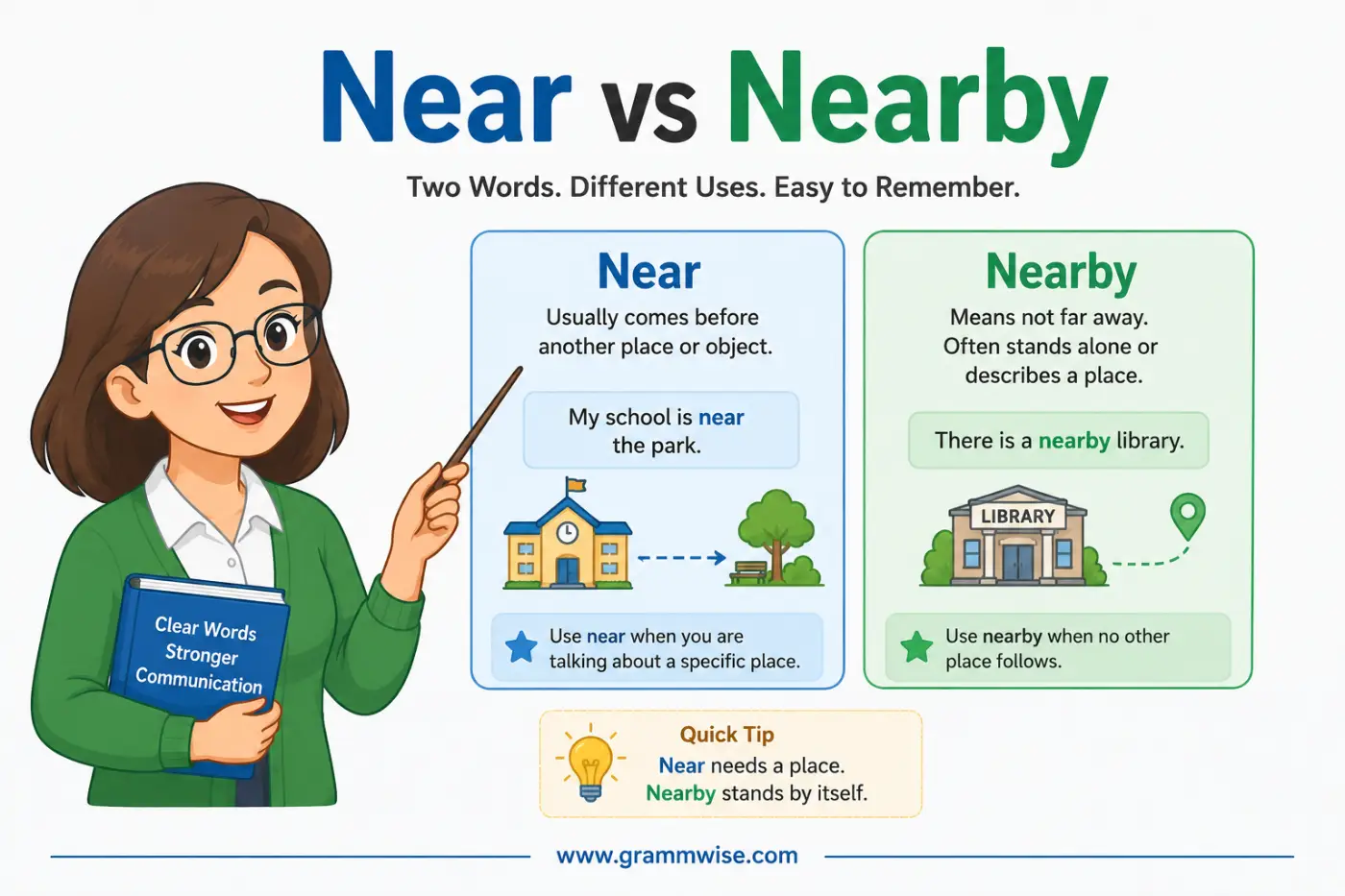
Many English learners get confused about near vs nearby because both words talk about distance. They both mean that something is not far away. Since they have similar meanings, people often wonder if they can use them in the same way.
The simple answer is this: near can be a preposition, an adjective, an adverb, and even a verb in some situations. Nearby is mainly an adjective or an adverb. Even though they are closely related, they do not always fit into the same sentence.
In this lesson, you will learn the difference between near vs nearby in very simple English. You will also see real-life examples, easy memory tricks, and common mistakes so you can use both words with confidence.
If you enjoy learning word differences, you may also like our guide on adapt vs adopt.
Simple Answer in One Look
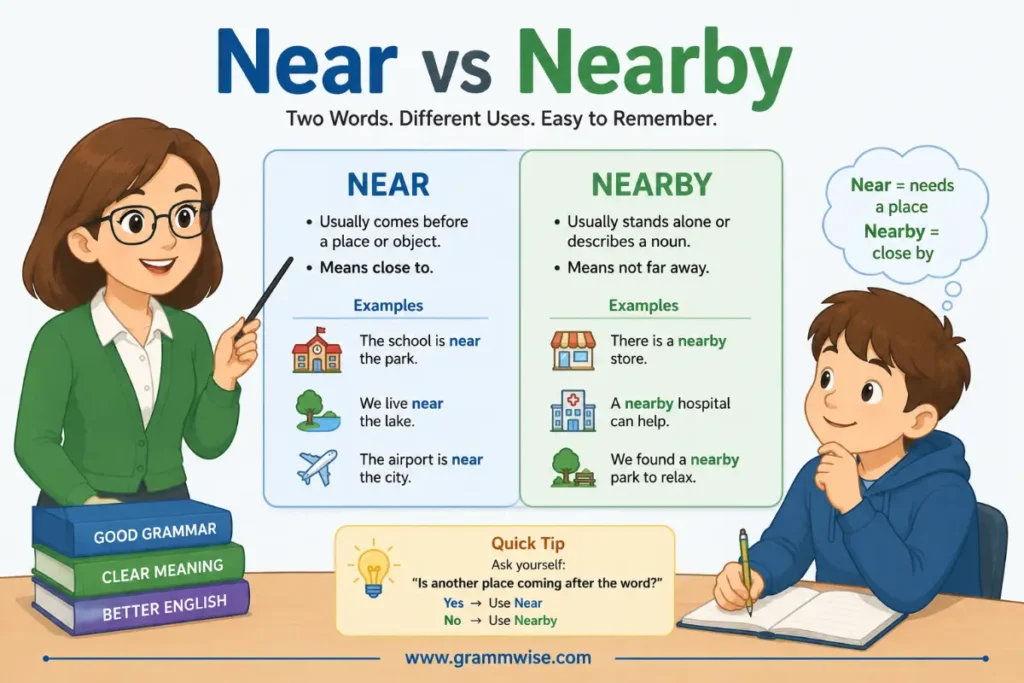
Near means “close to.”
Nearby means “not far away.”
Examples:
- My school is near the park.
- There is a nearby restaurant.
What Does Near vs Nearby Mean in Simple English?
Meaning of Near
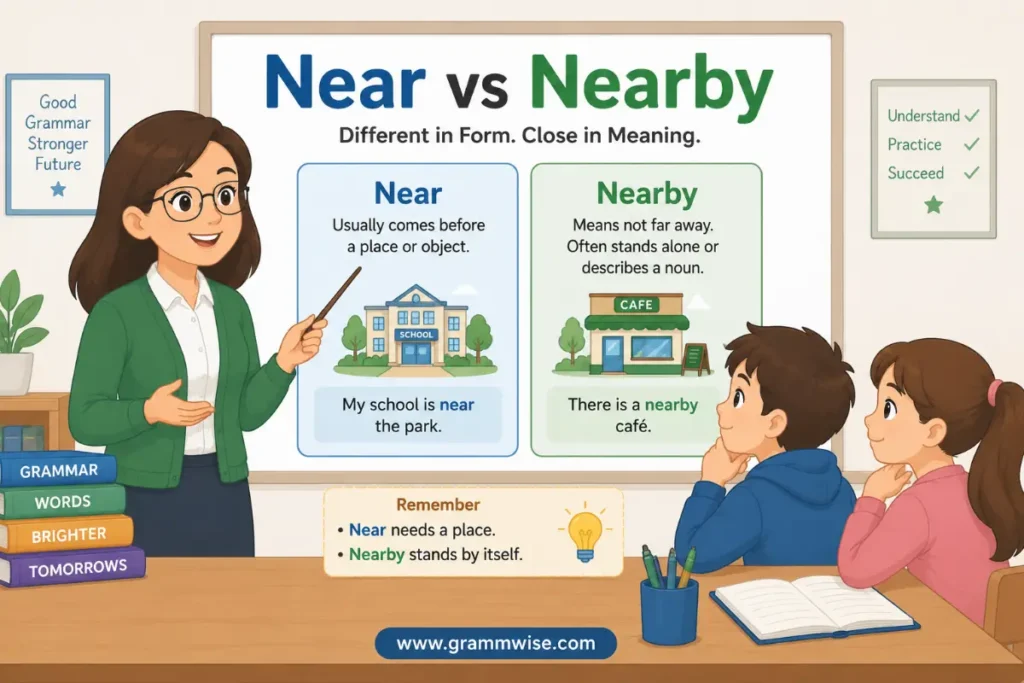
The word near means close to someone or something. It tells us that the distance is short.
For example:
“My house is near the library.”
The library is close to the house.
You can use near in many different ways.
Sometimes it comes before a place.
Examples:
- We live near the beach.
- She works near the airport.
- They parked near the school.
- The bus stopped near the station.
In all these sentences, near shows the location of something.
You can also use near to talk about time.
Examples:
- We are near the end of the school year.
- His birthday is near.
Here, near means “almost” or “close.”
Meaning of Nearby
The word nearby means not far away. It usually describes a place or tells where something is.
For example:
“There is a nearby café.”
The café is close.
You do not know the exact distance, but it is easy to reach.
You can also say:
“The café is nearby.”
Here, nearby tells where the café is.
Look at these examples:
- We found a nearby hotel.
- Is there a nearby hospital?
- She works at a nearby office.
- The children are playing nearby.
- My grandparents live nearby.
In every sentence, nearby means not far away.
Why Do People Mix These Words Near vs Nearby?
Many learners confuse near vs nearby because both talk about things that are close.
They also look almost the same.
Many people think adding -by does not change the meaning.
But English uses these words in different ways.
For example:
“We live near the lake.”
This sentence is correct.
“We live nearby the lake.”
This sentence is not correct.
Instead, you should say:
“We live near the lake.”
or
“We live nearby.”
That small difference causes confusion for many learners.
Near vs Nearby: Clear Difference Explained Simply
The easiest way to understand near vs nearby is to ask one question.
Is another noun coming after the word?
If yes, use near.
If no, you can often use nearby.
Here is a simple comparison.
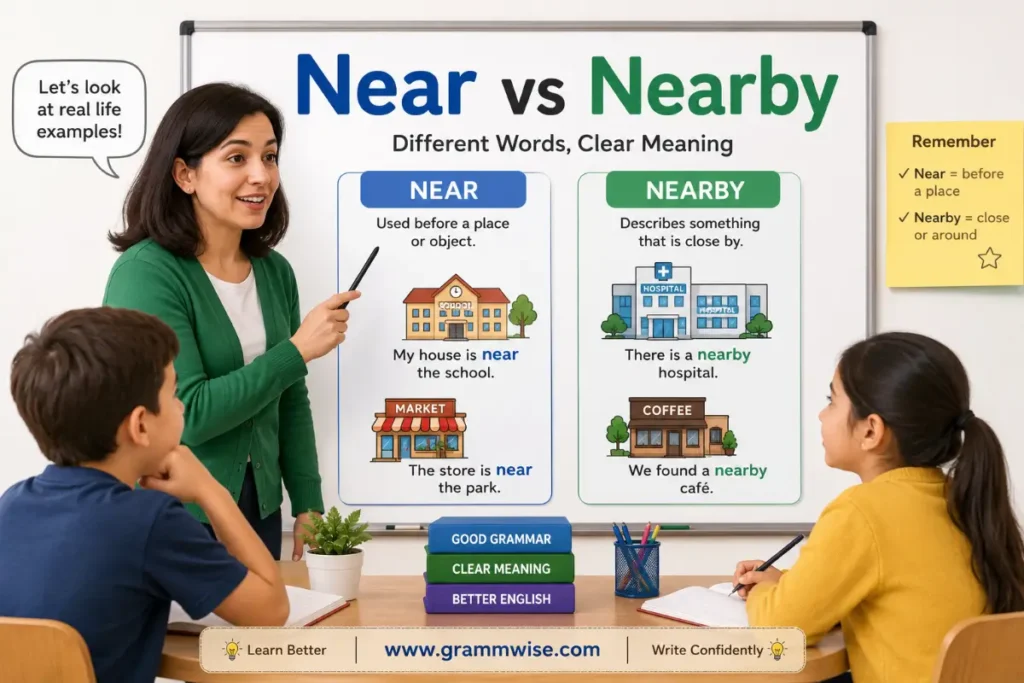
| Near | Nearby |
|---|---|
| Means close to | Means not far away |
| Usually comes before a noun | Often stands alone or describes a noun |
| Near the school | A nearby school |
| Near the park | Nearby shops |
Remember this simple rule:
Near + place
Nearby = close by
Near vs Nearby: Which Form Should You Use?
Ask yourself one simple question.
Is another place coming after the word?
If yes, use near.
Examples:
- near the school
- near my house
- near the station
- near the park
If no, use nearby.
Examples:
- The station is nearby.
- We found a nearby hotel.
- My grandparents live nearby.
- Is there a nearby pharmacy?
This question makes choosing much easier.
Easy Trick to Remember Near vs Nearby
Here is a memory trick.
Think about near. It likes company. It usually has another place after it.
Example:
Near the hospital.
Now think about nearby. It can stand by itself.
Example:
The hospital is nearby.
Remember this sentence:
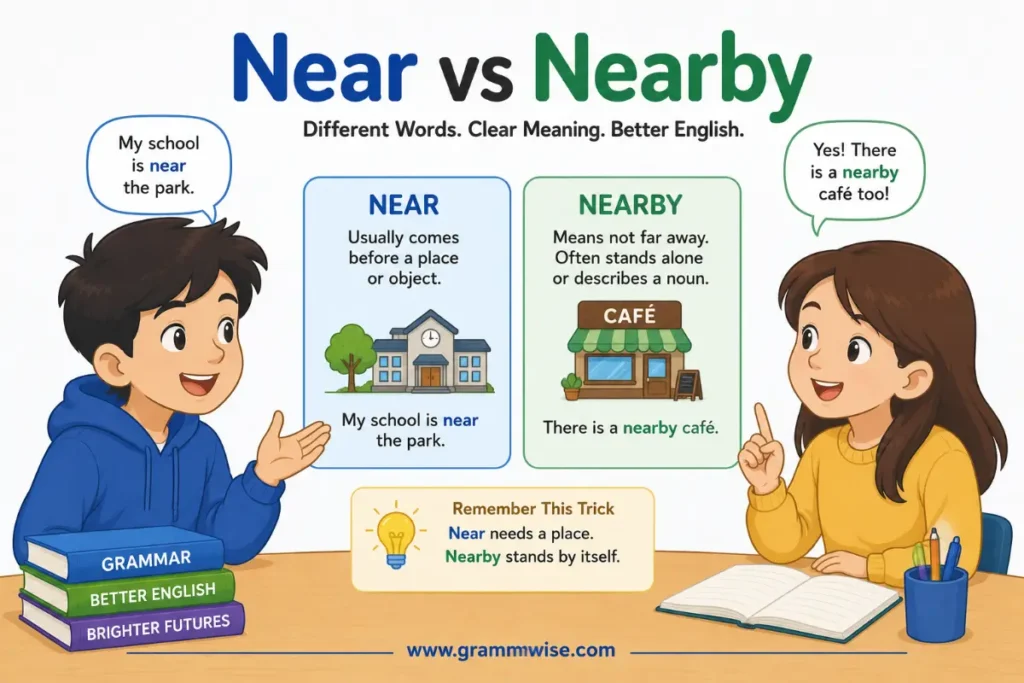
Near needs a place.
Nearby can stand alone.
This trick helps many students remember the difference.
Easy Real-Life Sentences on Near vs Nearby
Here are simple examples.
Near
- My school is near the library.
- We sat near the window.
- She lives near the beach.
- The shop is near the station.
- He stood near the door.
- The hotel is near the airport.
- Our house is near a park.
- They met near the bridge.
Nearby
- There is a nearby restaurant.
- The children are playing nearby.
- My grandparents live nearby.
- We stayed in a nearby hotel.
- Is there a nearby bank?
- I found a nearby coffee shop.
- Help is nearby.
- A doctor lives nearby.
Common Words Used with Near
Here are common phrases.
- near home
- near school
- near town
- near the beach
- near the station
- near the airport
- near the river
- near the door
- near the office
- near the park
These all show where something is.
Common Words Used with Nearby
These are common combinations.
- nearby hotel
- nearby school
- nearby shop
- nearby hospital
- nearby restaurant
- nearby café
- nearby park
- nearby office
- nearby town
- nearby village
These describe places that are close.
Common Mistakes People Make
Many learners make the same mistakes.
Incorrect: We live nearby the station.
Correct: We live near the station.
Or
Correct: We live nearby.
Another example:
Incorrect: There is near restaurant.
Correct: There is a nearby restaurant.
Another mistake:
Incorrect: The school is near by.
Correct: The school is nearby.
Remember that nearby is one word.
Another example:
Incorrect: A near by hotel.
Correct: A nearby hotel.
Always write nearby as one word.
Near vs Nearby: Where Do These Words Come From?
The word near has been part of English for hundreds of years. It comes from an old English word that meant “close” or “close at hand.”
Later, English speakers created the word nearby by joining near and by into one word.
Over time, nearby became a common way to describe places that are close.
Today, both words are used every day, but each has its own job in a sentence.
How Are Near and Nearby Understood in Culture and Stories?
Writers often use near and nearby to help readers imagine where people and places are. The word near usually tells us that one thing is close to another.
For example:
- A small village is near a river.
- A castle stands near the forest.
- A child sits near the fire.
These examples help readers picture the location clearly.
The word nearby often describes something close without giving an exact place.
For example:
- A nearby village helped the travelers.
- The children found a nearby cave.
- A nearby shop sold fresh bread.
Readers know the place is close, even if they do not know the exact distance. Many adventure stories use these words together.
For example:
“The campers stayed near the lake.”
“There was a nearby cabin where they found shelter.”
The first sentence tells the exact location.
The second sentence simply tells us the cabin was close.
Knowing the difference between near vs nearby helps you understand stories more easily.
Biblical and Mythological Meaning of Near vs Nearby
The words near and nearby are not special religious words, but the idea of being close appears often in religious writings and old stories.
Many Bible translations use near to describe people, places, or even relationships.
For example:
- God is near those who pray.
- The city was near the mountain.
The word nearby is more common in modern English than in older religious writing.
In myths and legends, heroes often travel near rivers, mountains, or castles.
They may also discover a nearby village or a nearby cave during their journey.
The meanings stay simple.
Near shows closeness to something.
Nearby describes something that is not far away.
Symbolism of Near vs Nearby Explained in Simple Words
Words can also have deeper meanings.
What Near Represents?
Near often represents closeness. It can describe friendship, family. It can even describe reaching a goal.
For example:
- We are near success.
- She stayed near her friends.
- The finish line is near.
The word gives people a feeling of comfort and hope.
What Nearby Represents?
Nearby often represents convenience.
It reminds us that help, safety, or opportunities are close.
Think about these examples.
- A nearby hospital
- A nearby school
- A nearby friend
- A nearby store
These examples make people feel that what they need is easy to reach.
A simple way to remember the symbolism is this:
Near represents closeness.
Nearby represents something close and easy to find.
Related Words You Should Know
Learning related words helps you build a stronger vocabulary.
Close: A short distance away.
Example: The shop is close to my house.
Close By: Not far away.
Example: A café is close by.
Around: In the nearby area.
Example: Is there a bank around here?
Next To: Right beside something.
Example: The library is next to the school.
Beside: At the side of something.
Example: She sat beside her friend.
Around the Corner: Very close.
Example: The bakery is around the corner.
Within Walking Distance: Close enough to walk.
Example: The hotel is within walking distance.
Local: In the same area.
Example: We visited the local market.
Each of these expressions talks about distance, but each has its own meaning.
Near vs Nearby Compared with Similar Words
Many learners ask which words are similar.
Here is a simple guide.
Near is close to:
- close to
- beside
- next to
- by
- not far from
Nearby is close to:
- close by
- around here
- in the area
- not far away
- close at hand
These expressions have similar meanings, but they are not always used in the same way.
Always remember this simple question:
Is another place coming after the word?
If yes, use near.
If no, nearby is often the better choice.
How People Actually Use Near and Nearby in Daily English
Here are natural examples you may hear every day.
- “My office is near the train station.”
- “There is a nearby supermarket.”
- “My grandparents live nearby.”
- “We sat near the window.”
- “Is there a nearby pharmacy?”
- “The children stayed near their parents.”
- “I found a nearby parking lot.”
- “The hotel is near the airport.”
- “There are several nearby restaurants.”
- “Our teacher lives nearby.”
These are common examples in everyday English.
Near vs Nearby in Travel
Travelers use these words all the time.
For example:
“The hotel is near the beach.”
“We found a nearby café.”
“Is there a nearby ATM?”
“The museum is near the city center.”
“The guide showed us several nearby attractions.”
Using the correct word makes asking for directions much easier.
Near vs Nearby in School Writing
Students often use these words in essays.
Correct examples:
“Our school is near the park.”
“There is a nearby library where students study.”
One sentence connects two places.
The other describes the library.
Both are correct.
Near vs Nearby in Business English
Businesses also use these words.
Examples:
“Our office is near the railway station.”
“We opened a nearby branch.”
“There are several nearby hotels for visitors.”
Correct word choice makes business writing sound more natural.
Common Mistakes People Make
Many English learners make the same mistakes.
Mistake 1
❌ We live nearby the airport.
✅ We live near the airport.
Or
✅ We live nearby.
Mistake 2
❌ There is near hospital.
✅ There is a nearby hospital.
Mistake 3
❌ The restaurant is near by.
✅ The restaurant is nearby.
Remember that nearby is always one word.
Mistake 4
❌ A near by school opened last year.
✅ A nearby school opened last year.
Mistake 5
❌ The children played near.
✅ The children played nearby.
When no place follows the word, nearby is usually the better choice.
Easy Practice Quiz
Choose the correct answer.
- My office is ________ the bank.
- We found a ________ café.
- My cousins live ________.
- The bus stopped ________ the museum.
- Is there a ________ hotel?
- My house is ________ the park.
- We stayed in a ________ hotel.
- Is there a pharmacy ________?
- The children stood ________ their teacher.
- We visited a ________ museum.
Answers:
- near
- nearby
- nearby
- near
- nearby
- near
- nearby
- nearby
- near
- nearby
If you answered all five correctly, you understand the difference very well.
Final Teacher Explanation
Imagine I am standing in front of the classroom with two signs.
The first sign says Near.
The second sign says Nearby.
The word near likes to point to another place.
For example:
- Near the school.
- Near the park.
- Near my house.
The word nearby does not need another place after it.
For example:
The school is nearby.
A nearby park.
You do not need difficult grammar rules.
Just remember one simple question.
“Is another place coming after the word?”
If the answer is yes, use near.
If the answer is no, nearby is usually the correct choice.
With practice, using near vs nearby will become easy and natural.
Quick Recap
The difference between near vs nearby is simple.
Near usually comes before another place, while nearby describes something that is close or stands alone.
Remember this easy trick: Near needs a place. Nearby stands by itself. That simple rule will help you choose the correct word every time.
Conclusion
Understanding near vs nearby is simple once you know how each word works. Near usually comes before a place or object, while nearby describes something that is not far away or stands on its own. Remembering this difference will help you speak and write more naturally.
Whenever you are unsure, ask yourself, “Is another place coming after the word?” If the answer is yes, use near. If the answer is no, nearby is usually the right choice. With regular practice and everyday examples, using these two words correctly will soon become easy.
Frequently Asked Questions (FAQs)
What is the difference between near and nearby?
Near usually comes before another place or object. Nearby means not far away and often stands alone or describes a noun.
Is near the same as nearby?
No. They have similar meanings, but they are used differently in a sentence.
When should I use near?
Use near before a place or object, such as near the school or near my house.
When should I use nearby?
Use nearby to describe something close or when no place follows the word, such as a nearby shop or The shop is nearby.
Why do people confuse near and nearby?
They have similar meanings and almost the same spelling, so many learners think they work the same way.
Can I say “nearby the park”?
No. Say near the park or simply nearby if no place follows.
Is nearby one word or two?
Nearby is always written as one word.
How can I remember the difference between near and nearby?
Remember this easy classroom trick: Near needs a place. Nearby stands by itself. This simple rule works in most situations.