
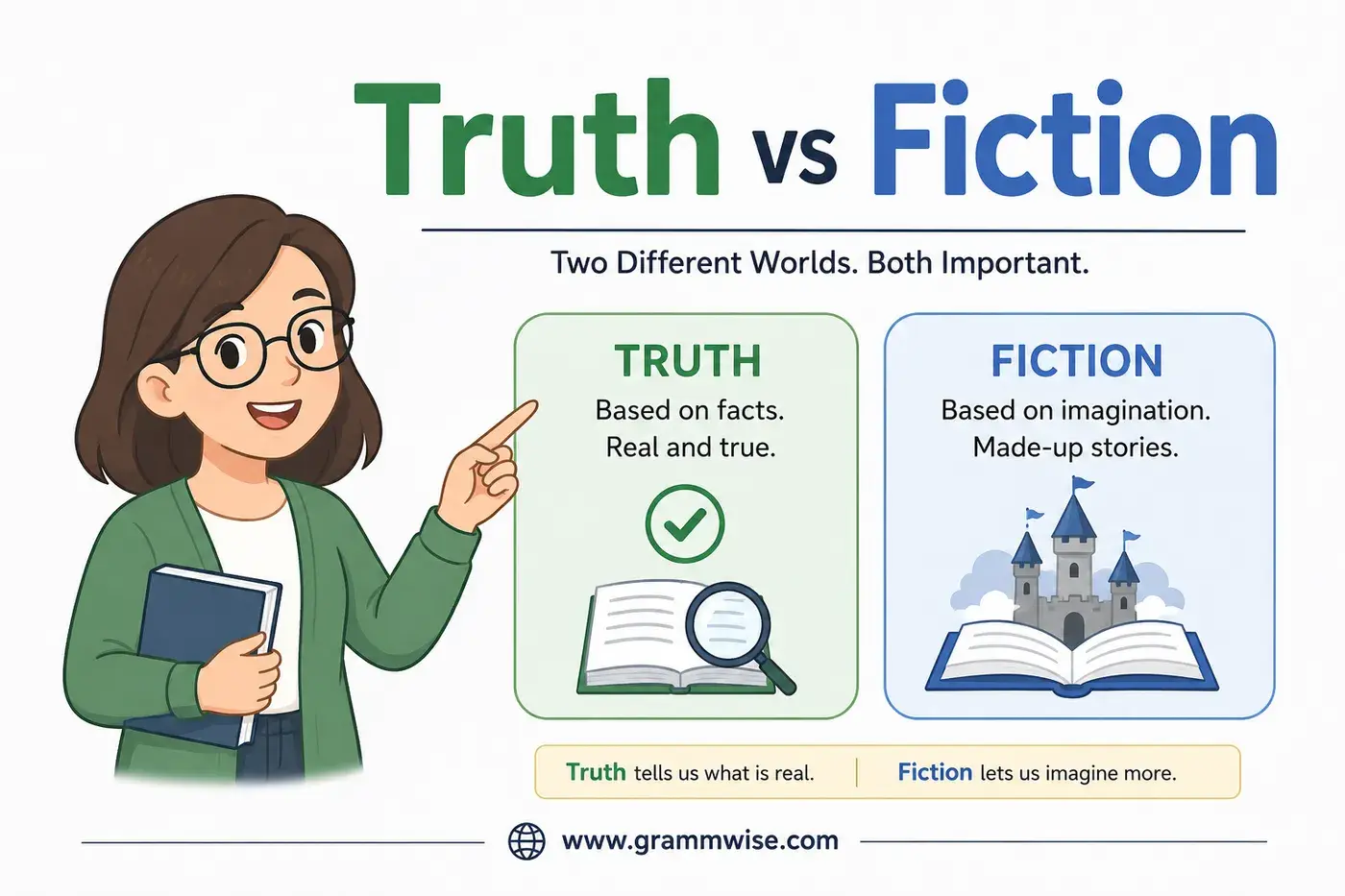
Many English learners get confused about Truth vs Fiction because both words are used in stories, books, movies, and everyday conversations. One talks about real facts, while the other talks about made-up stories. Knowing the difference will help you understand what is real and what comes from imagination.
If you have ever wondered which word to use, you are not alone. People often hear these words when reading books, watching films, or talking about news. Once you learn their meanings, it becomes much easier to tell them apart.
In this guide, I will explain Truth vs Fiction in simple English. You will learn what each word means, why people confuse them, how to use them correctly, and easy ways to remember the difference.
English has many word pairs with subtle differences in meaning and usage such as eldest vs oldest.
Simple Answer in One Look
- Truth means something that is real, correct, or based on facts.
- Fiction means a made-up story or something created from imagination.
Easy rule:
- Truth = Real facts
- Fiction = Made-up stories
Meaning of “Truth vs Fiction” in Simple English
These two words have opposite meanings.
What does “truth” mean?
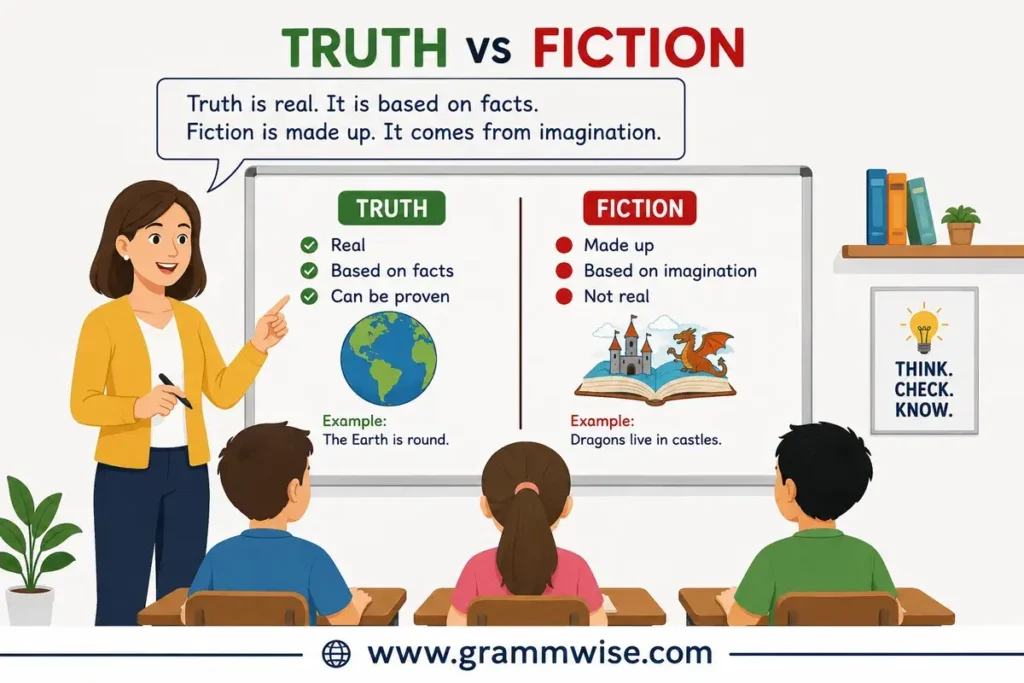
Truth means something that is real or correct.
It is based on facts.
Truth does not change because of someone’s opinion.
For example:
- She told the truth.
- The news reported the truth.
- Scientists search for the truth through research.
In each example, the word truth means something real.
What does “fiction” mean?
Fiction means a story that comes from imagination.
The people, places, or events may not be real.
Fiction is written to entertain, teach lessons, or help readers imagine new worlds.
For example:
- I enjoy reading fiction books.
- That movie is fiction.
- The writer created a fiction story about space travel.
These examples describe stories that are not real.
Why People Mix These Words “Truth vs Fiction”?
Many learners confuse these words for a few simple reasons.
1. Both are connected with stories.
Some stories are completely true.
Others are completely fictional.
Some stories even mix real facts with imaginary parts.
This makes it hard to know which word to use.
2. Movies and books sometimes combine both.
A movie may begin with real history but add fictional characters.
A novel may include real places but imaginary events.
Because of this, people sometimes wonder if a story is truth or fiction.
3. Some news online is misleading.
Today, people read information from many places.
Not everything they read is true.
Learning the difference between truth and fiction helps people think carefully before believing something.
4. Both words appear in school.
Students learn about fiction books and nonfiction books.
They also learn about finding the truth through facts and evidence.
Since both words are common in education, learners sometimes confuse them.
Clear Difference Between “Truth vs Fiction” Explained Simply
The easiest way to understand the difference is to think about reality.
| Truth | Fiction |
|---|---|
| Based on facts | Based on imagination |
| Real | Made up |
| Can be proven | Created by the writer |
| Found in real events | Found in stories and novels |
Think about these questions.
Did this really happen?
If yes, it is truth.
Did someone imagine or create it?
If yes, it is fiction.
A quick comparison
Truth
- facts
- evidence
- history
- real events
- honest answers
- scientific discoveries
Fiction
- novels
- fairy tales
- fantasy
- superheroes
- magical worlds
- imaginary characters
Truth vs Fiction: Which Form Should You Use?
Ask yourself one simple question.
Are you talking about something real?
If yes, choose truth.
Examples:
- Always tell the truth.
- We searched for the truth.
- The report tells the truth.
Are you talking about an imaginary story?
If yes, choose fiction.
Examples:
- She enjoys reading fiction.
- That movie is fiction.
- The author writes fiction for children.
Can a story contain both?
Yes.
Some stories are based on real events but include imaginary characters or conversations.
These are sometimes called historical fiction.
The main story may come from history, but some parts are created by the writer.
A Simple Memory Trick for “Truth vs Fiction”
Here is an easy way to remember.
Think of the word fact. Facts belong with truth.
Now think of the word fantasy. Fantasy belongs with fiction.
So remember:
Truth = Facts
Fiction = Fantasy
Another easy trick is this:
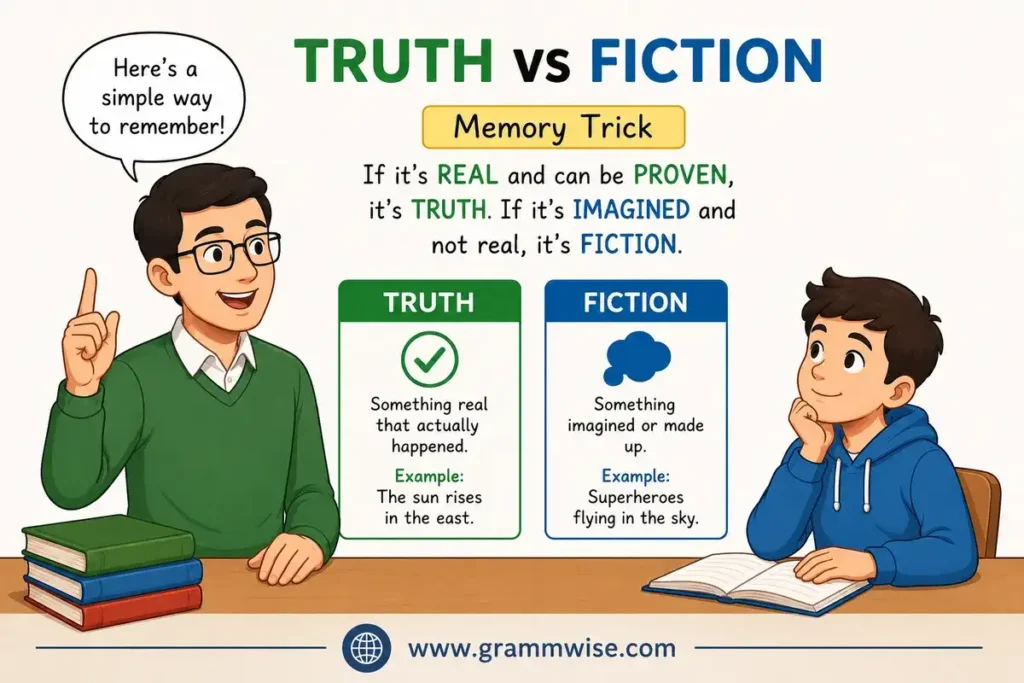
If something can be proven, it is usually truth.
If it comes from imagination, it is fiction.
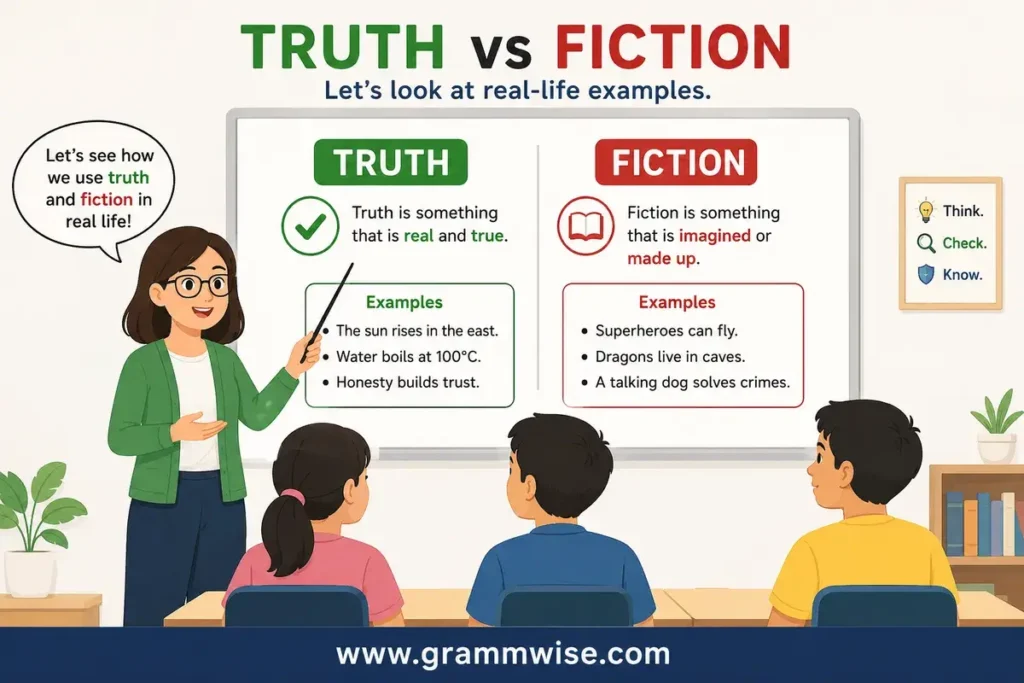
Easy Real-Life Sentences on “Truth vs Fiction”
Here are some natural examples.
Using “truth”
- She always tells the truth.
- The teacher explained the truth.
- We want to know the truth.
- His story was based on truth.
- Scientists work hard to discover the truth.
- Please tell me the truth.
- The police searched for the truth.
Using “fiction”
- My favorite books are fiction.
- He writes fiction for children.
- That movie is fiction.
- She enjoys science fiction novels.
- The story is pure fiction.
- This library has a large fiction section.
- I like reading fiction before bed.
Everyday conversation examples
Correct
“I always try to tell the truth.”
“This book is fiction, but it is very exciting.”
“The reporter wanted to discover the truth.”
“My daughter loves fiction stories about dragons.”
“The documentary tells the truth about the event.”
These examples show that truth is connected with facts, while fiction is connected with imagination.
Truth vs Fiction: Where These Words Come From?
The words truth and fiction have different histories.
The word truth comes from very old English. It has always been connected with honesty, facts, and things that are real.
The word fiction comes from Latin. It originally meant to shape or create. Over time, it became the English word for stories created from imagination.
Today, both words are used around the world.
Truth helps us understand reality.
Fiction helps us use our imagination and enjoy creative stories.
Both are valuable, but they serve different purposes.
Knowing the difference between Truth vs Fiction helps you become a better reader, writer, and speaker. It also helps you understand books, movies, news, and conversations with greater confidence.
How These Words “Truth vs Fiction” Are Understood in Culture and Stories?
The words truth and fiction are found in almost every culture around the world. People have always shared both real events and imaginary stories. Each has a different purpose.
Truth is often connected with honesty, trust, and learning. Parents teach children to tell the truth. Teachers encourage students to use facts in their schoolwork. Friends build strong relationships by being truthful with each other.
Many stories also show that telling the truth is the right choice, even when it is difficult. A character who tells the truth often earns respect and trust.
Fiction, on the other hand, is connected with creativity and imagination. Fiction allows writers to create exciting adventures, magical worlds, talking animals, superheroes, and unforgettable characters.
Children grow up listening to fairy tales and bedtime stories. Adults enjoy novels, movies, and television shows that tell fictional stories. Even though these stories are not real, they can teach valuable lessons about courage, kindness, friendship, and hope.
Truth helps us understand the real world.
Fiction helps us imagine new worlds.
Both are important in different ways.
Biblical and Mythological Meaning of “Truth vs Fiction”
The Bible often teaches people to value truth.
Many passages encourage honesty, faithfulness, and speaking the truth with kindness. Truth is shown as something that helps people build trust and make wise decisions.
The Bible does not use the word fiction in the modern sense of novels or fantasy stories. However, Jesus often taught through parables. These were simple stories that helped people understand important lessons. While the stories were used for teaching, their purpose was to explain spiritual truths.
In mythology, many stories are considered fictional because they include gods, magical creatures, and impossible events. These stories were created to explain nature, teach lessons, or entertain people.
Today, mythology is usually understood as part of literature and culture rather than historical fact.
Symbolism of “Truth vs Fiction” Explained in Simple Words
What “Truth” Represents?
The word truth often represents:
- honesty
- trust
- fairness
- wisdom
- knowledge
- reality
- integrity
- justice
People usually connect truth with doing the right thing.
When someone tells the truth, others are more likely to trust them.
What “Fiction” Represents?
The word fiction often represents:
- imagination
- creativity
- adventure
- dreams
- entertainment
- storytelling
- fantasy
- new ideas
Fiction allows people to explore places and situations that may never happen in real life.
Many great inventions even began as fictional ideas before becoming real.
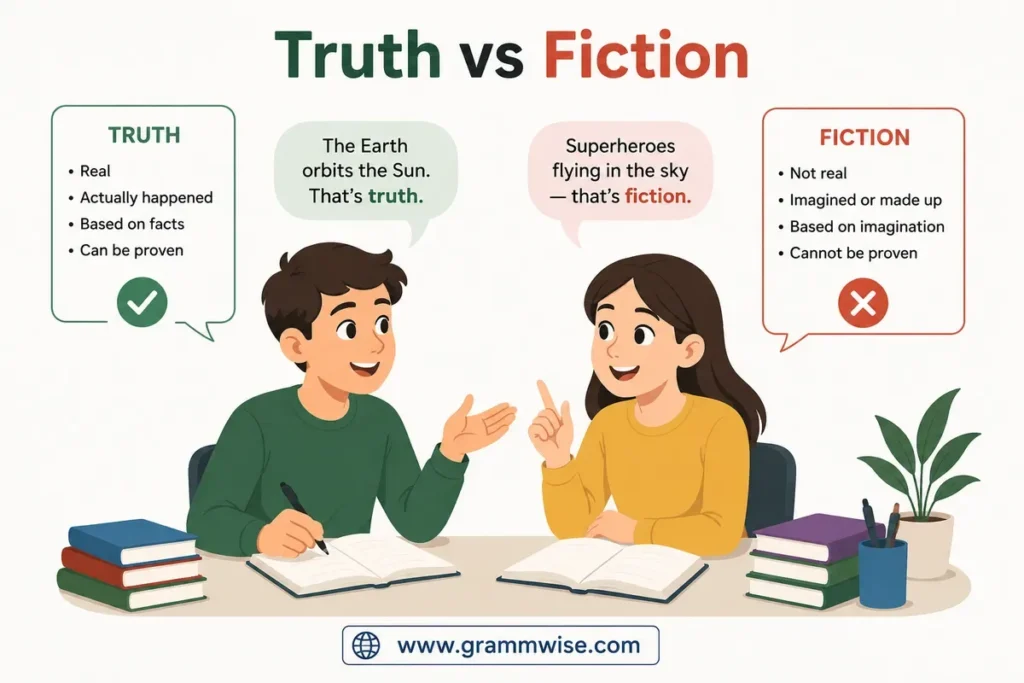
Related Words You Should Know
Learning related words makes it easier to understand Truth vs Fiction.
Fact: Something that can be proven to be true.
Reality: The real world as it truly exists.
Honesty: Telling the truth and being sincere.
Evidence: Facts that help prove something.
Nonfiction: Books or writing based on real facts and real events.
Novel: A long fictional story.
Fantasy: A type of fiction with magic, imaginary worlds, or magical creatures.
Myth: An old traditional story that often explains nature or culture.
Legend: A traditional story that may contain both real and imaginary parts.
Storytelling: The act of sharing stories with other people.
These words often appear in books, schools, libraries, and everyday conversations.
How People Actually Use “Truth vs Fiction” in Daily English
Here are some natural examples.
Using “Truth”
- Please tell me the truth.
- We are trying to discover the truth.
- The witness told the truth in court.
- She always speaks the truth.
- The report revealed the truth.
Using “Fiction”
- My favorite books are fiction.
- She enjoys historical fiction.
- This movie is fiction.
- He writes fiction for young readers.
- The library has a large fiction section.
Everyday Conversations
“I want to know the truth.”
“That story is fiction, but it is very interesting.”
“The newspaper tried to report the truth.”
“My son loves science fiction books.”
“Sometimes fiction teaches important life lessons.”
These examples show how naturally native English speakers use both words.
Common Mistakes People Make About “Truth vs Fiction”
Many learners make small mistakes because both words are connected with stories.
Here are some common examples.
Mistake 1
❌ This newspaper is fiction.
✅ This newspaper reports the truth.
Newspapers are expected to report real facts.
Mistake 2
❌ Harry Potter is truth.
✅ Harry Potter is fiction.
It is an imaginary story.
Mistake 3
❌ Always tell fiction.
✅ Always tell the truth.
People tell the truth, not fiction.
Mistake 4
❌ This history book is fiction.
✅ This history book is nonfiction.
History books are based on real events.
The easiest way to avoid mistakes is to ask yourself one question.
Is it real or imagined?
If it is real, choose truth.
If it comes from imagination, choose fiction.
Final Teacher Explanation
Now imagine we are finishing today’s English lesson.
Here is the easiest way to remember Truth vs Fiction.
If something is real, based on facts, or can be proven, use truth.
If something is imaginary, created by a writer, or made for entertainment, use fiction.
There is nothing wrong with fiction. Fiction helps us enjoy stories, dream about new ideas, and learn valuable lessons through imagination.
Truth is different because it helps us understand the real world and make good decisions based on facts.
Remember these two simple ideas.
Truth = Facts
Fiction = Imagination
Whenever you are unsure, ask yourself one question.
“Did this really happen, or was it created by someone’s imagination?”
The answer will help you choose the correct word every time.
Quick Recap
The difference between Truth vs Fiction is simple.
Use truth for real facts, honesty, and things that actually happened.
Use fiction for imaginary stories, made-up characters, and creative writing.
Just remember:
Truth = Reality
Fiction = Imagination
Conclusion
Understanding Truth vs Fiction is easy once you know the basic difference. Truth is based on real facts and honesty, while fiction is created from imagination for entertainment or storytelling. Knowing when to use each word will help you read, write, and communicate more clearly.
Keep practicing these words in everyday situations, books, and conversations. Remember this simple rule: Truth = Facts and Fiction = Imagination. With this easy trick, you can avoid confusion and use both words confidently.
Frequently Asked Questions
What does truth mean in simple words?
Truth means something that is real, correct, or based on facts.
What does fiction mean?
Fiction means a story that comes from imagination and is not based on real events.
What is the difference between truth vs fiction?
Truth is real and factual. Fiction is created from imagination.
Can fiction teach real lessons?
Yes. Fiction is imaginary, but it can teach important lessons about life, friendship, courage, and kindness.
Is a novel fiction?
Most novels are fiction because they tell imagined stories, although some are based on real events.
What is nonfiction?
Nonfiction is writing based on real people, real facts, and real events.
Why do people confuse truth vs fiction?
Some stories mix real events with imaginary parts, making it harder to know which parts are factual.
How can I remember the difference between truth and fiction?
Think of Truth = Facts and Fiction = Imagination. This simple rule will help you choose the correct word.