
Many English learners get confused about Eldest vs Oldest because both words talk about age. They seem almost the same, but they are not always used in the same way. Knowing the difference will help you speak and write English more naturally.
If you have ever wondered which word is correct, you are not alone. One word is mainly used for people in a family, while the other can be used for people, animals, places, and things. Once you know this simple rule, choosing the right word becomes much easier.
In this guide, I will explain Eldest vs Oldest in simple English. You will learn what each word means, why people confuse them, how to use them correctly, and easy tricks to remember the difference.
Understanding word differences improves writing clarity and communication.
Simple Answer in One Look
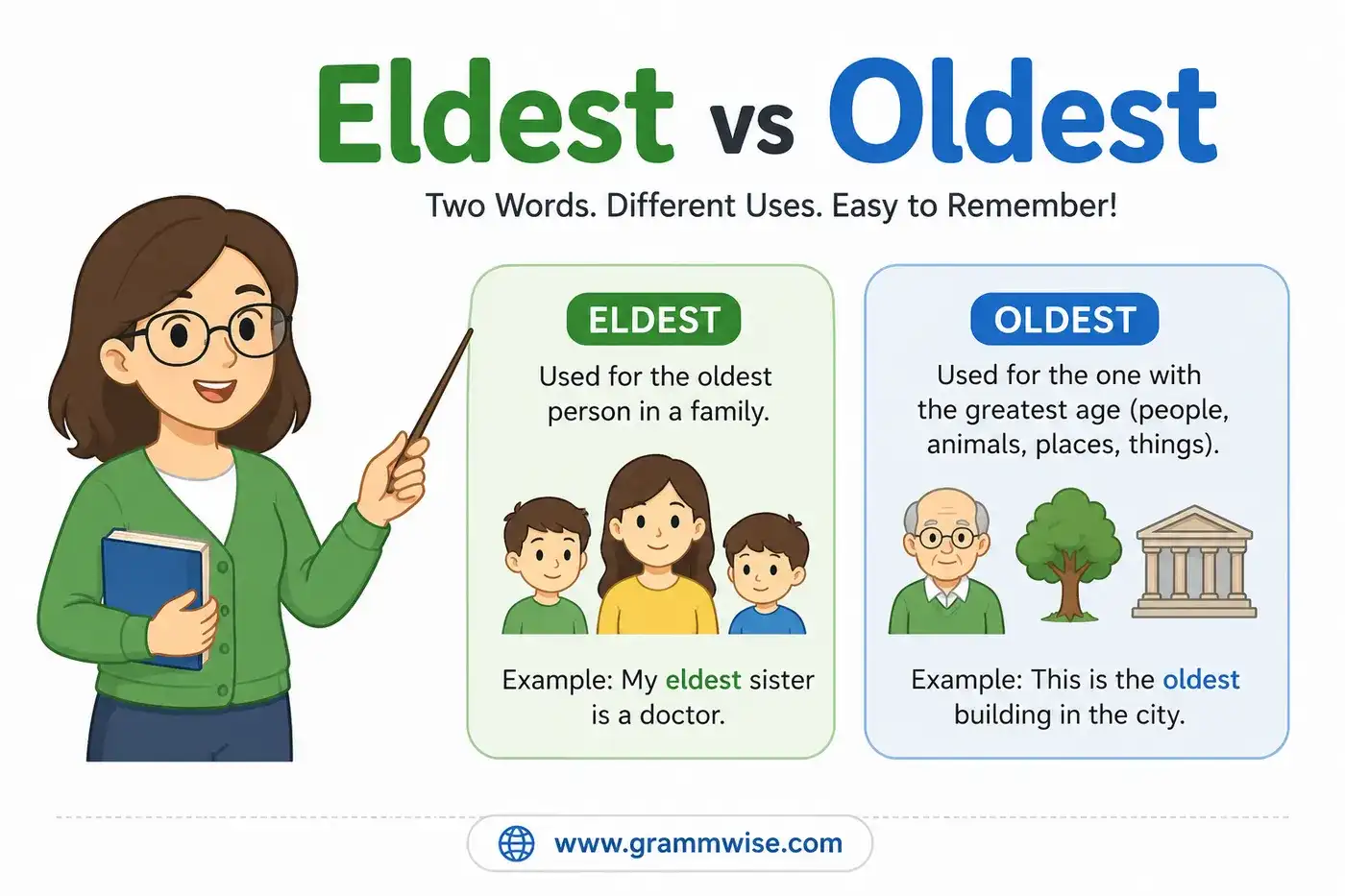
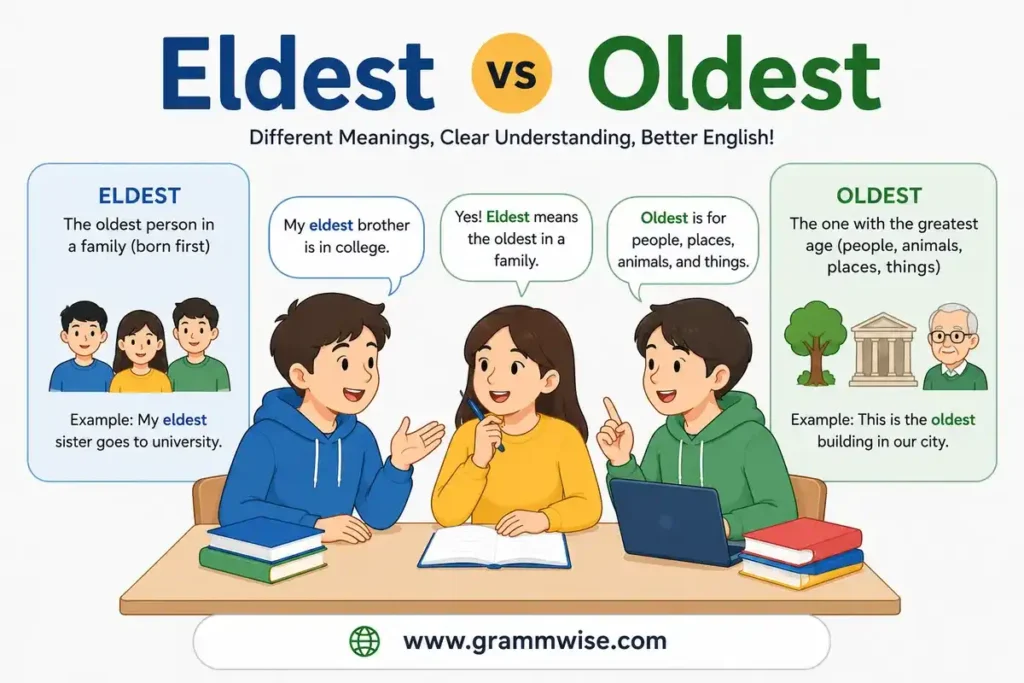
- Eldest means the oldest person in a family.
- Oldest means the one with the greatest age among people, animals, places, or things.
Easy rule:
- Eldest = Family
- Oldest = Everything else
Meaning of “Eldest vs Oldest” in Simple English
These two words both describe age, but they are used in different situations.
What does “eldest” mean?
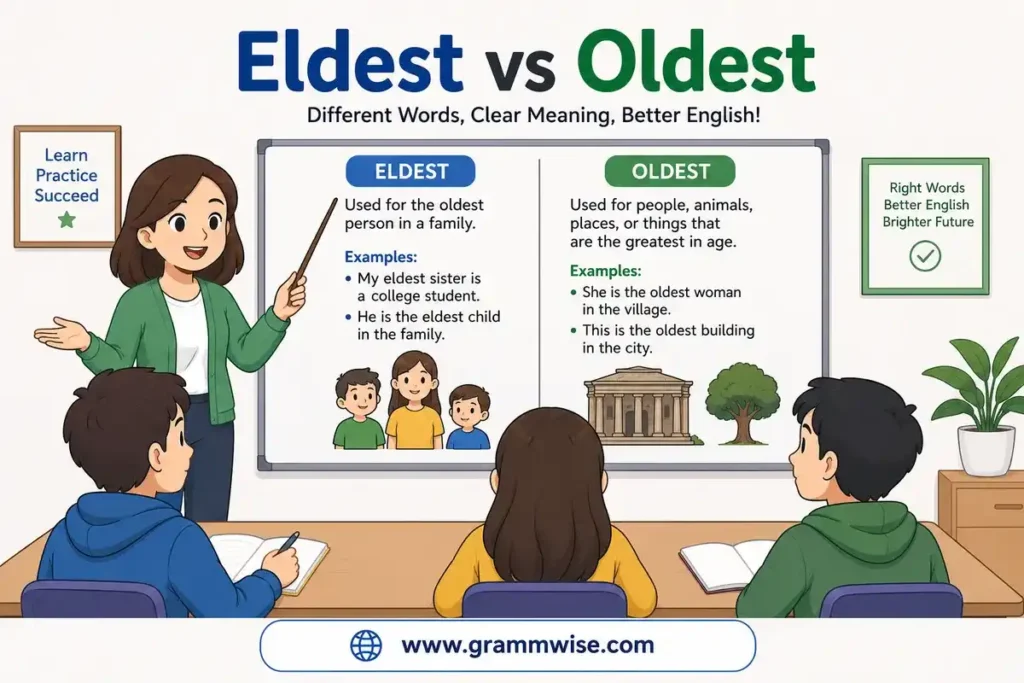
Eldest is usually used when talking about brothers, sisters, or children in the same family.
It tells us who was born first.
For example:
- My eldest brother lives in Canada.
- She is the eldest daughter.
- Their eldest child starts college this year.
In these examples, eldest is used because the people belong to the same family.
What does “oldest” mean?
Oldest means having lived longer than others.
It can describe people, animals, buildings, cities, trees, books, and many other things.
For example:
- He is the oldest man in the village.
- This is the oldest tree in the park.
- The museum has one of the oldest maps in the country.
Here, oldest compares age in a general way.
Why People Mix These Words “Eldest vs Oldest”?
Many learners confuse these words for a few simple reasons.
1. Both talk about age.
Both words compare how old someone or something is.
This makes many people think they always mean the same thing.
2. They come from the same word.
Both eldest and oldest are related to the word old.
Because of this, their meanings are close.
3. Sometimes both words are correct.
When talking about family members, both words are often possible.
For example:
- My eldest sister is a doctor.
- My oldest sister is a doctor.
Both sentences are correct.
However, eldest sounds more traditional and is more closely connected with family relationships.
4. Many learners translate directly from their first language.
In some languages, there is only one word for both ideas.
When learners translate directly into English, they may not know which word fits better.
Clear Difference Between “Eldest vs Oldest” Explained Simply
The easiest way to remember the difference is to think about family.
| Eldest | Oldest |
|---|---|
| Usually used for family members | Used for people, animals, places, and things |
| Talks about birth order | Talks about age in general |
| Mostly brothers, sisters, sons, and daughters | Can describe almost anything |
| Example: My eldest son. | Example: The oldest building. |
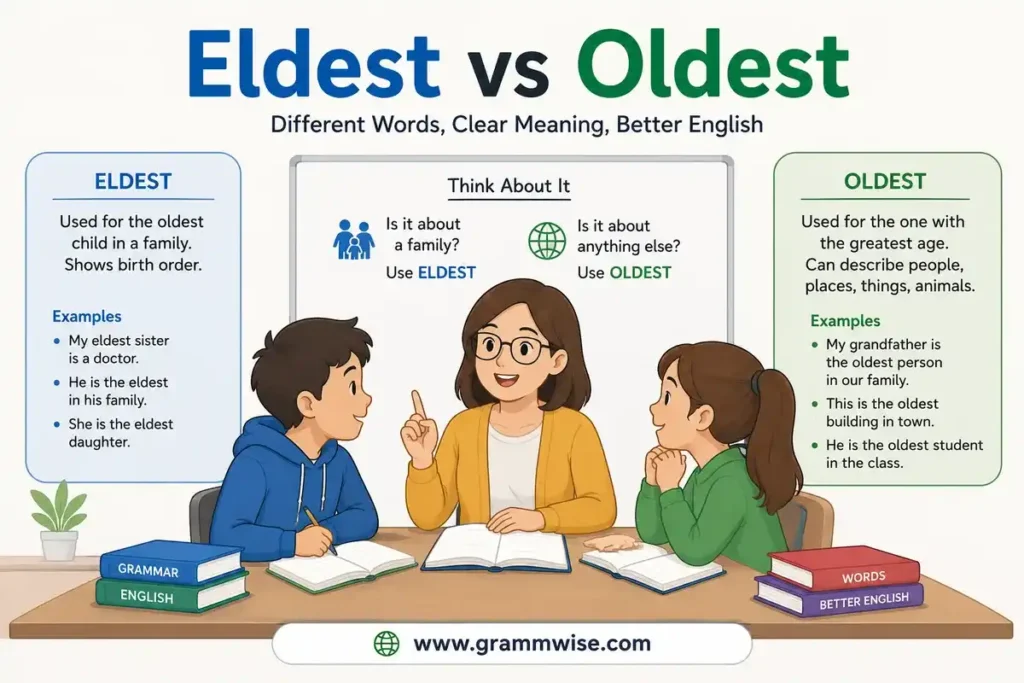
Think about these questions.
Are you talking about brothers, sisters, or children in one family?
If yes, eldest is usually the best choice.
Are you talking about anything else?
If yes, use oldest.
A quick comparison
Eldest
- brother
- sister
- son
- daughter
- child
Oldest
- teacher
- man
- woman
- dog
- tree
- city
- building
- book
- car
Eldest vs Oldest: Which Form Should You Use?
Ask yourself one simple question.
Are you talking about family members?
If yes, choose eldest.
Examples:
- My eldest brother is an engineer.
- Their eldest daughter loves painting.
- She is the eldest child in the family.
Are you talking about people in general or about things?
If yes, choose oldest.
Examples:
- She is the oldest person in the town.
- That is the oldest bridge in the city.
- Our dog is the oldest pet in the house.
Can you use “oldest” for family members?
Yes.
Many native English speakers say:
- My oldest brother.
- My oldest sister.
These are completely correct.
However, eldest often sounds a little more formal and clearly shows that you are talking about members of the same family.
A Simple Memory Trick for “Eldest vs Oldest”
Here is an easy way to remember.
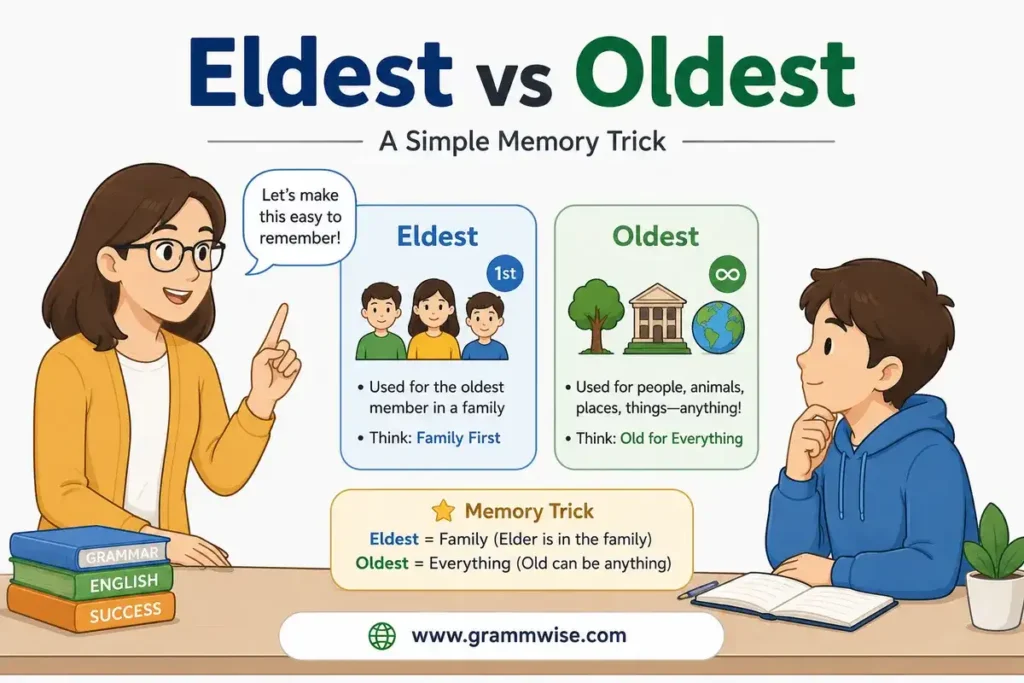
Think of the word elder.
People often use elder when talking about older family members or relatives.
Since eldest comes from elder, it is easy to connect it with family.
Now think about oldest.
It comes from old.
Anything can be old.
A tree can be old.
A house can be old.
A city can be old.
So:
Eldest = Family
Oldest = General age
This simple trick helps many learners remember the correct word.
Easy Real-Life Sentences on “Eldest vs Oldest”
Here are some natural examples.
Using “eldest”
- My eldest sister is a teacher.
- Their eldest son loves soccer.
- She is the eldest child in the family.
- Our eldest brother lives overseas.
- His eldest daughter just graduated.
- My eldest cousin is getting married.
- The eldest grandson visited his grandparents.
Using “oldest”
- She is the oldest student in the class.
- This is the oldest church in the city.
- The oldest tree is over 300 years old.
- My grandfather is the oldest person in our family.
- That is the oldest dog at the animal shelter.
- This is one of the oldest books in the library.
- The oldest restaurant is still open today.
Everyday conversation examples
Correct
“My eldest brother works in a hospital.”
“My oldest neighbor is ninety years old.”
“She is the eldest daughter.”
“This is the oldest castle in the country.”
“Our oldest cat sleeps all day.”
These examples show that eldest is mostly connected with family, while oldest has a much wider use.
Where These Words “Eldest vs Oldest” Come From?
The words eldest and oldest have been part of English for hundreds of years.
Long ago, the word elder was commonly used when talking about older members of a family or people who deserved respect because of their age.
From this, English formed the word eldest, which means the first-born or oldest child in a family.
The word oldest comes from the adjective old. It became the normal way to compare age between people, animals, places, and objects.
Today, both words are correct, but they are used in different situations.
Remember this simple idea:
Eldest belongs to the family.
Oldest belongs almost everywhere else.
How These Words “Eldest vs Oldest” Are Understood in Culture and Stories?
The words eldest and oldest are more than simple grammar words. They also have special meanings in many families, cultures, and stories.
In many cultures, the eldest child is seen as someone with extra responsibility. Parents may expect the eldest son or eldest daughter to help younger brothers and sisters. The eldest child may also be asked to set a good example for the family.
Many stories, movies, and fairy tales begin with the eldest brother or the eldest sister. Sometimes the eldest child is wise and responsible. Other times, the youngest child becomes the hero. Even so, the word eldest usually reminds people of family relationships.
The word oldest has a wider meaning. It is often used when talking about history, nature, or records.
For example, people say:
- the oldest tree
- the oldest city
- the oldest building
- the oldest person in the village
These examples are not about family. They simply compare age.
Both words are common in everyday English, but each has its own place.
Biblical and Mythological Meaning of “Eldest vs Oldest”
The Bible often mentions the eldest son or the firstborn.
In many Bible stories, the eldest child received special responsibilities or blessings. The eldest son was often expected to lead the family after the father.
However, some Bible stories show that God sometimes chose the younger child instead of the eldest. These stories teach that character is more important than age.
The word oldest is also found when talking about people who have lived the longest or places that have existed for many years.
In mythology, kings, queens, and royal families often had an eldest prince or eldest princess who was expected to become the next ruler.
These ideas are part of history and storytelling. They are not special meanings of the words themselves.
Symbolism of “Eldest vs Oldest” Explained in Simple Words
What “Eldest” Represents?
The word eldest often represents:
- family
- responsibility
- leadership
- maturity
- guidance
- care
- tradition
People often expect the eldest child to help younger family members and make good choices.
Because of this, the word sometimes gives the feeling of wisdom and trust.
What “Oldest” Represents?
The word oldest often represents:
- age
- history
- experience
- tradition
- time
- knowledge
- long life
When something is the oldest, it has usually existed longer than others.
People often respect old buildings, old trees, and older people because they remind us of history and experience.
Related Words You Should Know
Learning these words will help you understand Eldest vs Oldest even better.
Elder: An older person or an older member of a family.
Younger: A person who has lived for fewer years.
Youngest: The person with the least age in a family or group.
Firstborn: The first child born into a family.
Senior: Someone older or having a higher position.
Junior: Someone younger or with the same name as an older family member.
Ancient: Very old, especially buildings, places, or history.
Mature: Fully grown or developed.
Generation: People born around the same period of time.
Ancestor: A family member who lived many years ago.
These words often appear in conversations about age, family, and history.
How People Actually Use “Eldest vs Oldest” in Daily English
Here are some natural examples.
Using “Eldest”
- My eldest sister is getting married next month.
- Their eldest son studies medicine.
- She is the eldest child in our family.
- The eldest brother took care of everyone.
- My eldest cousin lives in Australia.
Using “Oldest”
- My grandfather is the oldest person in our family.
- This is the oldest school in the city.
- The oldest dog in the shelter is very friendly.
- She is the oldest player on the team.
- We visited one of the oldest castles in Europe.
Everyday Conversations
“My eldest daughter starts college this year.”
“Who is the oldest person in your neighborhood?”
“The eldest brother helped his younger sisters.”
“This is the oldest restaurant in town.”
“Our oldest cat sleeps most of the day.”
These examples show how naturally native English speakers use both words.
Common Mistakes People Make About “Eldest vs Oldest”
Many learners make small mistakes because both words talk about age.
Here are some examples.
Mistake 1
❌ This is the eldest building in the city.
✅ This is the oldest building in the city.
Buildings are not family members.
Mistake 2
❌ My oldest son is my first child.
✅ My eldest son is my first child.
While oldest is not wrong here, eldest is usually the better choice because you are talking about family.
Mistake 3
❌ The eldest tree is over 500 years old.
✅ The oldest tree is over 500 years old.
Trees are described with oldest.
Mistake 4
❌ She is the eldest woman in our village.
✅ She is the oldest woman in our village.
You are comparing people in general, not brothers or sisters.
The easiest way to avoid mistakes is to ask yourself one question.
Am I talking about family members?
If yes, use eldest.
If not, oldest is usually the correct choice.
Final Teacher Explanation
Now imagine we are ending today’s English lesson.
Here is the easiest way to remember Eldest vs Oldest.
Use eldest when talking about brothers, sisters, sons, daughters, or children in the same family. It tells us who was born first.
Use oldest when talking about people in general, animals, places, buildings, trees, books, or anything else that has age.
There is one thing that makes this topic even easier.
You can also use oldest for family members, and it is still correct.
For example:
- My oldest brother.
- My oldest sister.
Native English speakers say these very often.
However, eldest sounds a little more traditional and clearly points to family relationships.
So remember this simple rule.
Eldest = Family
Oldest = Family, people in general, animals, places, and things.
If you remember this one idea, you will choose the correct word with confidence every time.
Quick Recap “Eldest vs Oldest”
The difference between Eldest and Oldest is simple.
Use eldest for the first-born child or the oldest brother, sister, son, or daughter in a family.
Use oldest when comparing age in general, including people, animals, places, buildings, and objects. It can also be used for family members, but eldest is more specific to family relationships.
Conclusion
Understanding Eldest vs Oldest is simple once you know when each word is used. Eldest usually refers to the oldest child, brother, sister, son, or daughter in a family, while oldest is used for people, animals, places, buildings, and other things. Remembering this small difference will help you choose the right word with confidence.
The best way to master these words is to use them in everyday sentences. Think of eldest as the family word and oldest as the general word. With regular practice, you will avoid common mistakes and use both words naturally in speaking and writing.
Frequently Asked Questions (FAQs)
What does eldest mean in simple words?
Eldest means the oldest child, brother, sister, son, or daughter in a family.
What does oldest mean?
Oldest means having the greatest age among people, animals, places, or things.
What is the difference between eldest and oldest?
Eldest is mainly used for family members. Oldest has a wider meaning and can describe almost anything.
Can I say “my oldest brother”?
Yes. It is completely correct and very common in everyday English.
Which is more correct, eldest vs oldest?
Both are correct. Use eldest when you want to emphasize family relationships. Use oldest in general comparisons of age.
Can I use eldest for buildings or trees?
No. Use oldest for buildings, trees, cities, books, animals, and other things.
Why do people confuse eldest vs oldest?
Both words compare age and have similar meanings. The main difference is that eldest is mostly used for family members.
Is eldest more formal than oldest?
Yes. Eldest often sounds a little more formal or traditional, while oldest is more common in everyday conversation.