
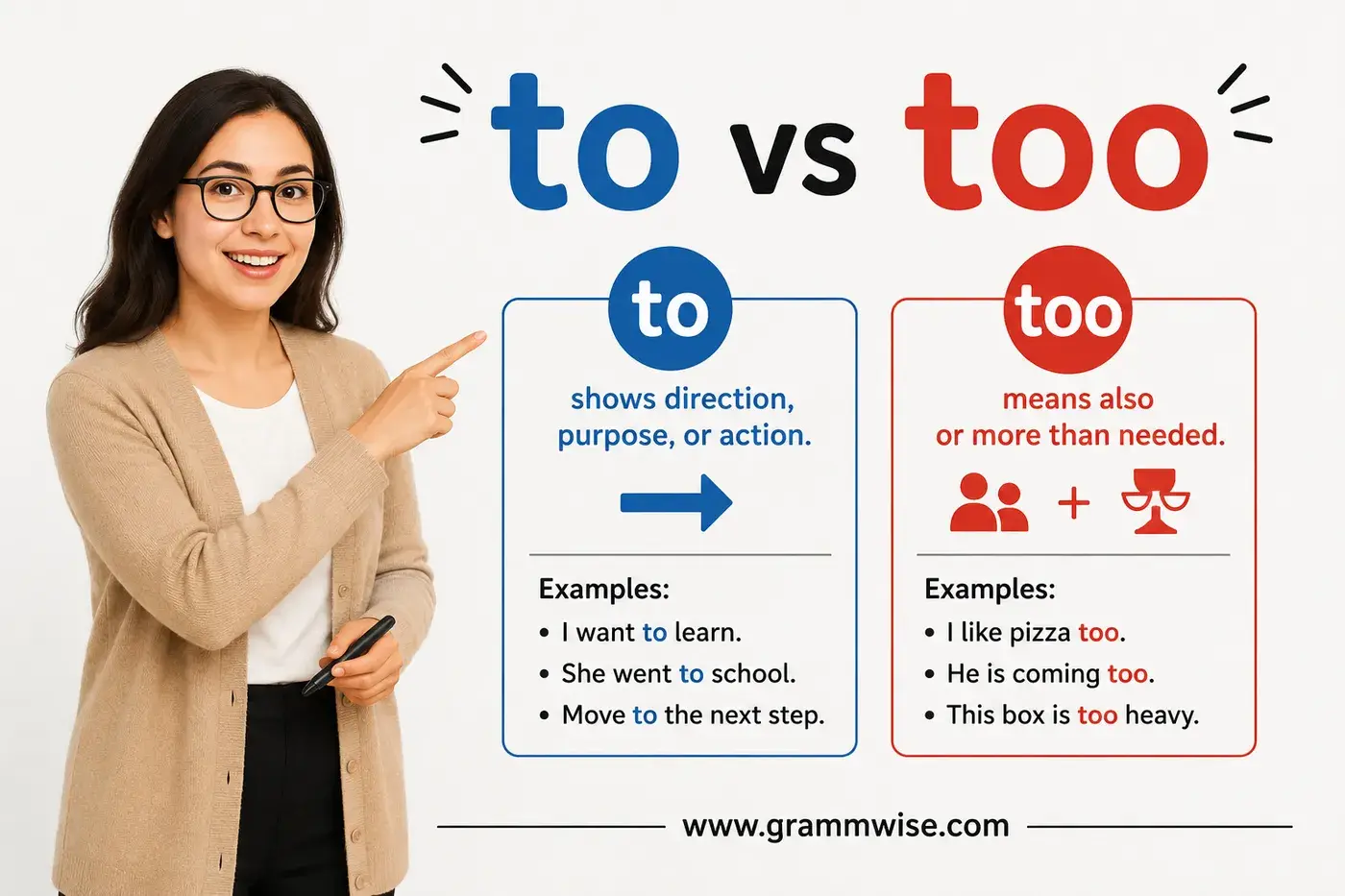
Many English learners feel confused about to vs too.
These two small words look the same.
They sound the same.
But they do not mean the same.
In this lesson, I will explain to vs too like I explain it in a real classroom.
Slow.
Simple.
Clear.
- You will learn what each word means.
- You will learn why people mix them up.
- You will learn which one to use and when.
By the end, to vs too will feel easy, not scary.
Browse related articles below for more grammar help.
Simple Answer in One Look
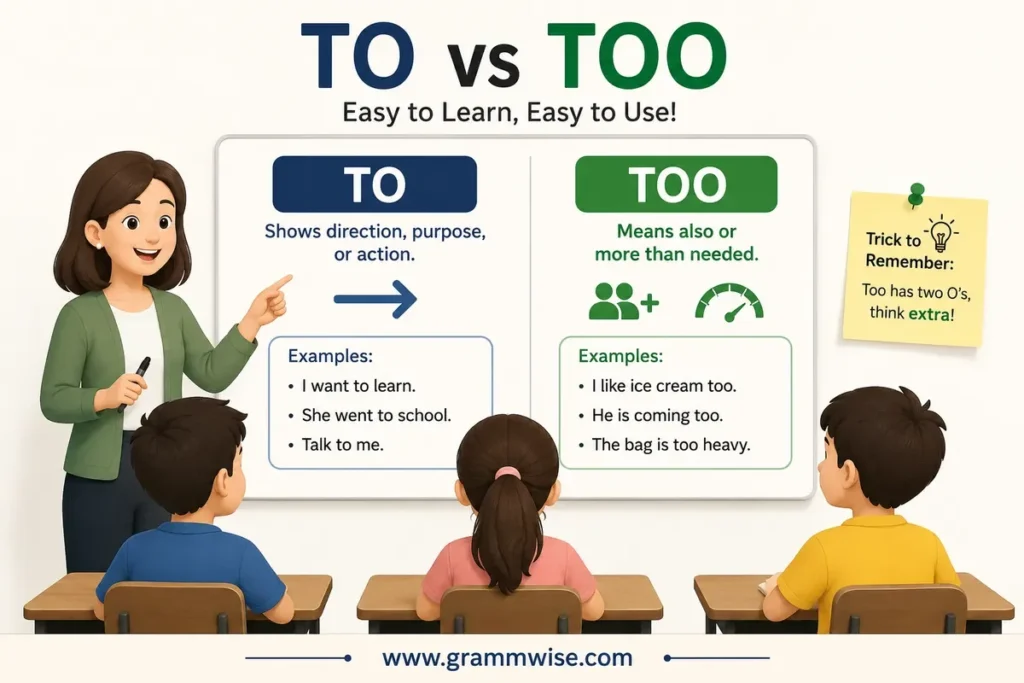
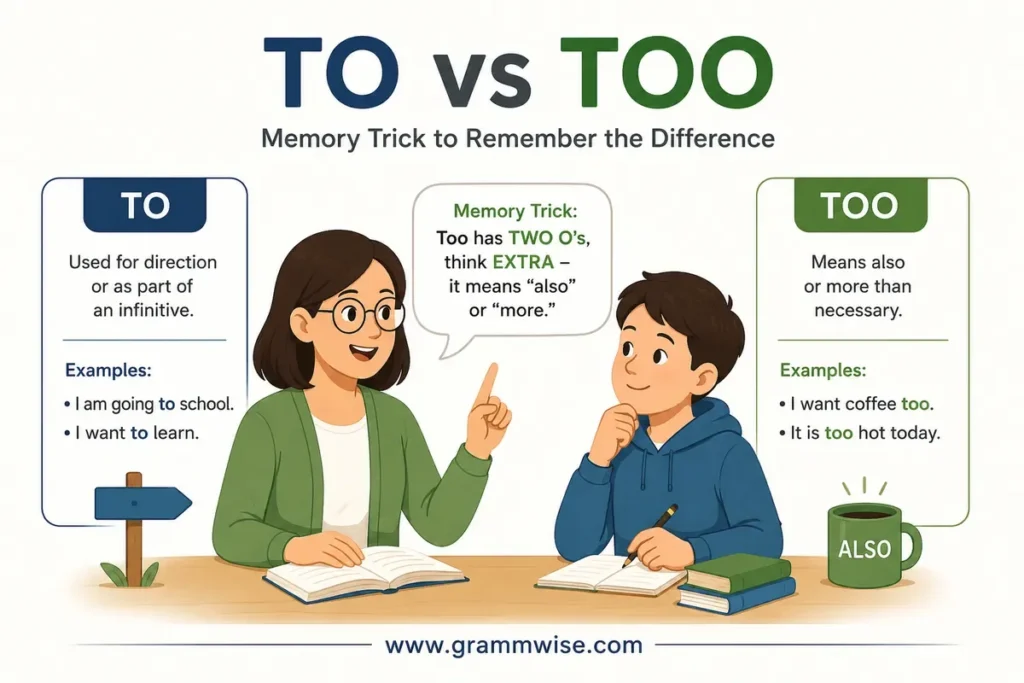
To shows direction, purpose, or action.
Too means also or more than needed.
That’s the core difference between to vs too.
Meaning of “To vs Too” in Simple English
Let’s talk like a teacher talking to students.
What does to mean?
To is a helper word.
It helps show where, why, or what action comes next.
You often see to before a place or a verb.
Examples:
- Go to school
- I want to eat
- She walked to the door
Think of to as a small arrow ➜
It points somewhere.
What does too mean?
Too has two common meanings.
- Also
- More than needed
Examples:
- I want ice cream too (also)
- The bag is too heavy (more than needed)
A classroom trick:
👉 Too has two O’s
👉 It often means extra
That small spelling hint helps many students remember to vs too.
To vs Too: Why People Mix These Words
Students mix to vs too for three simple reasons.
1. They sound the same
When we speak, to and too sound identical.
Your ear cannot hear the spelling.
So your brain gets confused when writing.
2. They are very common words
We use to and too every day.
In texts, emails, school work.
Common words create more mistakes.
3. Fast typing and texting habits
When people type fast, they choose the wrong one.
Autocorrect does not always fix it.
That is why to vs too errors are very common online.
Clear Difference of “To vs Too” Explained Simply
Let’s put to vs too side by side.
To
- Shows direction
- Shows purpose
- Comes before a verb
- Comes before a place
Examples:
- Walk to the park
- I need to study
Too
- Means also
- Means more than needed
- Often comes at the end or before an adjective
Examples:
- I want pizza too
- It is too hot
One-line memory trick
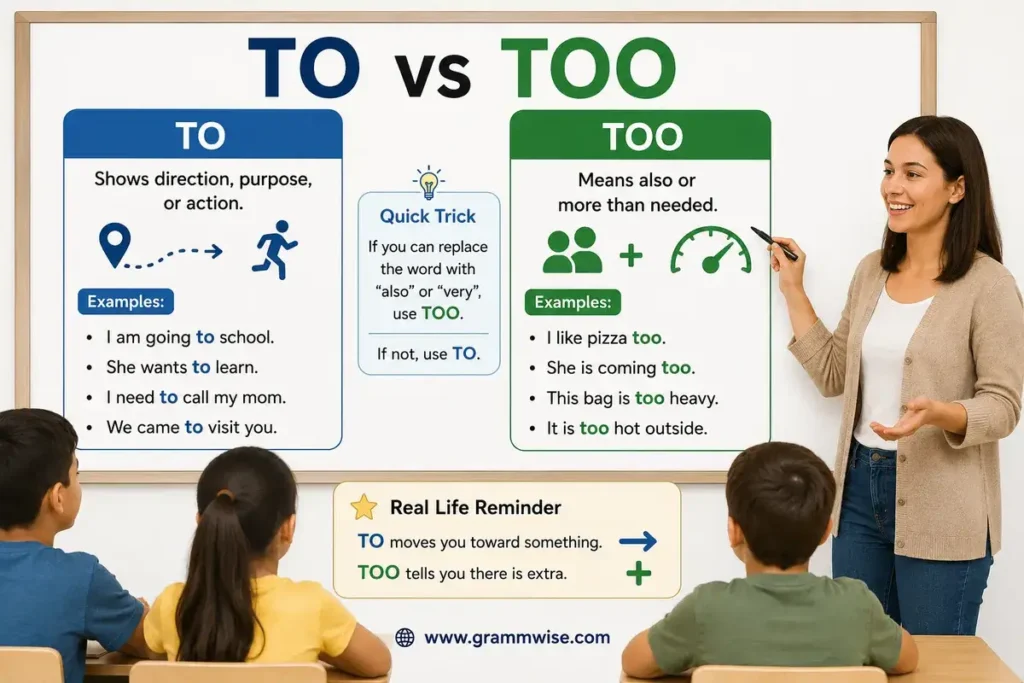
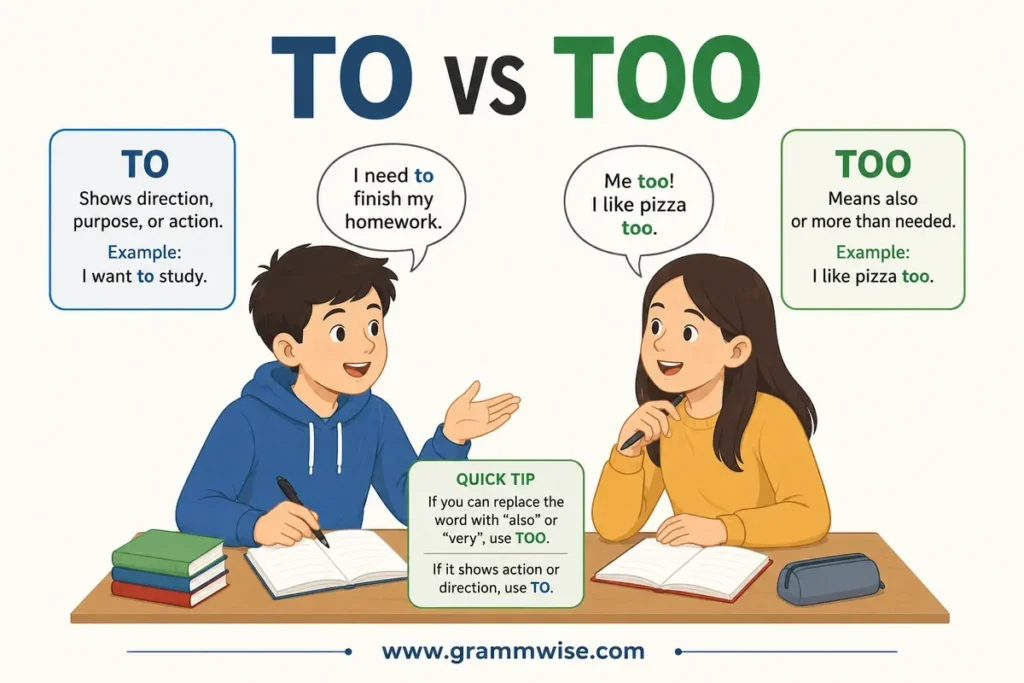
If you can replace the word with also or very, use too.
If not, use to.
That trick solves most to vs too problems.
To vs Too: Which Form Should You Use?
Let’s slow this down and make it very clear.
Ask yourself one question:
👉 Am I talking about action or direction?
If yes → use to
Examples:
- I like to read
- She went to work
👉 Am I talking about extra or also?
If yes → use too
Examples:
- I like reading too
- This coffee is too hot
Simple classroom rule
- Action or direction → to
- Extra or also → too
No grammar terms needed.
Just meaning.
Easy Real-Life Sentences on “To vs Too”
Here are simple, everyday sentences using to vs too.
- I want to sleep.
- She wants to play.
- I am going to school.
- I like pizza too.
- He is coming too.
- The box is too big.
- It is too cold today.
- We need to leave now.
These sound natural because people really say them.
To vs Too: Where This Word Difference Comes From?
You do not need history to use to vs too, but a little background helps.
To
The word to comes from very old English.
It always showed direction or movement.
That meaning stayed the same for hundreds of years.
Too
The word too also comes from old English.
It meant in addition or more.
That meaning also stayed the same.
So even long ago, to vs too had different jobs.
Mistakes on “To vs Too” During Coversation
| Wrong Sentence ❌ | Correct Sentence ✅ |
| I want too go home | I want to go home. |
| She is to tired | She is too tired |
| He came to | He came too |
When you see mistakes like these, stop and ask:
👉 Is this about action or extra?
Spoken English vs Written English
In speaking, to vs too sound the same.
No problem there.
In writing, spelling matters.
That is why teachers correct to vs too in exams, emails, and homework.
Good writing shows clear thinking.
Why Learning This Early Matters
Many students think to vs too is small and unimportant.
That is not true.
These mistakes:
- Lower exam scores
- Make writing look careless
- Confuse the reader
Fixing to vs too makes your English cleaner and stronger.
Quick Self-Test on “To vs Too”
Choose the right word.
- I want ___ eat.
- This bag is ___ heavy.
- She wants ice cream ___.
Answers:
- to
- too
- too
If you got these right, you are learning fast.
Final Classroom Reminder
Think of to as an arrow ➜
Think of too as extra ➕
That picture stays in your mind.
To vs Too: How This Word Is Understood in Culture and Stories?
In real life, people do not think about grammar rules when they speak.
They think about meaning.
That is how to vs too works in culture and stories.
In daily English, to feels neutral.
It is quiet.
It just helps the sentence move forward.
Example:
- She went to find her dream.
Here, to feels like a path.
It shows movement.
Stories use to when someone is going somewhere, trying something, or changing.
Now think about too.
Too carries feeling.
It adds emotion.
Example:
- He was too tired to continue.
In stories, too often shows stress, love, limits, or surprise.
It tells us something is more than expected.
So in culture, to moves the story.
Too adds feeling to the story.
That is a big part of understanding to vs too beyond grammar.
Biblical and Mythological Meaning of “To vs Too”
The Bible and old stories do not explain grammar, but they use words carefully.
Use of to
In many old texts, to shows direction given by God or fate.
Examples:
- A journey to a promised land
- A call to act
- A command to follow
Here, to shows purpose.
It points toward action or destiny.
Use of too
The word too appears when something goes beyond balance.
Examples:
- Too much pride
- Too much anger
In stories, too often warns us.
It shows excess.
It shows when something good becomes a problem.
So even in old stories, to vs too shows a difference between direction and excess.
Symbolism of “To vs Too” Explained in Simple Words
What To Represents?
To represents movement.
It means:
- Going forward
- Trying
- Choosing a path
Emotionally, to feels hopeful.
It looks ahead.
Example feeling:
- I want to learn.
This sentence feels open and positive.
What Too Represents?
Too represents extra.
It means:
- More than needed
- More than comfortable
Emotionally, too feels heavy or strong.
Example feeling:
- I am too tired.
This sentence shows limit and feeling.
So in to vs too, one word moves you forward.
The other tells you when something is extra.
Related Words You Should Know
These words often confuse learners along with to vs too.
Two
A number. It means 2.
Example: I have two books.
Also
Means the same as too (also).
Example: I like tea also.
Very
Sometimes used instead of too, but not always correct.
Example: It is very hot.
Enough
The opposite idea of too.
Example: This is warm enough.
Knowing these helps reduce to vs too confusion.
Use of “To vs Too” in Daily English
Here is how native speakers really use to vs too.
- I want to talk.
- Do you want to come?
- I like coffee too.
- She is tired too.
- This room is too small.
- It is too late now.
- I need to leave.
- He wants to help.
- That shirt is too big.
- I was happy too.
People do not stop to think.
They choose based on meaning.
That is the skill you are building.
Common Mistakes People Make
Let’s fix them simply.
Mistake 1
❌ I am to tired
✅ I am too tired
Why
Tired is a feeling.
You are saying “more than comfortable.”
Mistake 2
❌ I want too learn English
✅ I want to learn English
Why
Learn is an action.
Mistake 3
❌ She came to
✅ She came too
Why
You mean “also.”
Quick fix
If you can say “also” or “extra,” use too.
If you can say “go” or “do,” use to.
Final Teacher Explanation
Let me explain this like I would in class.
Students, do not fear to vs too.
They are small words, but their jobs are clear.
To helps the sentence move.
It shows action, direction, or purpose.
Too adds weight.
It shows extra feeling or addition.
Do not memorize rules.
Understand meaning.
When you understand meaning, grammar becomes easy.
That is how good English is learned.
Final Thought on “To vs Too”
To is for action, direction, and purpose.
Too means also or more than needed.
They sound the same, but their meaning is different.
Think meaning first, spelling second.
Conclusion
To vs too is not hard when you focus on meaning instead of spelling.
Use to for action, direction, or purpose.
Use too when you mean also or more than needed.
These two words sound the same, but they do different jobs.
When you think first and write slowly, your English becomes clear, correct, and confident.
Frequently Asked Questions (FAQs)
What does to vs too mean in simple words?
To shows action or direction. Too means also or extra.
Which is correct: me too or me to?
Me too is correct. It means also.
Is it wrong to mix up to vs too?
It is common, but in writing it is considered a mistake.
Can I use too at the end of a sentence?
Yes. That is very common in spoken English.
Why do people confuse to vs too?
They sound the same and are used very often.
Is to vs too tested in exams?
Yes. Schools often test this difference.
How can I remember the difference easily?
Too has extra “o.” Think extra meaning.
Does speaking English require knowing this?
Speaking is fine, but writing needs the correct form.
You now fully understand to vs too.
Simple meaning.
Clear use.
No confusion.