Many people wonder whether smoky or smokey is the correct spelling. The confusion is easy to understand because both forms look natural. You may even see both spellings in books, menus, product names, and online writing.
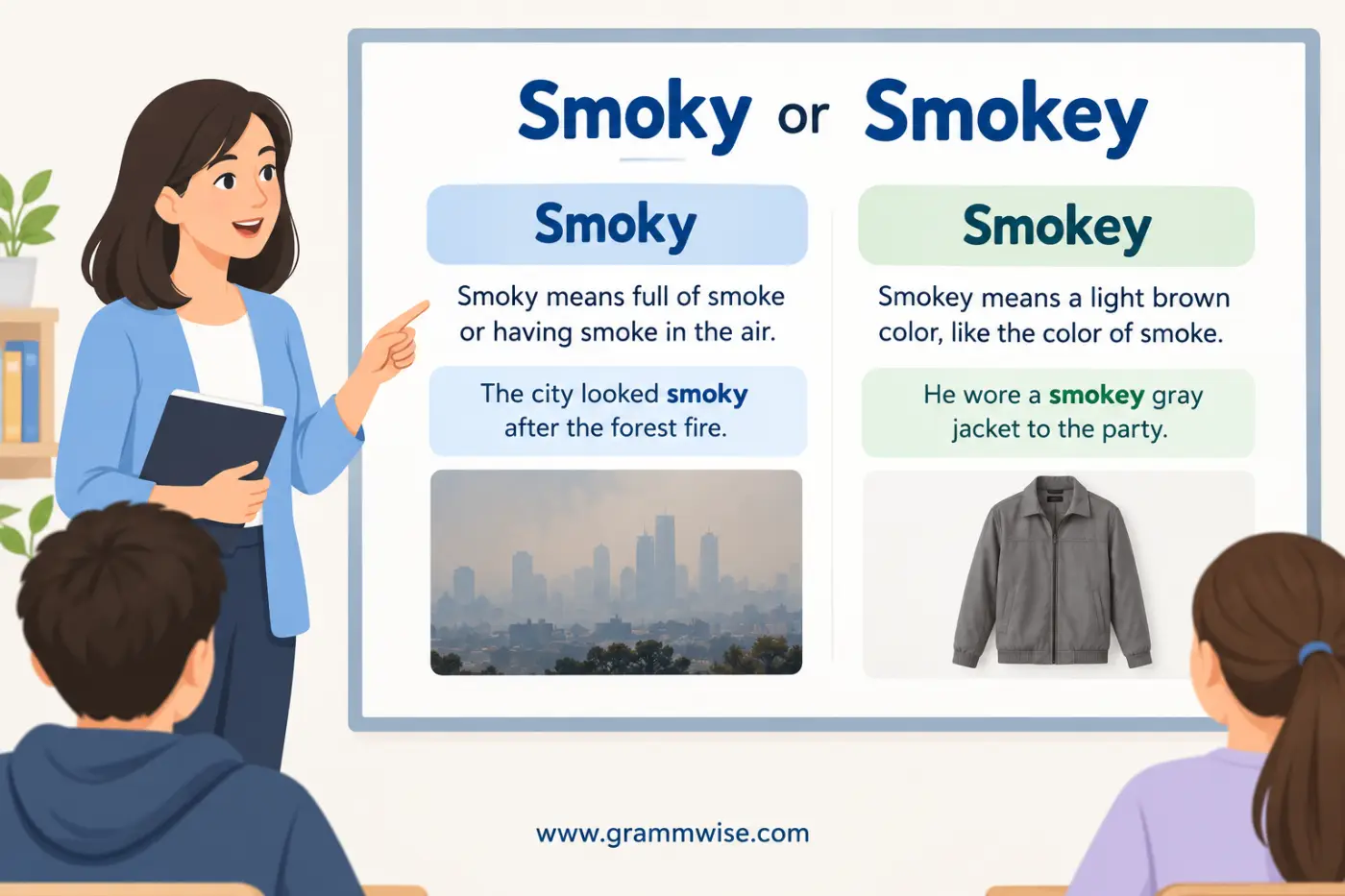
The standard spelling in American English is smoky. It means filled with smoke, smelling or tasting like smoke, or looking like smoke. For example, we can say, “The room was smoky,” or “This sauce has a smoky flavor.”
Smokey is also a real spelling, but it is much less common as a general adjective. It is often used as a proper name, nickname, character name, or brand name. The famous cartoon bear is Smokey Bear, for example. So, when you are simply describing something that has smoke or a smoke-like quality, smoky is usually the spelling you want.
Are fair and good interchangeable? Learn the difference in meaning and everyday usage.
Simple Answer in One Look
Smoky is the standard spelling when you mean filled with smoke, smelling like smoke, tasting like smoke, or resembling smoke.
Smokey is usually seen in names, nicknames, or special names, such as Smokey Bear.
Quick Rule for Smoky or Smokey
- General description → smoky
- Name or special use → Smokey
- Smoke + y → smoky
Examples:
- a smoky room
- a smoky smell
- a smoky flavor
- Smokey Bear
What Does Smoky Mean in Simple English?
The word smoky comes from the noun smoke. Smoke is the cloud or gas-like material that comes from something burning. When we add -y, we can use smoky to describe something connected with smoke.
For example:
“The kitchen became smoky.”
This means there was a lot of smoke in the kitchen.
We can also use smoky when something has the smell or taste of smoke.
For example:
“The chicken has a smoky flavor.”
This means the chicken tastes like smoke or has a flavor created by smoking or grilling.
The word can also describe an appearance.
“The sky looked smoky.”
This means the sky looked hazy or filled with something that looked like smoke.
What Does Smokey Mean?
Smokey can appear as a spelling of the adjective, but it is not usually the preferred spelling for normal descriptive English. You may see smokey in informal writing, creative names, product names, usernames, or other special uses.
The most famous example is:
Smokey Bear
This is the name of the well-known American bear character used in wildfire prevention campaigns.
Because Smokey is part of a name, it is capitalized.
So compare:
“The room was smoky.”
Here, smoky is a normal adjective.
“Smokey Bear teaches people about wildfire safety.”
Here, Smokey is part of a proper name.
This is one of the easiest ways to understand why you may see both spellings.
Is Smoky or Smokey Correct?
If you are writing a normal sentence and describing something related to smoke, choose smoky.
For example:
- The kitchen was smoky.
- The meat had a smoky flavor.
- We could see a smoky haze in the distance.
- The fireplace made the room smoky.
In these sentences, smoky is the standard spelling.
You generally do not need to write smokey unless you are copying or using a particular name, title, brand, or special spelling.
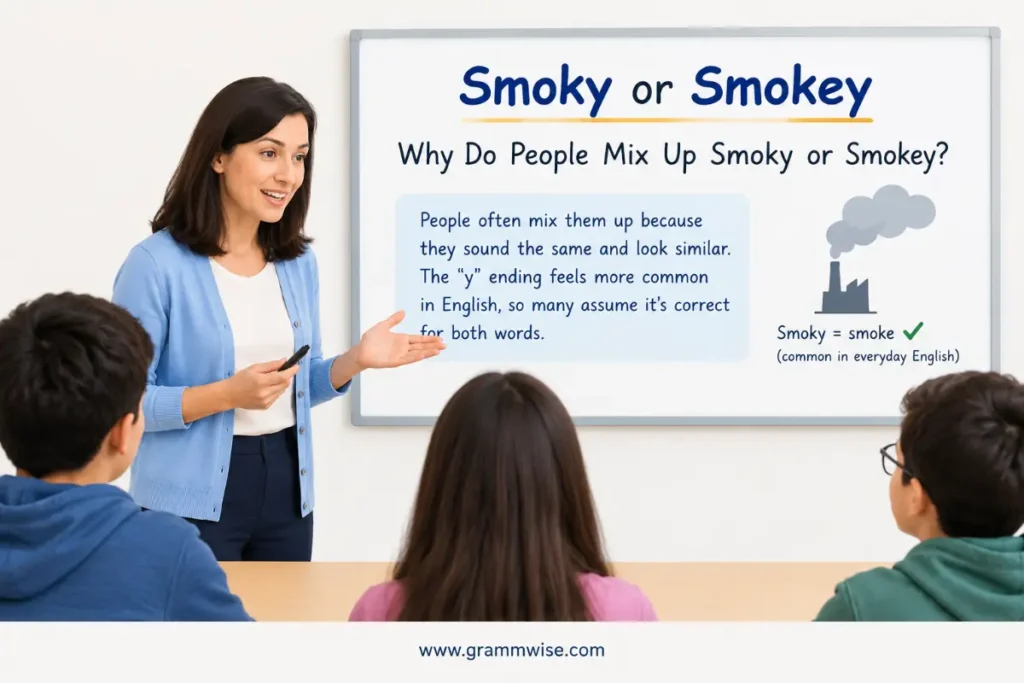
Why Do People Mix Up Smoky or Smokey?
There are several simple reasons.
The Word Comes From Smoke
People naturally think:
smoke + y = smokey
That seems logical.
But standard English spells the adjective:
smoky
The final e in smoke is dropped before adding -y.
This pattern appears in other words too.
For example:
noise → noisy
Not noisey.
ice → icy
Not icey.
taste → tasty
Not tastey.
In the same way:
smoke → smoky
Not usually smokey.
Both Spellings Can Be Seen
Another reason for confusion is that Smokey is used in names.
People may see Smokey Bear and assume that smokey is always the correct spelling.
It is not.
A special name does not change the normal spelling of the adjective.
Clear Difference of Smoky or Smokey
| Smoky | Smokey |
|---|---|
| Standard adjective | Special or less common spelling |
| Describes smoke or a smoke-like quality | Often appears in names |
| Used in normal English writing | Used in proper names and special uses |
| “a smoky room” | “Smokey Bear” |
| Usually lowercase | Capitalized when it is a name |
The key point is simple:
Use smoky for normal descriptions.
How to Use Smoky?
The word smoky can describe several things.
1. A Place
Use smoky when a place has a lot of smoke.
Example:
“The room became smoky after the fire.”
Another example:
“The restaurant had a smoky atmosphere.”
2. A Smell
Use smoky for a smell that reminds you of smoke.
Example:
“There was a smoky smell in the kitchen.”
3. A Taste
Food can have a smoky flavor.
Example:
“The grilled vegetables had a smoky flavor.”
This is very common in food writing.
4. A Drink
Some drinks are described as having a smoky taste or smoky flavor.
Example:
“The drink has a deep, smoky flavor.”
5. The Sky or Air
You can use smoky to describe air that looks unclear because of smoke or haze.
Example:
“The sky looked smoky after the wildfire.”
6. An Appearance
Something can have a soft, dark, or hazy look that reminds people of smoke.
Example:
“She used a smoky gray color for the walls.”
Smoky in Food and Cooking
One of the most common modern uses of smoky is talking about food.
You may see:
- smoky barbecue
- smoky chicken
- smoky sauce
- smoky cheese
- smoky flavor
- smoky vegetables
- smoky seasoning
For example:
“This barbecue sauce has a smoky flavor.”
Or:
“The grilled corn has a nice smoky taste.”
Here, smoky does not necessarily mean that the food is covered in smoke. It can simply mean that the food has a flavor similar to food cooked over smoke or fire.
Smoky in Descriptions
Writers also use smoky to make a description more vivid.
For example:
“A smoky mist covered the valley.”
This creates a picture of air that looks thick, gray, or hazy.
Another example:
“The room was filled with smoky air.”
The reader can imagine the air clearly.
You may also see phrases such as:
- smoky gray
- smoky blue
- smoky atmosphere
- smoky haze
- smoky clouds
These uses are common in descriptions of colors, weather, art, and places.
Easy Real-Life Sentences on Smoky or Smoke
Here are some simple sentences with smoky:
- The kitchen was smoky after dinner.
- The meat had a smoky flavor.
- There was a smoky smell in the room.
- The sky looked smoky after the fire.
- I love smoky barbecue sauce.
- The grilled vegetables tasted smoky.
- The room became smoky because of the fireplace.
- She chose a smoky gray color for the wall.
These examples show that smoky works with places, smells, tastes, colors, and appearances.
Common Phrases With Smoky
Learning common phrases can help you remember the word.
Smoky Flavor
A taste similar to smoke.
Example:
“The sauce has a smoky flavor.”
Smoky Smell
A smell like smoke.
Example:
“I noticed a smoky smell outside.”
Smoky Room
A room filled with smoke.
Example:
“The room became smoky.”
Smoky Air
Air containing or resembling smoke.
Example:
“The smoky air made it hard to see.”
Smoky Gray
A soft gray color that has a smoky appearance.
Example:
“She painted the bedroom smoky gray.”
Smoky Atmosphere
An atmosphere that looks or feels like smoke is present.
Example:
“The lights created a smoky atmosphere.”
What About Smokey Bear?
This is the most important special case to remember.
Smokey Bear is a proper name.
The name is spelled with Smokey, not Smoky.
So this is correct:
“Smokey Bear is a symbol of wildfire prevention.”
But if you are describing a room filled with smoke, write:
“The room was smoky.”
The two forms have different roles.
Compare Them
Smoky room
→ normal adjective
Smokey Bear
→ proper name
This is why seeing Smokey in a name does not mean you should use it everywhere.
Smoky or Smoked?
Another word that learners sometimes confuse with smoky is smoked.
These words are related, but they do not mean exactly the same thing.
Smoky
Something has the smell, taste, appearance, or quality of smoke.
“The sauce has a smoky flavor.”
Smoked
Something has been cooked, preserved, or treated using smoke.
“We bought smoked salmon.”
Compare:
smoky flavor
and
smoked salmon
A food can be smoked and have a smoky flavor.
Smoky or Smoke?
These words also have different jobs.
Smoke is the noun.
Smoky is the adjective.
For example:
“There is smoke in the room.”
Here, smoke names the substance.
“The room is smoky.”
Here, smoky describes the room.
This simple pattern can help:
Smoke = the thing
Smoky = describes something connected to smoke
Common Mistakes People Make About Smoky or Smokey
Mistake 1: Adding the Extra E
❌ The room was smokey.
✅ The room was smoky.
For normal descriptive English, smoky is the standard form.
Mistake 2: Using Smokey Because It Looks Like Smoke
Some people think:
smoke + y = smokey
But standard spelling removes the final e:
smoke → smoky
Mistake 3: Changing the Name Smokey Bear
Do not change the spelling of a proper name.
❌ Smoky Bear
✅ Smokey Bear
The name has its own spelling.
Mistake 4: Confusing Smoky With Smoked
❌ The salmon was smoky when you mean it was prepared using smoke.
Better:
✅ The salmon was smoked.
If you are talking about its flavor, however, you can say:
✅ The salmon had a smoky flavor.
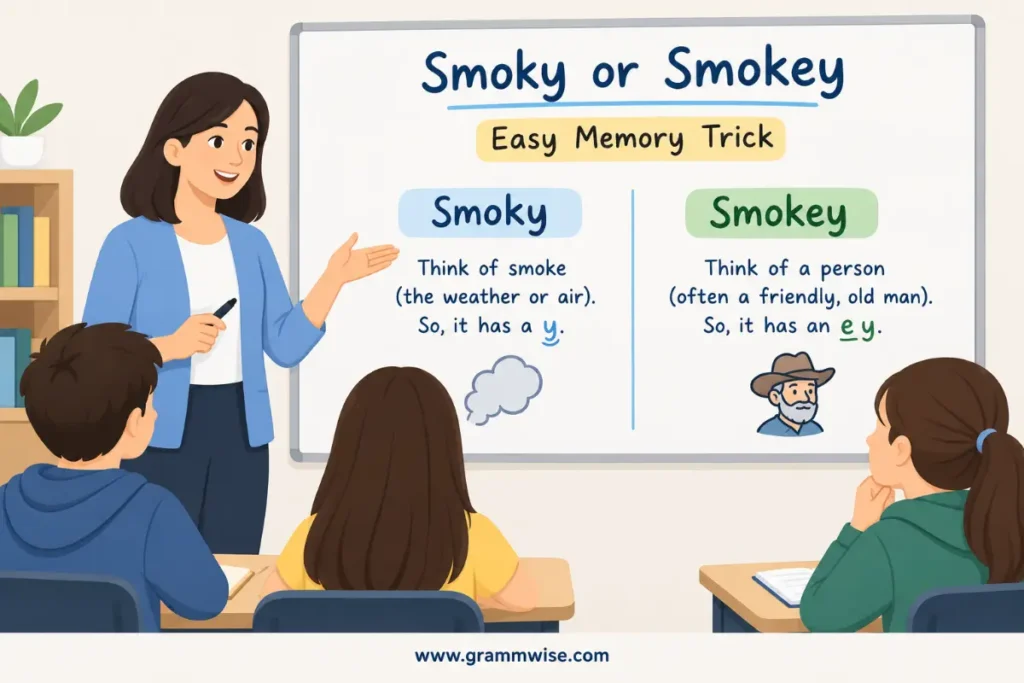
Easy Memory Trick for Smoky or Smokey
Here is a simple trick for remembering smoky.
Think:
SMOKE → SMOKY
Take the word smoke.
Remove the final e.
Add y.
You get:
SMOKY
So remember:
Smoke + y = smoky, without the final e.
For Smokey, think of a name:
Smokey = special name
The best-known example is:
Smokey Bear
So your memory rule is:
Normal description → smoky
Special name → Smokey
Quick Classroom Check
Imagine a teacher writes these sentences on the board.
1. The room was _____.
Which word fits?
Smoky.
2. The barbecue had a _____ flavor.
Again:
Smoky.
3. _____ Bear is a famous wildfire-prevention character.
Here:
Smokey.
The reason changes the spelling choice.
When you describe smoke, use smoky.
When you write the special name Smokey Bear, use Smokey.
How Is “Smoky or Smokey” Understood in Culture and Stories?
The word smoky can mean more than simply “full of smoke.” In stories, movies, songs, food descriptions, and everyday conversations, it can help create a certain feeling or picture in the reader’s mind.
Think about a quiet room with a fireplace.
You might describe it as having a smoky atmosphere.
The word gives us a picture of warm air, soft light, and a little haze.
Now imagine a barbecue restaurant. A menu might describe a sauce as having a rich smoky taste. Here, the word creates an idea of food cooked over fire or with smoke.
Writers can also use smoky to describe colors.
For example:
“The sunset had a smoky orange glow.”
The word does not mean there was necessarily smoke in the sky. It can suggest a soft, hazy, slightly dark appearance.
This makes smoky a useful descriptive word. It can help people imagine a smell, taste, color, scene, or atmosphere.
Smoky in Food Culture
Food is one of the places where you will see smoky very often.
People commonly describe grilled and barbecue foods with this word.
You may see phrases such as:
- smoky barbecue
- smoky chicken
- smoky ribs
- smoky sauce
- smoky cheese
- smoky vegetables
- smoky flavor
- smoky seasoning
For example:
“The restaurant is famous for its smoky barbecue.”
The word tells us something about the flavor and cooking style.
A cook might also say:
“I want to add a smoky flavor to the dish.”
That does not necessarily mean the food should be filled with visible smoke. The goal may simply be to create a flavor that reminds people of cooking over wood or fire.
This is why smoky is common in menus and food reviews.
Smoky in Art, Fashion, and Colors
The word can also describe colors.
You may hear:
- smoky gray
- smoky blue
- smoky brown
- smoky black
These expressions usually describe colors that look soft, muted, or slightly hazy.
For example:
“She chose a smoky blue dress.”
The dress is not made of smoke. The word describes the quality of the color.
Artists and designers may use words like smoky to create a soft or mysterious feeling.
This is similar to how words such as misty, dusty, or hazy can describe colors.
Smoky in Stories and Descriptions
Writers often use smoky when they want readers to picture a scene.
For example:
“A smoky haze covered the small town.”
The word haze already suggests unclear air. Adding smoky makes the picture stronger.
Another example:
“The cabin was warm, quiet, and smoky.”
The word gives the reader a quick idea of the air inside the cabin.
In a mystery story, a writer might describe:
“A smoky shadow moved across the wall.”
Here, smoky can create a mysterious visual image.
The word is useful because it can suggest something that is not sharp or completely clear.
Does Smoky Have a Symbolic Meaning?
Sometimes, yes.
The exact meaning depends on the situation. Smoke can represent things such as mystery, change, danger, confusion, or something disappearing in stories and art.
Because smoky is connected with smoke, it can sometimes carry these ideas too.
For example, a smoky scene may feel mysterious.
A smoky sky after a fire may suggest danger or loss.
A smoky memory may be used as a creative way to describe a memory that is unclear.
But these are symbolic uses. The basic meaning of smoky remains connected to smoke or something that looks, smells, or tastes like smoke.
Biblical and Mythological Meaning
There is no special biblical rule that changes the spelling of smoky or smokey.
However, smoke itself appears in many religious and ancient stories.
In the Bible, smoke can appear in descriptions of fire, offerings, mountains, and dramatic events. It can be connected with ideas such as fire, sacrifice, God’s presence, or destruction depending on the passage.
In ancient mythology, smoke was also connected with fire, offerings, rituals, and communication with the gods in some cultures.
The important point for English learners is simple:
These cultural meanings belong to the idea of smoke, not to a special spelling of the word smoky.
So you should not choose smokey because a story or religious text mentions smoke.
For normal English writing, the adjective remains smoky.
Symbolism Explained in Simple Words
What Smoky Can Represent
In creative writing, smoky can suggest:
- mystery
- something unclear
- warmth
- fire
- danger
- change
- fading memories
- a soft or hazy appearance
For example:
“His smoky memories of childhood were difficult to explain.”
This is not saying his memories literally contain smoke. It is a creative comparison.
Another example:
“The smoky room felt mysterious.”
Here, the smoke helps create the mood.
What Smokey Can Represent
Smokey does not have a separate universal symbolic meaning simply because it is spelled with an e.
When it appears as a name, its meaning comes from the person, character, organization, or brand using that name.
For example:
Smokey Bear
is a particular name associated with wildfire prevention.
So do not think:
smoky = one meaning
smokey = another meaning
The difference is mainly about normal spelling versus special naming and usage.
Related Words You Should Know
Smoke
The visible material produced when something burns.
Example:
“Smoke came from the fireplace.”
Smoky
Describes something connected with smoke.
Example:
“The kitchen was smoky.”
Smoked
Describes food or another item treated with smoke.
Example:
“We had smoked salmon for lunch.”
Smoker
A person or device connected with smoking or cooking with smoke.
Example:
“He bought a new meat smoker.”
Smoking
The act or process of producing smoke or using tobacco, depending on the context.
Example:
“The fire is smoking.”
Smokeless
Producing little or no smoke.
Example:
“The new stove is designed to be smokeless.”
Smokily
An adverb meaning in a smoky manner.
This word is much less common in everyday speech.
Smokiness
The quality or condition of being smoky.
Example:
“The smokiness of the sauce was easy to notice.”
These related forms help you see how the word family works.
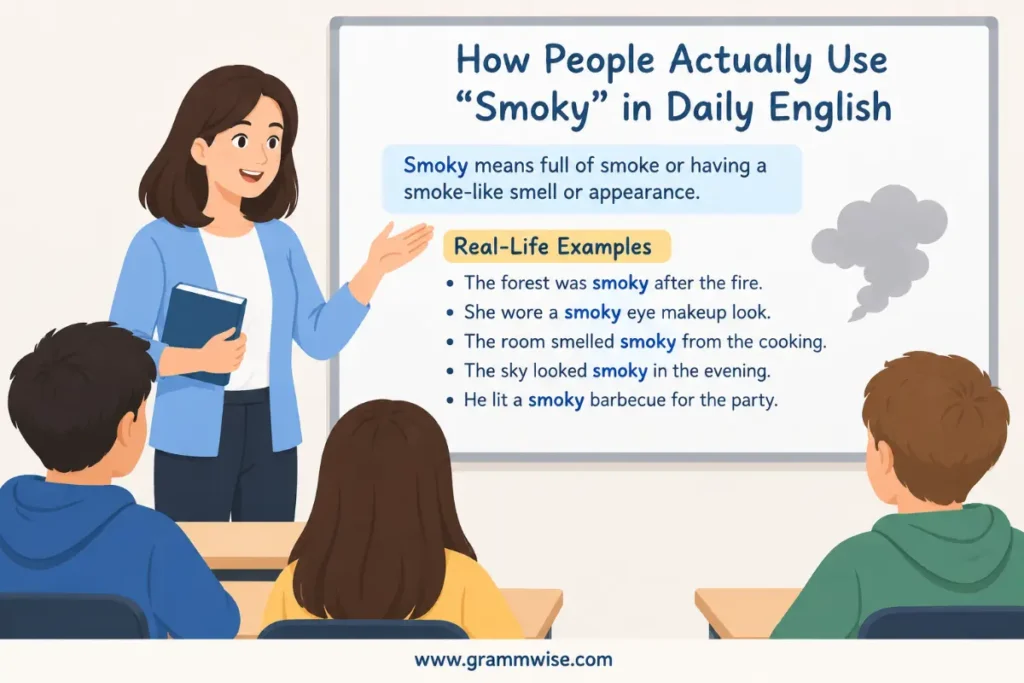
How People Actually Use “Smoky” in Daily English?
1. Talking About Food
“This chicken has a really smoky flavor.”
This is common when discussing grilled or barbecue food.
2. Talking About a Fire
“The room became smoky when the wood started burning.”
Here, smoky describes the condition of the room.
3. Talking About Smell
“I noticed a smoky smell on my clothes.”
The clothes smell like smoke.
4. Talking About a Color
“I like that smoky gray color.”
The word describes the appearance of the gray.
5. Talking About the Air
“The air was smoky after the fire.”
The air contained smoke.
6. Talking About a Restaurant
“They serve smoky barbecue here.”
The word describes the food’s flavor or cooking style.
7. Talking About a Drink
“This drink has a slightly smoky taste.”
The word describes the flavor.
8. Talking About a Scene
“The smoky background made the picture look mysterious.”
Here, smoky helps describe the visual effect.
9. Talking About a Voice
You may sometimes hear:
“She has a smoky voice.”
This is a creative description. It can mean the person’s voice sounds deep, soft, husky, or slightly rough.
This is a figurative use rather than a literal one.
10. Talking About a Memory
A writer might say:
“I have only a smoky memory of that place.”
This means the memory is unclear or difficult to remember.
Again, this is a creative use.
Smoky vs. Hazy
These words can sometimes appear together, but they are not identical.
Smoky means connected with smoke.
Hazy means unclear, misty, or difficult to see clearly.
For example:
“The air was smoky.”
There was smoke in the air.
“The mountains looked hazy.”
The mountains were difficult to see clearly.
You can also combine them:
“The mountains looked hazy through the smoky air.”
Smoky vs. Misty
Misty usually relates to very small drops of water in the air.
Smoky relates to smoke.
Compare:
“The morning was misty.”
There was mist.
“The morning was smoky after the fire.”
There was smoke.
The two words may create a similar visual effect, but the cause is different.
A Simple Writing Check
Before choosing smoky or smokey, ask yourself:
Am I describing something?
If yes, smoky is usually the word you need.
Am I writing a person’s, character’s, brand’s, or organization’s special name?
Then check the official spelling.
For example:
The kitchen is smoky.
But:
Smokey Bear is a proper name.
This quick check can prevent most spelling mistakes.
Final Teacher Explanation
Let’s put the whole lesson together.
You do not need to memorize a long grammar rule.
Start with the ordinary adjective:
smoky
Use it when something has smoke, smells like smoke, tastes like smoke, looks like smoke, or creates a smoky effect.
You can talk about:
- smoky food
- smoky air
- smoky rooms
- smoky colors
- smoky voices
- smoky scenes
The spelling smokey may appear in special names or other special uses. The clearest example is Smokey Bear.
So if you are writing a normal sentence such as:
“The barbecue has a smoky flavor.”
choose smoky.
If you are writing:
“Smokey Bear is a famous character.”
keep Smokey because it is the established name.
There is no need to make the choice harder than it is.
Quick Recap Smoky or Smokey
Smoky is the standard adjective for something related to smoke, such as smoky air, smoky food, smoky flavor, or smoky colors.
Smokey is commonly seen in special names, especially Smokey Bear. For normal English writing, remember: smoke → smoky.
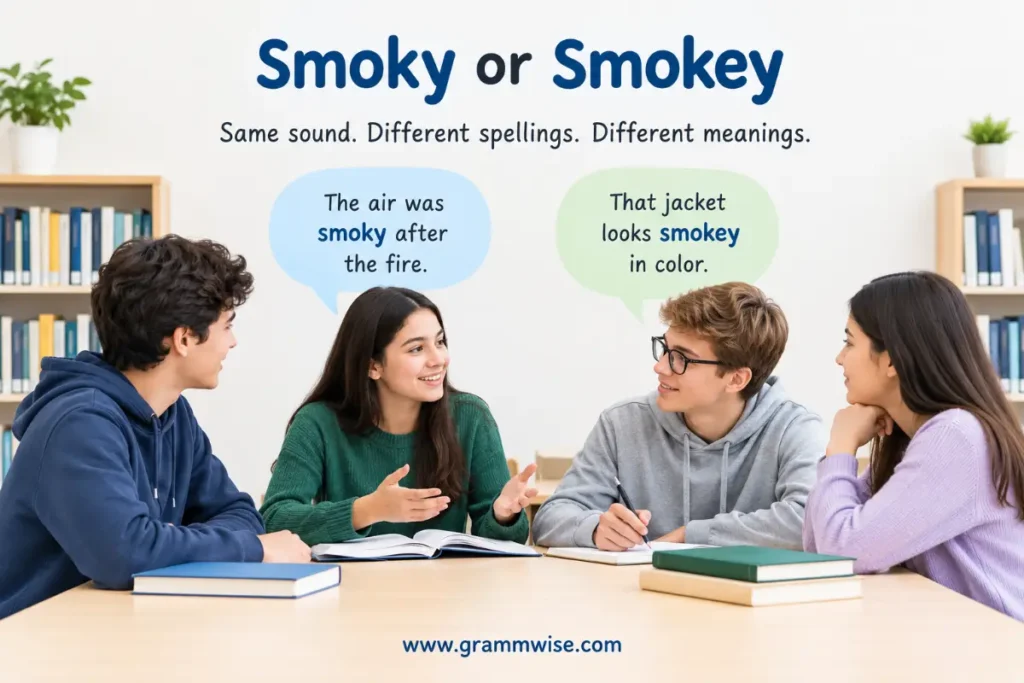
Conclusion
When choosing between smoky or smokey, use smoky for normal English descriptions related to smoke, such as smoky air, smoky food, or a smoky smell. Smokey is mainly used in proper names, nicknames, and specific names such as Smokey Bear.
The easiest way to remember the difference is simple: smoky is the standard adjective, while Smokey is usually a name. Once you know this small rule, you can choose the correct form with confidence in everyday writing.
Frequently Asked Questions
Is smoky or smokey correct?
Smoky is the standard spelling for the normal adjective. Smokey appears mainly in names and special uses.
Is Smokey Bear spelled with an E?
Yes. The established name is Smokey Bear.
Is “smoky flavor” correct?
Yes. Smoky flavor is a common expression for a taste that resembles smoke or comes from cooking with smoke.
Is “smoked” the same as “smoky”?
No. Smoked usually describes something treated or cooked with smoke, while smoky describes a smell, taste, appearance, or quality connected with smoke.
Can I say “smoky voice”?
Yes. Smoky voice is a figurative description for a voice that sounds deep, soft, husky, or slightly rough.
What is the easiest way to remember smoky?
Think smoke → smoky. Remove the final e and add y.
Why do people spell it “smokey”?
People may use smokey because it looks like a natural spelling of smoke + y, or because they have seen it in names such as Smokey Bear.
Should I use smoky in formal writing?
Yes. Smoky is the standard choice when you are using the word as an ordinary adjective in formal or everyday writing.