

Many English learners wonder if bony or boney is the correct spelling. Since both words look very similar, it is easy to think they can be used in the same way. However, one spelling is much more common and accepted in standard English.
The correct spelling in most situations is bony. It describes someone or something with very noticeable bones because there is little fat or flesh. The spelling boney is considered a less common variant and appears mainly in informal writing or certain names. In standard American and British English, bony is the preferred spelling.
In this guide, you will learn the difference between bony or boney in very simple US English. You will also learn when to use bony, why boney is uncommon, easy memory tricks, and real-life examples that will help you choose the correct spelling with confidence.
Many learners struggle with spelling patterns. You may also like our article on frequently misspelled words.
Simple Answer in One Look
Bony is the correct and standard spelling.
Boney is a less common variant and is rarely used in standard English.
Quick tip: If you are describing a person or animal with visible bones, use bony.
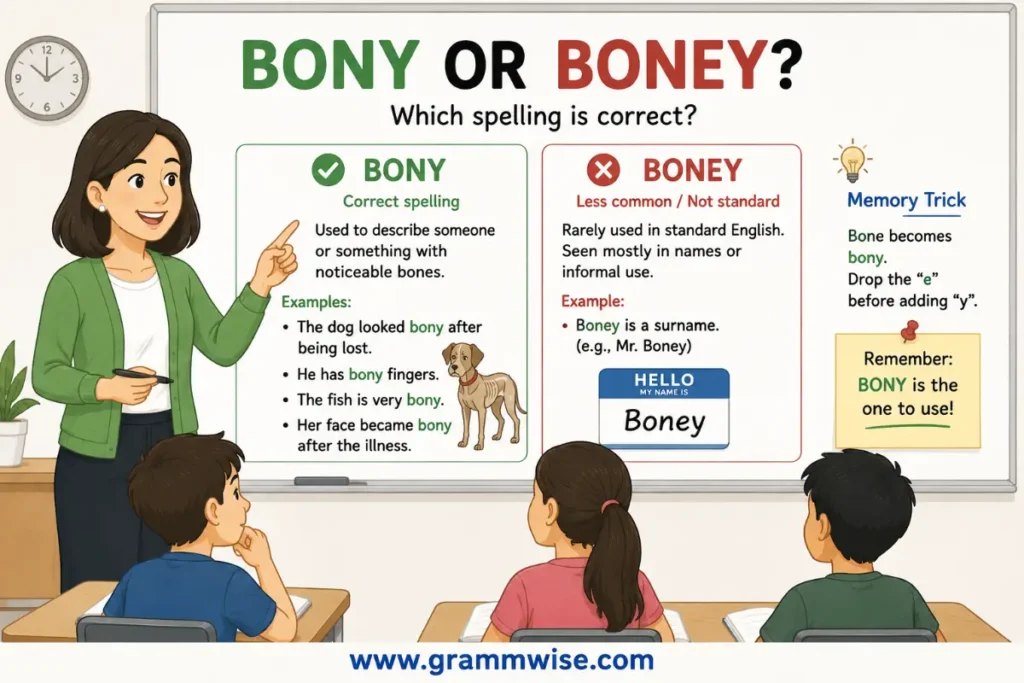
What Does Bony or Boney Means in Simple English?
The easiest way to understand bony or boney is to learn what bony means.
The word bony describes someone or something with bones that are easy to see because there is very little fat or muscle.
For example:
- The dog looked bony after being lost.
- His hands were bony.
- The horse became bony during the winter.
- She has a bony face.
In each sentence, bony describes appearance.
The word does not always mean someone is unhealthy. Sometimes it simply describes a person’s natural body shape.
What Does “Bony” Mean?
Bony is an adjective.
It means:
- Having noticeable bones
- Thin with little flesh
- Made mostly of bone
- Full of bones
Examples:
- The fish has many bony parts.
- His shoulders are bony.
- The old tree has bony-looking branches. (A creative description.)
- The cat became bony after being sick.
What About “Boney”?
The spelling boney is much less common.
Some people use it informally, but most dictionaries list bony as the preferred spelling.
You may sometimes see Boney used as:
- A surname
- A nickname
- Part of a business name
- An older or regional spelling
For everyday writing, schoolwork, and professional English, bony is the correct choice.
Bony or Boney: Why People Mix These Words?
Many learners confuse bony or boney because English has many words that end in -ey.
For example:
- honey
- money
- donkey
Seeing these words makes some people think boney should also be correct.
Another reason is pronunciation.
Both bony and boney are usually pronounced almost the same.
When people hear the word, they may not know which spelling is correct.
Look at these examples.
❌ The dog looked boney.
✅ The dog looked bony.
Another example:
❌ She has boney fingers.
✅ She has bony fingers.
Using bony helps your writing match standard English.
Clear Difference of Bony or Boney Explained Simply
Here is an easy comparison of bony or boney.
| Bony | Boney |
|---|---|
| Standard spelling | Less common variant |
| Accepted in dictionaries | Rare in standard writing |
| Used in American English | Mostly informal or names |
| Used in British English | Rarely preferred |
| Example: A bony hand. | Rare: A boney hand. |
Ask yourself one simple question.
Am I writing normal English?
If yes, choose bony.
If you see boney, it is usually part of a name or an uncommon spelling.
Bony or Boney: Which Form Should You Use?
The answer is simple.
Use bony in almost every situation.
Examples:
- The puppy looked bony.
- He has bony knees.
- The bird has bony legs.
- The fish is very bony.
- Her face became bony after the illness.
Avoid boney unless you are writing someone’s name or copying an official title.
Easy Memory Trick
Here is an easy way to remember the correct spelling.
Think about these words:
- stone → stony
- bone → bony
Notice what happens.
The extra e disappears before adding -y.
Now remember this sentence:
Bone becomes bony, not boney.
This simple trick helps many learners remember the correct spelling.
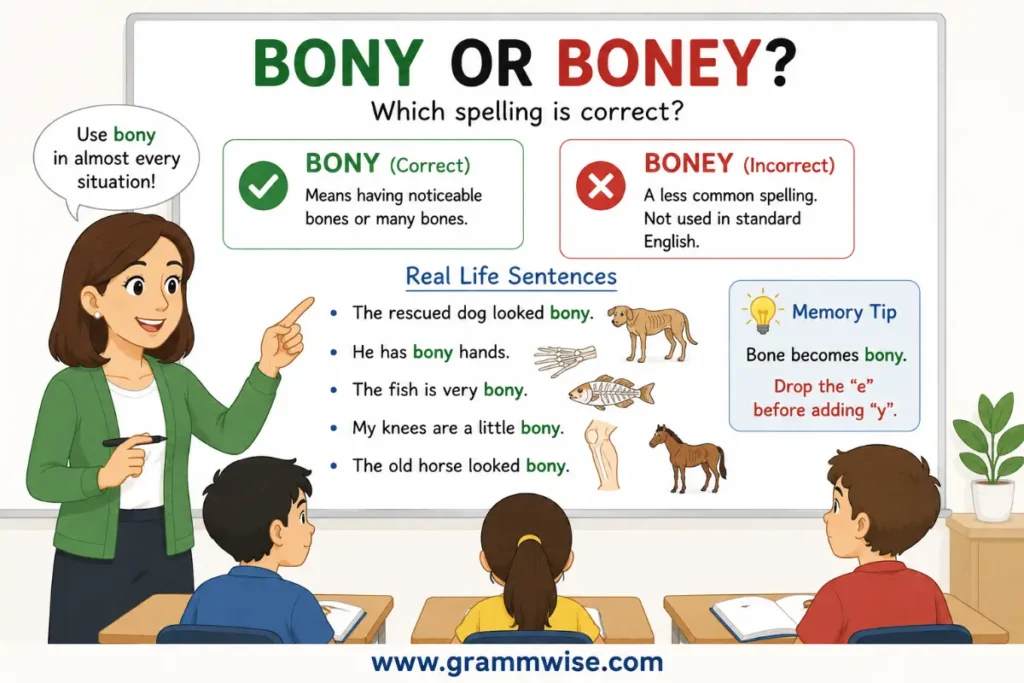
Easy Real-Life Sentences on Bony or Boney
Here are natural examples using bony correctly.
- The rescued dog looked bony.
- He has bony hands.
- The fish is too bony to eat easily.
- The old horse became bony.
- She has a bony face.
- His elbows are very bony.
- The chicken has many bony pieces.
- The child’s knees looked bony after growing taller.
Now compare them with incorrect examples.
❌ The horse looked boney.
✅ The horse looked bony.
❌ She has boney arms.
✅ She has bony arms.
Reading correct examples often will help you remember the standard spelling.
Bony or Boney: Where This Word Comes From?
The word bony comes from the noun bone.
For hundreds of years, English speakers have used bony to describe people, animals, or objects that have noticeable bones or contain many bones.
Over time, this spelling became the accepted form in both American and British English. The spelling boney appeared occasionally in older writing and informal use, but it never became the standard spelling.
Today, dictionaries, schools, newspapers, and professional writers almost always use bony. That is why learning the standard spelling is the best choice for students and English learners.
Bony or Boney: How This Word Is Understood in Culture and Stories?
The word bony is often used in books, movies, and everyday conversations to describe the appearance of a person or animal. It helps readers imagine someone whose bones are easy to see.
For example, a story might describe an old horse as bony after a long journey. A writer may also describe a lost dog as bony to show that it has not had enough food.
Sometimes bony is used to describe parts of the body.
For example:
- His bony hands held the old book.
- She rested her bony elbows on the table.
- The bird stood on its bony legs.
These descriptions help readers create a clear picture in their minds.
The word is not always negative. Some people naturally have a bony body shape because of their genetics. In those cases, bony is simply a description and not a judgment.
The spelling boney is rarely seen in books or newspapers. If it does appear, it is often part of a person’s name, a business name, or an older style of writing.
That is why most English teachers and dictionaries recommend using bony in everyday writing.
Biblical and Mythological Meaning of Bony or Boney
The words bony and boney do not have special biblical or mythological meanings.
However, bones are important symbols in many religious and traditional stories. They often represent life, strength, or the man body.
Because bony simply describes something with noticeable bones, it keeps its normal meaning even in these stories.
If you are reading the Bible, myths, or classic literature, bony is usually just an adjective describing appearance.
Symbolism Explained in Simple Words
What “Bony” Represents?
The word bony can represent different ideas depending on the situation.
It may suggest:
- Thinness
- Age
- Weakness
- Survival
- Hunger
- Simplicity
- Natural body shape
For example, a bony stray dog in a story may represent hardship before finding a safe home.
A bony old tree may symbolize age and the passing of time.
Sometimes artists and writers use bony to create a strong picture in the reader’s mind.
What “Boney” Represents?
The spelling boney does not have a separate meaning in standard English.
It simply represents a less common spelling of bony.
If you see Boney with a capital letter, it is often someone’s surname or part of a proper name.
For everyday English, remember that bony is the spelling you should use.
Related Words You Should Know
Learning related words makes bony or boney much easier to remember.
Bone
The hard part inside the body that supports it.
Example: The doctor checked the broken bone.
Skeleton
All the bones together in a body.
Example: We studied the Monkey skeleton in science class.
Thin
Having very little fat.
Example: The cat became thin after being sick.
Slim
Pleasantly thin.
Example: She has a slim figure.
Skinny
Very thin, sometimes too thin.
Example: The puppy looked skinny.
Lean
Having little body fat but healthy muscles.
Example: The athlete has a lean body.
Frail
Weak and delicate.
Example: The old man looked frail.
Rib
One of the bones around the chest.
Example: He injured a rib while playing football.
Spine
The row of bones in the back.
Example: The spine supports your body.
Joint
The place where two bones meet.
Example: My knee joint hurts after running.
How People Actually Use Bony or Boney in Daily English?
Here are some natural examples showing how native speakers use bony.
- “The rescued dog looked bony.”
- “He has bony shoulders.”
- “The fish is very bony, so be careful while eating.”
- “My knees became bony after I grew taller.”
- “The old horse looked bony but healthy.”
- “She has bony fingers.”
- “The bird stood on its bony legs.”
- “The doctor examined the patient’s bony wrist.”
Notice that all of these examples use bony, not boney.
This is the spelling you will see most often in books, magazines, websites, and dictionaries.
Common Mistakes People Make
Many English learners make the same mistakes when writing bony or boney.
Here are the most common ones.
Mistake 1
❌ The puppy looked boney.
✅ The puppy looked bony.
Use the standard spelling.
Mistake 2
❌ She has boney hands.
✅ She has bony hands.
The adjective is always bony in standard English.
Mistake 3
❌ This fish is very boney.
✅ This fish is very bony.
Remember that fish with many bones are called bony fish.
Mistake 4
❌ Boney knees.
✅ Bony knees.
Drop the e before adding -y.
Mistake 5
❌ Bone → boney
✅ Bone → bony
The spelling changes by removing the final e.
Before you finish writing, ask yourself one simple question.
Am I describing someone or something with noticeable bones?
If yes, choose bony.
If you are not writing a person’s name, you almost never need boney.
Final Teacher Explanation
Imagine we are ending today’s English lesson together.
The easiest way to remember bony or boney is to think about the word bone.
When bone becomes an adjective, the final e disappears.
That gives us bony.
This spelling rule is common in English, and it helps keep words simple. Although you may occasionally see boney, it is not the standard spelling used in modern English. For school assignments, exams, emails, articles, and everyday writing, always choose bony.
The more often you read and use the word, the easier it will become to remember the correct spelling.
Quick Recap Bony or Boney
The correct spelling is bony, not boney, in standard English. Bony describes someone or something with noticeable bones or many bones, while boney is a rare variant that is mostly found in names or informal use. If you want clear and correct English, bony is almost always the right choice.
Conclusion
Understanding bony or boney is easy once you know the standard spelling rule. Bony is the correct spelling in modern English and is used to describe someone or something with noticeable bones or many bones. While boney may appear as a rare variant or in names, bony is the right choice for everyday writing.
The more you read and practice using bony in real-life sentences, the more natural it will become. Remember the simple rule—bone becomes bony by dropping the final e—and you will confidently use the correct spelling every time.
Frequently Asked Questions
Is bony or boney correct?
Bony is the correct and standard spelling in modern English.
What does bony mean?
Bony means having noticeable bones because there is very little fat or flesh, or containing many bones.
Is boney a real word?
Yes, boney exists as a less common variant, but it is rarely used in standard English. Bony is the preferred spelling.
Why do people write boney?
Many people think the word should keep the e from bone, but standard English drops the e before adding -y.
Is bony rude?
Not always. It simply describes appearance. However, when talking about someone’s body, it is best to use the word politely and with care because it may sound personal.
Can I use bony to describe animals?
Yes. It is commonly used for animals that have visible bones or for fish that contain many bones.
Is bony used in both American and British English?
Yes. Bony is the standard spelling in both American and British English.
How can I remember the correct spelling?
Remember this simple rule: bone → bony. Drop the final e before adding -y, so the correct spelling is bony, not boney.