

Many English learners wonder if time flies or time flys is the correct spelling. Since both words look similar, it is easy to think they are both correct. However, only one spelling follows the rules of English grammar.
The correct phrase is time flies. The word flies is the correct verb form of fly when the subject is time. The spelling flys is almost always incorrect and is not used as the verb in standard English.
In this guide, you will learn the difference between time flies or time flys in very simple US English. You will also learn why flies is correct, why flys is wrong, easy memory tricks, and real-life examples that will help you remember the correct spelling every time.
English has many word pairs with subtle differences in meaning and usage like missus or misses.
Simple Answer in One Look
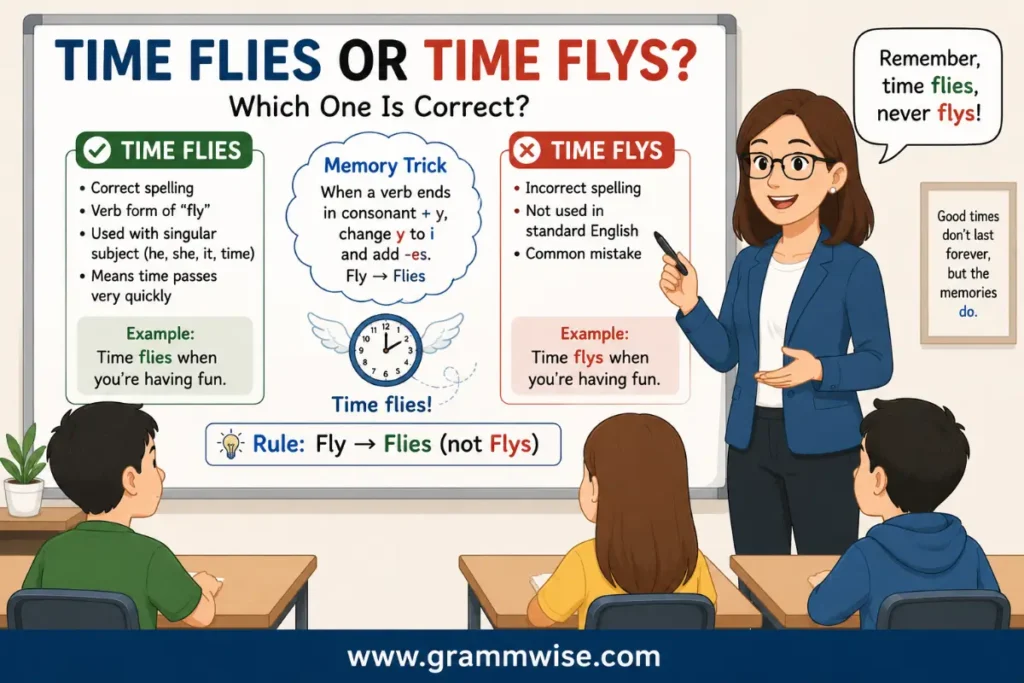
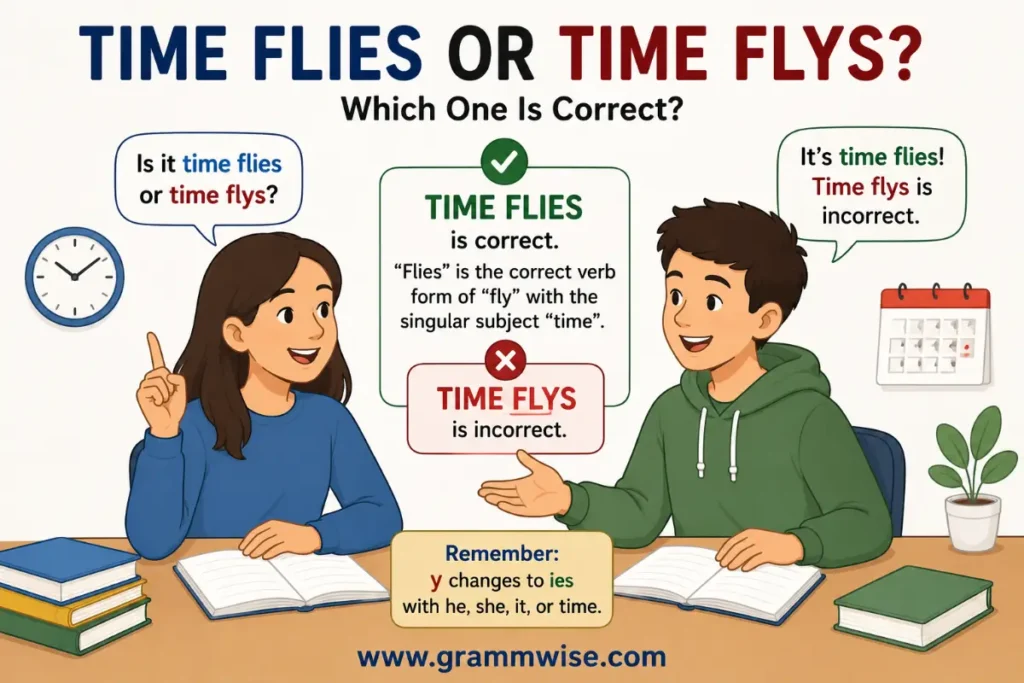
Time flies is correct.
Time flys is incorrect in standard English.
Quick tip: When fly is used as a verb with he, she, it, or time, add -ies to make flies.
Time Flies or Time Flys: What This Means in Simple English?
The easiest way to understand time flies or time flys is to learn what the phrase means.
The phrase time flies means time seems to pass very quickly.
People often say this when they are having fun or when they are surprised by how quickly days, months, or years have passed.
For example:
- Time flies when you’re having fun.
- I can’t believe it’s already Friday. Time flies!
- Time flies during the summer holidays.
- Time flies when you’re with friends.
In each sentence, flies is the action word. It tells us what time is doing.
Think of time as if it were a bird flying through the sky. Of course, time cannot really fly, but this expression helps us imagine how quickly it passes.
Why Is “Flies” Correct?
The verb fly changes its spelling when it is used with a singular subject like:
- he
- she
- it
- time
Look at these examples:
- The bird flies.
- She flies to New York every year.
- Time flies.
In each sentence, the subject is singular, so the verb becomes flies.
Why Is “Flys” Wrong?
Many learners think they only need to add -s to the word fly.
That would create:
❌ flys
But English has a spelling rule.
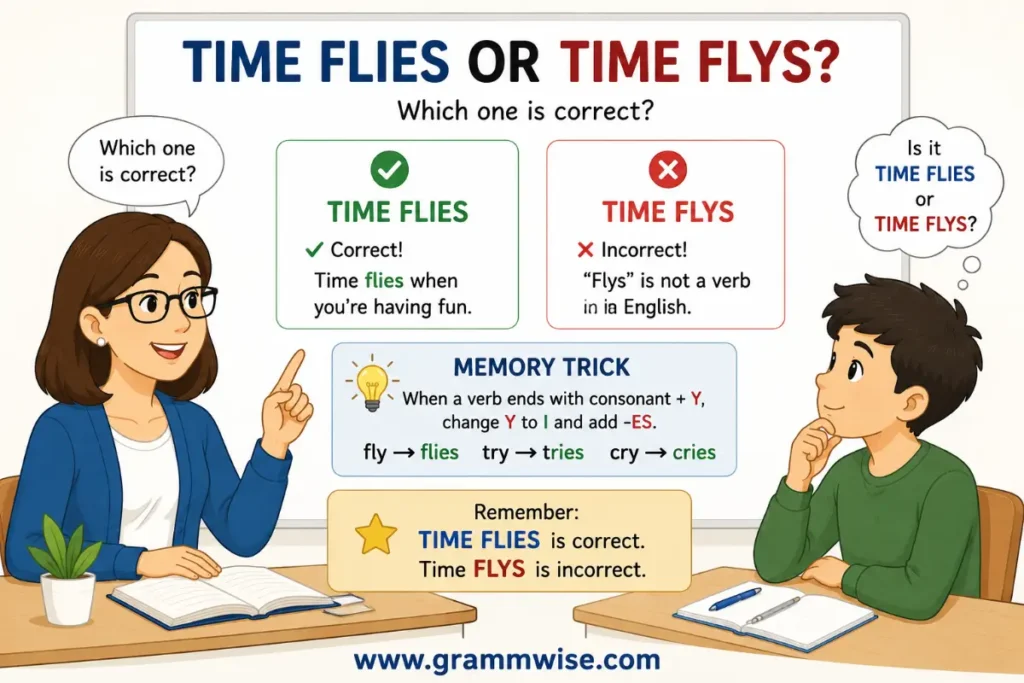
When a verb ends in a consonant followed by y, change the y to i and add -es.
So:
- fly → flies
- try → tries
- carry → carries
- study → studies
- cry → cries
Because of this rule, flys is not the correct verb spelling.
Why People Mix These Words Time Flies or Time Flys?
Many people confuse time flies or time flys because adding -s works for many English verbs.
For example:
- runs
- jumps
- eats
- walks
So learners naturally think:
fly → flys
Unfortunately, this verb follows a different spelling rule.
Another reason is that people often hear the phrase before they see it written.
When someone says,
“Time flies.”
you cannot tell if it is spelled flies or flys.
This causes many spelling mistakes.
Look at these examples.
❌ Time flys when you’re busy.
✅ Time flies when you’re busy.
Another example:
❌ My holiday flys by every year.
✅ My holiday flies by every year.
Once you learn the spelling rule, these mistakes become much easier to avoid.
Clear Difference of Time Flies or Time Flys Explained Simply
Here is an easy comparison of time flies or time flys.
| Time Flies | Time Flys |
|---|---|
| Correct spelling | Incorrect spelling |
| Uses the correct verb form | Breaks the spelling rule |
| Used in everyday English | Not accepted in standard English |
| Means time passes quickly | Incorrect as a verb |
| Example: Time flies when you’re happy. | Incorrect: Time flys when you’re happy. |
Think about the verb.
If the word comes from fly, the correct form with a singular subject is always flies.
You should never write time flys in normal English writing.
Time Flies or Time Flys: Which Form Should You Use?
The answer is simple.
Always choose time flies.
Use flies whenever the subject is singular.
Examples:
- Time flies.
- The plane flies every morning.
- She flies to Canada twice a year.
- A butterfly flies from flower to flower.
- The kite flies high in the sky.
Never use flys as the verb.
Easy Memory Trick
Here is an easy way to remember the correct spelling.
Think about these words:
- fly → flies
- try → tries
- cry → cries
- study → studies
Notice the pattern.
The y changes to i before adding -es.
Now remember this sentence:
Time flies, never flys.
Say it a few times.
The correct spelling will soon become automatic.
Easy Real-Life Sentences on Time Flies or Time Flys
Here are some natural examples that use time flies correctly.
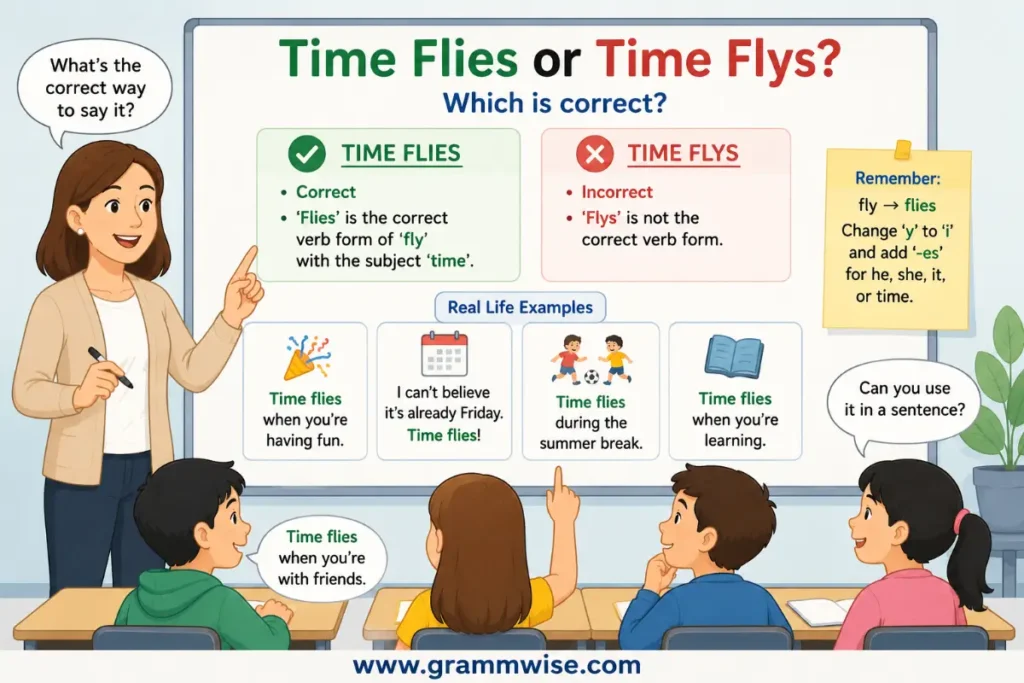
- Time flies when you’re having fun.
- Time flies during family vacations.
- Time flies as children grow up.
- Time flies when you’re busy at work.
- I can’t believe it’s already December. Time flies!
- Time flies when you’re learning something new.
- Time flies while we are talking.
- Time flies faster than we expect.
Now look at incorrect examples.
❌ Time flys when you’re happy.
✅ Time flies when you’re happy.
❌ Time flys during summer break.
✅ Time flies during summer break.
Reading correct examples again and again helps you remember the right spelling.
Time Flies or Time Flys: Where This Expression Comes From?
The expression time flies has been used in English for hundreds of years.
People have long compared time to something that moves very quickly through the air.
One of the oldest famous ideas comes from ancient Latin. A similar expression means “Time flies.” Over the years, English speakers adopted this idea because it perfectly describes how quickly life seems to pass.
Today, people use time flies all over the world.
You may hear it when someone talks about:
- Growing older
- Finishing school
- Family holidays
- Spending time with friends
- Busy workdays
- Happy memories
The phrase has remained popular because almost everyone has experienced days that seem to pass much faster than expected.
Time Flies or Time Flys: How This Expression Is Understood in Culture and Stories?
The phrase time flies is one of the most common expressions in English. People use it when they are surprised by how quickly time has passed.
You will hear it in conversations, books, movies, songs, and even greeting cards.
Parents often say:
- Time flies. It feels like you were just a baby.
Teachers may say:
- Time flies when you’re enjoying your lessons.
Friends might say:
- We’ve been talking for two hours. Time flies!
In stories, the phrase often appears after an important event.
A writer may begin with:
“Ten years later…”
Then the story reminds readers that time flies.
The expression helps people understand that life moves quickly, even when we do not notice it.
People also use it when remembering happy moments.
For example:
- Time flies during family holidays.
- Time flies when you’re with people you love.
- Time flies while reading a great book.
The phrase usually has a positive feeling, although people sometimes use it when they wish they had more time.
Biblical and Mythological Meaning of Time Flies or Time Flys
The phrase time flies does not have a special biblical meaning. However, many parts of the Bible remind people that life is short and that time passes quickly.
These teachings encourage people to use their time wisely, help others, and enjoy each day.
The expression time flies fits these ideas because it reminds us that days, months, and years move faster than we often expect.
In mythology, stories often include long journeys, changing seasons, and heroes growing older. Although the exact phrase is not used, the idea that time moves quickly appears in many traditional stories around the world.
So while time flies is not a religious expression, its message is easy for people from many cultures to understand.
Symbolism Explained in Simple Words
What “Time Flies” Represents?
The expression time flies often represents:
- Life moving quickly
- Happy memories
- Growing older
- Change
- Learning
- New experiences
- The value of time
When someone says,
“Time flies when you’re having fun,”
they mean they enjoyed the moment so much that they did not notice the passing hours.
The phrase reminds us that good moments often seem shorter than they really are.
What “Time Flys” Represents?
The spelling time flys does not represent anything in standard English because it is incorrect.
It is simply a common spelling mistake.
People usually write time flys because they forget the spelling rule for verbs ending in -y.
Whenever you see time flys, remember that the correct phrase is time flies.
Related Words You Should Know
Learning related words makes time flies or time flys much easier to remember.
Fly: To move through the air.
Example: Birds fly across the sky.
Flies: The correct verb form of fly with a singular subject.
Example: The airplane flies every morning.
Flew: The past tense of fly.
Example: We flew to London last summer.
Flown: The past participle of fly.
Example: She has flown many times.
Quickly: In a fast way.
Example: The week passed quickly.
Time: The passing of minutes, hours, days, and years.
Example: Time helps us learn and grow.
Moment: A very short period of time.
Example: Enjoy every moment.
Memory: Something you remember from the past.
Example: That holiday is a happy memory.
Experience: Something that happens in your life.
Example: Travelling was a wonderful experience.
Journey: A trip from one place to another.
Example: Their journey took three days.
How People Actually Use Time Flies or Time Flys in Daily English
Here are natural examples that show how people use time flies in everyday conversations.
- “Time flies when you’re having fun.”
- “I can’t believe it’s already evening. Time flies.”
- “Time flies during the school holidays.”
- “Time flies when you’re busy at work.”
- “Our children have grown so fast. Time flies.”
- “Time flies while watching a good movie.”
- “I’ve lived here for ten years. Time flies.”
- “Time flies when you’re learning something new.”
- “We’ve been friends for twenty years. Time flies.”
- “The weekend is over already. Time flies.”
These examples sound natural because time flies is a very common English expression.
You will hear it often from native speakers.
Common Mistakes People Make
Many English learners make the same mistakes when writing time flies or time flys.
Here are the most common ones.
Mistake 1
❌ Time flys when you’re having fun.
✅ Time flies when you’re having fun.
Remember that flies is the correct verb form.
Mistake 2
❌ Time flys so quickly.
✅ Time flies so quickly.
The spelling rule stays the same.
Mistake 3
❌ The bird flys away.
✅ The bird flies away.
The same spelling rule applies to every singular subject.
Mistake 4
❌ She flys to Paris every year.
✅ She flies to Paris every year.
Change y to i before adding -es.
Mistake 5
❌ Time fly when you’re busy.
✅ Time flies when you’re busy.
The singular subject time needs the singular verb flies.
Before you finish writing, ask yourself one simple question.
Does the verb come from fly and have a singular subject?
If yes, always write flies.
Final Teacher Explanation
Imagine we are finishing today’s English lesson together.
The easiest way to remember time flies or time flys is to focus on one spelling rule.
The verb fly changes to flies when the subject is singular, such as time, he, she, or it.
That is why time flies is always correct.
The spelling time flys is a common mistake because many learners simply add -s instead of changing y to i and adding -es.
Keep reading English books, watching English videos, and writing your own sentences. The more often you see the correct phrase time flies, the easier it will become to remember.
Quick Recap Time Flies or Time Flys
The correct phrase is time flies, not time flys. Flies is the correct verb form of fly with the singular subject time, while flys is an incorrect spelling in standard English. Remember the simple spelling rule, and you will use this expression correctly every time.
Conclusion
Understanding time flies or time flys is simple once you know the spelling rule. Time flies is the correct phrase because flies is the proper verb form of fly with the singular subject time. The spelling time flys is incorrect in standard English.
The more you read and use the phrase in everyday conversations and writing, the easier it will become to remember. Keep practising with simple examples, and you will confidently choose time flies every time.
Frequently Asked Questions (FAQs)
Is time flies or time flys correct?
Time flies is correct. Time flys is a spelling mistake.
Why is time flies correct?
The verb fly changes to flies when it is used with a singular subject like time, he, she, or it.
What does time flies mean?
It means time seems to pass very quickly, especially when you are busy or enjoying yourself.
Is flys a real English word?
No. Flys is not the correct verb spelling in standard English. The correct form is flies.
Why do people write time flys?
Many learners think they only need to add -s to fly, but verbs ending in a consonant followed by y change y to i before adding -es.
Can I use time flies in formal writing?
Yes. Time flies is a correct and widely accepted English expression in both formal and informal writing.
Is time flies when you’re having fun a common saying?
Yes. It is one of the most popular English expressions and is used by native speakers around the world.
How can I remember the correct spelling?
Remember this simple rule: fly → flies, try → tries, cry → cries. If the subject is singular, use flies, never flys.